Dynasty Warriors Strikeforce
KOEI's latest battlefield brawler isn't really a battlefield brawler.

Forget everything you thought you knew about Dynasty Warriors. Remember, instead, the days of the Dreamcast, and the first time you ever played Phantasy Star Online. Remember the sheer logistical improbability of it all - the trouble you had getting hold of a keyboard and trailing your phone line across your house just so you could meet up with friends online. Remember meeting up and dancing in the lobbies, before heading out, just the four of you. Remember the way that everybody was so nice and friendly, and how higher-level characters (or everybody on the Japanese servers) would drop gifts on the floor before nannying you through the difficult bits.
Remember the way the game managed to combine the best bits of massively multiplayer gaming with the intimacy of multiplayer with mates. And remember forgetting all of those logistical difficulties because it was all just so much fun.
Remember it because that, in a nutshell, is Dynasty Warriors Strikeforce. Instead of the sprawling battlefields and seemingly endless hordes of enemies that usually characterise KOEI's marmite brawler, the latest handheld version has been stripped down and reconstructed, rebuilt from the ground up from smaller, more concentrated battlefield scenarios that are clearly designed to be played co-operatively with friends.
The game is KOEI's response to the massive surge in sales of the PSP in Japan - specifically, it's KOEI's response to the games behind that massive surge in sales. Capcom's Monster Hunter series has become a bona fide phenomenon in Japan, and while it barely troubles the outer reaches of the sales charts over here, in Japan it's reached record sales figures and inspired the PSP to become the best-selling gaming hardware of 2008. It's also woken other publishers up to the potential of multiplayer gaming on the PSP, which is how the latest instalment of the Dynasty Warriors series has come to resemble SEGA's online classic.
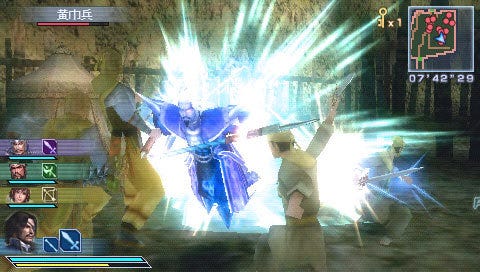
As with PSO, the action in Strikeforce starts out in hub levels, but these hub levels resemble ancient Chinese towns, where you can buy items like grenades or potions for use on missions. What's more, these hubs are upgradeable, so you can use the resources that you acquire over the course of missions to build better shops, giving you access a wider and better range of items - as well as enticing more lowly ranked players by offering them a glimpse of the riches that they'll reach if they play on.
While you'll still play as one of the multitude of characters from the Dynasty Warriors mythos, you'll also get to customise them a bit by strapping equipment to their arms and legs, or by equipping them with new weapons entirely - a change that will be as groundbreaking to fans of the series as the introduction of character flight will be to those with only a passing knowledge of the games (yep, you can equip your character with items that allow them to soar above the battlefield - cementing the series' reputation for historical inaccuracy).