Retrospective: DuckTales

Tales of derring-do.

DuckTales, oo-oo!
Tales of derring-do, bad and good luck tales, oo-oo!
D-d-d-danger, watch behind you!
There's a stranger out to find you!
What to do? Just grab onto some DuckTales, oo-oo!

This song has come up on my mental playlist often during the last 20 years - maybe yours, too, if you watched the DuckTales series in the late eighties. I have such a blinding fondness for Scrooge McDuck & Friends that I was well into adulthood before I realised the DuckTales theme doesn't make a terrible lot of sense. "Derring-do"? "Luck tales"? And I don't see how grabbing onto DuckTales - whatever that means - is going to help me with my pressing danger and/or stranger situation.

No matter. When you're dealing with talking ducks, cold rationality heads out for a smoke break. Capcom's DuckTales for the NES was no paragon of logic, either, and it's still a highlight of platformers' golden age. The game's premise (explained only in the instruction booklet, quaintly enough): Uncle Scrooge is in a race with archrival Flintheart Glomgold to capture the world's greatest treasures from five exotic locales. That's a solid concept, but the great race is forgotten almost immediately. You don't even see Glomgold until the closing seconds of the quest.

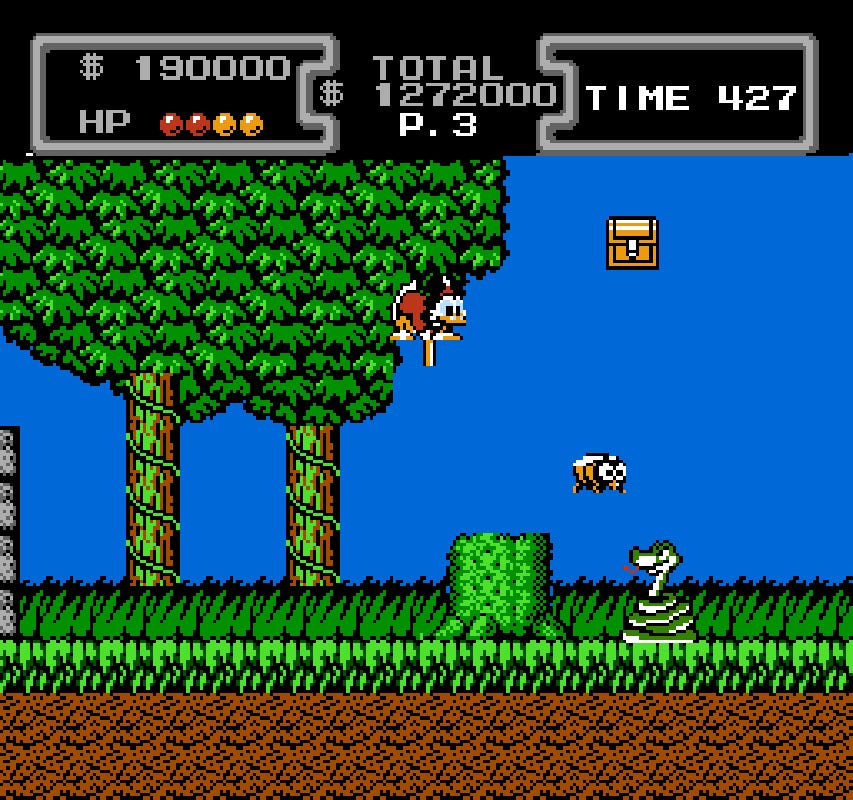
The real premise is simply that you're an old duck whose cane doubles as a high-powered pogo stick, so hey, let's go bounce on some stuff. Loyal fans of the TV show will recall all the occasions that Scrooge whipped out his pogo cane, such as never. This never happened. Yet this weird, springy non sequitur of locomotion is DuckTales' most distinctive feature, infusing the game with a peppiness that sets it apart from its contemporaries.
1

The springy cane is a perfect way to access self-levitating treasure chests.

I understand, on an aesthetic level, why the pogo-stick dynamic never caught on, but in terms of kinetic feel, it's a blast. The five stages of DuckTales - The Amazon, Transylvania, African Mines, The Himalayas, and The Moon (!) - are typical early-nineties run-and-jump layouts, but if you're running, you're a chump. You might as well jog laps on a trampoline.

This game is all about catching air. The pogo cane bounces off land, enemies and even sharp spikes, typically the universal game symbol of insta-death. In portions of the Himalayas stage you can't bounce because Scrooge's cane will get stuck in the snow. It's awful. The developers take away their gift to remind you of what you have. "I'll never take it for granted again," you say, and the game's all, "OK, you rapscallion, you've learned your lesson." And you say, "I will now bounce around on the freaking moon."

The genius of the pogo cane is brilliant but obvious. After all, in the run-plus-jump formula, why not put all the emphasis on jump? Running is old hat for us mortals. Even those of us who don't run regularly do a more modest form of running, called walking. It's how we get from the couch to the ice-cream sandwiches in the freezer. But jumping! Game characters are outrageously better than humans at jumping. Scrooge can jump about five times his own height. I can barely jump five times.

All that glorious hopping and careering is the most immediate charm of DuckTales. The more gradual pleasure comes from exploring the game's twisting landscapes. Given the memory constraints of a 1990 NES cart, the five stages on offer are modest little worlds. To a new player, though, they feel vast, because the level designers use a crafty psychological trick: the illusion of choice.

DuckTales' levels aren't laid out in standard left-to-right fashion. They branch out, double back on themselves, use vertical space. Players often come to a juncture where they can choose between two routes - up or left, say. Both directions will continue on for a while, and they might both be valid ways of reaching the boss. You can only choose one at a time, though. There could be anything on the path not taken. And in our brains, that unknown "anything" feels huge, a reality that wasn't lost on the clever folks at Capcom.

Over a couple completions of DuckTales - which doesn't take long, as the game isn't especially challenging - you explore all the side routes and catalogue the vast unknown. You undo the deception that made DuckTales appear much bigger than it was. The upshot is that the world coalesces from a confusing sprawl to something more manageable.

2

The cane also serves as a golf club in a pinch. Pictured: a pinch.

When we talk about "completionists" in modern games, we're typically talking about obsessives like the Assassin Creed II feather collectors. DuckTales springs from a time when completionism wasn't such a chore. With a bit of work you can memorise all the maps of the game and commit the whole playthrough to muscle memory - in other words, get it in your brain and get it in your hands. That intimate, thorough knowledge of the game is possible because DuckTales is simple, yet it's gratifying because DuckTales seems complex.

I'd be remiss not to mention that the soundtrack, composed by Capcom mainstay Yoshihiro Sakaguchi, is among the NES' best. In particular, the extraordinary theme for the Moon stage somehow creates a grand sense of odyssey from the system's boops and bleeps. Do a search on YouTube and you'll find not only the original, iconic chiptune but also a slew of worthwhile remixes.

Thanks to the briar patch of intellectual-property contract law that surrounds a licensed game like this, you shouldn't expect to see DuckTales on Virtual Console anytime soon. That's the distressing downside of the 8-bit renaissance - the legacy of the medium is being shaped on the basis of commercial expediency, and inevitably, important titles get left behind.

If you want to play DuckTales today and don't own the original cartridge, you'll have to try your luck on the used market or otherwise track down a copy. (Use your imagination!) It's one of those cases where the fan community has to fill in the blanks created by corporate inertia, as this winningly weird platformer deserves to be remembered. What to do? Just grab onto some DuckTales.

Comments (84)

Comments for this article are now closed, but please feel free to continue chatting on the forum!

  • Loading...hold tight!