DS Roundup • Page 2

Prey the Stars, Subbuteo, Driving Theory Training, Bakushow, PictoImage.

I had a harrowing experience the other day, readers. I tripped and stumbled and fell down a dark deep well and there wasn't a rope in sight. Fortunately, after hearing my cries for help from below, good old Tom came up with a solution. He'd pour all the average to terrible DS games he could find down into the well so I could swim to the top. I was out in five minutes. Hooray for DS Roundups! Here's just a few of the games I shook out of my shoe after getting to the surface.

Prey the Stars

  • Developer: KOEI Canada
  • Publisher: KOEI

If we can get the tenuous x meets y comparison clich out of the way first. It's Pac-Man meets Katamari Damacy. It's Pac-Man because you roam around a grid eating things to win the game. It's Katamari Damacy because you get bigger as you do so, both in terms of the current level you're on and the overall arc of the story. Your small alien eating machine starts out small, eating food from the inside of a fridge, before expanding rapidly to the size of a house and beyond as the game progresses.

To pare it down to its apparent influences is misleading, however, as it lacks the quality or purity of either of its spiritual parents. Instead the game has you running around a small, partly top-down map made up of different squares, each containing a certain number of objects to eat. Some squares contain larger items, for which you have to chomp down on power-ups that make you big enough to eat them. The more you eat, the more points you get. Meanwhile other players, AI or human, are trying to do the same, hindered only by the attack power-ups unleashed by people every once in a while until someone wins.

1

The clutter on the screens belies its simplicity.

While the game itself is none too complicated, the problem is it's over-egged the design. You can't just eat something and move on. Instead you're forced to stop moving and time your button presses to chomp down a number of times before you can actually swallow anything, and the buttons are different depending on what you've got in your gob. The result is a little too stop-start for a knockabout multiplayer game.

There's an unappealing visual style to it as well. It's all done up in that blocky low-res 3D the DS musters - too bland to stand out and not charmingly retro enough to evoke nostalgia - while the front-end bears a spirit of wackiness that doesn't quite gel. And I might have given the impression that the size thing was impressive, whereas the truth is that the individual levels are all exactly the same, it's just they've drawn bigger things on a smaller scale for each consecutive one.

Visuals aside, the game ultimately gets too repetitive too soon. It claws back some respect by providing additional challenges for each map and offering different characters with slightly different abilities for replay value, but the mechanics never really change enough to capture your interest for long. There's better could be done with the idea, really.

5/10

Subbuteo

  • Developer: Artematica
  • Publisher: 505 Games

Now here's one we haven't heard from in a while. It's one of those real-life childhood games that, like Guess Who? and Mouse Trap, you'd think had been trampled underfoot by the might of the videogame already, but no, they're still cranking them out and you can buy them in your local toy shop (even though you wouldn't know where that was). Still, that hasn't stopped them trying to make some cash porting the football-flicking Subbuteo to DS, where it can try to avail itself to masses weaned on FIFA and PES.

In the spirit of the Subutteo itself, there's no real-time action here. Instead, it's a turn-based set-up tied into the original game's rule-set. Two players are allowed a set number of moves to knock the ball up the field and into the net by flicking players set onto plastic hemispheres around the pitch.

It's something you'd expect the DS to do well, letting the stylus and touch-screen simulate the experience of batting a player around with your index finger. Bizarrely, that's not an option. Instead you're forced to adjust the shot strength and angle by pressing a few arrows around a picture of a virtual hand before tapping on your player to take the shot. Where's the fun in that?

That detachment carries over to the graphics by way of a sole camera stuck in a bird's-eye viewpoint, which makes the players all look like indistinguishable dots on the pitch. The sound, too, is made up of awful samples that I can only guess are meant to be people cheering. At least they've drawn a few creases on the pitch, presumably to give it character.

Still, if you can get past the poor visuals and presentation, you could wring a few decent matches out of the two-player game, assuming you like your football a little slower-paced. Without the tactility of the original tabletop tile, though, it fails to capture much of what made its parent game popular in the first place. Flick off, basically.

4/10

PictoImage

  • Developer: SEGA
  • Publisher: SEGA
2

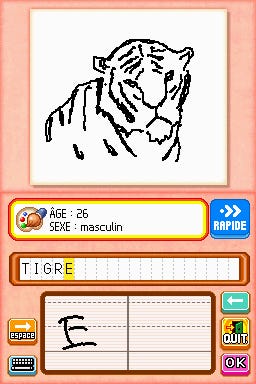
Why so sad, Mr Tiger?

PictoImage being a Pictionary (or Win, Lose or Draw, if you will) derivative, I really wanted to start this review with a mathematical step-by-step comparison of the costs and energy expended playing the game on DS as opposed to using a good old-fashioned pen and paper. It didn't take long to decide against it. Not only because it would lead me into a headache minefield of minutiae in trying to discover how many kilojoules of energy you expend doodling in the pages of a WH Smith spiral-bound notepad, but because the answer would inevitably lead to the self-righteous Daily Mail conclusion that the non-electronic method is far better and I'm turning into the kind of person who grumbles that the old days were far better when kids had to make up their own entertainment.

Is paper really better, though? In PictoImage's main multiplayer mode, you're given a word and have to use the stylus to draw as best an approximation of it as you can for the other person to guess. There's a big selection of easy and hard words here, the sketchpad interface is simple enough for your basic needs and there's a variety of different modes to satisfy a bored car journey. All you could ask for, really.

To make your money go further, they've even stuck a single-player mode in here as well, giving you around 300 ready-made images or so, all drawn by different age groups, to guess. Funnily enough, it's often the under-fives' scribblings that provide the most challenge in this game. You feel rather proud of yourself when you realise that the abstract series of squiggles in front of you is actually a pillow. Ah, bless, you virtual moppet.

It's a guess-the-drawing parlour game for all intents and purposes, though, and there's always a nagging feeling in the back of your mind that there's far better things to do on a DS than this. As long as the likes of Professor Layton or Picross exist, it's easily overlooked.

5/10

Bakushow

  • Developer: Route24
  • Publisher: Rising Star Games

Thematically similar to the previous page's PictoImage (i.e. it's about drawing), Bakushow's existence doesn't just raise an eyebrow but the whole upper part of my head. Scratch being similar, it's less than that; a mere slip of an idea masquerading as a game. It's a basic sketchpad program that allows 2-4 players (local wireless on one card) to doodle things and share them between each other. I wish there was more to say. That's it.

There is no game. You have to make it up. One person asks the others to draw a tractor, for instance, and then everyone votes on who sketched the best one. There's nothing else to it. It's a blank page staring into your soul, laughing at you for wasting money on a pad of virtual paper. At least they put some colourful borders around things to make it look like they made the effort. Everything else is up to your imagination and we all know there's no room for that in videogames.

Seriously, it's hard to justify Bakushow in a world where Pictochat exists for free, as every critic in the world will probably point out. I felt insulted just loading it up and forcing people to play with me. We might have had some fun doing things together, but that's not the "game", that's us. We don't need it. I find it so lacking in worth that I fear I'm drastically missing the point here. Perhaps. I'll put an extra point on the score just in case.

2/10

Driving Theory Training

  • Developer: Anuman
  • Publisher: Atari

Hang on, this isn't a game, it's an educational tool. What next? A review of AutoCAD 2009? We're making a mockery of the Eurogamer name today. We only throw it in as an indicator of where the DS market is these days, for good or bad.

3

The predictable answer is low flying motorcycles, of course.

Anyway, I have little interest in this. I've passed my test, you see, and like everybody else on the road, that automatically allows my brain to forget ninety-five-percent of everything I ever bothered to learn to get there. As I recall: give way to the right, don't drive on the pavement, and remember that people can see you picking your nose at traffic lights. The rest is fluff, isn't it?

For those of you, predominantly teenagers, on the other side of the coin, it's one of the major hurdles to overcome on the way to independence and the embarrassment of asking your mum to give you a lift to a date. For a couple of months at least, knowing the maximum speed of a motorised scooter on the road (8mph) is of paramount importance. No wonder the Highway Code is a perennial bestseller in the book charts.

The DS version's one big, important feature is the practice mode allowing you to prepare for your multiple-choice theory test for car or motorbike through mock exams. Marking shows you where you went wrong and gives you some indication of progress. As a reference tool, however, it's not so great. The layout is too basic and boring - just a series of numbers to tap on and rules to read with a few pictures every now and then. There's no decent indexing system either, making it a chore to find the parts you want to bone up on.

There are a few throwaway mini-games (aha! I knew we'd redeem ourselves) included to justify the product on a handheld, but really, why bother? You can take practice tests online if you really want, just as you can study the official Highway Code. Or you can just buy the book. A bit of a redundant and rather bland aid, all things considered.

3/10

Read the Eurogamer.net scoring policy

Comments (26)

Comments for this article are now closed, but please feel free to continue chatting on the forum!

  • Loading...hold tight!