Dissidia: Final Fantasy Review

Final Fantasy meets Final Fight... Finally!

Version tested: PSP

Hands up anyone who thought Square Enix would ever release a fighting game made up completely of Final Fantasy characters? Okay, so maybe the DreamFactory-developed Ehrgeiz hinted at it, but I honestly didn't see this coming. Dissidia offers players the chance to fight as either the lead hero or villain from Final Fantasy I through to Final Fantasy X, in full real-time bouts a million miles away from the series' turn-based staple. Time to see whether Squall's Gunblade mastery really is a match for the Buster Sword-wielding Cloud.

Unlike the original Super Smash Bros. excuse of "they're fighting dolls", Dissidia's explanation for the Final Fantasy cast being in the same universe is more sinister. Chaos, the god of discord, and Cosmos, the god of harmony, have been fighting for an eternity within the Dissidia universe. In a bid to destroy Cosmos, Chaos sneakily imports all his favourite antagonists from the Final Fantasy games - with the dark army they subsequently build tipping the balance greatly in his favour. With no option left but to rip off Chaos's idea, Cosmos retaliates by summoning all the manically depressed protagonists from the same games in order to settle the score once and for all.

Rather than the face-to-face fighting style of Tekken and Street Fighter, bouts in Dissidia take place in open 3D arenas similar to Power Stone - but without all the Flamethrowers and Hammers. Players can lock on and off their opponent with the left trigger and run across the arena with the analogue stick. The four face buttons are allocated to Brave attack, HP attack, jump and context-sensitive environment manoeuvres, which might make more sense in Tony Hawk's, but basically deals with all your wall-running and ledge-grinding.

The right trigger, meanwhile, is your obligatory Guard, but as a guard state can't be held it works in effect more like a parry. Guard can also be used with the face buttons for more advanced moves. Guard and jump will execute a dodge manoeuvre which, if timed correctly, will allow you to completely evade an enemy attack for a swift counter.
1

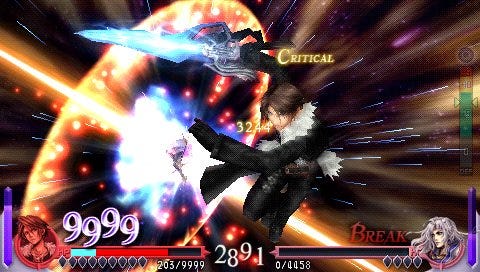
The EX burst attacks are a definite highlight.

Unlike most conventional fighters, Dissidia's Brave and HP attack system offers a genuinely fresh approach for KO enthusiasts. Each combatant begins a fight with a certain amount of BP (Brave Points) - indicated by a number above the health bar. By performing Brave attacks the player can steal BP from the enemy's gauge and add it to their own. Also, if through sustained Brave attacks the player brings the opponents BP total to zero, they will send the opponent into Break status and receive a massive BP bonus.

The point of accumulating all this BP is the HP attack. The amount of damage dealt by a HP attack is equal to the player's pooled Brave Points - with a successful hit resetting the attacking player's BP to zero for a short time. This lends Dissidia a very tactical style of play because a full health bar is meaningless if your opponent's BP is in the high thousands.

Working in tandem to the BP system is the EX gauge (you weren't expecting a Final Fantasy fighter to be simple, were you?). Your opponent will drop tiny EX orbs if you combo them through chained attacks which, when collected, will slightly increase your EX total. EX cores will provide a more dramatic boost and spawn in various locations across the arenas. Once the EX gauge is maxed your character will be able to enter EX mode for a short time.

In EX mode Cloud will ditch his rusty old Buster Sword and replace it with Ultima Weapon, gaining the rather annoying ability to Guard Crush (rendering guards useless). Tina's take on EX is turning into her naked Esper form, complete with the ability to combo her magic attacks and glide. Other highlights include Jecht's transformation into Final Aeon and Golbeza's summoning of the Shadow Dragon. In EX mode around half the characters will also slowly regain their lost health, Regen style.
2

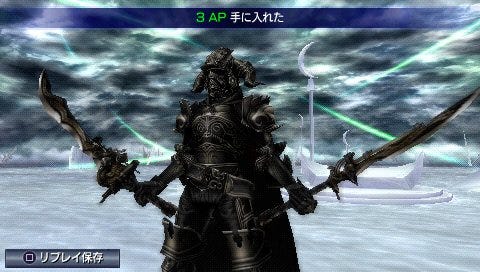
Once the final Shade Impulse chapter has been completed, the bonus Distant Glory chapters will open up. Here Shantotto from FFXI and Gabranth from FFXII can be unlocked.

Fleeing from a similarly skilled opponent who's achieved EX is often a sound strategy, as the worst thing you can let them do is land an HP attack. Connecting a HP attack while in EX Mode will launch your character's ultimate EX burst attack. These work similarly to the Limit Breaks in Final Fantasy VII (or if you want to be pedantic, perhaps even the Desperation Moves from Final Fantasy VI) and require a short quick-time sequence to successfully charge - i.e. mashing circle, matching displayed inputs, etc. The mayhem that ensues after a successful EX burst is all kinds of Omnislash over-the-top. Exdeath uses the power of the Void to crush his opponent in a gravity field and Sephiroth hurls his hapless victim into a Supernova. Basically, if you manage to land a perfect EX burst on your opponent with a ruinously high BP total, it's quite likely you've just won the match.

Dissidia's graphical presentation is in stark contrast to the gritty Crisis Core and has more of a Kingdom Hearts feel (hardly surprising with Tetsuya Nomura onboard). The arenas draw upon the previous Final Fantasy games and include the Crystal World from FFIX and the Magitek Research Facility from FFVI. All have a certain vibrancy which, despite their relative lack of destructible architecture, helps personify the titled Fantasy appeal.

Square Enix has anticipated most first-time players will pick their favourite hero from the PS1 and PS2 generation of Final Fantasy games, as they're some of the most accessible. Indeed, ex-SOILDER Cloud's reliance on close-quarter combos that hurl his opponent against the arena walls for extra damage is one of the easiest styles to master. Other hero highlights include Zidane, a very fast aerial combat specialist and Cecil, who can switch between his Dark Knight and Paladin forms.

On the Chaos side a more focused and tactical approach is often needed to achieve victory. Exdeath is possibly the slowest character in the game, with very little in the way of offensive moves. However, he makes up for it with a reliance on defensive counters, which, if timed precisely, are some of the most effective in the game. A character for beginners he certainly isn't. Dissidia's villains are generally more interesting than their goody-goody counterparts. The Emperor's trap-laying and Cefca's erratic magic styles offer viable alternatives over simply charging in like an idiot with a Gunblade.

As well as a Quick Battle option for one-on-one fights, Dissidia offers a Story Mode, should you feel like helping Cosmos out with her Chaos problem. This begins with a short Prologue where you play as the Warrior of Light (ala Final Fantasy I) and are schooled in the Story Mode basics. Having graduated from this the story splits off into ten Destiny Odysseys where each hero must track down a (drum roll...) "crystal" before the final show down with Chaos.

Each Destiny Odyssey is split into five chapters, and it's all relatively straightforward. You simply move your character piece across each area, with the odd battle or chest along the way, until you reach the Stigma of Chaos tile at the end and proceed to the next chapter. Progression through Story Mode also reveals many cut-scenes and dialogues between the characters. These often build up to the fifth chapter's end fight with the hero's own personal nemesis (Cloud and Sephiroth still don't get on, by the way).

As action-heavy as this new breed of Final Fantasy may be, it just wouldn't feel right without some level of number-crunching. Well, in Dissidia's case you can replace "some level" with "masses", as the level of tinkering available is staggering. Firstly, each character starts out at level one, and by gaining experience through battling, can max up to the level cap of 100. Levelling up not only increases your base attributes but also opens up new moves which can be mapped to analogue and attack button combinations.

3

Once the final Shade Impulse chapter has been completed, the bonus Distant Glory chapters will open up. Here Shantotto from FFXI and Gabranth from FFXII can be unlocked.

As well as new moves, levelling up also unlocks new abilities. These come in Action (increased speed, extra jumps), Support (automatic lock-ons, EX Burst commands) and Extra (better criticals, ability counters) flavours. Every move and ability costs a certain amount of points from your character's max allowance. Spending time in the menus is the best way to tweak a character towards your preferred style of play. Yet more customisation options are available through Equipment and Accessories, which doesn't change your character's physical appearance but does greatly enhance their stats and open up yet more tactical options.

Apart from Chocobo wings and Moogle hats, which other Final Fantasy mechanics have we yet to talk about? Ah yes, the Summons. There are over 50, ranging from Alexander to Ultimate Weapon, and they can be equipped to a character one at a time, and activated in a bout either manually or automatically, triggering different BP bonuses. Bahamut steadily increases BP for a short time, whereas Cactuar lowers the enemy's BP by 1000 points.

Dissidia contains more Final Fantasy nostalgia than a week-long cosplay convention. In addition to Gil, battling also earns PP which can be spent, funnily enough, in the PP catalogue. Not only is this the way to unlock the Chaos characters for player use, but PP can also be spent to unlock each character's alternative costume. Cloud gets his Advent Children threads and Squall gets all old-school in his classic SeeD uniform.

4

Out of all the characters available we generally favoured Jecht the most. He's a close combat monster with speed and power in equal measure.

Without all the number-crunching Dissidia feels like a solid PSP fighter with interesting combat mechanics and a varied character roster. With them, however, it has an insane amount of depth that will appeal to both dexterous fighter fans and more methodical RPG purists. It's not quite an Armored Core level of pre-bout engineering, but the possibilities of customisation grow steadily as you progress your character along.

Dissidia certainly isn't without its faults. The rate of descent once airborne is too slow, and the combat fundamentals occasionally feel jerky compared to more traditional and refined fighters. But these minor criticisms aside, it's a very accomplished fighter that's worth your time - whether you're a fighter nut or Final Fantasy fan. But if you've only played Final Fantasy VII, just be sure to try a character other than Cloud and Sephiroth.

8 / 10

Dissidia: Final Fantasy is out now and Japan and should be released in Europe later this year. You'll need a good translation guide to play it on import.

Read the Eurogamer.net scoring policy

Comments (37)

Comments for this article are now closed, but please feel free to continue chatting on the forum!

  • Loading...hold tight!