Thank Nintendo for this year's slice of E3 wonder. Last year Microsoft blew minds with the first reveal of Project Natal, but "the big N" appears to have sewn up E3 2010 with the only new piece of gaming hardware we'll see at this year's show: Nintendo 3DS.
Let's get out of the way everything that it isn't. There's absolutely no sign at all of an NVIDIA Tegra GPU in this as previously reported, and clearly the graphics technology is not in the same league. Earlier suggestions that the new console would be in the same visual class as PS3 or Xbox 360 are incorrect.
What we do have is a massively significant increase in rendering power over the existing DS, leap-frogging the PSP and probably offering around the same horsepower as a Dreamcast, maybe in some respects giving PS2-level performance. But from everything I've seen so far there's no sign of the sort of rendering features that you see in iPad or iPhone 3GS, so no evidence of programmable pixel shaders or other state-of-the-art OpenGL ES 2.0 loveliness.
Nintendo being Nintendo, there's very little coming out of the company about the technical make-up of the machine itself. However, it's clear that it is using ARM CPU architecture (albeit with a likely significant speed boost over DSi) so as to maintain compatibility with the existing range of DS hardware.
Well-informed sources have told us that after the NVIDIA deal went south a while back, Nintendo sourced a new graphics processor from closer to home. Japanese firm DMP is strongly rumoured to be providing the GPU for 3DS: certainly the firm's association with close Nintendo partner NEC, along with the fact that its graphics core is already being used with an auto-stereoscopic display, make it the most likely candidate by far.
If the GPU within the Nintendo 3DS is less powerful than some might have hoped for, the actual presentation via auto-stereoscopic 3D display is nothing short of sensational. The 3D image gives plenty of depth and looks superb: bright, clear and very crisp, right up there with the best PSP screens, albeit with that extra, crucial dimension.
In contrast to the current 3D screens using glasses, there's absolutely no dulled image quality with 3DS. Conventional stereo 3D requires half of the light emitted by the display to be sent to each eye, reducing overall clarity. Not so with 3DS, which is vibrant and beautiful.
My first port of call after returning from the E3 showfloor was to check out Oli Welsh's initial hands-on posted earlier in the day. Interestingly it's clear that my extended demo session covers a whole range of extra content: behind the scenes, Nintendo has three different 3DS prototypes, each with its onboard memory packed with a different selection of demos.
Getting to see them all in the charged E3 atmosphere and essentially hogging the hottest item on the showfloor isn't easy, but Nintendo is very courteous in allowing extended access to every piece of material available so we can provide the most accurate and extensive reportage possible.
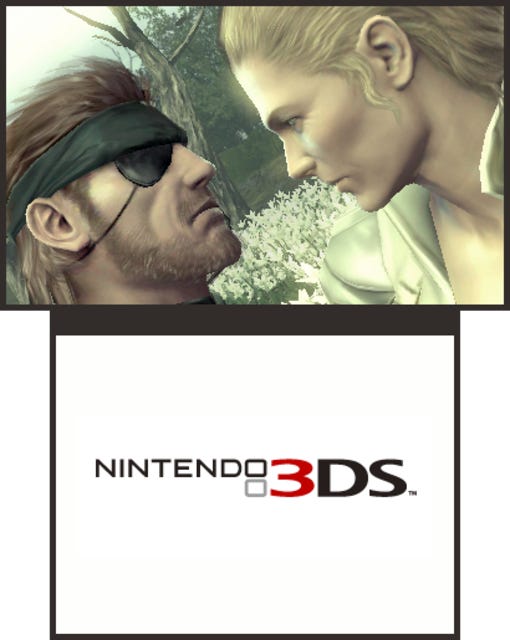
There's plenty of it, too - a refreshing state of affairs for a system still apparently in development. Star of the 3DS content is clearly Metal Gear Solid 3D: Snake Eater, presented in a so-called "Naked Sample Edition" for E3.
Oli's already raved about this, but this is an important title not least because Kojima Productions has put its name to it, meaning that it's the real deal. Not only that but the demo itself is very reminiscent of the extended trailers Kojima-san's team used to put together to thrill us at the trade shows of yore. There's just one difference with this one: it's clearly running in real-time, and we have control of the camera via the analogue nub.
Switching between first- and third-person cameras we get to see Snake moving stealthily through the jungle, facing a giant snake that pops out of the screen, negotiating his way past an enemy patrol, crossing a rope bridge and evading a swarm of bees (!) before facing off against a boss [surely "Boss" - Ed] in a field of flowers shedding their petals. Beautiful stuff. If you ever get to check out this demo, you will instantly want to buy a 3DS. It's that compelling.
In a similar vein to the MGS demo we have Resident Evil: Revelations from Capcom. No gameplay environments, but what we do have is a cut-scene featuring dynamic camera tweaking, zoom options and a pause button for appreciating some of the more spectacular shots.
What impresses here is that it looks as though Capcom has tried to scale back its Resident Evil 5 models to work on the 3DS. While backgrounds are very simplistic, those player models are astonishingly well-realised and very good-looking. The fact that the Chris Redfield model is readily recognisable from his HD adventures speaks for itself.
After skilfully negotiating our way through all three of the 3DS prototypes, we find that there are a total of three different playable samplers in among the non-interactive stuff.
Probably the simplest is called simply 3D Challenge. The idea is very straightforward, with each mini-game event showcasing a challenge based on the idea of 3D depth. The simplest puzzle sees you moving two strawberries about in 3D. One of them is flat, the other is a full 3D object. You're tasked with choosing which one is actually in 3D.
Ridiculously simple of course, but that is the base-level challenge. Moving up to a slightly more taxing one, three golf holes are displayed on-screen. However, two are flat pictures while only one is actually a hole with 3D depth. Select the right one and you're off to the next challenge.
An intermediate-level test sees you having to select one of three different routes - only one of which leads to the sparkling diamond prize. The thing here is that all three routes are fully realised in stereoscopic 3D, and operate in three different axis, intertwining and criss-crossing, so the task is somewhat more taxing than it initially sounds.
The other two playables consists of new renditions of two old Nintendo favourites. PilotWings Resort offers up two different levels for our consumption: a simple "fly through the rings" plane event and a "burst balloons in your jetpack" arrangement. The graphics are minimalistic and basic - certainly nothing like the same league as Resident Evil or Metal Gear - but the 3D works well, and the rebirth of the classic PilotWings series is bound to generate huge interest.
The final piece of playable action is a stereoscopic 3D rendition of Starfox 64. This is probably the most disappointing demo of the lot though. As it's derived directly from the N64 title textures are of a low quality, models are low-poly and the action just doesn't offer anything new or exciting.
It's interesting to note that Sony's conference earlier in the day championed the fact that its 2011 3D titles are designed from the ground up to support 3D, with the platform holder hinting heavily that adapted 2D titles just don't make the most of the 3D concept. Certainly in the case of Starfox 64 3D there is an element of pointlessness about the whole exercise.
StarFox isn't as exciting as its presence on the release line-up had us hoping, but Resident Evil Revelations definitely is, with excellent character modelling.
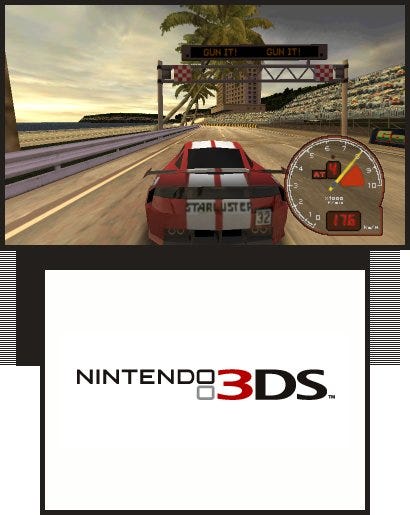
However, returning to the non-interactive material, there is plenty to whet the appetite. Mario Kart 3DS takes the form a rolling demo showing the titular character bombing around the track dodging bananas, firing off koopa shells and generally indulging in the sort of karting action that has kept us enthralled since the series debuted on Super Nintendo.
However, since the game is only represented by a very simple demo, it's difficult to imagine how Nintendo will use the 3D concept to enhance gameplay. Racing titles can benefit immeasurably from 3D (as Sony often tells us when demoing MotorStorm, for example), but the realistic effects of that brand of stereo 3D are limited to the first-person perspective, while Mario Kart 3DS almost certainly retains the traditional third-person angle.
What we do see are fairly basic but nicely rendered 3D environments and some nicely detailed karts and characters. The game engine is clearly locked at 60FPS, and one particular section, where Mario propels his kart skywards, offers some impressive views of the track ahead.
If the reveal of a new handheld Mario Kart game isn't enough to get you excited, perhaps the return of Paper Mario will. Again, not a huge amount is shown, but the mixture of 3D environments and 2D paper characters is unique and enchanting within the auto-stereoscopic 3D setup of the new hardware.
Our demo session heads toward its conclusion with another look at the 3DS tech demo Nintendo showcased at the climax of its E3 conference. A range of Nintendo scenes and characters are rendered with consummate detail in full stereo 3D. Oli described this scene in depth in his hands-on briefing, but one thing that should be factored into the discussion is that this is clearly a technical demonstration designed to show 3D on the system looking at its best.
Oli pointed out that the Link section looked better than the new Wii game, Skyward Sword, but just rendering a single character with no environments, no user input and no game logic is obviously a lot easier on the hardware than incorporating that same model into a full-on game with detail-rich characters and environments.
That being the case, to compare 3DS with Wii, or even GameCube, in terms of graphical quality based on this beautiful demo probably doesn't do the home console justice. The best demos we see based on actual game assets are of Dreamcast quality. While this may seem like a disappointment, bear in mind that we're running on a very small screen here, with a fairly high pixel density that will magnify the impact of that level of horsepower. Generally speaking, 3DS is a hugely attractive platform.
So, with the demos out of the way, it's time to get a closer look at the Nintendo 3DS' rather nifty party trick. The hardware features a total of three cameras, one stationed directly above the 3D screen, and another two on the lid. Why two cameras on the lid then? Welcome to the world of stereo 3D photography.
We never anticipated Nintendo incorporating this, and it really is cool. A simply capture tool allows you to line up and snap your chosen subject (with a stereo 3D viewfinder of course), and then you can view the images you've taken any time you want on the 3D screen, using the d-pad to adjust the parallax. It works, it's uncanny, and it's a great talking point.
What you can actually do with these images beyond looking at them on the 3DS screen remains to be seen, and you can't help but wonder what plans Nintendo has for this. In the other demos and games there was no need for this at all, and Nintendo builds its machines to a cost: there's no scope in this company's masterplan for any superfluous tech.
One can only imagine that there are plans in place for getting the most out of this addition, but in the here and now I can say with confidence that it is just very cool and I'm glad that Nintendo went for it.
Other elements of the 3DS remain something of a puzzle. At the conference Nintendo confirmed that the 3DS features a motion sensor and gyroscope. This is curious as there is a limited viewing angle with the stereoscopic screen, and extreme wobbling of the unit kills the 3D effect, as you would expect from a game supporting actual motion of the console.
One thing to be clear of here though is that, generally speaking, the sweet spot for the 3D effect is much larger than you would think. There is some occasional cross-talk (i.e. image data for one eye encroaching onto the other eye) but for the most part the effect is crystal clear and you won't have any problem enjoying the full effect.
Any kind of fast motion game using the sensors and gyroscope must surely be incompatible with the 3D screen, though, so the question is, why is the kit in there, and can it really be the case that Nintendo would allow non-3D titles to be released for the 3DS in order to best use the new sensors? Wouldn't this introduce a huge level of potential confusion for game buyers?
Kid Icarus is bound to make a few people happy. DJ Hero 3D is one of Activision's attempts. Presumably 18 Call of Duty games will follow.
Another massive surprise in the 3DS package is the support for 3D movie playback. I had the chance to view two 3D trailers: Disney's Tangle and Dreamworks' How to Train Your Dragon. Oli pointed out that the 3D effect here is rather subtle, and so it is. There are two likely reasons for this. First of all, you're viewing the content off the back of playing video games which really exercise the full depth available. Secondly, these trailers were designed to be viewed on a honking great cinema screen, not a relatively tiny 3.5" screen!
After my first taste of 3DS, I was somewhat sceptical about how these movies would work on the screen. The game content has a lenticular look about it, with pixel edges fairly evident despite the seemingly high DPI of the screen. My fear was that you'd see the same edges on the movie content.
Thankfully I was proved completely wrong. Movies playback beautifully on the 3DS screen, and while the 3D effect is subtle, it only takes a short while to grow accustomed to it, and turning off the 3D functionality clearly impacts the image in a negative way. Just about the only criticism you can have is that the screen itself is very small at 3.5", so not exactly immersive for movie viewing.
Speaking of which, it is interesting to point out that the 3D depth slider doesn't work for movie playback, where you effectively get a choice of watching in either two or three dimensions with no tweaking of the latter. This effectively confirms that the 3D slider is computationally altering the twin in-game 3D cameras on the fly in actual 3DS software, and that the 2D mode most likely works simply by turning off the output to one eye and adjusting the cameras accordingly.
So, bearing in mind the relatively unfettered access we had to the kit for an extended period of time, were there any other points of interest we've not yet brought to the table? Not really, except for final confirmation that within the development community, the 3DS is indeed codenamed Nintendo CTR. That's what the debug game launcher code we spied on the development units said anyway.
In closing, it's fair to say that Nintendo rarely gets any love from Digital Foundry, and arguably that's something we need to look at (what other platform holder is so committed to 60FPS gameplay, for example?). With Nintendo 3DS, that is set to change, because the arrival of the new handheld is clearly a major event.
In many ways, this new device is classic Nintendo. It's clearly built to a cost and the chances are that the platform holder will be in profit on this unit from day one. Just like Nintendo DS in its day, the GPU is under-powered, but on the flipside this should help immeasurably in maintaining battery life. And again, just like classic Nintendo hardware, it has a concept that is way ahead of the competition. The 3D screen propels the visuals into a different league, it's that good.
The inclusion of stereo 3D is also a masterstroke from Nintendo because it differentiates the handheld in a savagely competitive environment. While iPhone may be hoovering up more market share in the mobile arena, constantly re-inventing itself year after year with new hardware and features, it doesn't do 3D and likely won't for years to come, if ever. Nintendo has a unique selling point and it's certain to be another monster hit.