In Theory: Is this how OnLive works?

Digital Foundry mulls over shots and expert opinion.

After its sensational - and controversial - debut at GDC last year, little has been heard publicly about the OnLive cloud gaming system. During the summer, the firm kicked off its promised beta sign-up phase, but in a world where footage is leaked from betas within hours of their debut, the lack of any tangible feedback on the system from testers was telling. Was OnLive still on schedule? In the run-up to Christmas, momentum picked up: many confirmed OnLive beta testers finally broke cover and a mammoth 48-minute presentation from company front man Steve Perlman was released.

In a small, intimate venue, the Columbia University alumnus, equipped with the OnLive browser plug-in and microconsole, presented what amounted to a more informal re-run of the original GDC presentation - mostly the same tech, showcasing the same games. More details emerged about the make-up of the system, and Perlman produced a mouth-watering presentation of Crysis running via OnLive on the iPhone. The core issues many commentators took issue with (latency and video compression) were also covered, albeit in an extremely vague manner.

So, the big questions remain: in particular, just how does OnLive compress video? Perlman suggests that OnLive has created a new video compressor divorced from the conventions of normal video encoding: the so-called group of pictures (GOP). GOP is all about retaining and re-using as much video information as possible to reconstruct the current frame. Picture elements can be brought from past and future frames to ensure the highest-possible compression. But OnLive has a problem. Taking elements from future frames would require buffering them and thus introducing lag, which would sit on top of the time taken to beam information across the internet as well as the inherent latency in the game itself.

Perlman says that OnLive doesn't use GOP, and uses a proprietary compression system. Jason Garrett-Glaser, one of the key developers of the x264 open source h264 encoding system used industry-wide and thus extremely well-connected, claims otherwise.

"As far as I know, OnLive is just using h264, so this doesn't really go in the 'new and alternative' category," he wrote on the Doom9 forum under his online alias, Dark Shikari. "Their 'new idea' is splitting the stream into 16 rectangular slices, each of which gets its own encoder. This brilliant idea massively reduces compression on the edges between slices when the scene is in motion and lets them brag about latency 16 times lower than what they actually have."

The process of cutting the picture into pieces and parallelising the encoding of the whole image is actually supported in the h264 spec. For many-threaded decoders such as that within the PS3, the use of slices makes for far faster playback of challenging content (for example the WipEout HD 1080p60 videos). However, Garrett-Glaser suggests that OnLive is physically cutting the screen into 16 pieces and sending them to 16 different independent encoders.

"With slices, each slice can reference data anywhere in the previous frame," says Garrett-Glaser. "This means that if something moves from slice A to slice B, there's no problem: slice A can point to it with a motion vector just as if it didn't cross the edge. But OnLive isn't using slices: they're encoding the video as a bunch of separate streams. These streams are completely separate, and so each stream cannot reference data from the other streams. So, if something crosses the edge of a slice, it cannot be referenced properly! This effect is normally rather small, as it only affects the edges of the frame, but with OnLive's method, it affects about eight times the number of macroblocks as it otherwise would, because it affects those on both sides of each slice boundary as opposed to merely the frame edges."

But of course, the compression system and how it works is basically irrelevant if it does the job and looks good. Does it make the grade visually, and what about the lag? As mentioned in our original piece, if you accept a certain amount of "givens" that don't quite match all the company's claims, OnLive goes from the being something quite fantastical into something very real. A good frame of initial reference is David Perry's Gaikai. There's absolutely nothing technically outrageous about Perry's presentation in terms of frame-rate and bandwidth figures. If you scale up resolution and maintain 30FPS, OnLive's 5mbps throughput level for 720p with 5.1 surround sound seems reasonable.

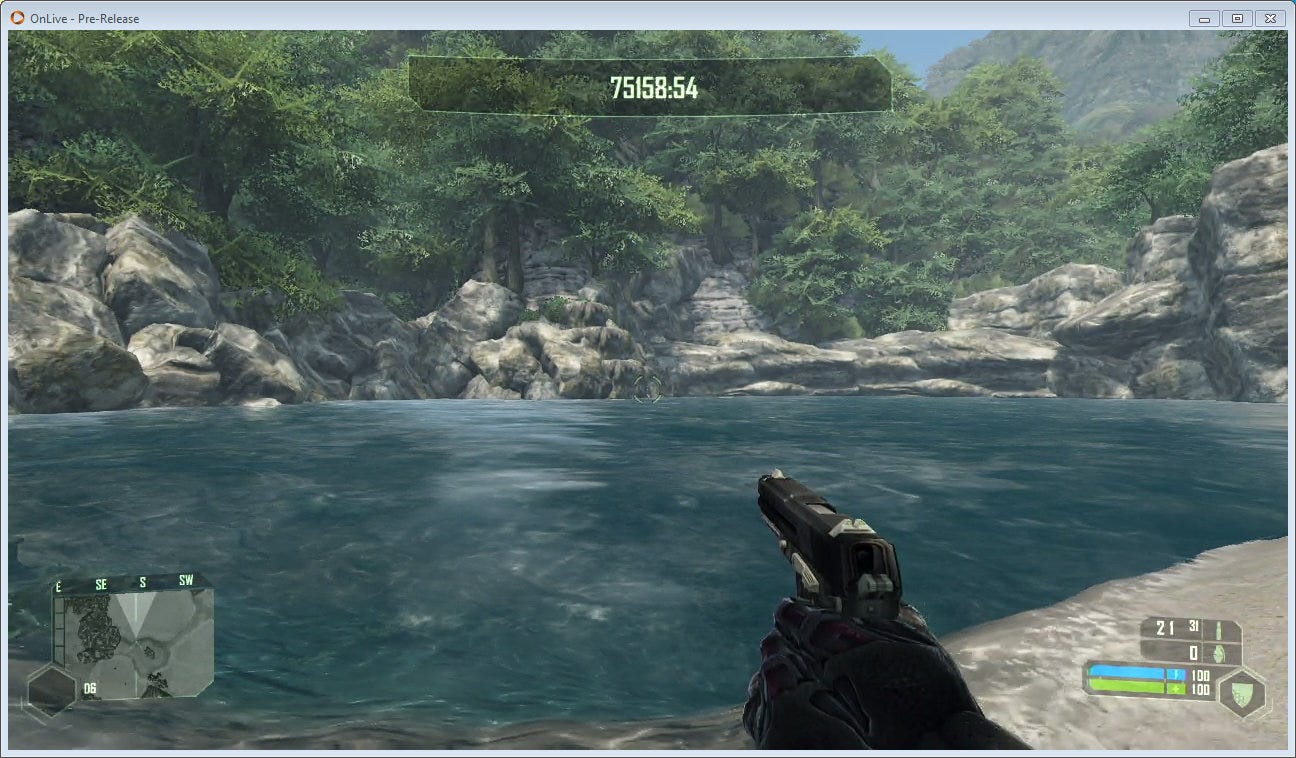
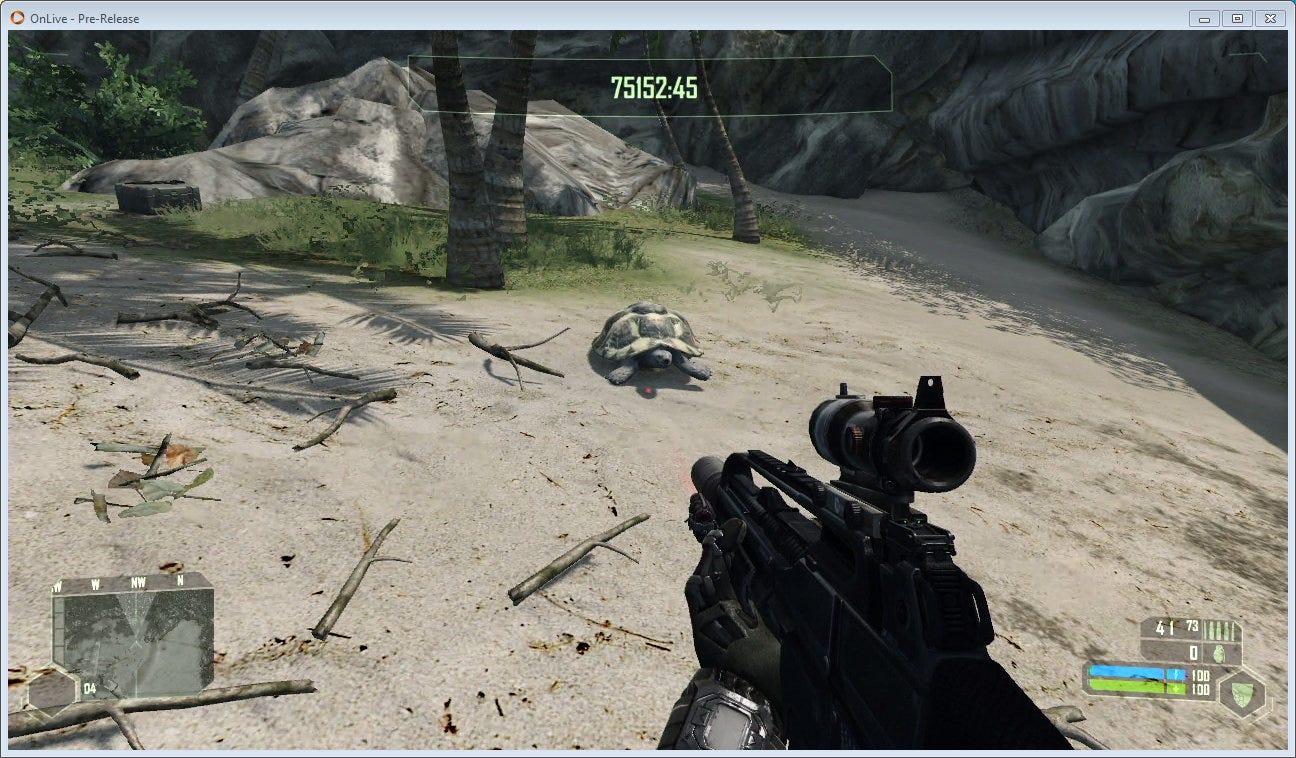
So how is the picture quality? An excited beta tester broke his NDA within moments of downloading the 1MB plug-in for his browser and posted these images of Crysis, which do a fairly decent job of showing how OnLive looks at what we can presume to be nigh-on optimum conditions. They might be fake, but it seems unlikely bearing in mind how the Crysis settings seem to be a match for previous OnLive demos.
Comments (51) Latest comment 2 years ago

Comments for this article are now closed, but please feel free to continue chatting on the forum!

  • wizlon #1 2 years ago

    I can see this system being used by office workers to play doom3 in their lunchtime.. typically, me.
  • insincere_dave #2 2 years ago

    The scientists at CERN should bloody well get on with rewriting the laws of physics so we can get this thing running at 1080p60.
  • mcbi4kh2 #3 2 years ago

    I really don't like the word 'slice'.

    /has nothing relevant to say
  • cianchristopher #4 2 years ago

    It's a brilliant idea! Brilliant!

    But, it's about 20 years away from actually becoming feasible. (You'd need current internet speeds to get a helluva lot faster to support this at 1080p60 for the potential audience of hundreds of millions of people all over the world).

    I look forward to the day when I have a 1,000,000Mbps internet connection.
  • Crembo #5 2 years ago

    Wow Eurogamer you idiots, now the dude can get banned in OnLive :|
  • Zaiz #6 2 years ago

    OnLive - It'll work great at 5mbs!

    >.> Uh, where? Most folks have issues pushing their 10 mbps lines all the way to 2 mbps. Is this only going to be open to the select few who actually get 100% of the speed their high speed internet provider 'provides'? It seems entirely unreasonable still. Eh, a definite no-go for me until America's internet infrastructure is upgraded in, uh, 5-20 years.
  • foamy #7 2 years ago

    Needs moar, or fuck it.
  • Markusdragon #8 2 years ago

    I STILL can't view YouTube videos at certain times of the day without heavy buffering. Apparently, the average broadband speed in the UK is 3.6Mbps, and that's certainly not at peak times. Even with a couple of years of growth and the (Bahahahah-SNORT!) 75% drop in web piracy that the government are predicting, there's just not going to be enough capacity, especially with the rise of Video On Demand services competing for the bandwidth; by the time this is out, your granny will be competing with you for bandwidth so that she can watch old episodes of Heartbeat on demand through her set-top box.

    It's a nice idea, but it's not going to work until we replace the entire phone network infrastructure in the UK with Fiber Optics.
  • Freek #9 2 years ago

    Nobody is saying this isn't great or isn't the eventual future of games. What people are skeptical about is OnLives ability to do all these great things right here, right now under commercial conditions to the high quality specs that they are claiming.
  • ignatiusjreilly #10 2 years ago

    despite the countless advances that we as a species have made in all areas it still makes me laugh that every time something new comes along there are those who say 'it can't be done'.

    Yes, it is funny. The EG articles are slowly going from entirely impossible; to unlikely; to possible; to reasonable; while the comment threads are doing the same backtracking just at a slightly delayed pace :D
  • yegon #11 2 years ago

    What freek said.

    As a viable proposition in the UK this is currently pure fantasy...or a horrible game experience, your pick :)
  • Distributor #12 2 years ago

    I dont think anyone is realistically expecting this to replace local gaming as such, from the start. Or are they?
    These things are always hyped by the marketing people and then torn down by the tech crowd. Reality is somewhere in between. Its a start of something that will come into fruition in the future, maybe. The people who will use this service from the get go arent probably too bothered about the lag and/or image quality or artefacts in background foliage. Just a quick a mellow gaming experience.

    Never overhype, never be too sceptical. Just enjoy and if its crap, then take warm wee on it after the launch party.
    Edited by Distributor at 05/01/10 @ 16:02
  • chiz #13 2 years ago

    despite the countless advances that we as a species have made in all areas it still makes me laugh that every time something new comes along there are those who say 'it can't be done'. You are always proved wrong eventually. This is clearly the future and how we will all be playing games in years to come.

    You lot are the twats who insisted the world was flat. I can't believe you can't actually see that. morons.


    Sorry pal, it's called the speed of light. As insincere_dave says, you would need to change the laws of physics.
    Edited by chiz at 05/01/10 @ 15:58
  • ignatiusjreilly #14 2 years ago

    I dont think anyone is realistically expecting this to replace local gaming as such, from the start.

    I don't think OnLive are but it sounds like the sceptics may be.

    It's a nice idea, but it's not going to work until we replace the entire phone network infrastructure in the UK with Fiber Optics.

    What about replacing half of it? Or a quarter? Or the people in Sweden, Japan and Korea? Or is OnLive a failure until every granny in the Pennines is playing Crysis on their EeePCs?
    Edited by ignatiusjreilly at 05/01/10 @ 16:00
  • ignatiusjreilly #15 2 years ago

    @notmyrealname

    Trouble is, a desktop monitor is going to show up compression artefacts much more noticeably. I think the best use of it would be a set-top box/TV in the living room where you have a few feet between you and the screen to compensate.
  • penhalion #16 2 years ago

    Why is this debate even still going. Most of us pegged it as nothing more than a money grab for investor money ages ago. The only thing still puzzling me is who is giving this thing cash and where is the inevitable law suit when that person/organisation realises they've been had.
  • jambo74 #17 2 years ago

  • ignatiusjreilly #18 2 years ago

    The only thing still puzzling me is who is giving this thing cash

    "OnLive's original investors include Warner Bros., Autodesk and Maverick Capital. A later round of financing included AT&T Media Holdings, Inc. and Lauder Partners as well as the original investors."
    http://en.wikipedia.org/wiki/OnLive

    The info is not hard to find. I think what's really puzzling you is why these seasoned investors see the project as worth investing in when you think it can't possibly work. That's a question only you can answer I suspect.

    @notmyrealname: Yeah, I really think mobile applications could be THE killer app for this. Bandwidth will be more of a problem there I guess, although the lower resolution needed should help there. Wireless bandwidth is usually easier to upgrade too, seeing as it doesn't involve digging up roads. I actually wouldn't be surprised to see wireless speeds overtake home braodband connections in the reasonably near future. Maybe we won't have to rely on BT after all ;)
    Edited by ignatiusjreilly at 05/01/10 @ 16:34
  • AOFanboi #19 2 years ago

    I am less interested in whether the technology works than in how the business model for this is supposed to work. Custom servers, custom software, rewritten game engines, and that are just the base expenses. How many customers, and how much for each, to even break even on this thing?
  • DaemonSpawn #20 2 years ago

    Personally I wish Perry's Gaikai all the luck with this cloud gaming thing - at least they are straight and quite open in comparison with OnLive team.
    Edited by DaemonSpawn at 05/01/10 @ 17:26
  • Ryze #21 2 years ago

    My questions remain:

    - How well does this play on most Internet connections?

    - How successfully will this scale up if it takes off? If 5000 people suddenly subscribe in Manchester, will everyone get a crap version of Crysis, or will they ship in a tonne of servers to cater?

    - Referencing the questions above - how long will it take to actually make any money from the casuals who will be the main audience for this?

    I'd love for this to work - as the concept is fantastic. It just doesn't seem like much of a successful business idea yet.

    /waits...
  • soviet_ #22 2 years ago

    Doesn't matter how good OnLive is, my PC is a beast
  • StooMonster #23 2 years ago

    Markusdragon: but it's not going to work until we replace the entire phone network infrastructure in the UK with Fiber Optics.

    Similar issues in the USA too, a few of my friends live in California and have broadband that's even worse than UK; and more expensive too. One guy in Marin gets a couple of megabits max, another further North relies on satellite broadband to get his connection above 1Mbps, a friend in Malibu gets 4-5Mbps but the connection drops a couple of times an hour and in busy times every few minutes. Pals who live outside cities in Australia have 3G mobile as their only option for 'broadband'. None of these would work with OnLive.

    Makes me glad of my Virgin Media cable modem. :) Although I am sceptical of the quality of OnLive, however, it may well succeed because it is 'good enough'. There are plenty of examples of online 'good enough' beating quality, for example MP3 versus CD or DivX / streaming versus DVD where convenience outweighs lower quality.
  • PlugMonkey #24 2 years ago

    @designerheadache:

    "Would be more useful to those on Virgin Cable 50mb/s though :p "

    Heh heh. I'm guessing you're not a current Virgin Cable 50mb/s subscriber, or you wouldn't have such high opinion of their capabilities. ;D

    @ chiz: Did you watch the video? I think that was covered, unless you have some other info you are keeping to yourself.


    From watching the video it would appear to work, under favourable network conditions, so I can see why people would invest in it. If it works in the real world, it will make a LOT of money.

    But that's a big if, especially when the 'real world' you are specifically interested in is Great Britain, where you'll find a Virgin 50mb/s fibre optic connection will deliver a solid 45mb/s download speed, just provided you aren't so selfish as to want to use it during evenings or weekends, when it won't even stream a YouTube clip due to an unspecified "network issue" that they are "working on".
  • oktava #25 2 years ago

    I liked the part of the presentation where the bigwig guy said something along the lines of that 80ms is not perceived as a delay by human beings. I work as an audio engineer. Everything bigger than a 3ms delay on musicians headphones and they start cursing at me.
  • Chufty #26 2 years ago

    The encoder, picture quality, resolution, colour depth, motion pixellation and vector inefficiencies are all irrelevant points.

    The sole reason this will not work is latency. 80ms might be just about bearable, certainly to average PC gamers if not console gamers too. Many PC gamers will find it too much. But 80ms is a lie anyway. It will be, at the very least, twice that.

    Remember this isn't network ping time, this is input/output latency. The figures just don't correlate with current technology.
  • StooMonster #27 2 years ago

    ignatiusjreilly: "OnLive's original investors include Warner Bros., Autodesk and Maverick Capital. A later round of financing included AT&T Media Holdings, Inc. and Lauder Partners as well as the original investors."
    http://en.wikipedia.org/wiki/OnLive

    these seasoned investors


    What makes you think these are seasoned investors in private equity? e.g. Autodesk makers of CAD software, Lauder Partners is a one man band business angel which "primarily invests the capital of Gary Lauder and family members", Maverick Capital is a Hedge Fund rather than a VC which means they deal in liquid publicly quoted equity rather than illiquid private equity.

    Interestingly I cannot find reference to "AT&T Media Holdings, Inc." except on OnLive press releases, even went to att.com and searched there to no avail; can't find it in their annual reports either. Hrm... I would've thought AT&T Ventures, Inc. would be the subsidiary that might invest in likes of OnLive.

    It's not like they've got Draper Fisher Jurvetson or suchlike onboard is it?

    Also, Wackypedia says "OnLive was incubated within Rearden LLC, a company founded by Steve Perlman. Since it was spun out as an independent company, it has also taken over control of MOVA, another Rearden start-up founded by Steve Perlman, as a wholly-owned subsidiary. MOVA is a facial creation and motion capture company whose technology has been used in films such as The Curious Case of Benjamin Button."

    When I was a VC this was the kind of behaviour that would be raising red-flags for me. Steve Perlman obviously made a tonne of cash when he sold WebTV to Microsoft back in 1997, and he uses http://www.rearden.com/ as his vehicle for new ideas which is all fine. But what he appears to have done here is taken investors money in OnLive and then purchased another of his businesses with the capital, despite the fact this other business is in unrelated sector. If I was an investor I would be livid.
  • makeamazing #28 2 years ago

    Dont know how many times people need to say this, but it just aint going to work, what with bandwidth and service scale (even if they use Virtual servers), its just not going to be good enough. This is something that might work great "in the future", this just isnt worth the hassle with the current issues the net has.
  • hiddenranbir #29 2 years ago

    "bunch of mathematics"

    Awesome, now show us the mathematics. Some of us like mathematics!
  • sarcasmoidosis #30 2 years ago

    Many of you seem to think that it can't work right now. I have to agree. But it will almost surely work in the future and, by that time, Onlive will have had their foot in the door. They would be first there, already knowing the ropes, having slammed their heads in the usual walls.

    And, as I see it, it may work reasonably well if you have a crappy PC, a good Internet connection and a low resolution display (1024 or 1280). Even the idea of being able to RUN the likes of Crysis or GTA IV on a single core processor shows why this is a reasonable idea.

    PS: The Onlive dude looks like a madman though
  • rickimalone #31 2 years ago

    I know that change comes to eveything BUT. A new console launch for me at 29 is probably, along with the birth of my children, the most exciting time of my life. On Live looks to take that away from me and for that I'm against it. (I say that while looking at my prestine SNES and Megadrives in their perfect boxes from 1993 :)
  • Moz #32 2 years ago

    It's defintately a good start. And it's only using 5mbs. In as little as 5 year we could be looking at 50mbs being a normal household connection speed which will allow for far better quality.
  • persus-9 #33 2 years ago

    Technology aside I still just don't see who is going to buy this. Gaikai makes sense to me but OnLive just doesn't.

    I'm a hardcore gamer (as I'd guess we all are since we're actually reading the gaming press) and I don't want this because I already have a beast of a PC and a current gen console so I'd be basically paying a subscription to get worse graphics and increased input lag. Now okay maybe I get the games as well but if I wanted to subscribe to games then I'd use metaboli. Now I know the hardcore are the tiny minority and so not really important but as minor as we are we do tend to be the best early adopters (or suckers to look at it another way) and for a service that's going to require a fair few subscribes to get rolling and become profitable I can't see it getting that far without us.

    The bigger problem is I can't see what an everyday gamer would want with it either, they've also got consoles or something so they're in the exact same boat as me but gaming is a less important part of their lives so they're even more likely to hesitate at the cost of a subscription.

    The casual gamers on the other hand, the type Nintendo have been trying hard to convert might not own a gaming platform or might want to try something other than their Wii or laptop but surely they really aren't going to want to commit to an monthly subscription for something that really isn't important to them. They're also pretty much by definition not early adopters. I know plenty of casual gamers have bought Wiis and that would I dare say get you a good few months of OnLive for a similar price but thing is you can a casual gamer a Wii because it's a physical object that can be given as a gift. Imagine all those casual gamers were asked to cough up monthly to keep their Wii's running, how many do you think would? Imagine how many would give OnLive as a gift knowing that it committed them to a subscription. Imagine how many would feel totally ripped off and start demanding their money back when they found out they couldn't get access to a server on Christmas Day because of the usage spike. Imagine the fear and uncertainty when they found out it might not work it their internet connection isn't up to scratch or the shear white hot rage if they're made to find that out the hard way. Na, I don't think this will take off with the casual crowd.

    Basically I just can't see it working at all unless it's very cheap or offers a good free trial and I can't see how it can do either. Price wise they've got to buy a huge number computers, run them out of datacentres with consuming huge amounts of bandwidth and electricity and that sort of thing ain't getting any cheaper as anyone who regularly pays for webhosting will have noticed. Compare that to a console where the customer only notices paying for an initial subsidised hardware cost. Now the big expense is capacity so the last thing you want it to offer people a free trial before the service is well up and running. Not to mention the fact it isn't entirely software based so it'll cost them a good few quid just to let people try it out.

    I can't see anything but failure for this one. It's a sexy idea that is I'm sure doing well pulling in investors but ultimately many of those investors are going to get burned. My prediction, failure for OnLive and slow burning success for Gaikai and ultimately, if streamed subscription gaming is the future (and I'm far from convinced) I reckon it's a lot more likely to be Gaikai diversify into that market that will bring it to the masses rather than OnLive.
  • ukgamer #34 2 years ago

    Looks like crysis on low.
  • hahayou #35 2 years ago

    As far as a business model for casuals goes it'd be easy for them to pause every 10 minutes for an ad.

    P.S. Expert investors? Like the ones who bought into CDOs you mean? Well it must be perfectly sound then...
  • PlugMonkey #36 2 years ago

    "Basically I just can't see it working at all unless it's very cheap or offers a good free trial and I can't see how it can do either. Price wise they've got to buy a huge number computers"

    @ Persus-9: Did you watch the video? He specifically covered how they WON'T be buying a huge number of computers.

    I find your logic equally unsound. As he says, there are already the Alienware owning hardcore PC gamers out there, but the entry level is waaaaay too high for the vast majority.

    You talk about casual gamers not wanting this as they are not early adopters, but the whole point of the technology is that you don't have to adopt anything. The requirement to connect is a little dongle that costs practically nothing. I reckon there are a lot of people out there with PCs that they'd like to play games on, but can't. Now they can in a way that's a hell of a lot cheaper than a new PC.

    And I reckon there are a lot of parents out there who would welcome a system where they pay a flat monthly fee for their kid's gaming rather than £300 when the console comes out, and then get hit up for £40 everytime there's a new game.

    And metaboli requires me to download the game before I play it. They're talking about true games on demand.

    I think they'll find a big market for it, especially as we move toward the next console turnover, assuming they can find enough people with a stable internet connection. Which in the UK, I doubt.
  • Bennicus #37 2 years ago

    "physically cutting the screen into 16 pieces"
    Physically?! Makes a change from "literally" I suppose.
  • StooMonster #38 2 years ago

    In my opinion the lag is the least of the problems, it's the input mechanism that I think is a challenge.

    OnLive emulates PC games, such as Crisis. They are proposing to offer it as a 'console' type thing that sits under the television.

    How to I play Crysis with my keyboard and mouse?
  • JensonJet #39 2 years ago

    Reading some comments and even articles about OnLive I'm surprised to read so many sceptical gaming enthusiasts. Which strikes me as a little strange seeing as our favourite hobby was and remains built on continually developing, improving, pushing boundaries of technology and is still going from strength to strength.

    I feel quite positive about OnLive. I totally accept that this company and their product may not come to fruition, but the idea, the business model, a technology similar will become reality one day. I don't understand why so many seem concerned or cynical.

    I agree that the graphics look pretty basic, but they'll improve with time. Does that really need to be told to anyone who's a gaming enthusiast? From what we know about the service, it's going to be very easy to demo the system to see for ourselves whether this is the gaming platform for us.

    In some guise or another, perhaps many, this service could sit alongside the current gaming platforms and mediums and, who knows, if it's really good may replace one. I am more than happy to sit back and see where we end up.

    The big question for me, that few seem to be asking, is how much will this cost? The technology will either prove to be unworkable or completely possible so assuming it works, how much will this cost the consumer? Will pricing be based on a monthly or yearly fee? Will games be individually priced or free once an account, paid yearly or monthly, is set up? There are so many unanswered questions. All we can do is wait to see where this takes us.
    Edited by JensonJet at 06/01/10 @ 10:03
  • thesombrerokid #40 2 years ago

    i think the same thing I've always thought, why would i let someone else host this service when I'm perfectly capable of hosting it myself? An open source project will hopefully come around providing all the benefits and none of the drawbacks.
  • StooMonster #41 2 years ago

    designerheadache: I am well aware i am in the minority on speed and luck with my provider ;-)

    I 'only' have the 20Mbps package too as it works perfectly for me, consistently hits 20Mbps in online download tests (even at peak times) and it allows me to stream multiple videos (including BBC or Xbox HD ones) and run downloads at the same time, whilst the Mrs and kids are using the net too. But if I have super large downloads to do I tend to keep them to non-peak times, e.g. Steam games or BBC iPlayer HD downloads etc.
  • Zephro #42 2 years ago

    Shockingly the UK actually has quite good broadband compared to some countries like the US or South Africa. The chances of it working any time soon in the majority of countries seems quite limited.

    Coupled with QoS at peak times, on shared lines, or just having your gaming held ransom to inevitable outages and so on isn't really going to wash for a long time yet.

    The 80ms lag time for input is pure fantasy as well. I mean that's just a lie.
  • Murton #43 2 years ago

    This will never fly in the UK. The providers still claim that the likes of iplayer and spotify are damaging the network with their high bandwidth demands, BT for example throttle all streaming related traffic to death whenever anyone in the country is awake thus making something like this nigh on impossible.

    Luckily I'm reminded of something the biggest prick in the world said just a few days ago in a UK Sunday newspaper. Bono claimed that "due to the immutable laws of the internet people will soon be able to download an entire season of 24 in 24 seconds." I've done the math and assuming that each episode is standard definition and divx encoded then Bono seems to be under the impression that within the next couple of years connections in the UK will reach somewhere around 4 GIGABITs per second. Can't wait for that service to come out, I wonder what they'll charge for it...
  • Fodder #44 2 years ago

    Bit of an odd decision to post screenshots in lossy JPEG format if you're trying to show compression artefacts. Surely the original PNG would be more sensible?
  • oktava #45 2 years ago

    @notmyrealname

    its a little offtopic but a good musician that plays anything rythmical aims to be in a pocket close to 3ms. an average player like myself wouldn't have a big problem with lets say an 8 ms delay between my input and the sound but it gets very noticeable beyond that to pretty much everybody. no ear magic included.

    and it doesnt really have a lot to do with reaction time. its just coping with the lag of your input vs. what you can see/hear.

    now i dont know how relevant this is to gaming since its more a visual thing and also depends on the game i guess. e-sports quake or racing sims would certainly suffer more than an rpg. i just found that presenters statement, about how unnoticeable 80ms are, a little funny.
    Edited by oktava at 06/01/10 @ 12:44
  • Vermillion3000 #46 2 years ago

    persus-9 and a few others have summed up my (sceptical) thoughts quite well.

    I do see the big crunch coming from business model and the cost to run the service which now has to take on all the costs that have previously been distributed to the user.

    I'm afraid I am very sceptical of the hardcore PC market adopting this service - those users are the elitists (and fair play to them) and demand the very highest fidelity in all areas of the experience. I think the hardcore market is off the menu. (and the early adoption they bring - good point well made, sir)

    However, shift over to the Wii-type market and plug in, not to a gorgeous PC monitor, but 2012's internet TV's and suddenly you have a better proposition. The fidelity is definitely less of an issue and an "always there" series of channels are perfect for the group of lifestyle-photography friends you all have.

    The problem, again, is one of payment. Casual gamers are cheap gamers, they have bought a Wii, but game sales are very low if you extract the big 5 per year. They won't be wanting to subscribe, so it'll have to be bundled with your media service (Sky, Virgin etc.) And that'll skim some of the profits. or - you have to have freemium model, ad supported - which will then compromise the content available because it'll have to be total mass market.

    There's bear-traps everywhere - and I still insist that the running costs and hardware/power/insurance costs for the data centres will be astronomical.
    Let's assume that the tech can work - and there is still a lot of problems that I'm not hearing solutions to.
    Edited by Vermillion3000 at 06/01/10 @ 12:51
  • OldK1ngCole #47 2 years ago

    I have to agree with what people are saying about ISP speeds. I'm on BT Broadband and my speed isn't that bad, my line is rated at 7Mbps but at about the same time every night (7pm to 11pm) my speed is cut by more than half down to around 2Mbps. This is even worse at weekends. Been as though these are the times I mostly play games, OnLive just doesn't stand a chance with me.
    Edited by OldK1ngCole at 06/01/10 @ 13:30
  • Spydy #48 2 years ago

  • Vixremento #49 2 years ago

    Well I used to get around 400 - 700 ms latency on a good day with WoW...which is still kinda okay (provided you don't try your hand at PvP) but for something like the games they want to provide (i.e. Crysis) I just don't see it working. That plus the cost of the bandwidth in our country makes it even more expensive than buying the game off of Steam (sure - it's on special for X but to download Y GB costs twice X...so I'm kinda screwed).

    Anyway - cool idea but like others have said...a bit too early for it's time.
  • whoslotte #50 2 years ago

    I can see it now...

    "OnLive Message...

    Crysis 3 is oversubscribed in your region. At the moment you are unable to play and have been placed in the queue.

    You are queue position 4,543,232 out of 4,543,235...

    Would you prefer a game of Peggle ?"
  • robg #51 2 years ago

    Sigh. Once again, this may work on casual/non-cutting-edge games, but:

    Every time you upgrade a server to render a game quicker, or encode it to video faster, the same rate of technological advancement is occurring in home console power, instantly making your cloud-based solution look out of date.