Let's begin at the end, because that's what Command & Conquer 4 is: the conclusion to a sweeping PC favourite, the last entry in a classic - and convoluted - soap opera. Here, in a tiny meeting room at EA LA's headquarters, the team behind Kane's latest battle have spent the last few hours taking us through the entire narrative arc of the series. Now, they're going to give us a few hints on how they're about to finish it all off. "We didn't want to do just another sequel," says Sam Bass, the campaign and story lead for C&C4, a man who's voice seems to have at least four different accents swimming about in it, suggesting that he's possibly arrived from the future himself, and a time when national boundaries no longer have meaning. "We didn't want an enigmatic fade to white. We wanted to bring the story to a close."
And we're almost tempted to believe him, even though conclusions are about as convincing in videogames as they are in cinema and penny dreadfuls, each tumble over Reichenbach Falls strangely susceptible to rewriting when there's enough money on the table. Even within C&C there's plenty of precedents: Kane, after all, has been ionised, blown to pieces, and splattered across Temple Prime so many times by now that he's a bit like Phil Connors in Groundhog Day, except with a pointy beard and a preponderance for odd hand gestures.
But listen for the finer print: "We're not ending the universe, necessarily," adds Bass quickly. "But we wanted to bring this particular arc to a resounding close." EA isn't talking about writing off C&C for good, then - after all, a cash cow of these proportions is harder to fell than a well-structured tank rush. Instead, they're rounding out this episode. Bye-bye Kane. So long Tiberium. Thanks for all the memories (and the weird genetic mutations).
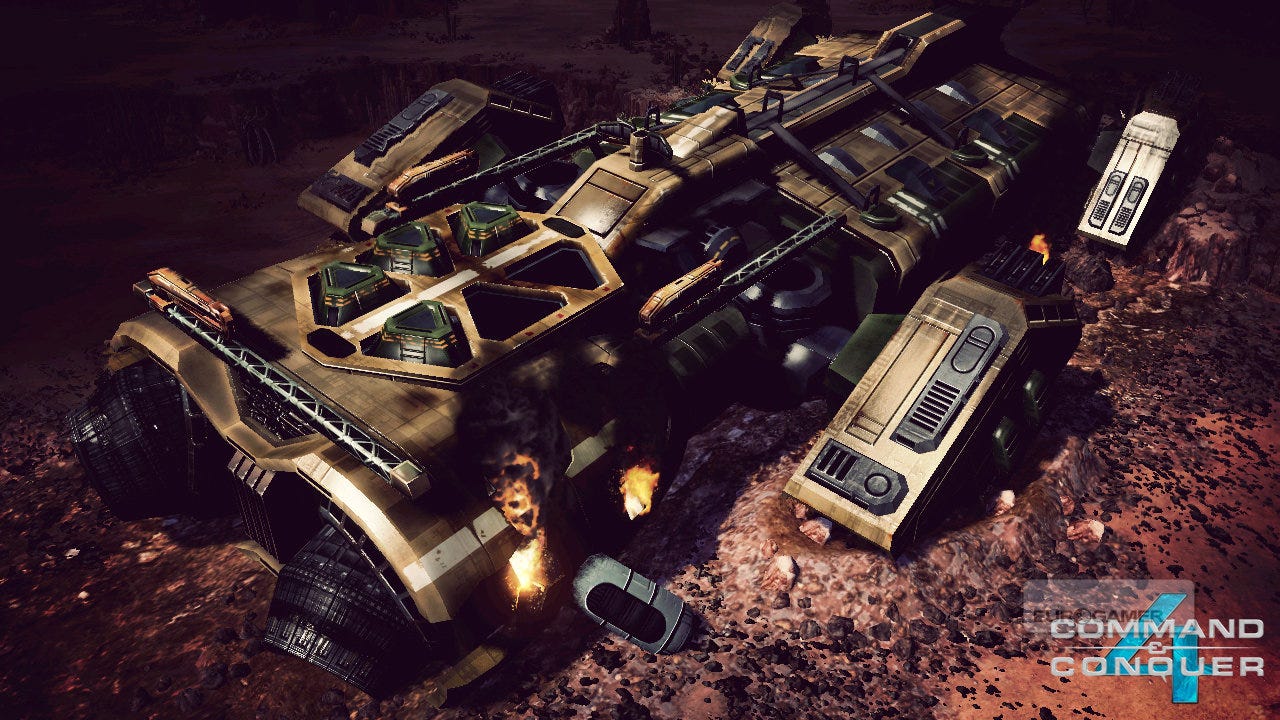
FMVs return, naturally, although Bass admits the series had gotten a little "Shatnerian". Expect a "grittier" tone this time around.
Here's how they're going to do it: C&C4's story starts about 10 years after the end of Kane's Wrath. Humanity is running out of air and water as Tiberium ravages the Earth. That's when Kane reappears, and approaches the GDI with a proposition. He's designed a system that allows him to control Tiberium across the planet, but he needs help to build it. Despite its suspicions, the GDI agrees.
The campaign kicks off 15 years after that, as the Tiberium Control Network nears completion. The partnership has worked, but there's mutual distrust and military escalation on both sides. "We're on the cusp of a new golden age, but there's still this sense of unease," says Bass. "Things went a little too well. So we're asking: what drove Kane to turn his back on Tiberium? And what does he want in return?"
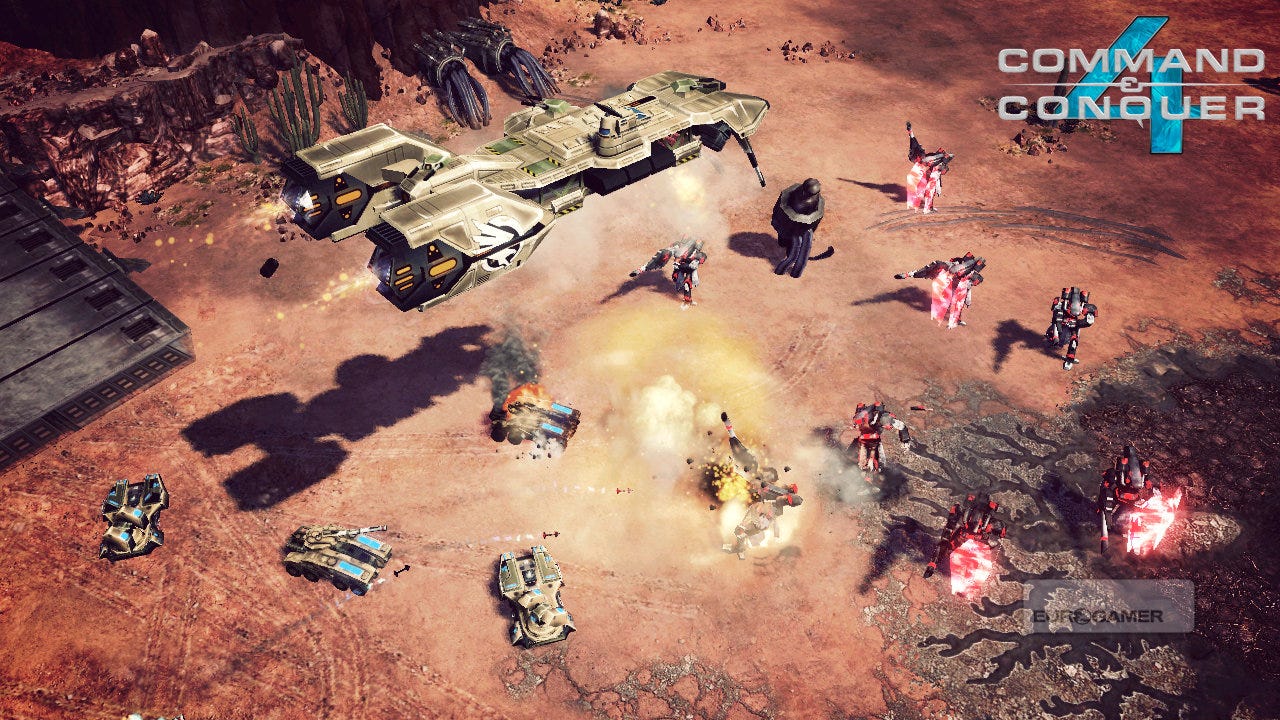
Alongside the desert, we're shown a handful of other locations, from the frosty wilderness of a Thing-style ice station, to a landscape built from scrap, and Polynesian waters, where tiki culture is shoe-horned in alongside massive metal terraforming slabs.
Only two campaigns have been announced so far - EA remains tight-lipped on whether the Scrin will feature again - and their focus reveals a good deal about the directions the game is heading in. C&C4 is, unsurprisingly, aimed at netting as wide an audience as possible, and that means catering for players of varying depths of skill and knowledge of the series. "We wanted a lot for long-term fans, but there's an entry point for people who don't want to go back through the last game too," says Bass. "We want it to be friendly."
"For GDI, we have a campaign called The Man who Killed Kane," he continues. "It's an action-oriented sci-fi story, a little Bourne Identity, a little 24. The idea is to do the big explosive conclusion to the Tiberium saga. People play GDI first, so it's designed to fill in the gaps and explain the lore. Then there's the Nod campaign. It's called All Things Must End, and this is the big one. It reveals the truth behind Kane's plan: who he is, what he wants, and why. It's a darker tale. We want you to see your actions from a new perspective, and wonder, 'Maybe what I was doing in the GDI campaign was not so much saving the world as making it worse.' This campaign is for the hardcore: this is their ending."
If EA won't be drawn on further specifics, it will be drawn on "stickiness", a slightly irritating term for a very basic concept. What the development team's saying is that, once you've started playing C&C4, they'd rather like it if you didn't really want to stop all that much, and to that aim, they've co-opted a simple system of bribes that has already been proven to work.
Somebody's been playing Call of Duty 4. "Every unit you kill will give you experience," says Mike Glosecki, affable giant and the lead producer of C&C4, a series vet with a lineage that stretches back to testing on Dune 2. "That will help you level up, which will give you new toys to play with." He pauses dramatically. "This is different than the other ways games handle this feature. You can level up in skirmish, campaign, or multiplayer, and the toys that you earn in all three can be taken back and forth between those modes: it's a global system. Tie that in with product updates after release, and there'll always be something new out there. Look at it as an RTS with a little bit of an MMO in it."
What does this mean for the product? It's PC-only for a start, always online (even in campaign mode, allowing for two-player co-op, and letting your friends track your whereabouts) and has no DRM. Take a look at that list of features: It's enough to make some suspicious that this may not arrive on a disk at all, and might not be paid for in a single chunk, although this is pure speculation at this point - like my theory that Tiger Woods and Veejay Singh faked the moon landings which I am right about.
What does it mean for balance? The developers aren't too worried, as they'd like you to get to the end of this game, no matter how you do it, and then hopefully lose yourself in multiplayer too. "I think it's nice as a player that if I want to stomp a mission, I can go and power up and then plough through," says Glosecki. "If I get blocked in single-player, I can go and play some skirmish, earn some new units, and hopefully allow them to let me get past the single-player mission I was stuck on. It's about the player's comfort factor."
You'll be limited to two players in campaign co-op. "It's because we have so many factors," says Bass, "that it would cause our QA leads to come upstairs and beat me to death if we went higher".
Again, it's aimed at making newcomers feel welcome, but it doesn't damage the delicate core of the experience as much as you might think. "Getting more powerful isn't really what it's about," says Bass. "We're giving you more options: different units to let you try something different."
Much of this came from the team's experience looking at multiplayer, and watching new players repeatedly wiped out by more experienced armies until they got fed up and left, generally never to return. But isn't that slightly wonky logic, as the people who have been playing the longest will also have better toys alongside their better skills? To get past that, there's a command-point cap, forcing you to think about what units to build instead of spamming out vehicles. It's an anti-tank-rush mine, in other words.
Presentation over, Glosecki fires up the demo, and we get to see C&C4 in action. We're in an area of rust-coloured desert, a wilderness halfway through terraforming, and, playing as the GDI, the objective is to get our vast transport ship, shot down by the Nod, up and running again, by connecting it to the Tiberium Control Network.
With the arrival of some Nod Scorpion tanks, along with burrowing units returning after Tiberium Sun, it's straight into the action. The most immediate difference in C&C4, apart from the experience points now rising from every felled enemy, is the rate at which the mission flows from one objective to the next, orders quickly redirecting us from clearing the area of all Nod units - alongside the Scorpions they'd brought in some nasty Fire Tanks and Spider Tanks, all looking spectacularly villainous in black and red - and telling us to search the immediate surroundings for a TCN node to connect the transport to. Once that's done, things switch to a sweaty defence situation, as we protect the healing vessel from the big guns of the Nod arsenal, namely Centurions, massive shielded robot units that can inflict some serious damage. Luckily, we've brought along a Mastodon, an equally gigantic four-legged walker - "a mobile death factory," according to Bass.
While we watch them set to, Glosecki occasionally zooming in to show us the procedural damage and deferred lighting model, allowing each splatter of gunfire to cast its own glow and shadows, it's worth mentioning something else that's new. That's our base itself, the Crawler, now mobile as the name suggests, and capable of building units while it's moving, and spitting them out when it sets itself down. It should be a handy tool for newcomers, as it allows players to focus their attention on one area of the map at a time, and it also - whisper it - respawns if destroyed, a new model dropping out of the sky afresh after the last one was blown to pieces. There are limitations, though: you can only respawn on your side of the map, and there's a minute cooldown between redeployment to stop you turning the whole thing into an impromptu meteor attack.
Some may be tempted to see the focus on accessibility as a form of dumbing down, but there's more than enough evidence that C&C4 is holding back treats for those that really know how to play. EA's been thinking about both ends of the spectrum: a respawning Crawler means you can fail a few times before succeeding, but it also allows canny commanders to lure enemies to a dead zone and then crush them from above, as the base does significant splash damage when it lands on top of you. Ideas like this should change the game on whatever level you're playing it at.
Kugan's back, and now that MJ's gone, he can presumably make that single-glove schtick his own.
Respawning the Crawler (surely a NIN title?) also allows you to reselect your class as, yes, C&C4 is now a class-based game. There are three classes available - Offence, Defense, and Support - and they're there to allow you to tailor your approach to each situation. If you're a new player, choose the one that's easiest moment-to-moment; if you're an expert, force your way through the whole campaign using just the Support role - it will be possible.
With the Nod reduced to rubble, the demo's over. C&C4 is looking good, then - and EA knows it has to. Rarely mentioned but presumably never far from anyone's mind, Starcraft II is going to make it very hard for even the most recognisable of RTS franchises to control much of the market in the next few years, without big ideas to battle it with.
But if Blizzard's a fearsome enemy to take on, EA's clearly been thinking - and working - extra hard on this one. C&C4 oozes intelligence, both borrowed and native, and its mix of epoch-ending narrative and experience-based toys suggests it will be hard to pass up. Besides all that, the RTS, above all else, knows that asymmetric line-ups can lead to drawn out battles. That's good news for us, then, as it's the drawn-out battles that often prove to be the most entertaining.
