Double Fine's Tim Schafer

On fans, funnies and roadie love.

Eurogamer is standing in a dark dungeon of a room in a ridiculous ark-shaped building in west London. Cloth flames flicker melodramatically in the corner, and a bearded man is wiggling a fake skull behind our head. That would be Tim Schafer, he of Monkey Island, Day of the Tentacle and Grim Fandango immortality.

And creator of Eurogamer's favourite game of 2005, the fabulous Psychonauts.

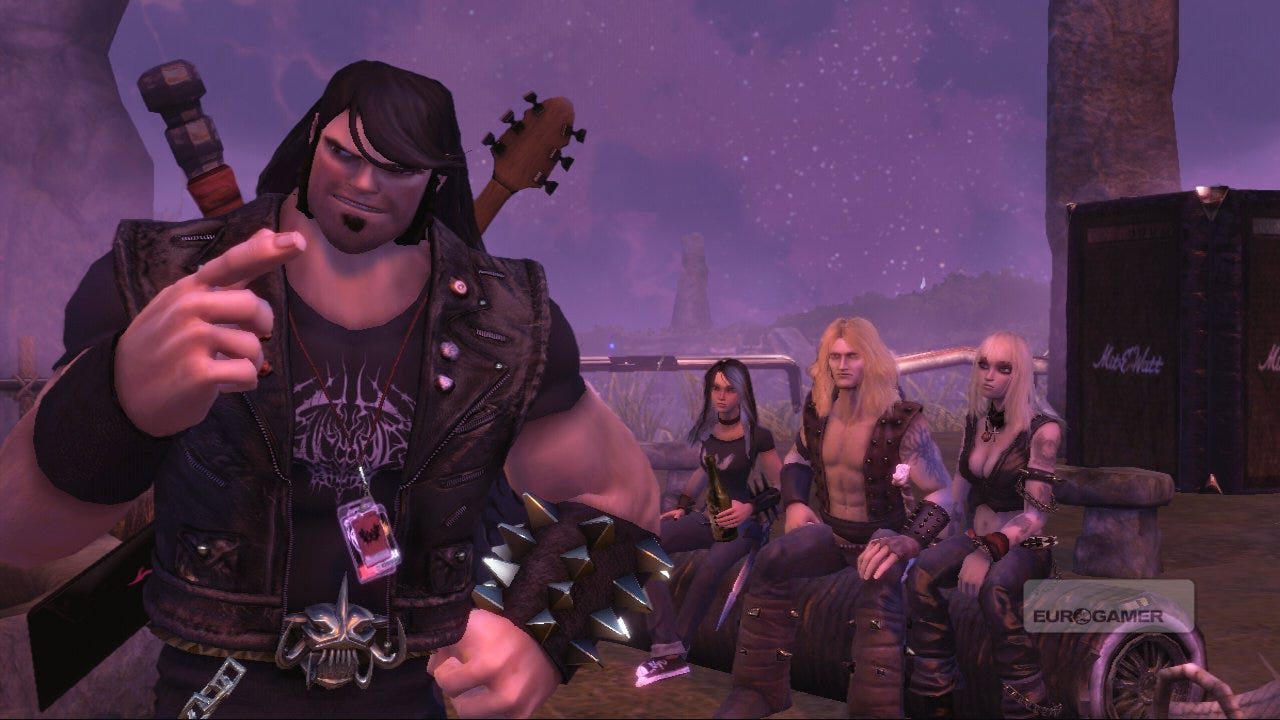
Schafer is holed up backstage at an EA event to show off his latest project, Brütal Legend, a heavy metal-themed action-adventure starring Jack Black as Eddie Riggs, the world's greatest roadie, that exploits the magnificent ridiculousness of rock to uproarious effect (you can read all about it in our latest preview).

A keen Twitterer himself (as @TimOfLegend), when we tweeted we were going to meet him, the gushing responses we got back illustrate the esteem in which the designer is held by gamers and fellow game designers alike. And also how many people want to get in our knickers.

So when we grabbed some time with the boss of Double Fine Productions, we had a good old chinwag about fan-love, how to make a game funny, and why Eurogamer needs to invent a new award to commemorate the release of his latest game.

Be sure to click below to check out our video highlights from the chat, and look out for an exclusive opportunity to put your no doubt superior questions to Schafer directly in the next few weeks...

Schafe as houses.

Eurogamer: As I just mentioned, I tweeted I was going to meet you and in terms of the love that's out there for you [reads from phone]: 'Tell him I love him and will he please make more Grim Fandango. And, and, and pants'.

Tim Schafer: 'And, and, and pants'?

Eurogamer: In asterisks, as in gasping with excitement!

Tim Schafer: Oh, pants!

Eurogamer: "Tell him, Johnny - don't ask, tell him - more monkeys and skeletons, please."

Tim Schafer: [Laughs]

'Double Fine's Tim Schafer' Screenshot 1

Jack Black stars in Brütal Legend, Schafer's digital ode to the roadie.

Eurogamer: Given your past and the legacy of the projects you've worked on, how do you react to the interest?

Tim Schafer: We've always had a great response from fans. I don't know why, it's a certain kind of people who like maybe humour in games, or they like the care we put into the characters, because I guess the characters are real to us. We write them, or when we animate them, or when we put them in the game and the things that happen to them, we treat them like people that we know and we care about, so hopefully people who play the games care about them in the same ways and that just turns itself into a great fan response.

Eurogamer: Your fans are always saying, please, please, please remake your old games, which is nice obviously as it shows how well loved those old games are. But do you always want to be doing something new?

Tim Schafer: It's really nice when your fans like your old games enough to ask you to do another one. That's very flattering and that's exactly the response you'd want. But - I don't want to sound patronising - they don't necessarily really want that. If they like that game, what they like about it hopefully was not that it was specifically a biker game or specifically about pirates; I think what they really related to was that it was a surprise, something new that was fun, entertaining and creative. I think that's what they really want: make me something fun, entertaining and creative that I've never seen before. So that's what I try to do with every game.
'Double Fine's Tim Schafer' Screenshot 2

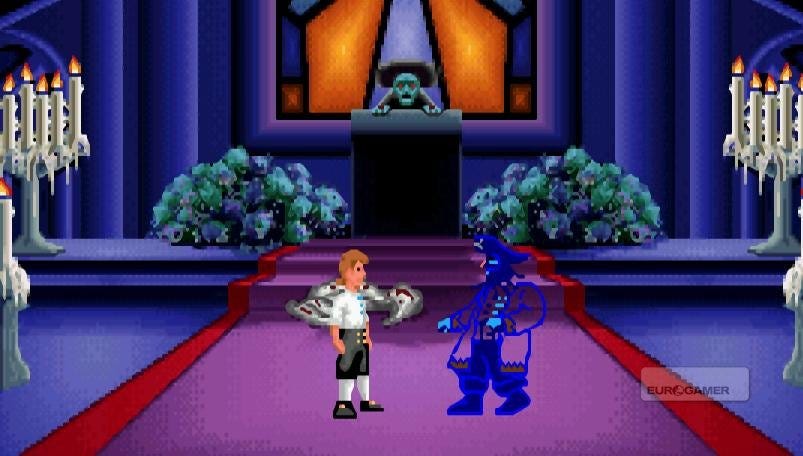
Monkey Island's lead was originally just called "Guy" until George Lucas intervened.

Eurogamer: Why do you think there are so few actually funny games?

Tim Schafer: Ah, I don't know why there are so few funny games. There's a lot of comedy in games. There's a lot of things like, LittleBigPlanet is a really funny game; and in unexpected places like in Okami there'll be these funny moments. You don't call that a comedy game, but there's these funny things that happen. But actually coming out and declaring your game is a comedy or something, maybe people aren't expecting it. Games tend to be a little imitative, so once Brütal Legend is a huge, huge hit you'll see all games will be comedy games!

Eurogamer: The number of press releases I read that really make a point of saying a game is "hilarious" and so on - and it very, very rarely is. Is it to do with the medium?

Tim Schafer: I feel differently depending on the day where that comes from. Sometimes it feels like people are trying to be as scary and threatening as possible with their games, because they're worried about appealing to a certain hardcore young male demographic. What do young males want? They want to be tough and edgy and scary and the coolest. But I think actually that crowd loves to laugh, likes comedy and likes crazy, ridiculous things to happen - it is an appealing thing.

And in fact, I think comedy is a way to appeal to a much broader audience than ever play games now. What's better than laughing, and why can't that happen interactively?

Eurogamer: I was at a BBC event yesterday and one of the panels had writers from their comedy shows talking about how they decide what's funny. In your case, how do you decide a joke or a line is funny? Is the most important thing [as it was for the panellists] simply that it makes you laugh?

Tim Schafer: Entertaining yourself is actually a really important way to approach writing for something that's supposed to be funny. You can't approach it too theoretically. In theory, the word 'chicken' is funny, so I'll use the word chicken in this joke because it will be humorous. There are some things that are just so embarrassing - it could be a fart joke or something - that you can't help but laugh when you do it. And you think, if I'm laughing, someone else out there might.

But every once in a while that's wrong, and you really just have to test it; and that's why it's been great showing Brütal Legend in these demo environments, because you never get to see a lot of the audience react to a game. But hearing people laugh at a demo and laugh at all the right spots is really rewarding and helps you at the spots you think are gonna get a laugh: 'Hmm, no-one laughed at that one, maybe we should cut it?' We test our games and watch people playing them all the time, and you can get an impression of what's working and what's not.

Eurogamer: It's almost the equivalent of gaming stand-up.

Tim Schafer: Yeah, you write material, you test material, you improve your material, so it is a little bit like stand-up. And that's maybe why there's not so much of it, because it is kinda scary.

'Double Fine's Tim Schafer' Screenshot 3

Psychonauts was Eurogamer's top game of 2005. For Brütal Legend Schafer wants a special award for the best "game of two years".

Eurogamer: Brütal Legend is a project that's been kicking around in the recesses of your mind for many, many years, from back around the time of Monkey Island?

Tim Schafer: Yeah, when we were working on Monkey Island I used to think about our competition, which were really serious fantasy games, or what we called in our mean tone of voice, 'elves in tights'. We wanted to make something different, pirate games or biker games - still fantasy worlds, but different.

But I thought, if we were to make a fantasy game it would be cool to out-fantasy the fantasy games and go even farther. And what would be the name of something like that? And that's where the name Brütal Legend came from, because it just sounded like the hardest core fantasy thing out there. So I've been kicking around with that idea for years.

Eurogamer: Why has it taken so long to make it? Why now?

Tim Schafer: Hmm, why now? You don't often get an idea all in one chunk; the whole game as you see it now didn't just fall into my lap 15 years ago. The name came and various ideas, and I've always liked the music, and I always wanted to do a game where you're controlling minions, you know, and had minions at your disposal, and I always liked roadies. And it just seems like these ideas slowly moved together over time, and then it just kind of hits you that they all work great together and you can make a game about it.

'Double Fine's Tim Schafer' Screenshot Ranch2

We took this photo of George Lucas's house when we stayed overnight at Skywalker Ranch. UNLIKE SCHAFER.

After Psychonauts I was talking about various game ideas with the team and what we could do next, and when I brought up that I wanted to do this one that was based on heavy metal, and based on combat and epic wars in a heavy metal fantasy world, all of a sudden the team got really, really excited. And that's always a good sign, when you can see everyone on the team relating to it. And there's a lot of fun challenges for the team: the programmers have these AI challenges, the designers can pick up these crazy unit designs, the artists obviously got very excited about all the stylised things they could do, and so just feeling the team getting excited was a good sign that this is a great game to make.

Eurogamer: So in terms of the creative process when you come to work on new projects, obviously you have limited resources for how many things you can do at any one time, so is that how it works? You throw around a few ideas and you see which the team responds to the best?

Tim Schafer: Sometimes you can't choose what you do next, because you get this idea and you just have to do it. That's the way it was with Psychonauts, and with Brütal Legend it was just like, you get an inspiration and you have to follow through on it. And then you have to adjust it for practical situations, like what kind of team you have at that time: do you have the team in place to make that game right then? Could you get someone else interested in funding it? That all comes together, all those things start turning green and giving us the go ahead on Brütal Legend.

Eurogamer: I also read that the success of Guitar Hero helped you make this game, because it made heavy metal big business all of a sudden.

Tim Schafer: Yeah, when we were first pitching Brütal Legend, it was before the first Guitar Hero game was announced and we were like, there's this game in a heavy metal world, [and they said] 'We like the game, but could we change it to be a hip-hop game, or maybe country music?' There's nothing against that music, but it doesn't have a lore of heavy metal, in terms of a certain kind of mythology that leads to epic, medieval battles.

And then after Guitar Hero came out and [Black Sabbath's] Iron Man was one of the first songs on it, it seemed to expose a whole new generation to that kind of music, so by the time we were pitching the game for a second time there was a lot more interest in it being exactly what it is, which is a brutal heavy metal action-adventure.

Eurogamer: It worries me that some suit somewhere thought that a country music game would have sold more than a heavy metal game! That's a terrifying insight into the pitching process.

Tim Schafer: The pitching process is terrifying, and you meet a lot of people who are... They're business and they care about the bottom line, and they've got to make that work. That's when we knew that we had a good partner with EA, 'cause they've been talking to a lot of different creative partners like Suda 51 and Valve and Harmonix, and all these great teams that were doing creative stuff. Doing something creative involves a certain amount of risk and launching a new IP is a very big investment. [EA] were interested in doing both of those things and that's how we knew that was the right place to go.

'Double Fine's Tim Schafer' Screenshot schafer

The bearded man and wiggling skull in question.

Eurogamer: There's a lot of appeal with the theme of the game, and the soundtrack and the character himself, and Jack Black being in there, all of that, but what excites you about the game?

Tim Schafer: I like the open-world environment and how it feels like a real place to go. I like that you can control minions and have them at your disposal; and I like that in that setting somehow humour comes out of that. When you're playing the game you can be surprised - and even though I wrote it and someone else programmed it and I know what's going to happen, it still makes me laugh because one of the characters will say something at a certain time when it's unexpected, and just these great moments happen.

Eurogamer: What for you is the appeal of the roadie?

Tim Schafer: I met a roadie years ago from Megadeth who had all these stories about the world of rock and roll, and the decadence and the excess of it were told from the perspective of a foot-soldier, a guy who has to come in, make sure everything still works and get the sound perfect and clean up afterwards. It's still a really glamorous lifestyle, but told from a point of view people don't usually hear. And also there's a certain air of humility about them because they put on the show, they make the show work, but they don't really get the applause. The applause goes to the rockstar, and after the applause has died, the roadie comes and cleans it all up, puts it in the truck and takes it to the next town.

'Double Fine's Tim Schafer' Screenshot 8

Schafer admits there aren't many funny games about, but reckons titles like LittleBigPlanet are filled with comical moments.

So there's something about that guy that just does the work behind the scenes and isn't interested in taking much credit for it and can fix anything, can deal with unexpected situations. That was a fun character to drop into the most unexpected situation of all: being pulled back in time.

Eurogamer: One interesting thing someone tweeted to me - given your stature as a game maker, they wanted to know if your name is going to be on the box? 'Tim Schafer's Brütal Legend'?

Tim Schafer: Why would I want to be teased like American McGee for my name? You know, we had our name on the box... Ron Gilbert [game designer and ex-LucasArts colleague] put his name on Monkey Island. He said he did it as a joke, and made the font really, really big as a joke and sent it back, and then they used that on the box. Even though they're really team efforts, they're really not made by just me, there's a huge group of people going together to make the game. It's helpful to get your name on the box because it helps you to pitch your next game, that's the main thing.

Eurogamer: Is it going to happen with this?

Tim Schafer: You'll just have to wait and see for the final box art, won't you!

Eurogamer: Do you think there's still a future for the point-and-click adventure? Things like Capcom's Zack & Wiki did some clever things with the control scheme, for instance.

Tim Schafer: There's a very passionate fanbase for point-and-click graphic adventures out there, and they're making their own games now using certain engines anyone can pull down and make a game in. But there's also companies like Telltale [also ex-LucasArts] making graphic adventures and Autumn Moon [creator of A Vampyre Story, again ex-Lucas], a lot of games being made in Europe, and Zack & Wiki on the Wii. I played that and, wow, it was so strange to see a Japanese game especially that had this point-and-click graphic adventure, which I don't think were ever really very popular over there. It was funny to see, and I'm very interested to see what happens in the future with it.

Eurogamer: Looking back at the old days of LucasArts - were you based on Skywalker Ranch?

Tim Schafer: We started at Skywalker Ranch and they kicked us off because they could only have so many flushing toilets. That was the excuse they gave at the time: 'We can only have so many flushing toilets as per the county code and we have to get rid of someone and it's you guys'. They didn't like us because we worked crunch mode hours and we were at the Ranch day and night and they wanted us all to leave so they could run around naked. I don't know.

Eurogamer: We got to go to the Ranch a couple of years ago, and spent the night there...

Tim Schafer: You spent the night there?! How did you get to spend the night there?!

'Double Fine's Tim Schafer' Screenshot 7

The cast of Grim Fandango, with Schafer bottom left.

Eurogamer: Obviously we're important people!

Tim Schafer: I never got to spend a night at the Ranch! Eurogamer gets everything!

Eurogamer: Did you have much contact with George Lucas? Was he hands-on at that time, or did he leave you to your own devices?

Tim Schafer: George was never really that hands-on. I met him three times - I was there 10 years. But he did come by in the early days of Monkey Island, and Ron [Gilbert] demoed the game to him and I remember he said: 'You should emphasise the main character more'. Which was a good piece of advice we got at the time, because the main character was just called 'Guy'. Here's the guy in the game and he wants to be a pirate. When George found out his name was just Guy I think he was like, that's a sign that maybe you should develop that character more. And that's good advice for any game.

I think a lot of games want to have this blank main character and they usually use the excuse of [puts on mock intellectual voice], 'We want to be a blank slate, a tabula rasa!' But usually I think that's just an excuse for the fact that it's hard to write a main character, because you have to make a lot of commitments and risk turning off the audience by making him or her have any specific characteristics. It's hard to do; it's hard to do with books or anything. You just have to pick it and work on it really hard to get the right character that the people, even though it's different than them, will want to be.

'Double Fine's Tim Schafer' Screenshot 5

Purple: the colour of bastard.

Eurogamer: As we know, Psychonauts was Eurogamer's game of the year. Do you think Brütal Legend's going to be up there for us?

Tim Schafer: I hope Brütal Legend is also Eurogamer's not just game of the year for one year, I'm hoping it's so good they give it two years in a row. Game of two years? Three?

Eurogamer: It's that good.

Tim Schafer: It's so big, the first half of it gets game of the year this year, next year the second half.

Brütal Legend is coming to PS3 and Xbox 360 on 16th October. Or 'Rocktober' as Schafer has henceforth decreed it shall be known.

Comments (20) Latest comment 3 years ago

Comments threads automatically close after 30 days, but please feel free to continue chatting on the forum!