It's rather quaint to think that just over six years ago, we were all a-twitter at the prospect of Grand Theft Auto III and its swanky new 3D world. "How will that classic top-down gameplay work in 3D?" we mused, like big silly things. "Could it possibly beat Driver?" we pondered in all seriousness. Aah, innocent times.
Since then, of course, we've been swamped up to our chinsacks in three-dimensional sandbox games, most of them firmly in the naughty crime spree mould. To begin with, all such games were slapped with the rather dismissive "GTA clone" label, but is this really accurate? Certainly, most of these games have taken their inspiration from the sprawling cities and doowatchulike aesthetic of Grand Theft Auto, but Rockstar's finest was far from being the first openworld game.
For the purposes of this history lesson, let's split the GTA template into two distinct but equally vital gameplay elements. First we have the gameworld itself, a world with no levels or boss battles. An environment that you're free to explore however you choose. And we also have the structure of the game; non-linear and open-ended, leaving it up to the player to decide what tasks to tackle and when. Together these are the two pillars that hold up the modern free-roaming action-adventure genre. But would it surprise you to learn that this sort of free-roaming gameplay has been around for over twenty years? That there were games as long ago as 1991 that let you explore 3D polygon worlds in a variety of vehicles at your own pace? Would it surprise you? Would it? I hope so, or this is going to be a very short feature.
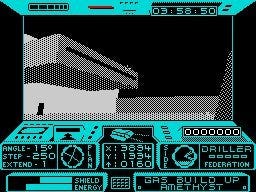
Driller. It looks sturdy, but could you lean on that shelf?
Way back in 1979, Warren Robinett's seminal Atari 2600 version of Adventure sowed the seeds of openworld gameplay, with an open plan flip-screen layout which allowed the player to wander freely around three castles and the (admittedly sparse) landscape in-between them. The goal was still rigid - find the golden chalice - but it was certainly not a linear experience. From this tiny acorn grew many gamey oaks, including pretty much the entire RPG genre, but for the sake of brevity we'll leave that branch of the free-roaming tree untouched for another time.
As the 1980s rolled around, this tentative baton of innovation was soon taken up by a variety of British programmers, then beavering away to squeeze as much juice as possible from the ZX Spectrum. The first game that can be convincingly linked to today's virtual cityscapes was the 1983 hit 3D Ant Attack. Developed by solid 3D pioneer Sandy White, the game cast you as a man (or woman) venturing into a city infested by giant ants in order to rescue your partner. Rendered in stark monochrome isometric 3D with solid shaded buildings, and even rudimentary shadows, the creepy sci-fi gothic world of Ant Attack remains a joy to explore - even if the aim of the game proves predictably simple by current standards.
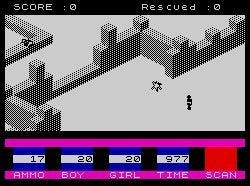
Ant Attack. I prefer to squish them with my thumb. After naming them.
The same year also saw the release of Atic Atac, the clip-clop adventure classic from the Stamper brothers and their beloved Ultimate Play The Game label. Owing much to Adventure in terms of concept, this top-down gem found you scurrying about a vast castle, searching for the pieces of a key that would allow you to escape. Made up of several floors, each linked by staircases and trapdoors, the game also boasted secret passages that could only be used by certain character types. Once again, while the overall goal was set in stone, players could happily spend hours ignoring their main quest, seeking out new areas or hunting down monsters such as Dracula, and Frankenstein instead.
Come 1984, and Sandy White followed Ant Attack with Zombie Zombie, another 3D city adventure (now in glorious Speccy colour!), while Atic Atac begat the sprawling jungle maze of Sabre Wulf. Both games continued the trend of eschewing pre-defined levels for a more laissez-faire approach to exploration, even though the core of the gameplay still hinged on the twin clichés of battling endless enemies and finding specific items to win.
However, 1984 also saw the release of arguably the first truly open-ended 3D adventure - Ian Bell and David Braben's Elite. Debuting on various Acorn systems, before being ported to every electronic device in the world including Major Morgan and those digital watches that had calculators in them, Elite quickly obsessed an entire generation. Admittedly, its rather abstract wireframe planets and spaceships make it a distant cousin of the sandbox genre in terms of style, with the likes of Freelancer as its more direct descendents, the ramifications of Elite's open-ended approach are still being felt in today's games.
Cast as a space pilot, players were free to travel anywhere in the galaxy, trading in whatever goods they desired, from common commodities to valuable contraband. While attaining the rank of Elite was the stated aim, there was absolutely no penalty for choosing to do your own thing, defining your own victory conditions as you went along. Vicious alien Thargoids roamed the darker reaches of space, and playgrounds were filled with anecdotal chatter about the legendary "witchspace" where Thargoids galore could be found - and destroyed, by pilots with enough skill and firepower. Also inspiring lengthy expeditions into deep space was talk of an apocryphal space cruiser, supposedly drifting somewhere in the nether regions of the game's vast cold void. That the game could inspire such classroom legends, with no two players having the same experience, is a feat that still impresses today.
1986 saw Metroid thunder onto the gaming scene, bringing with it some wonderful Gunpei Yokoi design work and applying the open plan gameplay style to the previously rigid world of Nintendo platformers. As exciting as this was for Japanese and American gamers who had foolishly overlooked the ZX Spectrum, Metroid was still just a classic style arcade game freed from the strait jacket of linear levels. And as fun as that was, another mid-'80s game would prove even more important in the development of true openworld gaming.
Mercenary. Apparently before we put much in our open worlds.
Mercenary, written by Paul Woakes and released by Novagen for a bunch of 8-bit and 16-bit formats, took the Choose Your Own Adventure framework of Elite and brought it down to Earth. Or Targ, since that's the planet where you crash-land at the start of the game. Escape is the inevitable goal, but players were given even more freedom to find their own way to victory than ever before. Plunged into the middle of a civil war between the good guy Palyars and the invading Mechanoids, there were numerous routes to success to be found by working both sides of the conflict, carrying out missions in a wireframe world for your own gain. As the title suggests, a certain moral flexibility was required, enabling players to align themselves with the bad guys and the good guys at the same time, for purely selfish reasons. With such ambiguous ethics and a non-linear approach to narrative advancement, perhaps more than any other game since Ant Attack, Mercenary provides us with the next major ancestor of the Grand Theft Auto series.
The critical success of Mercenary opened the floodgates and through the late '80s and early '90s there were many attempts to build on this framework. The Freescape system, developed for the now-ailing 8-bit platforms, resulted in a trilogy of solid 3D adventure games. Driller was the first, in 1987, followed by Total Eclipse in 1988 and Castle Master in 1990. With their chunky early polygons, and with the sluggish pace forcing the games to focus on solving environmental puzzles rather than combat, their relation to today's free-roaming games is far from direct, but as part of the move towards tangible three-dimensional game worlds, their impact can't be underestimated.
Mercenary III. This one was red. Cor, this caption lark is easy.
More Mercenary expansions and sequels followed, landing on the Amiga and Atari ST in 1990 and 1992 respectively. Damocles, the second game, offered a filled 3D world, with a whole solar system to explore. Basic non-player characters were introduced, along with a public transport system, allowing you to take taxis and buses to key locations. Mercenary III, meanwhile, centred on an election and is of particular note as an example of early open-ended gameplay. Tasked with preventing the sinister PC Bil from taking office, the game offers numerous potential methods of derailing his plans, ranging from terrorist sabotage to standing as a candidate and mounting your own election campaign.
Also taking groundbreaking steps in allowing gamers to find their own solutions to problems, 8-bit legend Mike Singleton gave us the popular Midwinter in 1989. Set after a nuclear winter, the game plonked you on a huge snow-covered island (160,000 square miles, if the original promotional guff is to be believed) and left it up to you to figure out how to oust an army of invaders. As the head of the island's security force, it was up to the player to muster an army of their own, by visiting the various inhabitants and talking them into active service. Governed by a complex series of social needs, careful negotiation was required to recruit as many agents as possible. Even once recruited, maintaining the mood of your fighting force was essential, lest low morale led to them giving up and returning to their homes.
Midwinter holds a special place in my memory, as it marked the first time I realised the potential of a completely open-ended gameworld. As a spotty 16-year-old, I wondered if I could just bypass all the recruiting and mount my own single-handed assault on the enemy HQ. After carefully picking my way through enemy territory on a snowmobile, I somehow braved an onslaught of bullets and mortars to destroy the enemy base - without doing what the game expected of me.
The final notable entry in this compact flurry of free-roaming innovation is, to my mind, the game that most obviously inspired the openworld games we take for granted today. And yet, few people seem to remember it, while fewer still ever played it. Hunter was the name, a 1991 Amiga and ST release by Activision. Much like Midwinter, you were cast as the lone soldier capable of taking down an enemy army, but even through the blocky graphics and rudimentary character models, it's hard not to see the resemblance to the later GTA games. While it wasn't exactly overstocked with buildings, those that did exist could be entered, and interaction with the NPCs inside was vital to success. The game even offered three ways to play; the narrative-driven Hunter mode, the reassuring linearity of Missions mode and the completely open-ended Action mode, where you were free to destroy the enemy installations in whatever order you fancied, using any means available.
It's in its generous exploration options that Hunter's influence is still being felt. Over a decade before GTA allowed players to roam its urban sandbox in dozens of different ways, Hunter was offering a generous selection of vehicles. Set across a series of islands, players were able to explore the world on foot, or take advantage of the numerous transport options. From obvious selections, such as cars and boats, to less obvious ways of getting around, like bicycles and surfboards, Hunter offered one of the most versatile gaming environments of its time. There was even a helicopter, allowing aerial exploration for anyone capable of mastering its twitchy controls.
Hunter. Not our favourite Gladiator, but you probably still would.
With the prospect of open-ended 3D worlds firmly established, it took the games industry a few years to really take advantage of it and hammer it into the shape we know today. Quarantine, the 1994 PC and 3DO openworld car game, is often cited as an example of the genre's development, though frankly it has more in common with purely vehicular romps like Carmageddon and Driver than anything else. No, we'd have to wait until 1997 for the potential to be realised, thanks to a certain bunch of Scottish rogues.
Grand Theft Auto burst onto the PlayStation and PC in 1997, bringing together the top-down lunacy of arcade games like APB with the open-plan cityscapes so tantalisingly suggested by the games we've already dissected. Its viewpoint helped to distance the gamer from the amoral carnage they were creating, but by applying a dark sense of humour to the sandbox arena, DMA Design found the way to make such epic exploration appeal to the masses.
And yet...we're not going to dwell too much on GTA just yet. While the original game, and its sequel, were clocking up the sales DMA had another stroke of genius going largely unnoticed on the N64. Body Harvest launched exclusively on Nintendo's console in 1998, and in retrospect provides a pretty much complete template for the game GTA III would become. Notably similar in style to Hunter, Body Harvest found players defending towns and villages from voracious aliens, completing basic missions along the way. Numerous vehicle types were available, with players free to jump in or out of them at any time. The game was still restricted by the traditional level and boss battle formula, but in terms of technical development, it was clear where the GTA series was going next.
Urban Chaos. Poor old Union City - it's enough to make you cry. [Awful - Ed]
But before we get there, lets quickly tip our hat respectfully in the direction of Urban Chaos, Mucky Foot's openworld cops-and-crims game which beat GTA III to the shelves by two years. Released for the PC in 1999, before slowly making its way to both Dreamcast and PlayStation, Urban Chaos (not to be confused with the recent riot-based first-person shooter) featured Darci Stern, a rare black female action lead in a game, cleaning up the streets of Union City. Able not only to run and drive, but also to clamber onto rooftops and engage in combo-based fist fights with suspects, Urban Chaos was a resounding flop on release, though its influence on later titles such as Crackdown are hard to ignore.
And so we reach 2001, and the end of our journey with the launch of Grand Theft Auto III. Although I've hopefully shown that its impact was hardly unprecedented, it remains a landmark game as much for its attitude and swagger as for the way it nimbly pulled together the disparate threads left dangling by many of its forebears. Once gamers had visited Liberty City, the prospect of freely exploring expansive worlds in a non-linear fashion went from being a curious backwater of the adventure genre and became the preferred choice for many third-person action games. And, just as we waited to see what GTA III could deliver, so we're now waiting to see what innovations GTA IV can add to the mix...and whether or not it will be enough to retain its crown as the daddy of openworld gaming.
