This is how Bizarre Creations wants to save racing games.
A field of 20 cars, licensed, tuned and modified: muscle cars, sleek tuner coupés, rusting vintage "rat cars" hiding monster engines, J-drift specials, off-roaders, not a Ferrari in sight. Lurid twilight skies brooding over trash-strewn wastelands. Sprawling, free-flowing tracks studded with jumps, giant aprons of cracked tarmac, corners shaped not by barriers and kerbs but hastily scattered traffic cones and destructible street furniture, arrows of light painted across buildings. Flash mobs and social networking and user-created content. Dark drum and bass.
And power-ups. Fantasy power-ups: bright, colour-coded neon crackles and waves of energy that shock, shunt and barge the opposition, as well as mines and speed boosts. Combined with the large, tightly-packed field of cars and broad tracks, they make for a bustling and chaotic race, a game that's less about technique than it is instinct and survival.
Project Gotham Racing this isn't. Bizarre's brilliant racing series for Microsoft - like its Dreamcast ancestor, Metropolis Street Racing - was never exactly a simulation racer. The tight-but-loose handling and the hint of score-attack about the kudos style system told you that Bizarre always had one foot in the arcade. But they were technical games, and with their beautifully-modelled production cars, demanding tracks and reverential dedication to the art and science of cornering, they were lumped in with the Gran Turismos and Forzas of this world more often than not.
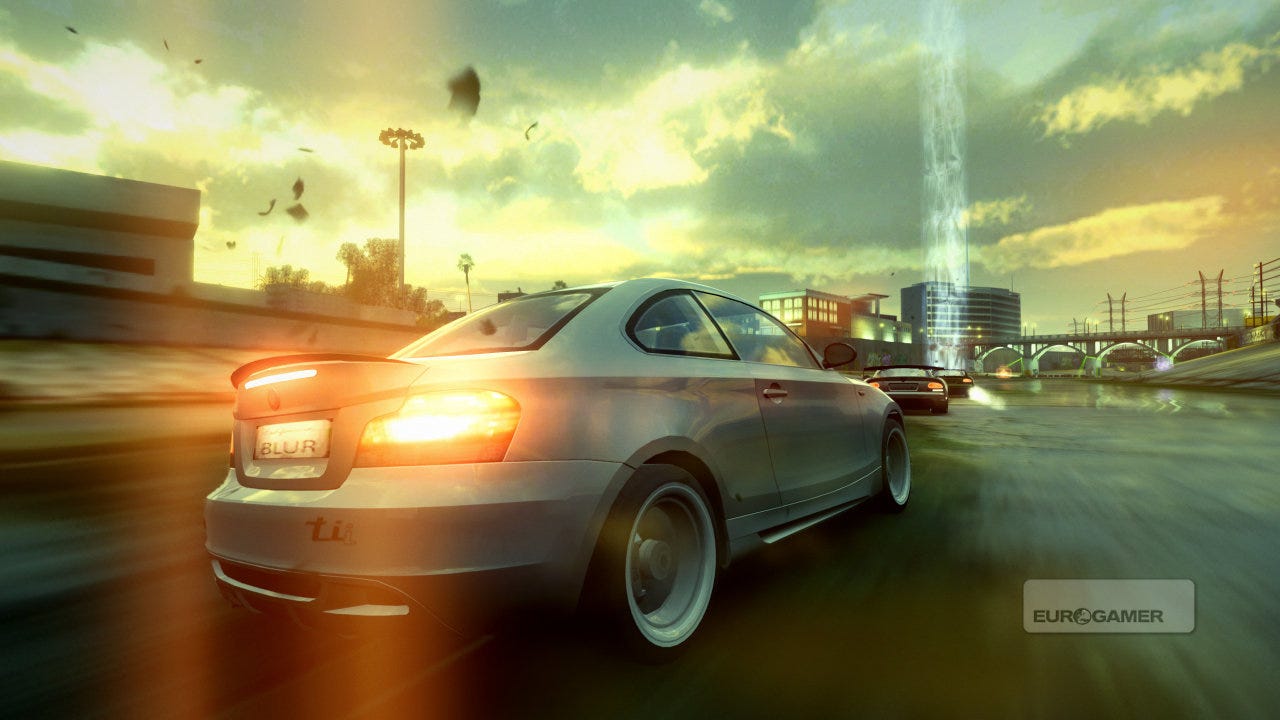
The pillar of light indicates the target of your next power-up.
That, the Liverpool studio has now decided, is just another cul-de-sac in a "stagnating" racing genre. Backed by new owners Activision, it's making a stab at the mass market with Blur. Talking to Bizarre staff at their offices, you'll hear huge admiration for games like Race Driver GRID and RACE Pro, but a determination to reach more people, to design something more accessible. Need for Speed gets mentioned, of course, but the names that keep cropping up are much older, examples of a "golden age" of racers for everyone: Road Rash, OutRun and the one blockbuster, multi-million-selling racing game that still exists: Mario Kart.
After playing through a four-track demo a few times you can add a few more names to its hall of fame: the gritty street glamour of Midnight Club, the futurism and weapon balance of WipEout, the combative, bodywork-shredding crashes of Burnout. And yes, PGR, not forsaken completely, but living on in the poised, tactile handling with its detailed physical feedback and those trademark drifts. It's just that it's now balanced on a sturdy, accommodating pillar rather than a knife-edge.
"In Gotham, the Ariel Atom was quite easy to handle," says lead designer Gareth Wilson. "But if you gave it to someone who didn't play racing games they'd smack into every wall, and go, 'This is crap, I'll go and play Halo, thank you.'" Earlier, in a presentation, Wilson explains that "we used to hate the gamer... We only liked you if you completed the whole game on Platinum, and less than one per cent did that. 20 per cent of people were playing on Steel."
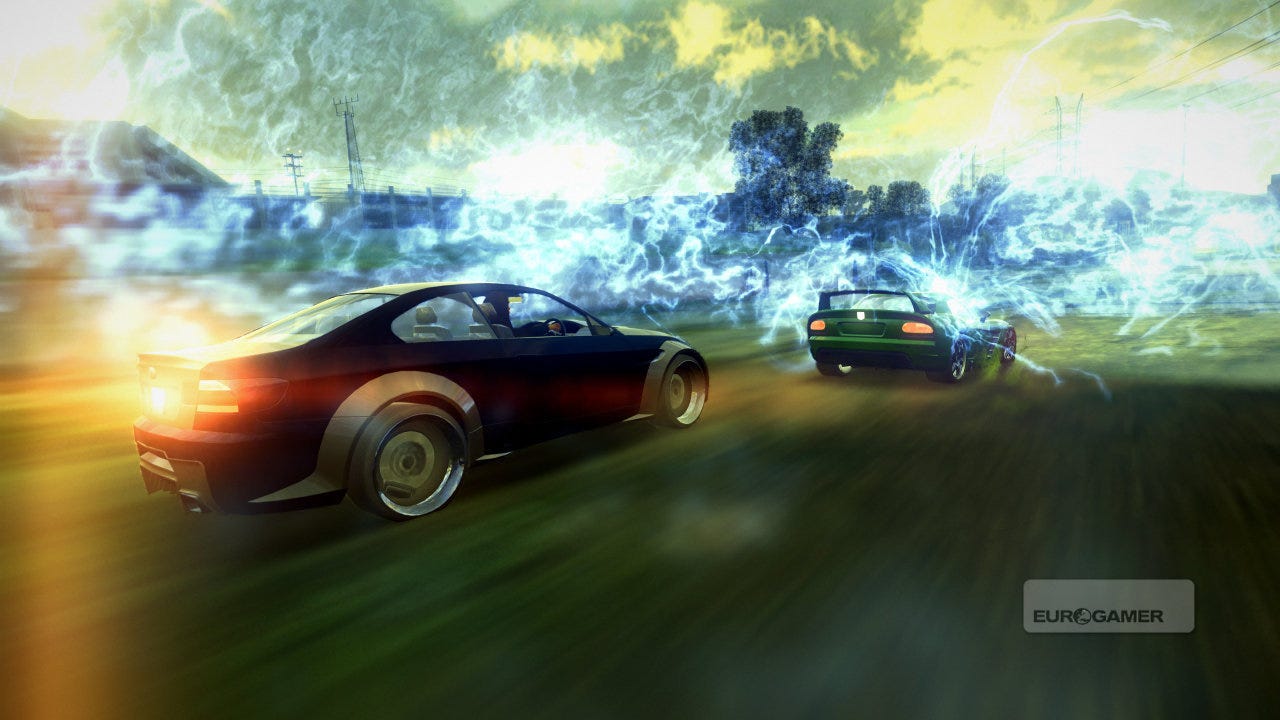
Detail on car models has been slightly reduced from PGR4 to accommodate the 20-car field.
Studio founder Martyn Chudley is more blunt. "Gotham was part of the problem," he says. He sums up its attitude as "look how f***ing clever we are".
Clever indeed, but also bored. After five racing games in the same mould Bizarre needed a change, even if that change would be hard to achieve. For a studio that had excelled at technical, high-skill, hardcore, leaderboard-driven score-attack games - not just with PGR but with The Club and Geometry Wars, too - breaking out of its own mindset wasn't easy. "The team, for ten years, had advocated reality and done it really well," says Wilson. "So yeah, it was tough, but everyone's on board now." It took months.
So if technique is out, what replaces it? Variety, says Bizarre, "big-boy bumper cars", rowdy competition, emotive excitement, a little strategy, a lot of fun, and hyper-real Hollywood showmanship. Still in: licensed cars, top-end graphics and audio, structural innovation and real-world locations.
Those will include deserts, suburbs and mountains as well as cities, and the latter are more likely to be represented by run-down back-streets than tourist traps. We see Los Angeles (a fairly familiar, benighted landscape of storm-drains and oil wells) and a Nevada desert setting littered with abandoned industrial architecture. We also know San Francisco, Spain and Tokyo will feature.
But the defining location at the moment seems to be London, or rather Hackney. Its backbone is a real stretch of the A10 (you race past Shoreditch Church and the Tea Building, and spot the Gherkin squatting in the skyline) but the surrounding chunks of Old Street, Dalston and Hoxton have been rearranged at Bizzare's whim into a shape that suits the fast, open track (rather than the Gotham method of coaxing good corners out of a tight, verbatim street plan). There are painstaking recreations of hideously ugly boarded-up council blocks. The tone is scruffy, cool, but also dangerous, low-rent and a bit, for want of a better word, chav.
That's more or less reflected in the selection of cars. The mainstays seem to be US muscle cars - Dodge Challenger, Mustang, Chevy Camaro - and Japanese and European street-racer favourites like the Nissan 350Z, Mistubishi Evo, BMW 1-series coupé and Focus RS. We also spot (although licensing isn't confirmed) a heavily modified vintage VW Beetle and a 1990s Ford Transit van with a Formula One engine in it. Representing off-roaders is that magnificent Range Rover on steroids, the Bowler Nemesis. It's a far broader range than even the pretty Catholic PGR2.
Bizarre says it wants to reflect more sides to street car culture than the rims and fins of the Fast and the Furious films. Wilfully beat-up "rat cars" and "smooth" culture - the art of eliminating all detail from a car's bodyshell to express the purity of its shape - are examples of two underground car scenes that nobody else is supporting, Bizarre reckons. Manufacturers have approved a series of special concepts especially for Blur, and allowed damage and even - for the first time - flames. "There have been a couple of big manufacturers, can't tell you who, that have gone, 'You can't set the cars on fire,' and we've gone, 'OK, we won't use your cars then,'" says Wilson. "Because the cars are not the star of the game, the gameplay is the star of the game."
There'll be a livery editor - how flexible and full-featured, we don't yet know.
Damage, of course, became a necessity when power-ups were brought into the equation. These are meant to have a less dramatic effect on the race than Mario Kart's, tipping the balance towards skill, but unlike Mario Kart your car does have structural health and can be fatally damaged if you don't drive through the repair icons. "I think in power and influence we're much closer to WipEout," says Wilson. "They certainly influence the race, and when you play harder difficulties you can't win those races without using power-ups, but they're not as random or as final as some of the Mario Kart ones are."
Shock emits an area-of-effect EMP pulse that slows the target car (your current target is indicated with a pillar of light) and others near it down. Shunt targets a car in front and pushes it left or right depending where you aim from, best used to send opponents into the wall on corners. Barge sends waves of force out of the sides of your car, slamming rivals into the scenery or each other. Shield, Mine and Boost are self-explanatory. They're picked up off the track in classic style, although you can always see what you're getting and aim for a particular power-up.
Tuning the effect and presentation of these power-ups so they pack a punch without destroying the balance of the race isn't going to be easy and Bizarre still has some way to go. At the moment, they feel a little weak, which is partly down to their non-physical fantasy presentation, although beefy, bassy sound effects help. Barge is the most original, and also the most fun.
There'll be some 70 cars in the game, offering different driving styles within each performance group.
Handling initially lacks involvement too, but once a Gotham veteran gets into a drift car like the Challenger and steps the back end out they'll know that the magic is still there. As is the full physics engine; this isn't just arcade contrivance. "Burnout doesn't really have a proper physics engine in the same way," says Wilson. "This is still a proper physics engine... We're not dumbing down at all." While the handling has been simplified, a lot of the physical interest will come from the simulation of varied surfaces and the weight of the destructible track furniture - neither feature was in the build we played.
So far, Blur is looking like a solid arcade racer, bolstered by an unerringly cool car collection and some evocative locations and lighting (the game always takes place in the semi-dark to pick out the neon effects of the power-ups, and the lasers and glow-sticks of the crowd, who are apparently all nineties ravers). But Bizarre, being Bizarre, has a trick up its sleeve.
Its "linear, RPG-style" progression is organised as a fictional social network of underground racers, organised into local groups. They'll message and invite you and comment on races, as well as chipping in with some (cheesy, but not irritating) audio lines mid-race. To some extent the network is just a front-end conceit, but the groups also organised Blur into racing themes, which is where the variety of racing objectives comes in: not just winning races, but protecting friends, team racing, aiming to cause damage, stunt and style racing and so on.
To start with, in Los Angeles, you'll be focused on power-ups and combative racing. San Francisco's group favours stunts, drifts and style. The UK is focused on team racing - the Hackney track we played was a face-off between two two-man teams, with the objective being to beat your one arch-rival - while Spain is all about class A cars and raw speed. Every 45 minutes or so of gameplay you'll move on to a new chapter, and can expect the location, style and context of the racing to change.
Side-groups will appear off the linear progression, offering missions and unlocks based on your driving style. If you're aggressive, you might be offered a destruction derby; if you're fast, a time trial; if you're social, you might get access to new features in the paint editor. Tying into all this is the "fan" system, an echo of PGR's Kudos, whereby you earn fans for impressive or effective driving in a certain style.
Damage doesn't affect handling hugely, but doors and panels scratch, distort and hang off.
The clever part about the social network - codenamed "racebook", but probably not for long - is that it works as a multiplayer front-end, too. Blur supports 20 players online and four-player split-screen, a very impressive effort, but its most exciting multiplayer feature is the ability to create custom groups mirroring those of the single-player games, with your own bespoke style and racing rules, perhaps offering livery unlocks as a reward. This is an attempt to embrace the creative racer culture that spawned cat-and-mouse in PGR2, and will have the filtering and rating systems and developer recommendations you expect from user-generated content.
This is central to Bizarre's hopes for Blur in the long term. "Obviously we want this to be a regular franchise, so we hope that moving forwards it's going to become a massively community-driven racing property; the final thing could be that it becomes the place where people come to effectively build their racing game," says Wilson.
The social network also serves as a more inclusive replacement for the hardcore, competitive, leaderboard-jostling community that followed PGR - influenced by the friends-list focus of Geometry Wars 2. "I think the whole leaderboard thing is a bit of a red herring," he says. "I don't think the majority of people really care that much about being number one in the world... What's going to be much more interesting is in time attack. If you're in my friends list and you do a best lap, the social network will inform me that you've just done a fastest lap on this particular track. You can send that ghost to me and go, 'Beat that, bitch,' and then I'll race it, and then I'm actually playing against someone, probably of comparable ability, who I'll actually care about beating."
All the music has been licensed from Ninja Tune Records, including custom interactive tracks by "a famous producer".
Bizarre has set itself a stiff challenge with Blur: creating a content-sharing community around a racing game while simultaneously selling it into the mass market, and hopefully, taking its hardcore fans with it, not to mention going against its own internal grain, learning to let go of its historical strengths. It's scary, and not just for the studio; many will mourn the gloss, excitement and finesse Bizarre brought to real-world racing. From what we've seen of Blur, it's a confident game but one that's still some way from the near-perfection of latter PGRs.
But Blur is also tremendously exciting, because it's the work of a hugely talented studio stepping out of its comfort zone, raising its expectations, and refusing to settle for being the big fish in the small pond. "I think that space is up for the taking," says Wilson. "I think Need For Speed has lost its way. NFS Shift looks like it's just jumping on where Gotham was, it's almost like you can see them saying oh, no Gotham this year, let's do Gotham. I don't think that's the right thing to do. I think we should be going back to the reason people play racing games."
