BlazBlue: Calamity Trigger Review

Thank goodness for arcades.

Version tested:

Capcom is a company responsible for much invention in the fighting game field, and of its hit and miss attempts to push the medium forward, X-Men vs. Street Fighter was the defining point in a new era of 'manic' fighting games. With the action cranked to eleven, it redefined the genre in a new, frenzied form. Although Arc System Works' Guilty Gear is no idle rip-off, it has drawn influence from Capcom's crossover series.

Even if its complexity can be eluding, with beautiful anime styling, heavy-metal themes and wildly overblown combos, there's no denying its spectacle. With Guilty Gear, the Yokohama-based developer has not only raised the profile of 2D fighting games over the last ten years, but has itself become a recognised power in the field.

In light of this success it's unfortunate to learn that, through a legal loophole, Arc System has lost the Guilty Gear rights to SEGA Sammy Holdings. It's no surprise then that it's urging fans to adopt its latest fighting game, BlazBlue, in its place.

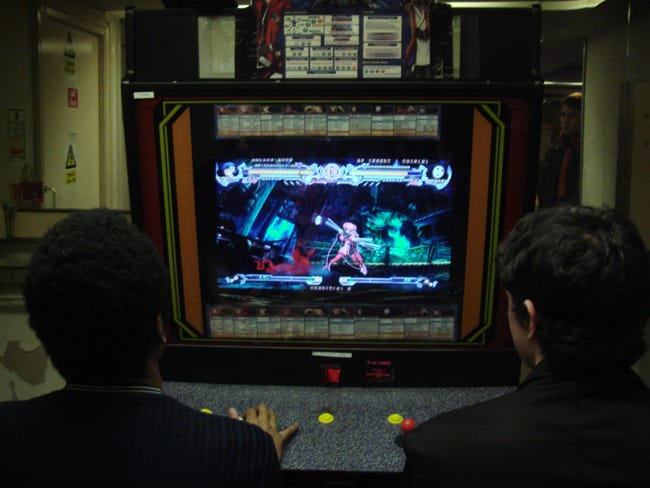
Situated to the right of Goodge Street station, Casino, one of Central London's oldest arcade establishments, is looking a little run down. The carpet patterning looks like the seating upholstery on a 1970s National Express coach, the Electrocoin cabinets are bordering on antique and the walls could use a serious lick of paint. But despite being guilty of aesthetic complacency, Casino eschews the current to stubbornly serve the hardcore market. Be this for financial reasons or through the influence of its denizens, who knows. For a while, the London Trocadero's line-up of Japanese Candy-Cabinet housed fighting games has played the more popular host to the dwindling London scene. With the advent of BlazBlue in Casino - its first appearance in Europe - the old place is suddenly alive again.
1

Yes, I've been outside my flat. Don't say we don't take risks for you.

Running on Taito's Type X2 hardware, BlazBlue is one of the first 2D fighting games to be designed from the ground up in high definition. It's very similar to Guilty Gear in style, with similarly vibrant graphics and an even crisper display. The backgrounds are in 3D, but with enough detail and colour depth to sit comfortably with the foreground sprites. Initially the designs don't quite leap out at you like some of the better Guilty Gear locales; but little touches, like the influence of certain moves on Rachel's rose garden and some impressive background activity, really lend the game atmosphere.

Although the high-definition display hasn't improved the animation much beyond Arc System's already excellent standard, BlazBlue's ten original characters are distinct, colourful and vivid. But, despite obvious artistic similarities, they aren't as initially striking or appealing as the Guilty Gear line-up. With Ragna, the sword-toting Sol Badguy replacement, it's clear Arc System hasn't lost its affection for belts and buckles. Blond-haired Jin bears a close resemblance to Ky, as does his female counterpart, the gun-toting and annoyingly shrill Noel.

Tager is an obvious stand-in for Potemkin, steamrolling your energy bar with a repertoire of debilitating grab attacks, and Rachel and Carl have the whole gothic thing going on. Arkune, the game's token 'weird' character, presents the first opportunity to play as a demon from a Miyazaki flick, his warped design lifted straight from Spirited Away.

BlazBlue isn't as female-heavy as Guilty Gear, with Litchi being the only one to sport a set of proper high-definition boobs. The jury is out on what creepy cat-like Taokaka is meant to be, and that just leaves Bang, a fairly uninspired Ninja whose voice acting lends him great individuality.

What does stand out about the character roster is the amount of effort that has gone into giving the characters a tangible personality. The back-stories are particularly strong and shrewdly implemented. For instance, Noel and Jin's speech changes when they meet in battle, even extending to things they shout when throwing projectiles.

The first thing that's apparent about BlazBlue's fighting system is that Arc System has stripped away some of their Guilty Gear eccentricities. That's not to say it doesn't bear many of its older cousin's hallmarks. Air recoveries, double jumps and crazy aerial rave combos are all present, but on a base level it's a more accessible first outing.

With a layout that now matches an SNK format, the game features three main buttons for attack - light, middle and heavy - with the fourth button assigned to 'Drive'. In a genre where almost everything has been tried in one form or another, originality is tough to come by. BlazBlue's hook is the way the Drive button is responsible for unique attacks assigned to each character. For example, Ragna's Drive will absorb his opponent's energy, while Jin's Drive will freeze anyone coming into contact with him.

Although it's commonplace that fighting game characters have distinct abilities, the Drive system is what makes BlazBlue really interesting. Drive moves don't do enough damage to unbalance the game, and need to be carefully integrated into combos and timed attacks to be most effective. Noel isn't particularly powerful, but her Drive is focused around combo-extending, meaning she can string together some of the more punishing sequences, while Litchi makes up for not having too many long-range attacks by sending her possessed staff to do the dirty work. One of the most innovative skill-sets belongs to Rachel, who can control the wind and in turn the actual physics of the match. If she throws an opponent, she can utilise the wind to reel the character back in for a follow-up combo.

2

Winner stays on. And gets a blanket.

A lot of BlazBlue is governed by gauges; a Heat Gauge, a Barrier Guard gauge and a Guard Libra gauge. You're damn right it's confusing. Arc System, love it or loathe it, can't resist tinkering with common formulas in the pursuit of innovation. Fortunately it's not as complex as it first seems, with one gauge simply managing guard crushes while the other allows for a more effective method of blocking. The Heat gauge is the one you'll be watching the most, which, as well as storing supers, can be used to break out of any combo in the game at a serious detriment to your character's strength.

Although some efforts have been made to win new followers, BlazBlue hasn't completely shaken off its Guilty Gear shackles. Compared to the more basic approach of Street Fighter IV and the impending King of Fighters XII, it only has niche appeal by comparison. As a brand new IP it's still a terrific first outing, but you can't help but feel that the refinements in the next couple of iterations will make for a better-rounded game.

It would've been nice to see Arc System break away from the familiar look and feel of Guilty Gear, but after extended play BlazBlue reveals itself to be reasonably exclusive in its characteristics. Whether or not it will be enough to convince players to give it the recognition it deserves, only time will tell.

Regardless, Arc System has proven itself as a developer of undeniable ability, capable of successfully integrating fresh ideas into existing templates, and serving up fighting games of immense creativity. BlazBlue may even convert some to the cause, but certainly not all.

8 / 10

Read the Eurogamer.net scoring policy

Comments (40)

Comments for this article are now closed, but please feel free to continue chatting on the forum!

  • Loading...hold tight!