Retrospective: Blast Corps

Dozy blastard.

Three pads. The collective price of Rare's Blast Corps among my circle of school-friends. Three pads, their triple prongs shattered, their analogue sticks hanging floppy, detached from their housings by countless forceful smashings. Three pads, added to the exorbitant price of an N64 early-era release. Three entire pads, ruined, all for this game. Was it worth the expense and the disapproving parents? Worth it for Blast Corps? Totally.

A bit of context might be necessary. It's 1997! The Nintendo 64 has made its debut! It's world-smashing, and synapse-blowing! It's not actually any of those, but bear with me for now. For expectant players, there's the genuinely, truly, unquestionably classic Super Mario 64 and there's...! Well, there's not much else. As a compulsory-education aged proto-fanboy, I was desperate for N64 software to prove my obvious superiority over my friends who'd had the temerity to purchase another company's product. Those morons! Did they not know? Sixty four bits! SIXTY FOUR!

So, obviously, any new cartridge, no matter how dodgy, was jumped on as the next saviour of gaming. Exercising my hyperbole muscles, I extolled the virtues of a host of lazy ports and rushed cash-ins. Reading previews of Blast Corps, I warmed them up again, ready to defend the indefensible, a concept that read like something scooped from Michael Bay's wastepaper bin, something like this:

There's some missiles, right, all nuclear and stuff, and they're on a sort-of lorry thing, and that lorry is going in a straight line and stuff. The slightest knock will detonate both missiles, but, ack, there's loads of houses and junk in the way. So, to stop all that stuff being destroyed by atomic explosion, you've got to, umm, destroy it. In bulldozers and trucks and...giant flying mecha suits! Yeah!
1

As games go, it's so high concept it needs methadone treatment, but crikey, it worked. And it worked because Blast Corps did, and still does tread the line between total frustration and sheer relief more effectively than almost any other game.

Clint Hocking argued in his speech at GDC this year that as soon as a player has total mastery over their game-world, the experience is ruined. On paper, Blast Corps, with its city-playground levels, most stuffed to the rafters with structures to knock down in tantalisingly tactile ways, is a serious offender. At times, this is certainly on the verge of being the case.

Part of the game's lasting appeal is its characterisation. As is to be expected from the product of a remarkably small development team, parts of the game don't quite tie in - video messages appear from unnamed members of the corps with zero explanation, the game's 'last' unlockable level is a dump-truck race on Neptune, etcetera - but the vehicles the player is handed are, by-and-large, particularly memorable. None more so than the cartridge's cover star, the jet-powered J-Bomb.

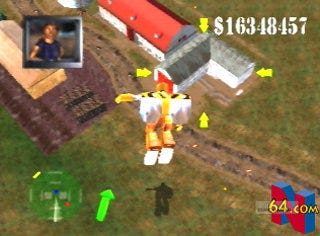
J-Bomb-centric stages are overwhelmingly simple fare, and fly in the face of Hocking's decade-later judgment. As a giant robot (J-Bomb, not Hocking, though I've never seen them in the same room...), he can launch into the sky on an infinitely-fuelled jetpack, before stabbing back down, storey-sized-feet first, totally obliterating anything in his path. Skyscrapers are levelled, disintegrated; smaller obstacles are nothing. For an interlude, it's superb; you're Godzilla, swatting puny high-rises aside, multi-coloured explosions and a score for damage caused endlessly turning as simple motions rack up the score. Jump, smash, rinse, repeat.

It's game wish-fulfilment of the highest order. It's what we say we want: spectacle, simplicity, feedback. The combination developers have been trying to brew since the 1970s, the sugar rush of arcade achievement and enjoyment. But, like most quick fixes, it doesn't last forever.

I found, cherrypicking J-Bomb-heavy levels again on a recent playthrough, that I'd lost a handle on what it was that tied me to the game so strongly in the first place. Was 12 years too far back? What was the spark that linked it so intrinsically to my time with the Nintendo 64, and my childhood?

Flicking through the game's level-select hub, two names hit me, names that produced a near-physical response. A twitch, an involuntary jerk away from the pain they had associated with them: Oyster Harbour, and Diamond Sands. Oh God. Oh no.

2

For a certain generation of gamers, I'm fairly sure these levels will have a similar effect. The innocently named stages in question were, in truth, no more fiendish than some of the game's other offerings, but came to stand in unison for Blast Corps unwavering commitment to incredible frustration.

Oyster Harbour first. To explain exactly the machinations necessary to actually finish the level is a task that I have neither the word count nor the mental fortitude to complete - many of the century's greatest minds have no doubt been irrecoverably smashed attempting to do so. Suffice to say, to pass the nuclear carrier across the first of the Harbour's three major sections, players must judge the arc necessary to fire rockets into a mass of stacked crates, negotiate a cliffside path, jump in a bulldozer to mop up remaining obstacles, use said bulldozer to load crates of TNT (on a timed fuse) onto a crane, then finally, before detonation, operate the crane, dropping several explosive boxes onto an inconveniently placed wharf. That's before you've got the canal boats involved.

Men of Eurogamer - if you're ever accused directly of your genders' inability to multi-task, I implore you - find a copy of Blast Corps, finish Oyster Harbour, and display the medal you receive with proud tears streaming down your cheeks. To keep track of every possible variable in the level while simultaneously acting with enough of a sense of wild abandon to keep a step ahead of the onrushing nuclear lorry is an ability probably likely to land you a role in the air-forces of most major countries. It's indicative of how fiendishly far the developers could go with Blast Corps' innocuous setup, layers piled on layers as one misstep spells disaster, and in my case, broken controllers.

The other cursed name, Diamond Sands, was, on first inspection, a much simpler experience. "Oh, this?" the game said. "This is just a load of terraced houses down a central track. Nah, this is fine, just make sure you get them all and you're set." Ah, superb, a relaxing smash-fest. Wait, which vehicle do I get to use, game? "Hmm? Oh, just hrfhrf..." Pardon? "I said Backlash."

Backlash. Backlash! Bloody Backlash. A dump truck with delusions of grandeur, Backlash couldn't fly, or roll, or even spit acid. Backlash could wiggle a bit and then sort of spin sideways, if he felt like it. Wilfully denying of the laws of physics, hitting a house front on with Backlash wouldn't make a dent; manage to wrestle the controller hard enough to actually swing his rear end out, though, and structures were crumbling in seconds. The problem was with the game's camera: disobedient at best, I'm positive it actively flipped you off when you turned around. Diamond Sands revolved around a central artery, a track on which all offending obstacles were based. To clear the stage, the camera had to be constantly set, reset, and re-reset, while the truck itself comprehensively refused to slip into its signature tailspin.

But yet, despite these whimper-inducing trials of mental strength, to me and countless other N64 stalwarts, Blast Corps is still viewed through spectacles of the rosiest tint. The incredibly high rosieosity score (measured on my useful rosiemeter) can be explained by reference to Clint Hocking's statement, made like some reverse-Nostradamus 10 years later, that mastery of a game-world ruins the entire experience.

3

Blast Corps toes the line between two opposing absolutes. Exhibit A, the single-button city-annihilation levels, can only co-exist in a perfect playing experience with Exhibit B, the twisted, mental and ergonomic gymnastics required to best the Oyster Harbours and Diamond Sands of the game. The two elements are diametric opposites, but exist in a symbiotic relationship, ensuring that while the N64's other classics - the GoldenEyes, the Marios, the Zeldas - have all arguably had their respective genres headed by newer titles and lost a level of their relevance, Blast Corps remains one of the most compelling releases to have ever graced the console.

Time with the game is simultaneously punishing and rewarding. Hocking's concept of mastery, teased by some levels as an attainable goal, is quickly snatched away from the player. It's this desire to bend the game to your will as a player that drives us on, determined to beat the artificial constructs put in place by developers. Rare clearly understood that it had created a game with a powerful underlying compulsion - like a set of proto-Achievements, completion of levels within a certain time yielded rewards. As a form of cruel joke, the game is seeded with platinum medals, speedruns completed by the most overworked games testers on the project. Beating these is nigh-on impossible, but in today's Trophy/Gamerscore-obsessed climate, I'd say these records would last a week. Nintendo, bring Blast Corps to the Virtual Console, and let's find out.

Comments (51)

Comments for this article are now closed, but please feel free to continue chatting on the forum!

  • Loading...hold tight!