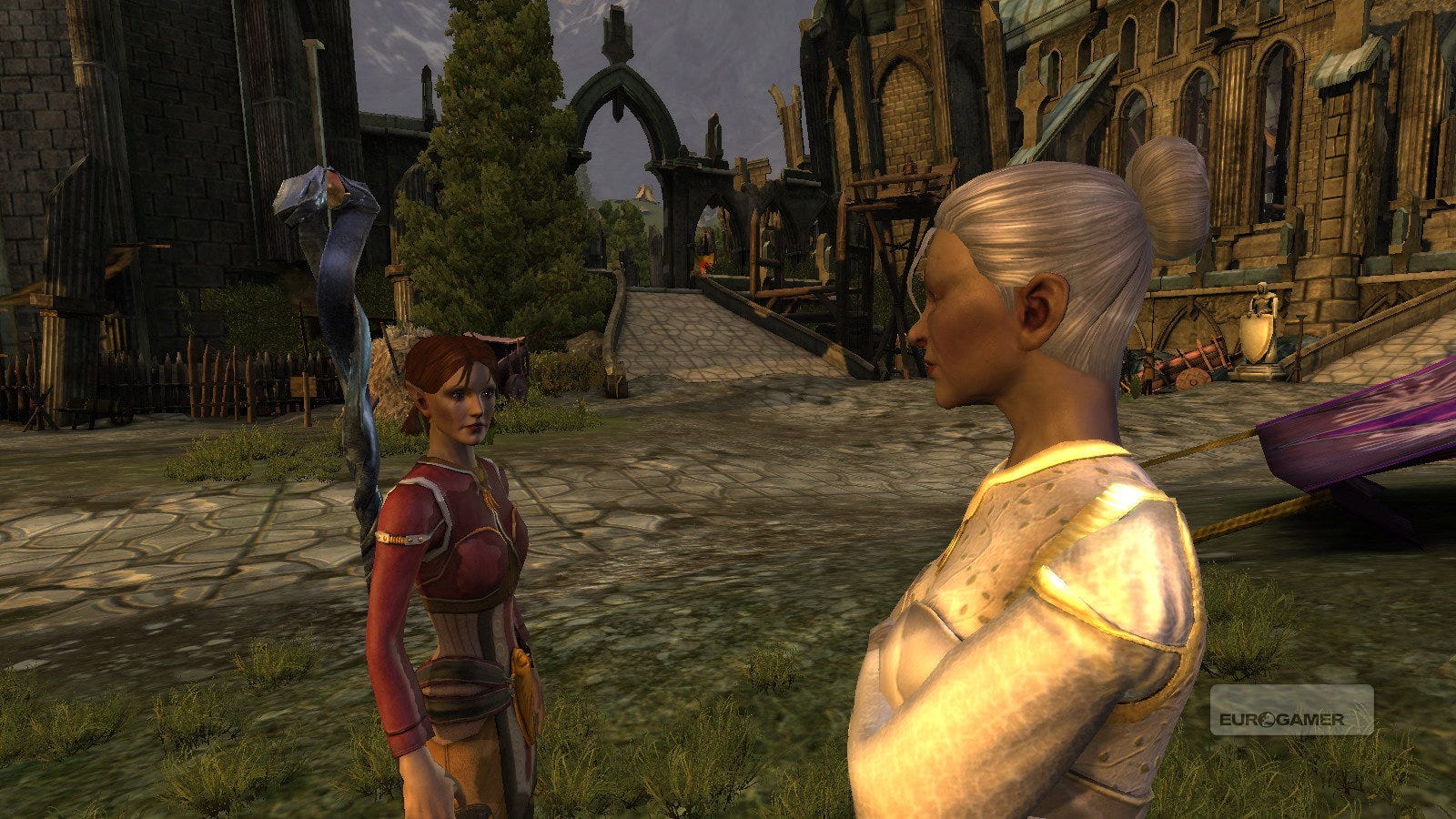
If you're a game developer who's prone to epileptic fits, repeated coronary occlusions, or regular spells of choking during lunch, you could do a lot worse than seek employment with BioWare, an RPG house run by not one, but two, MDs. With the release of Dragon Age: Origins looming, and a merger with stable-mate Mythic, the developer behind Warhammer Online, recently announced by parent company EA, we caught up with co-founder Dr Greg Zeschuk to discuss the ramifications of the new organisational structure, and what we can expect from the studio's latest, significantly darker take on fantasy. We also asked what he made of this strange lump on our neck. (It turned out to be peanut butter.)
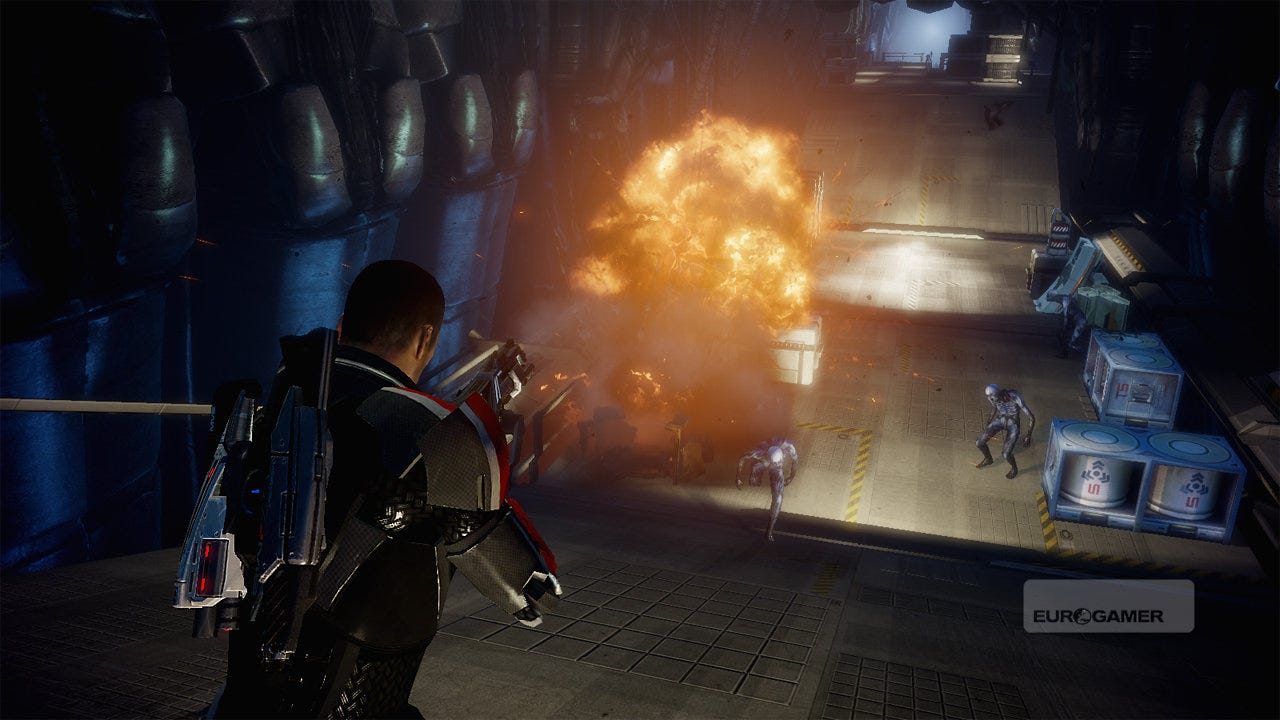
Eurogamer: Dragon Age: Origins is looking like a fairly grim game, and Mass Effect 2 is quite a bit darker than the first one - is everyone at BioWare feeling alright?
Dr Greg Zeschuk: Well, we've been with EA for a while. No, it's a funny thing. I think that why they are that way is interesting. Certainly, in the case of Dragon Age, it was to set it off thematically from the traditional perception of fantasy. People have been asking us, "Why have you been doing these more aggressive sex-and-violence trailers?" and a lot of it is to point out that fantasy isn't necessarily - I'm stealing this from a journalist in the US - it's not all "flutes, lutes and men in tights".
I think that was one of the things holding fantasy back. Obviously, Peter Jackson managed to break through that with the Lord of the Rings, and for us it's been that we've made a game that's very sophisticated, so it seems natural to follow that with very mature content. Also, it's typically our teams that really set the tone. Ray [Muzyka - co-founder] and I have very high-level goals, but the teams work on the moment-to-moment game, so the work they do is what translates into the experience that fans have most directly.
Eurogamer: When you take a dramatically different take on fantasy, as you have with Dragon Age, is there a worry that audiences might not get their heads around it properly? How do you feel the response has been so far?
Dr Greg Zeschuk: I think it's going to all come out in the product itself. It's hard to say what people are thinking. Generally the feedback's been favourable and people seem to like the game, but the litmus test is how many people end up buying it. Then the key thing for us is if the whole world fits together nicely, if it's contextually appropriate, and all the activities are unified with what the world seems to be. It's a very hard game to demo and show. Back when we were pitching the good old Baldur's Gate stuff, you'd get people who would sit at a kiosk and literally play it for an hour, and you didn't have: "15 minutes! Go! Show us Dragon Age!"
Eurogamer: You announced Dragon Age roughly seven years ago, and the team has apparently mapped out over 5,000 years of history for the game. Can you say a little bit about that process?
Dr Greg Zeschuk: That early announcement was about keeping people on focus that we're actually still working on PC, not just on console, because we'd done a few console things and we were like, "Hey, don't worry PC folk!" Typically at BioWare we've always got a couple of things going that aren't public, that's why we can be coy in interviews. Sometimes they see the light of day and sometimes they don't, so the reality is that Dragon Age was probably announced much earlier than we would normally announce it, because after that early prototype we went to a very intensive period of probably two years' pre-production, kind of conceptualising the world and writing the history and all that stuff.
With RPGs you have to fill out the richness of the world before you can really create the game, because otherwise there's nothing to hang the story on: no context, no terminology. If there's no political system that's clear, then you can't really make politics part of the game. Someone making a driving game doesn't usually thing about that stuff, whereas we actually - whether it's being foolhardy - that's one of the things we really do focus on.
We love all those complicated elements. The team sits down and thinks of ideas and we work on it and document and document until the team finally has a source book. One of my favourite things I ever read at BioWare was this huge source book for Jade Empire. It was, like, 150 pages: very much like if you ever read any of the Dungeons and Dragons source books. That's basically what it was. Once that source book is compiled, typically it will have the culture, the politics and the history of the world, and if there's gods in the world, who they are, and all these things. And every team member has to read it when they join the team, so they familiarise themselves with the context. Where it's used is providing the richness, and I think the thing that really makes the world successful is the consistency.
For example, I was playing Dragon Age on the airplane, and so I'm having to find the ashes of this dead god in the game, and I'm there at this temple and priests have been chanting and one of my characters - this irreligious character - makes some snide comment about the god that is contextually appropriate, and it just ties together so well. If you didn't have that depth, it would be, "Go get this thing and bring it back." It's like the classic fetch quest from an MMO: get me five pelts. But if the pelts have an important meaning in the world and the creature who has them is mythical in nature and has special powers and they've been around for this long and they've played this part in the world, that makes it a lot more worthwhile to get those pelts.
Eurogamer: It sounds like method game design.
Dr Greg Zeschuk: I think it is. It's more interesting that way, and I think that's why maybe we take a little longer than some developers and we do spend an awful lot of time in pre-production. It's because, once the writers are armed with that information, the world gets that much easier to build, the quests are that much richer, you don't see things as a deluxe FedEx quest. No, it's actually a really interesting quest to solve all the mysteries of the world.
Eurogamer: Does graphics and animation technology influence this too? It seems that you can tell slightly more complex stories now: there's a mixture of humour and fear in Dragon Age, and all of these things which would have been harder to get across when you didn't have digital actors.
Dr Greg Zeschuk: Exactly. You start to see the story in their faces. I just did this one other quest where it was really neat: I kind of knew what the story was, but I'd kind of forgotten how it went. We prototype a lot of our games on the Neverwinter Nights engine, and I'd played this sequence on the Neverwinter Nights version but I couldn't remember who the good guys and the bad guys were in this particular scenario. Then, to be playing in the final engine with the lighting, digital acting and the recorded dialogue: it was awesome. I noticed this one guy was acting kind of shifty, kind of weird, and I wondered if he was the baddy, and lo and behold, a few twists later... It was amazing. It was subtleties in the digital acting which made me suspicious of his motivations. I compare that to the 16 pixels of Baldur's Gate: that was compelling at the time, but this is so much more compelling.
Eurogamer: And is this kind of thing affecting how you approach story from the very beginning?
Dr Greg Zeschuk: Absolutely. There's a very specific thing when Casey [Hudson, executive producer on Mass Effect 2] was talking about Mass Effect and Mass Effect 2. He was chatting about this very concept - using facial expression instead of lines - and he said that when we started writing Mass Effect we had yet to actually finish the conversation system, and really we didn't reach the pinnacle of digital acting until the very end of the Mass Effect cycle, so you couldn't go back and go, "Oh, we don't have to say I'm really angry, we can just make this guy look angry!" But it was too late. So now we're able to use that: you can convincingly make a character look happy and, you know, the big gross emotions. But I was actually really impressed with this suspicious guy from earlier, I was like, "Wow, that's pretty subtle." In Baldur's Gate, you'd have a bracket saying "So-and-so looks around suspiciously," and now you're actually paying attention and thinking, "That guy's acting weird". That's a real improvement.
Eurogamer: Not if I'm playing it and I've got Asperger's, though. I'd have no idea why someone had just double-crossed me.
Dr Greg Zeschuk: "He just screwed me! What's going on?" Well, we could have special subtitles for Asperger's players.
Eurogamer: Changing the subject, can you tell us a bit about how the user-generated content for Dragon Age will work?
Dr Greg Zeschuk: It's only on the PC, obviously. There was actually a lot of work for us to do: we always planned it, but we hadn't taken the steps, so halfway though development we were, "Oh yeah, we have to rip it out from our internal database. Okaaaaay, how do we do that?" Literally months were taken to rip the tools out of there. It's generally the same tools we use. The key thing is that certain elements of the game aren't made in the toolset - things like character models - and we'll make sure that you can import that stuff if you want to go use Maya or 3D Max to make it, and we'll do the same thing for animation. But beyond that, most of the stuff is there: laying out areas, prop placement.
There's sort of a tile system - it's hard to call them tile systems any more because it's so much more advanced than Neverwinter Nights - as well as a terrain system, so you can do both smooth outdoor areas, and really complicated buildings and things. All the dialogue tools are there. For the acting stuff, you'll have to use pre-set emotions, but a lot of that stuff is there.
We had actually toolset events at BioWare and mod guys that worked on Neverwinter came out and worked on the new tools, and one of the fans actually acted out a Shakespeare play. It wasn't super killer, but it was really cool, because you can just see people taking this in really interesting directions. It's only for PC, but we want to try and figure out if we can take that content over to console to play it.
Eurogamer: How have things changed for BioWare since the Mythic merger? How has it affected your day-to-day operations?
Dr Greg Zeschuk: Interestingly, not that much. I think because we had been already working side by side within EA, we had already been sharing stuff back and forth, so there wasn't any, "Oh no, now we're forced to share things, how terrible." We'll just continue what we're doing, which is actually sharing technology ideas.
I think it will work very much like the Austin studio. Austin is one of the BioWare studios, but they're very independent. They manage the internal processes, they run it like a BioWare studio, but in the Austin vision. They've got stuff they're working on, Mythic's got stuff they're working on, and it's going to be a great team there. We've known the people there for quite a while, so in general, they've got their agenda, we've got our goals, they've got their goals, and what Ray and I do at an overall group level is try and make sure that everything's aligned and all the sharing's happening and everyone's supported and getting the resources they need.
Eurogamer: Will you be using Mythic's experience with MMOs on Star Wars: The Old Republic?
Dr Greg Zeschuk: Oh yeah, without a doubt.
Eurogamer: Does that go the other way, too? Could you be brought in to lend BioWare's storytelling skills to help out on Warhammer Online, which seems to be having subscriber problems? Have you been asked to help give it a popularity boost by association?
Dr Greg Zeschuk: I don't know. I think we always have lots of opinions to share, Ray and I. We've both played Warhammer, and actually I've still been playing it on and off for a while, so I think for us it's not to much a popularity boost as just the fact that we can probably bring perspectives to the table that will be new and perhaps helpful to the guys from Mythic in the same way from an online perspective they can certainly share with us. To give credit to the Austin team, we have a number of serious MMO veterans on there, so it's certainly not neophytes, but there's absolutely opportunities to share and learn things back and forth.
Eurogamer: Behind the scenes does it feel like there's just one company now?
Dr Greg Zeschuk: Oh no, there absolutely is still BioWare and Mythic, we're not merged at all. That's kind of how it all works. Ray and I, we've never operated by telling people what to do, that's one of the reasons why we have great games: we don't tell our team how to build Dragon Age. We say, "Here are the goals," and they go and figure out how they want it to work.
Dr Greg Zeschuk is co-founder of BioWare. For more on Dragon Age: Origins, which is due out on 23rd October, check out our in-depth hands-on preview elsewhere on the site today.