Beaterator

Rockstar gets musical.

As visitors to Rockstar's Kings Road office are constantly reminded, there are many benefits to producing the world's most successful videogames. You can afford an office on the Kings Road, for starters. You can fill it with giant plasma tellies, powerful surround sound systems and leather sofas bigger than most living rooms. You can put a special shelf up in reception just to hold your BAFTA trophies, and line them up in a long row to wink at visitors while they wait.

But perhaps the most important benefit is less obvious. Being so successful means you have more freedom to explore different ideas and go off on the odd whim, as Rockstar has demonstrated. You can decide to develop a tie-in for a 25-year-old cult film, for example, or produce the first adults-only title for the DS, or make a game about table tennis. In fact, if you're Rockstar, you don't have to make a game at all.

"Beaterator is something a little bit different for us," says the Rockstar chap conducting our demo. "It's not a rhythm action game. It's not even a videogame. There's no storyline, there are no goals or objectives. It's about music creation, pure and simple."

So there are no drug deals, shoot-outs or drive-bys either. There isn't even any table tennis. Instead there is Timbaland, the award-winning super-producer who's generated hits for everyone from Ludacris to Lindsay Lohan. It wasn't all his idea, though - Beaterator actually began life as a flash application on Rockstar's website back in 2005. A simple interface allowed users to mix their own eight-track tunes, mixing loops and sounds from established artists.
'Beaterator' Screenshot 1

Timbaland should not be confused with his sometime musical collaborator, Justin Timbaland.

It proved so popular Rockstar began working on a standalone product, and then came the discussions with Timbaland. "He's one of those people we've always wanted to work with. We could have easily just put some of his songs in a GTA or a Midnight Club, but we wanted to do something mutually creative," says Mr Rockstar. "Once Timbaland saw where we were coming from there were no two ways about it. He wanted to be a part of it."

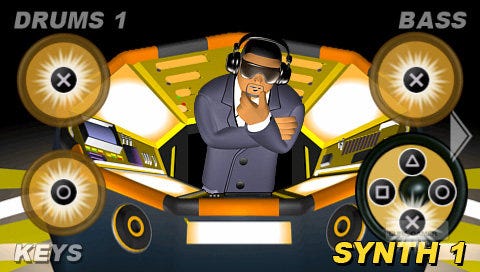
Timbaland certainly has a prominent role in Beaterator. He's contributed around 1700 loops to the in-game music library, including drum beats, basslines, vocal stabs and more. A cartoon Timbaland is seen operating the various soundbanks in Live Play mode, looking sharp in a suit and shades. He also guides you through what could the funkiest tutorial ever created, complete with super-smooth voiceover ("Have fun, baby") and background music so catchy you'll be humming it days later.
'Beaterator' Screenshot 2

Beaterator is also coming to iPhone and iPod Touch, but we only got to play the PSP game.

As Timbaland explains in the tutorial, Live Play is one of the three parts to Beaterator. It's designed to get you making music quickly, "Using ready-made loops played kinda by me, kinda by you." You begin by selecting a genre from options that include not just hip-hop but pop, rock and drum and bass. Then you use the d-pad and face buttons to play around with the various sound-banks, selecting a bassline, drum pattern, string section, vocals and so on. If you've got a PSP-3000 or PSP Go, you can use your handheld's mic to record your own samples and stick them in too.

The Live Play interface is intuitive and simple to use. The sounds you pick are mixed in automatically, so you don't have to worry about BPM or matching up beats. It's really about listening to what's going on and trying out the different sounds you can throw into the mix. There's no waiting for samples to load so the process of experimentation feels fluid. Even if you've got very little musical skill, it's easy to create something that doesn't sound nearly as terrible as it ought to.

Once you're happy it's time to record your Live Play creation and start mucking about with it in the Studio Session. This is where things start to get more complicated. Instead of the cartoon Timbaland, the various soundbanks are displayed across a grid as coloured bars. You can play, edit or remove loops, cut and paste sections, add in new sounds and so on. Surrounding the grid are knobs and dials used for things like adjusting the volume of individual tracks and changing the BPM.

"The best way to think about Studio Session is as a more robust, more sophisticated version of the Live Play mode," says the Rockstar chap. "We start to give you more options to play around with here, but not the full extent of what Beaterator offers."

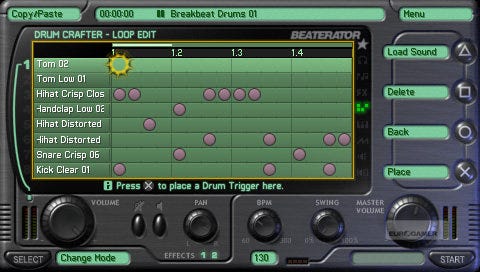
If the full extent is what you're after, Song Crafter mode is the answer. This is where you get to create your own individual sounds. You can make small adjustments to the loops that are provided for you or design brand new ones from scratch. There's a feature called Melody Maker that allows you to create melodies using a full keyboard and synth editor. There's also a Drum Crafter for making your own beats, with a huge selection of different sounds and rhythms to choose from. Those who are serious about their music-making could spend hours rejigging and fine-tuning their tracks here.

'Beaterator' Screenshot 3

You can create some everything from seriously dark drum and bass grooves...

When the rejigging and fine-tuning is finally over it's time to share your genius with the world. Songs created using Beaterator can be exported as a WAV file to your phone or Facebook profile. Alternatively you can share them via the Rockstar Social Club, just as it's possible to share videos made using the GTA IV PC editor. There are plans to hold competitions and set up a scoring system so users can rate each others' songs.

The idea, the Rockstar man explains, is to create an online community for budding musicians. "In an ideal world there will be thousands, if not millions of potential Timbalands out there, making that the start of their career," he says. But is Beaterator sophisticated enough to produce professional-quality music? If it's not a videogame, what is it? A toy or a tool?

"We're trying to hit two opposing spectrums," says Mr Rockstar. "Some people will have used music sequencing software before, serious stuff that costs hundreds of pounds - those people will want to jump in and go straight to the Song Crafter. At the same time, we want to reach people who may never have made music before, and take them through the whole process in a really fun, intuitive way."

'Beaterator' Screenshot 4

...To tracks which would be at home on the Chuckle Brothers soundtrack album.

Which is where the Live Play mode comes in, and why Rockstar has worked so hard to make Beaterator accessible. That doesn't mean it's just for amateurs, though. "In terms of whether it's a game or a serious piece of software, it's definitely the latter. That's how we're positioning it, that's how we feel about it and hopefully that's being reflected in what we've shown so far," says the Rockstar man.

Whatever it may be, Beaterator certainly marks a different direction for Rockstar - while simultaneously being unmistakeable as a Rockstar product. Only the producer of the world's most successful videogames could design a music creation tool this slick, sharp and downright cool, and get the producer of the world's most successful records involved to boot. You never know, they might have to put up an extra shelf.

Comments (11) Latest comment 2 years ago

Comments threads automatically close after 30 days, but please feel free to continue chatting on the forum!