With only weeks to go before Rare's venerable Banjo-Kazooie franchise emerges from its decade-long slumber, the game is seriously taking shape. This week, at Microsoft's UK headquarters in Reading, we were able to go hands-on with almost finished (albeit not yet bug-free) code.
You can tell a game is approaching its final state when the small touches start appearing - like loading screens bearing helpful hints, tips and suggestions. One of those tips in particular caught our eye - suggesting that if you aren't getting along with vehicle-based gaming, perhaps you might like to try out the Xbox Live Arcade download of Banjo-Kazooie instead.
It's a bit of a throwaway comment (and we suspect it might not make it to the final version), but it sums up our primary misgiving about Banjo-Kazooie: Nuts & Bolts rather well. A lot of players, we suspect, are going to find that this game has rather too much emphasis on Nuts & Bolts, and not quite enough Banjo-Kazooie to go around. It's going to be a controversial one, and right now, that could be Good Controversial or Bad Controversial. It's tough to call. It could go either way.
In essence, then, this is a game about vehicles. Its nod to its platforming roots lies in the progression system, which is a fairly pure example of Nintendo's well-worn Mario 64 system in action. The idea is that a chap called Log has decided to settle the battle between Banjo and Grunty for once and for all. In order to achieve this, he has created a number of game worlds and populated them with challenges - Banjo has to complete them, Grunty has to stop him.
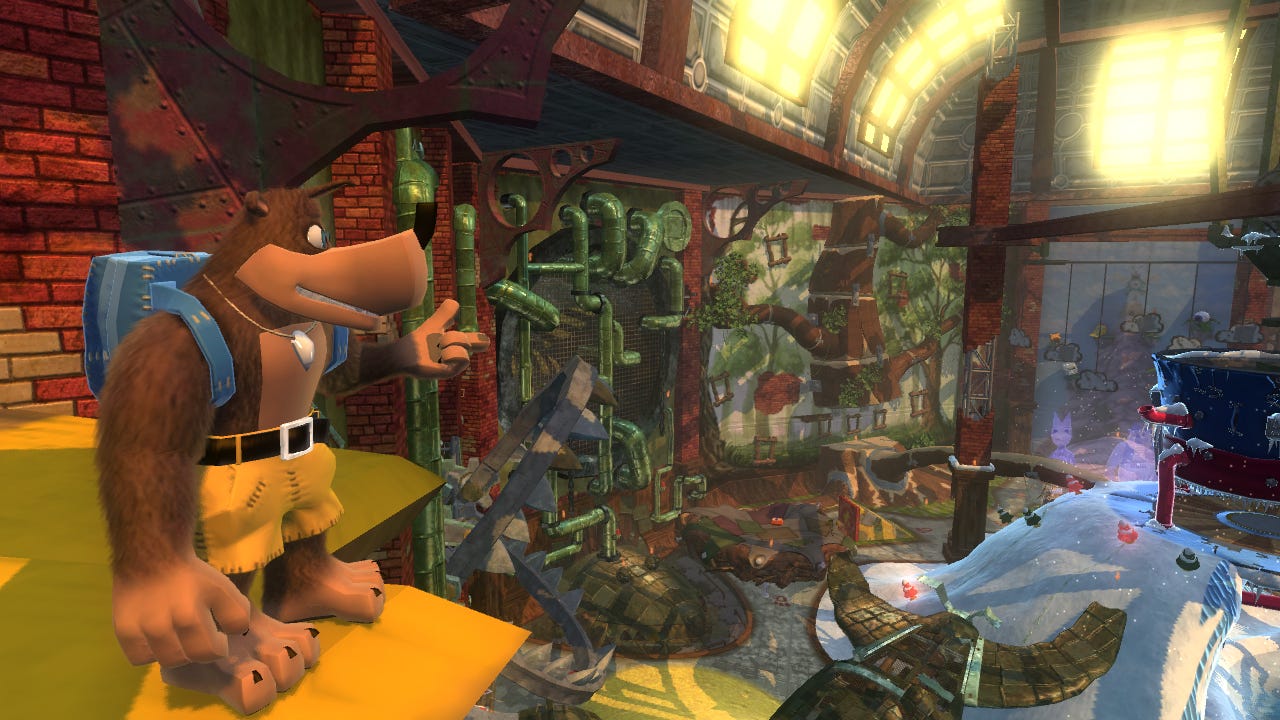
Here's Banjo, not sitting in a vehicle. Savour the moment - you won't see this much.
This gives us our hub world - Showdown Town, a city environment dominated by Log's Castle. Showdown Town has a large number of districts, only one of which (the Central Square) is accessible at the outset. There's also one challenge world available to begin with, Nutty Acres. As you progress, Log will give you new worlds to play with - these come in the form of crystal balls which need to be transported across town (progressively further away from Central Square) and placed on pedastals to activate dormant gateways.
Each world is accessed by several different doorways - and depending on which doorway you enter via, there'll be a number of different challenges on offer. Some doorways open as soon as you place the game sphere on the pedestal - others will only open when you achieve a certain Jiggy Score, indicated by the number above the doorframe.
Jiggys, of course, remain the currency you're awarded for each challenge you complete - the direct analogue of Mario's Stars. One interesting tweak, however, is that you have an opportunity to earn a TT Trophy for completing challenges in excellent time - win the trophy, and you'll earn a quarter-Jiggy, so four trophies add up to an extra Jiggy in the bank.
Each game world is uniquely themed, and is introduced by a retro-TV style video when you first unlock the world. In a nice twist, all of the standard characters from Showdown Town appear in each gameworld in different guises - Rare has deliberately given this an amateur dramatics society feel, with rather weak costumes and some bad character acting thrown in for laughs.
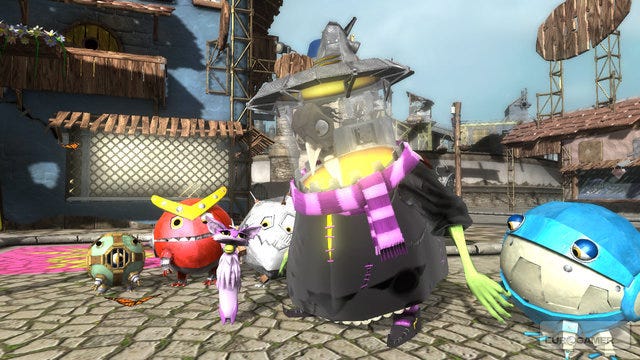
Grunty and her various minions and creations remain as endearingly mental as ever.
Similarly, each world has been crafted to look like it's been stitched together imperfectly by Log himself. "The design was that Log had created these worlds, and we wanted them to look like they'd been created," lead technical artist Neil Harrison explains. "Our idea was that he's done quite a good job of creating these worlds, but not perfect. There are holes in the floor which have been patched up, and sometimes you can see the workings of the levels, big cogs under the floor and that sort of thing." It's one of the nicest aspects of the game's unique visuals and was, Harrison claims, a fun challenge for the art team. "It's almost like you're trying to deliberately make things look bad sometimes, and that's quite risky.
"It would be quite easy to make a level with grass, put next-gen grass effects on it all blowing in the wind, and that looks great - that's what people expect. If you want to make it look constructed, though, you have to ask how you make it look as good as that, but without doing that - making this patchwork of fabric instead."
Risky it may have been, but it looks great. Visuals are one area where Banjo isn't going to court any controversy - it's a near-perfect update of the charming N64 original to the power of the Xbox 360 hardware, wisely spending its graphics budget on stunning draw distances and lovely textures while allowing its characters and worlds to remain stylised and simple.
No, the controversy, as hinted, is going to come not from the visuals, or the progression - it's going to come from the fact that Banjo doesn't walk anywhere any more. Every mission in the game is accomplished by choosing a vehicle (or constructing your own) to complete the objectives. Even navigation around Showdown Town is vehicular. Your default "shopping cart" vehicle is gradually upgraded, giving you access to more of the city - high grip tyres let you climb steep hills, floats allow you to cross water, and so forth.
The basic pattern of the game, then, is as follows. You enter a game world, and drive around to find the challenges (they're helpfully marked on your map). You accept the challenge, and are promptly given a screen where you can pick a pre-made vehicle or, in the majority of quests which allow it, build your own vehicle (or pick from one you built previously).
The system for building vehicles is very flexible and quite good fun. Just about anything you build will work, in some sense - put a seat, some fuel, an engine and a drive mechanism (wheels, propellers, rotors, rockets...) in there, and it'll move. They don't even need to be next to one another - pop them in any position in the vehicle and they'll work. All you need to ensure is that the parts of your creation physically connect, so they don't fall off instantly.
You can build an impressive assortment of vehicles - you'll start off with unwieldy, graceless creations like this...
You also get a pretty large canvas to play with - a cubic grid of 19x19x19, with a maximum of 250-odd parts in each vehicle. Most things you build will be much, much smaller, but it's nice to know that the potential for really weird, huge stuff exists for those who wish to exploit it.
The question - and it's one we don't have an answer to yet, so this really isn't a judgement on the game - is whether this LEGO-style construction is going to engage players in the long-term. The missions themselves, for all that Rare has worked to introduce variety, mostly seem to boil down to racing (either against opponents or against the clock) or vehicular brawling (vehicles can have weapons, and ramming isn't a terrible tactic either). Much of the variety is going to have to come from vehicle options - although since there are probably billions upon billions of possible vehicles to build, that's an admittedly healthy dollop of potential variety.
Given the freedom to create your own vehicles, it's little surprise that handling is left up to physics - albeit tweaked physics which focuses on fun over realism. One concern is that compared to the precise handling of a character in a platform game, or even the heavy handling of a "realistic" driving game, Banjo's creations tend to feel light - and flip over at the slightest provocation, causing some tooth-grinding in the process. This may be because we were playing with early vehicles, rather than an endemic problem - only light vehicle components are available at the outset.
... But down the line, rocket powered planes and a host of other wonderful creations await.
It's hard to deny a slight twinge of disappointment at Banjo's abandonment of its platforming roots, but this is a somewhat unfair sentiment. Nuts & Bolts, having set out to do something dramatically different, deserves to be judged not on what it could have been as a platformer - but on what it actually turns out to be as a mission-focused vehicle construction game.
As it stands we're absolutely certain that the idea itself works. Construction is easy, fun and flexible, the mission structure and progression is in place, it looks amazing, and it's even got some quite fun (if rather hectic) multiplayer game modes in there. It may not be the game we expected it to be, but if building and racing vehicles around Banjo's worlds has enough depth to hold interest, it could still turn out to be a game we learn to love.
Banjo-Kazooie: Nuts & Bolts is due out for Xbox 360 on 14th November.
