Here's a sequel that takes precisely zero time to prove it's not simply a repeat of its forerunner. Remember all those super-long, super-serious conversations between unsmiling men? From the very off, Assassin's Creed II features gags, flirting and urgency. Even Desmond, the glowering buzzcut bloke whose ancestors' memories the Assassin's Creed games document, gets to grin, joke and make eyes at a lady. What, what, what? Light-heartedness in my gritty historical stealth game?
It's an immediate improvement. It's also makes AC2 fresh enough that most of the backlash against the first game is washed away. "By trying to innovate in all directions, we all recognised that AC1 had its shortcomings," observes the sequel's producer, Sebastian Puel. "I think what was interesting to see was this love or hate kind of thing from reviewers and on the forums - some saying it was the best game of the year, and others that they were very disappointed.
"So we started AC2 listening to those comments, but there were things that we perfectly knew ourselves. The main, main focus starting AC2 was saying we have something that's very strong at its core, but we certainly have to add a lot of variety to that. So we took each part of the game and said 'how can we bring more depth to this?'"
By doing so, what's returned is the reason we all got excited about Assassin's Creed in the first place - free-running through a gorgeous, centuries-old city. AC2 really, really wants you to have fun - and that's why new lead character Ezio, a 15th century Italian nobleman, begins the game as a callow youth interested only in hedonism. "It is a good life we lead," his brother observes, as the two of them gaze across a sunlit, Renaissance skyline. "The best," rejoins Ezio, before heading off to do naughty things with a human female. It's a far cry from the scowling monks and restrictive rules of the first game's opener.
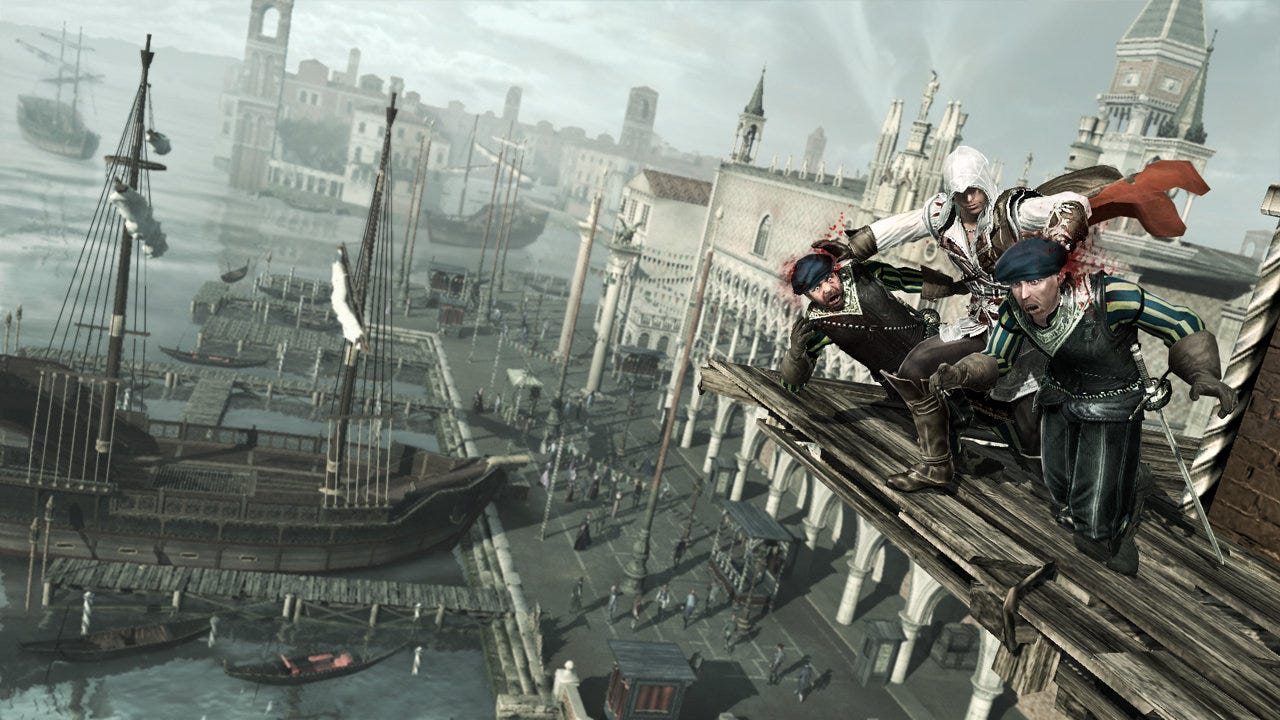
Enemies evolve somewhat over the course of the game, gaining better weapons and armour to counter your own upgrades. They're still goons, of course.
"The time period is warmer, the place is warmer," agrees Puel. "Maybe we wanted to take ourselves less seriously a little bit, we had to step back and say, 'this hero, he has to have some panache', and not always be mysterious, not talking too much as Altair was, much as we loved him... We need to have a hero who is more Italian. Even though he is still an Assassin, and even after he loses some of his family and become very focused, we wanted him to have a lot to say."
As Puel hints there, this contentedness doesn't entirely last - conspiracy and family tragedy quickly blight Ezio, removing characters you'd presumed were there to stay and thus, harrowingly effectively, shaking both his and your confidence in the state of affairs. In a Batman-esque montage, he dons his Assassin uniform and embarks on an urgent pursuit/flight across the great cities of Italy.
A big part of maintaining that urgency is that the game doesn't jump back to Desmond, skulking in his Animus memory virtualisation device, anywhere near as frequently as first time around. Even when it does, it's no longer the austere white room and cryptic scientists of before. It's a cartel of young, sparky folk in a stylish office. The Animus, in its (self-consciously described) 2.0 form, is no longer a frightening upside-down bathtub that takes four hours to extricate yourself from, but instead a comfy-looking red recliner chair.
If it all seems a little bit too Apple Store, there are hints all is not as it appears. You have no reason to trust these guys - who claim to be working for the contemporary Assassins - while their nominal leader, a preening Danny Wallace lookalike, is a bit rude to you for no good reason. Early on, in his escape from his captors in the first game, Desmond gets to do a spot of fighting of his own at last - so hopefully he'll get to bop Nasty Danny Wallace on the chin at some point.
But, for all this background 21st century conspiracy gunk, the spine of the AC series, this is very much Ezio's game. His choice of mission types jumps from the first game's five-ish to around 15, many of which will evolve into other forms as they go along - so the plague of repetitive mini-games shouldn't be troubling us again.
Side quests are picked up from folk on the streets as and when you like, and now have a benefit beyond eventual progression or collector-mania: cash. Ezio's forever in need of the stuff, to spend on doctor's bills, armour repairs, new weapons and clothing, and even paintings with which to decorate his Villa, a sprawling home/base he inherits a few hours in. Cash is easy enough to come by - gained from missions, from hidden chests, and from pickpocketing folk in the streets.
It's almost an RPG. What stops it is that there isn't really much choice in terms of upgrades - just gradual replacement of old things with better things. Though he does, to some extent, get to pick and choose what weapon types he wields on a given mission - even if the definition of 'assassin' is perhaps stretched by running around with a big hammer. [Stretched in a good direction, if you ask me. - Hammer Ed]
AC2's massively bigger than AC1 - comprising three larger cities, a couple of villages and swathes of countryside.
So, a little bit GTA, a little bit Elder Scrolls - but, most importantly, a sense of stuff to do, stuff worth doing, rather than just trying to summon a sense of pride about a completion percentage on a menu screen. And even that sense of completionism is overhauled, in the form of aforementioned Villa. It's Ezio's home, but it's also a reflection of how he's doing. Any armour and weapons he's bought are on display there, while his bedroom is filled with portraits of men of import he's assassinated.
Outside the main building are stores, taverns and even a brothel - he can pour cash into any of these to renovate them, which both makes them more impressive and adds a bunch of handholds to their exteriors, so he can climb them in search of secrets. The more he renovates, the better the place looks and the more it comes alive - so it's a living reflection of how well you're doing. Oh, and Leonardo da Vinci eventually turns up and starts hanging around. Apparently he's there to help, not just to sponge off your riches.
It's a game that's both familiar and immediately, obviously bigger and fresher. It's quite the accomplishment in so short a time. Has it had long enough to gestate, though? "When you're creating stuff it's never enough - certainly, you are always begging for more time," says Sebastian Puel. "Sometimes I surprise myself with the amount of stuff that has been done to the game. I'm really proud of this one."
Assassin's Creed II is due out for PS3 and Xbox 360 on 20th November and PC in Q1 2010.
