I love Another Code: Two Memories for what it sets out to do, rather than for what it necessarily achieves. It's a tremendously imaginative game, and contains at least two spellbinding puzzles. It's also peculiarly flawed, not just by an extremely short playing time, but also the madness of including English comprehension tests at various intervals.
Developer Cing made its move from Japanese mobile phone games to the DS in impressive style. While I'd argue Another Code (released as Trace Memory in the States) falls short of their following DS game, Hotel Dusk, it stands as one of the finest examples of the way the DS's peculiar design inspired developers to think uniquely.
It's the day before Ashley Mizuki Robbins 14th birthday. Believing herself orphaned aged three, the young aunt who raised her has revealed that her father is in fact still alive. He's on Blood Edward Island, where the pair are now heading, and wants to be reunited with his daughter after 11 years. Why? That's the point of the game.
It's a game that reminds me that the DS is magical. It's a game that understood why the DS is magical. The developers must have held the console in their hands, just staring at it, for many, many hours. It's been studied, interpreted, and re-imagined not only as a tool for playing an interesting adventure game, but to be used within the game.
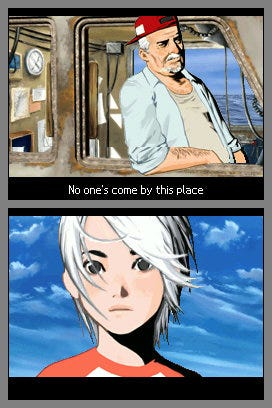
The boat captain doesn't like the spooky island! There must be ghosts!
Ashley has a suspiciously familiar device called a DAS (Dual Another System). Of course, this was 2005 and rather sadly the immediate effect of seeing the DS in-game is somewhat lost now you're most likely to be playing on a DS Lite or DSi. Hers is an original grey brick DS-alike, and it takes an edge off the resonance.
The DAS is, however, an awful lot more like the DSi than the original DS. It can take photos, rather helpfully. And identify biometric data. (The DSi can do that, right?) It's a tool that isn't fully explained at the start of the game, but is something to do with a mysterious piece of research known as Another. Something both Ashley's parents had been working on before they died. Or didn't die.
But let's rewind slightly. The game's intelligence is revealed at the very start. It's called "Two Memories" for a whole bunch of reasons, and it in fact gives away two of them in the opening cut-scene. You just don't know it yet. Then it does something interesting. It goes silent. White text, tiny, in the middle of a black bottom screen, the top screen black too, slowly appearing. No music, no beeps. It's inauspicious, subtle, and much more interesting for it. Then swoooosh, your DAS loads for the first time, requiring your index fingerprint to begin.
After arriving on the island your aunt Jessica quickly goes missing, leaving Ashley with little choice but to explore. Then things go to a reasonably typical point-and-click adventure place. The game's in 3D, but chooses to show itself from a top-down perspective. It's actually the most effective angle from which you could hope to play, but it makes it strange they didn't just leave it in 2D. No complaints though - it's a very decent use of the DS's 3D capabilities, and makes for some effective cut-scenes as the camera swoops in and out on characters.
However, it's also at this point that the game lapses into some of the very worst features of the adventure, especially including reams of completely non-interactive conversations, and some of the hoariest puzzles imaginable. We're talking 4x4 sliding-tile puzzle levels of unimaginative. Of course, that's to unfairly not repeat that there's also two of the smartest DS puzzles ever, and a ghost called D.
D is where the dual nature of the memories kicks in. Having died 57 years ago, D is the ghost of a boy about Ashley's age, with almost complete amnesia. You quickly buddy up with him (there's some nonsense about how Ashley can see him because she trusts people, which is a strange frame of mind for a girl who's just found out her aunt's been lying to her about her dad having died for 11 years, and who has dreams about witnessing a grisly murder aged three), and should you explore thoroughly enough you can help D unlock his memories. Explore not thoroughly enough, and quite horrendously you can completely fail in this sub-task, leaving the poor ghost child stranded on the island for possibly another 50 years.
The majority of the game - and that's a rather slack use of the word "majority" when the whole thing comes in at under four and a half hours - is spent inside the Edwards' mansion, learning about both the family history and D's relation to the former inhabitants of the island, as well as the more recent history of Ashley's father and his experiments. Throughout you'll find messages from her dad left in the form of DAS carts, guiding the girl to his laboratory deep within the enormous building.
I counted the puzzles. There's 25 of them. And it's the greatest shame of Another Code that the inspiration was saved for only two or three. Although it's important to be fair to the era. The DS had only been out in Europe for three months by the time this appeared, and so perhaps scrubbing laboriously at the screen to clean a brass plaque was more novel in those innocent days. Although I'm fairly sure having to blow about 600 times to get the dust off a painting was as bloody annoying then as it is now. (Although of course rubbing the mic with your finger will achieve the same effect, just slightly more slowly.)
Oh heavens, the scribble on the pad to get the previous message puzzle. Tsk.
What must be said for the puzzles is that most of them are based on trying to use the DS in a way that other consoles couldn't offer. Flinging a ball toward a target on the top screen, for instance, may require no imagination or skill, but you certainly couldn't do it on an Xbox.
However, there are two puzzles that will be celebrated in full, and completely spoiled below.
Special mention to another couple first, however. On two occasions you must discover keypad codes to open doors. But rather than finding them written upside down on the bottom of a bucket, or whatever other nonsense is usually offered in an adventure game, here you must realise you need to take photographs of paintings on walls, then learn for yourself that the DAS allows you to overlay two photographs, and then rotate and move each around.
The game never teaches you this, nor prompts you to think of it, and yet anyone inquisitive will stumble upon it without feeling cheated. Seeing two similar patterns on two paintings, realising that if only I could interlace them in some way, and then working out if the tools I'd been given could achieve this, is a very rewarding route to completing a task. Being told to do any part of it would have been a shame.
So, first the photo frame. This is a puzzle so obscure that the game here does give you some very unsubtle prompts (but rather cleverly, not until you've put the frame back down for the first time - you could potentially solve it without being nudged).
There's a folding two-leave photo frame in a room. Each side contains a black background with an arrangement of a few white lines and some drawings, behind the frame's glass. Look closely at it and the game puts each side of the frame onto one of the DS's screens. To solve it you have to take a peculiar step backward and realise the device your holding to now be existent within the game it's playing. It's not so much breaking the fourth wall as dematerialising it.
The DS has reflective screens. You know this because you've tried to play outside on a sunny day. But here it's to your advantage. If you angle the screens correctly, such that a key on one screen is reflected into the outline of a book on the other, then the odd white lines align to form a letter and a number. And it reflects them incredibly clearly. It's a joyful moment.
The second is even better. As you explore the mansion D begins to remember a female friend his own age, Franny. When you find her bedroom inside you discover her sketchbook of woodprints. One is incomplete. Elsewhere in the room are two wooden prints. Use them from your inventory with the sketchbook and their patterns appear on the top screen, the page on the bottom screen. What to do?
The first time I encountered this puzzle I remember being frustrated at not knowing what to do next. I remember even stupidly tapping the top screen with the stylus (we've all done it). And then the thought occurred. It's a print, right. And there's the print blocks on the top, the pad on the bottom. And my DS has a hinge. Surely not?
It works. It's so exciting that it works. Replaying it now five years later, having somehow forgotten most of the plot, this puzzle was unforgettable. But even now the moment of closing the DS (an act we associate with pausing a game, saving DS battery life, that sort of thing) being subverted into being a game mechanic is thrilling. A means of interaction within the game world by manipulating a device in the real world.
The top-down perspective does seem to waste the pretty 3D in places.
There are many other smart themes appearing. A favourite is D's fractured memories appearing to him in the form of pencil-sketched concept art. It's a theme Cing would go on to elaborate upon enormously in Hotel Dusk, but its brief, subtle use here is clever and effective. There are, however, some really damned stupid ideas too.
The English comprehension tests, for instance. At the end of each chapter Ashley insists on remembering everything that's just happened in the form of multiple-choice questions.
John described this idea as:
a) very clever
b) damned stupid
c) photosynthesis
No thanks. I'm not 10. Oh, and choosing to have the 'back' button make a farting noise doesn't lend appropriate gravitas to scenes about the deaths of loved ones.
It's a peculiarly bleak story. Especially when you consider that it's played from the perspective of a 13-year-old. Murder, betrayal, lies, suicide and kidnapping, spanning multiple generations and two timelines. And while D's story is clumsily told, with a meandering family tree that's quickly muddled, there's plenty going on despite the brevity.
Four and a half hours (4:26 to be precise, according to my end-game save) is clearly not long enough for any game. And especially not when any amount of that is taken up by a sliding-tile puzzle. But Another Code still feels worth returning to (although tough to find at a decent price). If anything it is a portent of the possibilities adventure gaming could have on the DS, if only anyone else had bothered to be so imaginative in the half-decade since.
Cing's Again is due to appear in North America on DS next month, and while there's no translated release date for Hotel Dusk sequel Last Window it's reasonably likely we'll see one. So it's good to know that at least one developer is willing to keep pushing at it, despite varying success. When a few of the good ideas are truly great, it can carry a game a long way.
