Another Code R: A Journey Into Lost Memories Review

Murder, she clicked.

Version tested: Wii

"Read & Solve like a Mystery Novel!" shouts the sticker on the box for this languid detective adventure, a sequel to the 2005 DS game Another Code: Two Memories. One of Nintendo's cleverer marketing ideas (and it's had plenty lately) has been to slip the classic narrative adventure in with its rebranding of videogaming to reflect the concerns of a front-of-store display in Borders. Character-driven, brain-teasing murder mysteries sit quite neatly alongside food, fitness and self-help, and a moribund gaming genre gets to find its second wind in the slipstream of a mass-market revolution. Cheers all round.

The thing is, though, that Another Code R: A Journey Into Lost Memories doesn't read quite like a mystery novel, and you don't solve it quite like one. For a start, it's moved from DS - where all the recent hits in the genre, from its predecessor and Hotel Dusk (also by Japanese developer Cing) to Professor Layton and Phoenix Wright, have found their home - to Wii. So you no longer hold it in your hand while you wait for a bus or sit on a beach, idly flicking through dialogue and snapping it shut to ruminate on plot points.

Secondly - and here it differs from Hotel Dusk and Capcom's brilliant legal dramas in particular - you don't solve it by teasing out plot clues and guessing characters' motivation and opportunity. The game does that for you, while you unlock the next section of the story through a series of specific, situational item-combination riddles, logic puzzles and motion interactions. It's more of a traditional videogame adventure in that sense.

Thirdly, it doesn't read like a novel because it's not written like one. There's plenty of reading to do in Another Code R - pages and pages of it, in fact - but its plain characters, flat dialogue and matter-of-fact style don't have much of the literary about them, and the themes are loss, memory and teenage growing pains rather than the weakness of the human condition. If Another Code R is a mystery novel at all, it's one from the 'Ages 11-16' section of the library, well-thumbed in a plastic jacket, and dotted with Ribena stains.
1

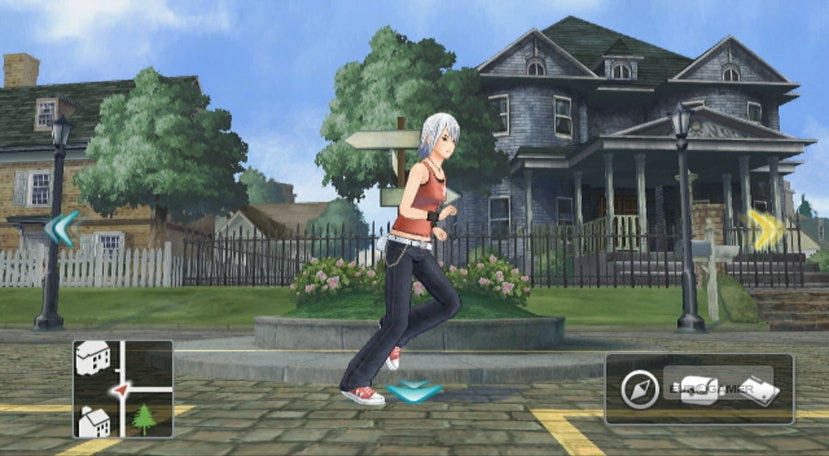
The map is clear and helpful, and navigation is a breeze.

None of which is necessarily a bad thing. A game about being a confused teenage girl is certainly a welcome change in a world of games about being an angry teenage boy in the body of a space marine / mutant / mutant space marine. But most of the above contributes to making Another Code R less immediately engaging than you might expect, a problem compounded by the fact that Cing's game is so... very... slow.

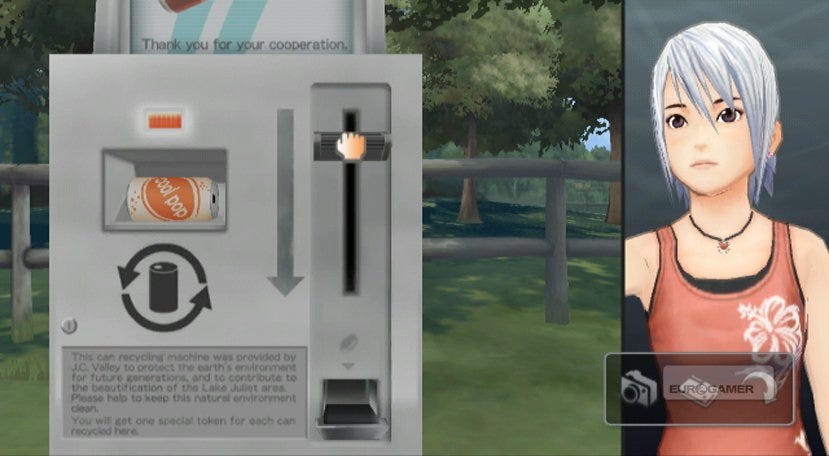
For the first three or four of the game's dozen or so hours, 16-year-old half-Japanese heroine Ashley Mizuki Robins - she of the immaculate white manga hair - doesn't do much more than recycle cans of pop and light barbecues while exposition washes over her. Washes over her? I mean creeps, like the tide, at an agonisingly slow pace, in "conversations" in which the last few words of every sentence are repeated as a question. As a question?
2

You're rewarded for recycling cans with sweets. Another Code's worthiness doesn't extend to diet, at least.

Two years on from the first Another Code, in which Ashley unravelled the events surrounding her mother's death, the teen is invited by her distant, absent scientist father for a camping trip at a resort called Lake Juliet, near the lab where he works. This idyllic and sunny location turns out to hide secrets that deepen the mystery of the mother's murder, as well as a parallel story involving a runaway 13-year-old orphan boy called Matthew Crusoe, whom Ashley befriends. The pair set about trying to uncover their parents' pasts and get closer to their lost families together.

You can already guess that Lake Juliet doesn't have anything like the haunting, lonely atmosphere of the DS game's Blood Edward Island. It's a pretty, open and reassuring place, thickly peopled with mostly amiable characters, and Ashley is often in company and almost always talking to someone. The pleasantly bland location, combined with the excruciatingly halting dialogue style and ambling, meandering plotting, means there's no sense of urgency or intrigue to Another Code R at first, and it takes a long time to build up. You're often forced down cul-de-sacs and byways in the plot as free exploration and curiosity are curtailed by some arbitrary decisions on what Ashley should be doing next.

Another factor is the cast of characters, most of whom seem rather shallow, if broadly likeable. They're attractively drawn and expressively animated, and they will get under your skin with time, but there's not much to them. The emotions expressed are poignant but plain, and the script can't match Hotel Dusk's sophistication, or the Phoenix Wright games' elegance, wit, pace and razor-sharp characterisation. Nevertheless, they do grow on you, as Another Code R itself does as it moves into its second act. The location starts to open up, the pace quickens, the plot-threads build until there are enough to sustain your interest, and the twin story lines begin to resonate nicely with each other.

3

There's beautiful attention to detail and realism in the locations.

The game's presentation is superb, too. Although it can be slow and marginally clunky to manipulate compared to the crisp 2D interactions of related DS adventures, it has a wonderfully clean and colourful 3D storybook style, and a logical, easy-to-use interface. Ashley runs between locations in a side-scrolling view, and investigates rooms in full 3D by standing in the centre and turning to face each wall. You can control the game entirely with the pointer, although basic movement is also mapped to the d-pad. Neat use of split-screen allows you to watch both sides of conversations and pick the animated mood, as much as the words, of Ashley's responses.

The first Another Code was known for its inventive use of the DS' stylus, twin screens and the form of the console itself in puzzles. The sequel does much the same for the Wii remote, which stands in for many objects and devices in the game, from test-tubes to flaps of cardboard. Sometimes these are amusing but disposable interactions to put you in the scene: throwing something, or shaking a test tube full of chemical solution.

But there are also several highly ingenious, fourth-wall-breaking puzzles that require you to really use your spatial imagination. Developers obsessed with punctuating their Wii games with novelty motion-control interludes should study Another Code R to see how it's done. Overall, puzzle design is very good, a little narrowly-defined at times but usually logical. Confounding moments of arbitrariness where you're reduced to clicking on everything with everything are rare.

4

It's good to see me?

In such a hyperactive, extravagant and attention-deficit medium as videogames, is it fair to mark a game down for daring to be understated? Because that's Another Code R's main quality, for better or worse - or rather, for better and worse. It's a beguiling and subtle piece of work, and a nice palate-cleanser. But it too often crosses the line from understatement to flat-out dullness, especially in its opening third. The sentimentality is touching, but rather earnest. The atmosphere, charm and writing aren't really there to pull you into the story before the game itself does, and the game takes its sweet time about that.

It's just not very compelling, and what might have made a pleasant, idle distraction in your pocket can't help feeling like a foot-dragging time-sink when sat on the sofa. Another Code R is a finely-crafted mystery adventure that's recommended for fans of the form with some time and patience on their hands, but anyone else looking for something engaging to read and solve might want to consider alternatives. Including the kind that comes printed on paper.

6 / 10

Read the Eurogamer.net scoring policy

Comments (50)

Comments for this article are now closed, but please feel free to continue chatting on the forum!

  • Loading...hold tight!