Alt Mod Scene

Modding things differently.

The past couple of years have seen a decline in the number of mods finding their way to completion. Partly this is because of the demanding nature of host games, such as the graphically complex Crysis or Unreal Tournament III, and partly it's because of the indie gaming boom.

Folks who might otherwise have worked on mods are making their own lo-fi games, or grabbing free engines like Unity or UDK to do what modding always previously provided, which was the opportunity to make something from scratch with the leg-up of engine tech.

There is, however, another positive and interesting trend in the contemporary modding scene, which is in creating mods that are unexpected, unusual, and dealing with subject matter that is far away from the norm of crosshairs, weapon-renders, or quirky physics.

There are two people I see as the pioneers, or at least frontiersmen, in this particular area of offbeat modding. One is Robert "Campaignjunkie" Yang, and the other is TheChineseRoom's Daniel Pinchbeck.

What is unique and significant about the work of both these men is that their mods explore intellectual and emotional subject matters, rather than tradition martial or tactical topics for modding.
'Alt Mod Scene' Screenshot 1

Both modders rely on the ease with which Valve's Source engine can be modified and repurposed for non-violent experiences, and both men have unusual reasons for creating the mods they did.

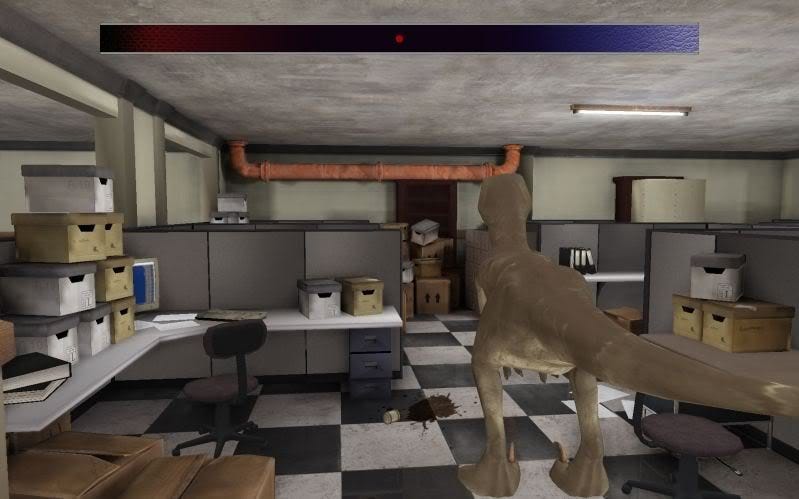
Most important of all, both seem to be inspiring a wave of experimental mods. (Possibly including the intriguing Velociraptor Job Interview Simulator Pro.)

Yang's "Radiator" episodes are, of course, what I'm talking about in here. This is the work of a mature modder - Yang has been working on modding since he picked up StarCraft aged 13, and he's now using mods to tackle subjects beyond that of extending the lifetime of his favourite RTS.

Radiator is a series of single-player mods, each focused on a limited, non-violent scenario. Each has a peculiar poignancy in the way it deals with emotional subject matter, and each is oddly beautiful. They are capsule stories, nano-takes told in game form.
'Alt Mod Scene' Screenshot 2

"Volume 1 is about the relationship between two men," explains Yang. It's about "the pain they cause each other and how one might go about dealing with that."

Yang says that he has had to find ways to explain this stuff to non-gamers, but it seems useful to everyone: "I usually focus on the audience aspect of it: it's an experiment to see if Gatorade-drinking men who make heads explode will enjoy a discourse on memory, identity and sexuality... and it turns out a lot of them do, as long as you're not preaching."

As it turns out, the feedback to Yang's project from the game-literature community was pretty diverse, and not always in a good way. "Games journalists are (usually) hardcore gamers with quirky sensibilities, so this is pretty much right up their alley," says Yang.

"Destructoid had a weird (in my view) perspective on it, disliking how my mod implies that lying in a relationship might not be all that bad - and, well, if you've never questioned whether honesty is always the best policy in a relationship, I'd argue that you've never been in a situation where honesty really mattered."
'Alt Mod Scene' Screenshot 3

The response from the wider community was rather less encouraging, with people criticising Yang's decision to include gay characters. Subsequently he has been motivated to speak out about homophobia in the gaming community.

"When I talk about homophobia, I'm not necessarily referring to xSpineExplodRx calling me a faggot in Halo 3," says Yang, "I'm talking about really intelligent people in these gamer communities dressing up their homophobia as design criticism: 'oh in Radiator it ruins the immersion' - whatever immersion means these days! - 'into a player character when I find out so and so is gay.' I find the intellectualisation of homophobia to be much more disturbing."

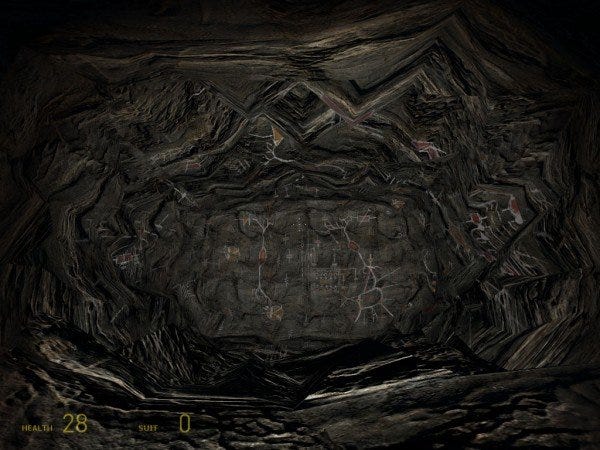
Pinchbeck too has encountered some criticism for his mods, Dear Esther and Korsakavia. These strange, narrated, single-player explorations of detailed environments engendered a range of reactions, from blank indifference, to accusations of pretension, to gushing enthusiasm about their surreal subject matter.

However, Pinchbeck wasn't delivering a personal project, like Yang's, but an academic experiment intended to study how games are made - an experiment that that has surpassed its original remit.

"What it's done is transcend the original research question," says Pinchbeck. "What we're now looking at is a pretty clear indication that this type of experience, which draws on bits and pieces from more traditional games but is still fairly unique, has a real place in the wider gaming scene.

"Since Esther came out, there's been a string of other experimental and indie games which have chosen to explore similar ideas (I'm not claiming that's down to me at all - it's just a really telling thing that all over the world, people have had similar ideas about this one way you can explore a different aspect to the medium). So we certainly hit a nerve, and I think it's quite an important one."

Perhaps that's the point of what is going on in this particular corner of gaming: to hit nerves, to be weird, and to challenge gamers. Whether the mod authors do this through characters, as Yang has done, or through exploration of an environment, as Pinchbeck has done, doesn't matter: it's about putting experimentation at the fore, and doing things differently.

'Alt Mod Scene' Screenshot 4

Yang is forthright about the attitude which as produced this: "The commercial video game industry is (rightly) concerned with what will sell instead of what will be interesting," he says, "so I highlight gay characters in my mod because commercial games won't; I put Emily Dickinson in my mod because commercial games won't; and so on."

For Yang, the mod community has largely been missing a trick: if there's no money, you don't have to mimick the "parent" material of mainstream games. Hell, you probably should be doing something that could never be commercial.

"One of the main reasons I stopped doing huge mod projects was because it takes years and years to release," says Yang. "I don't think mods should do that. It mimics commercial practice... but commercial games are funded, have marketing and QA... and mods don't. So why do we do it?"

The answer, of course, is because most of the time it's only gamers who make mods, and they want to make variants of the games they already enjoy. More crucially, perhaps, it's often only gamers who even realise these tools exist.

'Alt Mod Scene' Screenshot 5

When non-gamers discover mods, realise how powerful the tools are, and bring their agenda to them then, well, peculiar things can happen. Pinchbeck is a good example of this, and the influence of his work is growing quite rapidly.

But even he has reservations. "Richard Bartle said recently, 'Games are mainstream. Drown or learn to swim,' and I totally support that. I'm more worried about all the people piling into the lifeboats: sometimes it feels like everyone is claiming to be an expert at paddling, even when half of them have never been in a boat before."

As gaming becomes inundated with non-gamers wanting a stake of the new terrain, so mods and similar tools offer an easy way to dust off the chaff, and figure out who or what to take seriously, as Pinchbeck suggests.

"If you want to understand games, play them. For me, it's that simple. And what I've found out on top of that - at least for the very specific type of questions I'm interested in - is that if you really, really want to understand games, build them."

Comments (19) Latest comment 2 years ago

Comments threads automatically close after 30 days, but please feel free to continue chatting on the forum!

  • frostcircus #1 2 years ago

    It's not just the graphical complexity; it's also because games with comprehensive modding tools (or even capability) are becoming fewer and farther between.

    Also: Fantastic article. I really enjoyed it.
    Edited by 1 at 31/05/10 @ 06:24
  • Simonkey75 #2 2 years ago

    Great article, the sort of thing I'd like to see more of at Eurogamer, instead of the PS3 v XBOX, MS v Apple flame-baiting that has come to dominate the place recently.

  • o_ci2007 #3 2 years ago

    Trolling is an art, and I am Picasso. Actually no I am a loser, no hope, benefits receiving, chronic alcoholic with nothing better to do. I once held the record for the most negatives and I am looking to recapture my crown. it surprising how provoking the word first can be if used at the right time. I will be back, GT5 and Halo Reach reviews will help me in my quest.
  • skuzzbag #4 2 years ago

    why are you upset? maybe you should kill yourself?

    great article btw.
  • speed182 #5 2 years ago

    We are the mods, we are the mods, we are we are we are the mods!
  • 3william56 #6 2 years ago

    Trolling may be an artform, but hitting the Ignore Poster button is much more like Engineering.
  • frostcircus #7 2 years ago

    The world may implode if people keep mod-baiting an article about mods
  • AllenSpawn #8 2 years ago

    Can digital foundry do a mods v rockers face-off?
  • kimchibaka #9 2 years ago

    Interesting article, though after reading it I have absolutely no idea what these games are about or how they 'play'.
  • Hypercube #10 2 years ago

    Interesting article, though after reading it I have absolutely no idea what these games are about or how they 'play'.

    I was just about to post something like this. The mods sound like something very different from the usual mod fare, but having read through the article I've got little idea what they're about.

    To the google!
  • cattypat #11 2 years ago

    I think the current gaming industry is more focused on the latest graphics and physics than ever before, and it is hurting the interactivity and accessibility of games as a whole. I personally found the most engaging form of gaming with Interactive Fiction and the MUDs of old, to expand on where a game could take me.

    Never before have we had such a "split" between so called "hardcore" and "casual" gamers. The death of 3D software rendering is certainly the cause of this. 2D games online in flash and by smaller companies like Popcap continue to be enjoyed so its obviously not required to get a monster computer to enjoy all of modern gaming.

    Basic 3D engines like the original half life were actually enjoyable to mod for. There are hundreds of mods and total conversions made for it if you go search for them. Modding is becoming more difficult whilst the origins of modding has not changed, however I believe those who really want to create something will rise to the challenge of any editor and conquer it.
  • el_vicio #12 2 years ago

    Hmmm... about the content in question: I enjoyed Dear Esther, although I always found myself wishing for a hint where to go next, the fear of missing a part of the narration simply because I walked the other way grew rapidly until the last third of the game.
    That said, I think I'll start up Korsakovia today, it's been lingering on my steam acc for weeks now...

    Good article btw
  • Janyamik #13 2 years ago

    Thanks a lot for the interesting report. I played The Chinese Room mods on its release date and get impressed wiith both works -Dear Esther and Korsakovia so I always recommend them!- so I can only say a big thanks! Just 2 days ago was reading about Radiator on its official web ! I am a HL 2 1player mod lover so I really appreciate the article, Jim.

    @Hypercube: goggle or Moddb. :)
  • Ducklord #14 2 years ago

    That was an unexpectedly deep article, good read :)
  • webcider #15 2 years ago

    Seriously this is unreal how can Eurogamer produce two incredible intelligented articles on so short a notice.

    Incredible ^^ Very nice article keep them coming.
    Edited by 1 at 31/05/10 @ 15:34
  • clemenules #16 2 years ago

    Good read, cheers Eurogamer
  • Tiger_Walts #17 2 years ago

    Interesting article. Would like to see something not so focused on just two creators but this is a nice opener. A shame that EG has to get in guest writers for this sort of content. At least GamePro didn't get it, it's exactly the kind of stuff they want.
  • np #18 2 years ago

    Thanks Jim. I tried Esthey, plenty of atmosphere but I got stuck and gave up. I'll get round to trying Radiator sometime hopefully.
  • chineseroom #19 2 years ago

    Re: NotMyRealName - that wasn't actually the point I was making - when I spoke with Jim, I was referring to the influx into academia and games research of people who didn't actually make or even play games, and the danger this presented to games research being taken seriously by developers and gamers. It ended up a little out of context here. So it's not a dig at casual players and absolutely not an elitist thing about the gaming community (c'mon!), it's a comment on the rise of shit games courses left, right and centre, and dodgy uninformed games 'research' and the need for more researchers to explore their ideas through building and releasing into the real world....