Alpha Protocol

Diamonds take forever.

In the genre-bending world of modern videogames, things are not always what they seem. Alpha Protocol looks, walks and talks like a shooter, but it's not - under the hood it's a skills-based RPG. It's far more about character stats than firepower, and interactive cut-scenes form a substantial portion of the action.

This has a lot of counter-intuitive implications. Empty a clip of bullets into an enemy's head, and the damage done is determined by your character sheet rather than where you're aiming or how powerful the gun is - so you can rush up to a boss and unload a shotgun into his stomach, and it will do practically no damage if your shotgun stat isn't high. Try to fire an assault rifle from far away without the requisite skill points, and you simply won't hit anything, no matter where you aim.

The same goes for melee attacks. Walking up to an enemy and attacking them hand to hand without a high enough skill level means that they will simply block your every move. Similarly, the game's hacking and lockpicking mini-games are incredibly difficult unless you have a high Sabotage stat.

Like a shooter, Alpha Protocol is a game about a man with a gun solving political unrest with bullets. Unlike a shooter, your health doesn't recharge with time (although your shields do, to an extent). Unlike a shooter, you have to decide whether you want to prioritise hit points or offensive power or tech skills.

You have to manage your inventory, and spend a lot of time in menu screens, customising equipment or reading emails or dossiers that flesh out the characters and political conspiracies at the heart of the story. You also spend a lot of time talking, forming relationships with key characters in interactive cut-scenes by choosing from a selection of conversational responses.
1

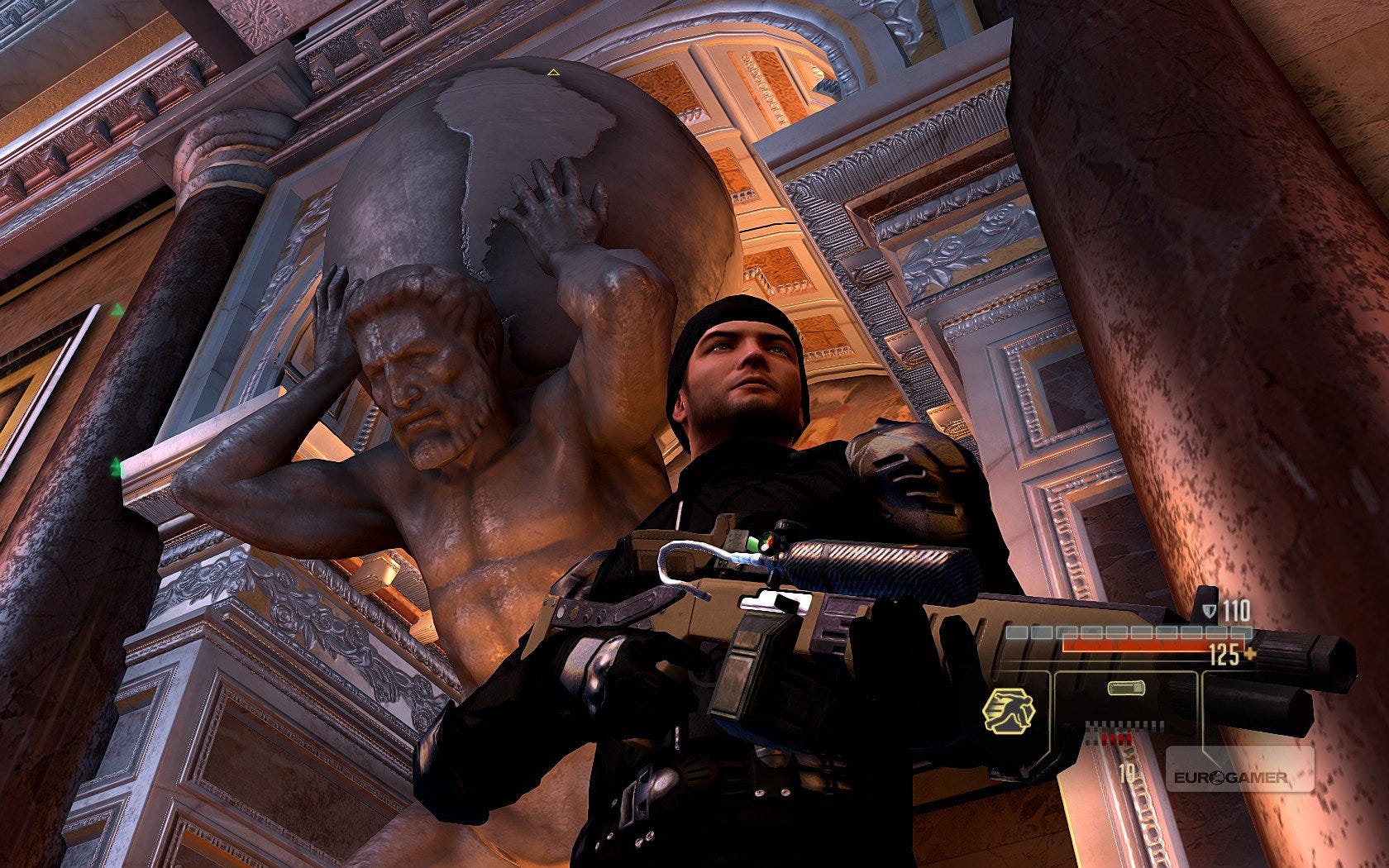
The past few months have been spent polishing Alpha Protocol up rather than changing anything fundamental - some of its environments look great.

Alpha Protocol is certainly different, and playing it necessitates a recalibration of your third-person shooter instincts. It feels completely wrong at first that shooting at enemies can do little to no damage, or that you have to stay out of cover with your reticule trained on someone for five seconds in order to get a critical hit. Over the course of four hours with the game, though, it did begin to make sense.

There's a static main character, Michael Thorton, an American agent for an agency secret enough for the government to deny its existence. You can tweak his appearance (in my case, to make him look like a backwards-baseball-cap-wearing Fidel Castro), but like Mass Effect's Commander Shepard, he is his own man. Your influence upon him extends to which skills you give him, and how you choose to make him respond in conversations.

Between missions, Thorton usually heads out for a chat with some of his contacts, or his government handlers. During these interactive cut-scenes you can choose one of three responses with the face buttons - hit the right tone and characters will start to like you more, which can have beneficial effects in later missions. A few helpful militia might turn up to fight if their leader is friends with Thorton, for instance, or you might gain access to some extra information or a weapon drop for the next mission.
2

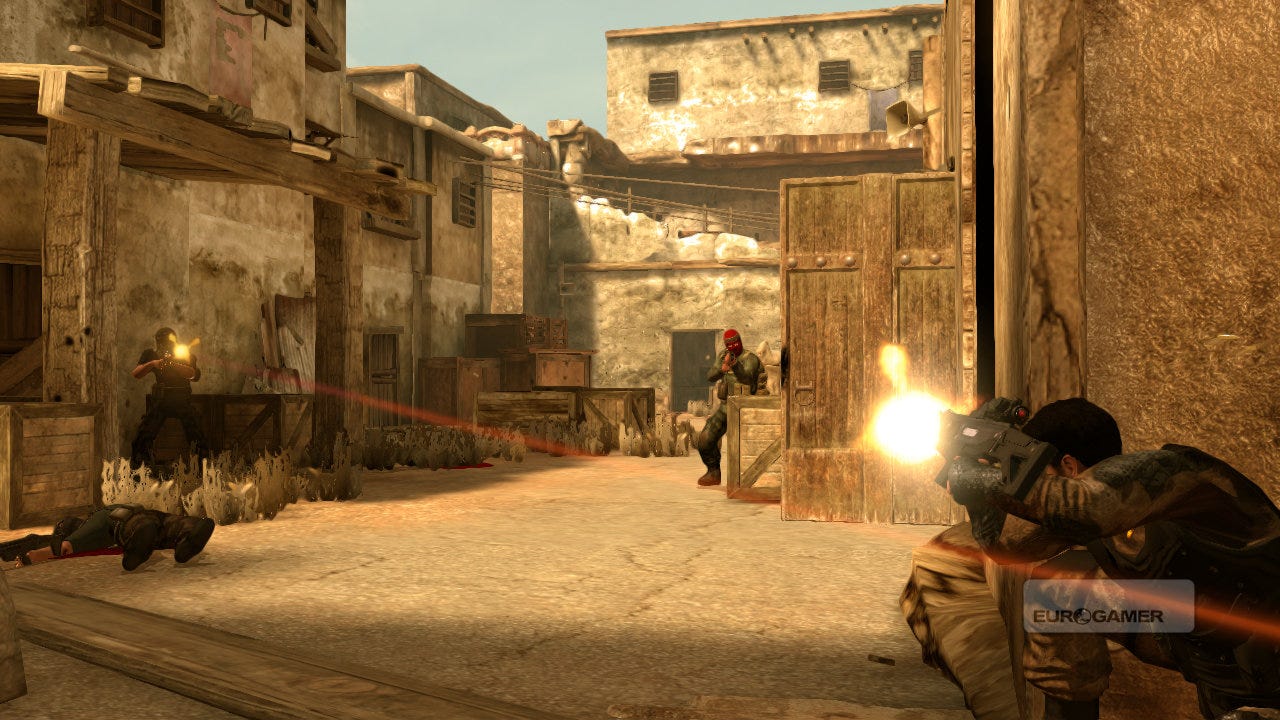
For a change, it's not always terrorists that you're shooting at.

These conversational responses are broadly grouped into Suave, Aggressive or Professional; lady characters might respond well to a suave approach, whereas politicians prefer professionalism.

There are two main problems with this at the moment: first, choosing wildly differing responses makes Thorton come across as a mentalist, and second, almost everything that Thorton says makes you want to either roll your eyes or punch him in the teeth. He's an arrogant smartarse, and his delivery often falls well wide of the intended Jack Bauer or James Bond mark.

It's also impossible to tell, at this stage, what effect your choices have in these conversations. Taking different approaches each time we played the hands-on missions changed the other character's immediate response dialogue, but we still ended up playing the same levels afterwards.

We're told that the mission structure itself will be the same for each player, but that they might have different outcomes depending on the choices you make - at one stage, Thorton only has time to recover half of the data from a hard drive, and what you recover changes your bargaining power with Thorton's contacts.

You definitely do have an impact on how the game actually plays, though, depending on how you choose to develop your character. Playing the same mission three times with different character builds, it's easy to see that it really is possible to approach Alpha Protocol in quite drastically different ways.

Taking the stealth approach involves pumping all your stat points into hand-to-hand combat and avoiding detection. Stealth-specialised characters have an Awareness skill that puts arrows on the screen representing where enemies are and whether they're aware of your presence. It's easier to sneak up behind them, and there's a usable Shadow Running skill that makes you effectively invisible. Pressing the d-pad to the right brings up your skills wheel, allowing you to deploy a sharp-shooting or stealth-enhancing ability at crucial moments.

In the mission provided for the hands-on, which was towards the latter third of the game, this meant picking locks and using a silenced pistol to work an alternative route around the level without being detected, either incapacitating enemies with a punch to the throat or a chokehold or avoiding them entirely. Unfortunately, triggering an alarm usually led to instant death - it wasn't the most forgiving approach, but it was rewarding.

Playing with a soldier build, things were much, much simpler. With high hit points and SMG skill, it was entirely plausible to simply run into rooms and mow everything down without even having to bother with cover, using aggro and rapid-fire skills for quick boosts. With a tech-focused character, it was easier to hack security cameras and bypass the infuriating hacking mini-games with an EMP. There was also more inventory space for gadgets, like a radio mimic to call off an alarm or a sound generator to distract sentries.

3

See, sometimes it's WOMEN!

The game relies on a mixture of active skills, which you select from a menu, and passive skills that lower your detection rates or make mini-games easier. Tech characters, for instance, sometimes avoid being seen even if they walk into the path of a camera; stealth characters might be given a few extra seconds of leeway before an enemy triggers the alarm.

Where you put your stat points, then, really does determine how you can play the game. Sadly it also means that players will necessarily pigeonhole themselves into a particular approach. It's literally impossible to change tactics for later missions, because your stats won't allow it - you can't suddenly roll out with a shotgun for a level that's giving you trouble if you've been pouring all your points into stealth abilities and pistols. Given that the stealth approach is way, way harder than the others, it's easy to see how this inflexibility might become problematic.

There's a great deal of tension between form and content in Alpha Protocol, and though this makes it interesting, it also makes it conflicted. It's neither a conventional third-person shooter nor a story-driven RPG; it's clear that the plot was written around the mission structure, not the other way around. It's impossible to tell from a few hours with the game how your choices will influence the way that events unfurl.

Given that Alpha Protocol is too idiosyncratic to make its name as a pure shooter, it's these aspects of choice and consequence that will make the difference.

Alpha Protocol is due out for PC, PS3 and Xbox 360 on 28th May.

Comments (45)

Comments for this article are now closed, but please feel free to continue chatting on the forum!

  • Loading...hold tight!