Air Traffic Chaos Review

Business class.

Version tested: DS

"A little light reviewing." That's how Tom characterised a chance to write about this quirky DS game, released in the US last year and adapted from a Japanese original. He proposed it as an easygoing respite from all those time-consuming, high-pressure blockbuster jobs, and I couldn't turn down anything with that title. Little did I realise that Air Traffic Chaos would come close to ruining Christmas and present me with one of the toughest critical conundrums I've faced in years of reviewing.

Here is a game that you can barely call fun - insofar as it's very much like work - but that is so mercilessly addictive it can consume days, so intense it can render you incapable of speech. Here is a game that looks and sounds novel but is, in fact, a conversion of a ten-year-old Japanese PC series. Here is a game so basic and simple - it consists of five screens, three difficulty settings and a rule set - it can barely be called a game at all, but so rigorous and pure and unbreakable it's impossible to criticise.

But I don't really have time to consider such niceties. I'm certainly not here to enjoy myself. I'm above fripperies like depth and reward and presentation. This is a serious business; there are airports to run, planes to get on the ground, skies to keep safe. Because - as the manga poppet on the box says, in tribute to the original Japanese title - I Am An Air Traffic Controller!
1

We're not scared of flying any more, but we are scared of takeoff and landing.

Of the tide of job-related carts that's turning the DS into a portable career fair - tiny plastic invitations to be a defence lawyer, a wedding planner, a short-order cook - the experience of playing Air Traffic Chaos is probably closest to the real-life world it simulates. You sit at a console, stacking aircraft in holding patterns, keeping them apart from each other, managing runway time and delays and gate allocations and communication channels. You sweat, and try not to have a heart attack.

There are no outlandish events or spurious videogamey challenges to respond to - although managing rush hour at Tokyo Haneda airport as is quite enough of a challenge, thanks, like performing an uninterrupted 30-minute combo juggle or live choreography of all the bullets in a Treasure shmup. There's no climax or payoff or sense of closure - just the sudden, abrupt end to your shift in the middle of the madness.

If there hasn't been a horrific collision in the air or on the ground, and you haven't driven pilots' stress levels through the roof, you get to keep your job, have a rest and be able to live with yourself. The important difference, of course, is that if you fail a shift you can attempt to undo your mistakes by playing the shift again. And again. And again. It's not unusual to restart ten or fifteen times in one sitting - and some shifts are fifteen or twenty minutes long. Failing at the very end of one is enough to make you weep.
2

And taxing to the gate.

It's the last game you'd think of playing to while away the time at the airport, but in fact, Air Traffic Chaos is a great weapon against air rage. You'll gain an acute appreciation of how mind-bendingly difficult, fast-paced and pressured it is to run an airport - like spinning thousand-ton metal plates. You're guaranteed to have more patience with delays after playing.

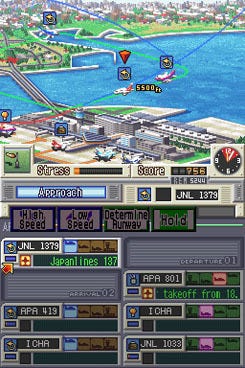
It works like this. Little pixellated aircraft appear in the skies over tidy, isometric, toytown representations of Japanese airports: Fukuoka, Osaka's Kansai International on its man-made island, Chubu, the hateful Tokyo Haneda (half the gates are inaccessible from runways 16L and 34R, if you can believe it) and Hokkaido's Neew Chitose. Each is available in three difficulty settings, which vary the length of your shift and the frequency of arrivals and departures, as well as sometimes introducing weather conditions, although these only really affect your own ability to see what's going on.

As soon as a plane hits the holding pattern (a squared circle) it appears in one of the four "arrivals" slots on the touch-screen. Here you can select it and radio the pilot, telling him to speed up or slow down to avoid crashing into other circling or arriving aircraft, hold, or assign him a runway to land. You need to keep an eye on the windsock to make sure there's not a tail-wind in the direction you're asking him to land, which could lead the plane to come in too fast and need to abort and return to the holding pattern.

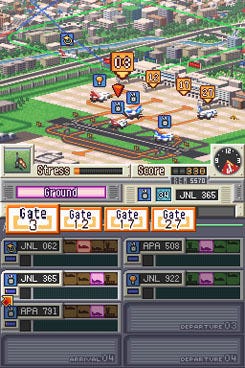
Once assigned a runway, you'll need to confirm the plane is clear to land, or it will automatically abort. Then, once it's touched down, assign it a gate to taxi to, giving permission to cross runways and making sure it won't bump into anything along the way. Sounds pretty simple, doesn't it? But what goes in must come out.

You'll be simultaneously managing departures. Once boarding's done, you need to confirm the plane's route, assign it a runway, wait for a pushback from a tug (and for the tug to return to base), clear it to taxi, give permission to cross if necessary, clear it for takeoff, and tell it to contact the departure radio channel.

Got that? Now consider you could be managing up to four arrivals and four departures, at various stages (or if you're really unlucky or inept, the same stages) at any one time. You need to manage the speed of craft in the air to avoid collisions, and keep an eye on slotting arriving planes into the holding pattern without mishap. You need to manage runway time to get everything on the ground and in the air without chokepoints, traffic jams or tailwinds.

And, perhaps trickiest of all, you need to manage the busy taxiways and gates for arriving and departing aircraft, avoiding ground collisions or long waits for a free gate for arrivals. This blocks further landings on that runway, which will often, due to the wind, be the only one you can use, as well as causing pilots a high level of stress.

Ah yes - we haven't mentioned stress. Pilots' stress increases according to how long they have to wait for their next instruction. Each plane has an individual stress meter, and there's an overall stress gauge that will fail you if it reaches maximum. Stress builds up quicker for some things (waiting for an arrivals gate) than others (assigning a departure runway), and can be mitigated to some extent by reassuring pilots with "hold" instructions. You won't want to do that too much though, as it ties up radio time.

3

And dials.

Right, yeah, radio time. You won't fall afoul of this too much in the earlier levels, but this is where the fun really starts (or rather, doesn't) later on. You have four radio channels - Approach (speed control and runway allocation for planes arriving and in the holding pattern), Tower (speed control for planes assigned a runway to land or on the approach, confirming and aborting landings, clearance to takeoff, contacting departure), Ground (gate allocations for arrivals, runway allocations for departures, clearance to taxi, permission to cross) and Delivery (confirm route for departures).

Each can only issue one instruction to one aircraft at a time, and a typical instruction can take fifteen or twenty precious seconds to transmit. Learning to assign your radio time carefully - balancing it against how long it takes planes to respond and start in on their instructions - is critical to success at higher difficulties. Ground is a tremendous organisational bottleneck, while a non-essential "hold" command issued over Approach at the wrong moment can leave you unable to make a critical speed change to stop a collision. All you can do is stare, appalled and powerless, as the radio chatters away and you wait for the air crash to happen.

It's frantic, intense, requires an organised mind, the ability to shuffle priorities and information at high speed and - most importantly and most improbably of all - a resistance to the stress generated by flashing boxes and alarm sounds. Thankfully the touch-screen interface is extremely fast (d-pad and buttons also work well enough for compulsive playing with gloved hands on cold train platforms, I found) and the retro, 16-bitty graphics are faultlessly precise. You cannot, ever, blame the game. You can only blame yourself, and you can only erase the burdensome guilt and furious frustration by hitting restart and trying, once again, to bring order to Japan's skies.

4

And blue.

Playing Air Traffic Chaos is exactly like having a very busy day at work. It really is debatable whether it's enjoyable at all, and there's a constant, nagging fear that the knife-edge balance between order and chaos is going to tip at any time. At its worst, you can find yourself paralysed by the fear, simply watching in impotent misery as the boxes flash and the little pixel-planes spiral into destructive patterns.

But it's a mighty adrenaline rush, no doubt, and surviving its trials offers a bitter kind of satisfaction, as well as a warmer glow of hard-earned self-worth. Better than that, the system is so impeccably balanced and designed - and the 15 strictly scripted stages are put together with such care - that, when everything comes together and you play a hard stage well, it takes on the deep, intricate beauty of the greatest game of Tetris you ever played.

Air Traffic Chaos is CakeMania for anoraks: a basic, bizarrely unglamorous, stern and unloving mistress that you just cannot bring yourself to leave, to stop wanting to please. The extras, options, and number of stages are a slap in the face, the rewards pitiful and the pain great, but you won't care; and you'll spend dozens of hours compulsively playing it, more than you will many other more lavish and entertaining DS games. I struggled for a long time to come up with a reason for this, but it might be as simple as this: Air Traffic Chaos is, basically, terribly, perfect.

8 / 10

Read the Eurogamer.net scoring policy

Comments (64)

Comments for this article are now closed, but please feel free to continue chatting on the forum!

  • Loading...hold tight!