2, 2, 3, 3, 5, 2, 3, 4, 5.
After a week playing a Chanter in the open beta for Aion: The Tower of Eternity, NCsoft's new MMO, this sequence of key-presses is hard-coded into the muscle memory my left hand. I can tap it out on a table-top, the rhythm steady, urgent yet patient, hitting every skill's cooldown on the nose. Not a second or a mana point wasted. 2, 2, 3, 3, 5, 2, 3, 4, 5.
I used this same stone-set sequence to defeat almost every monster I fought between the levels of 10 and 20. There might be slight variations depending on range, or if I'd made a terrible mistake and found myself fighting two enemies at once - but usually, the circumstances of every one-minute combat in the thousands of them I undertook would be exactly the same, because I'd make sure they were. Anything else would be sub-optimal. Anything else would risk dislodging me from the locked-down groove of the grind.
NCsoft has made much of its herculean effort to create, in Aion, an MMO that could appeal to both its Asian heartlands and the WOW-addled masses of the West. Although it was made in South Korea, it was designed with one eye on the Occident from the start, and since its Korean release it has undergone almost a year of additional "culturalisation": tweaking, testing, translating, adding features and content.
However, it turns out that you can take the MMO out of Korea, but you can't entirely take Korea out of the MMO. Like its predecessors the Lineage games, Aion is predominantly about grind. Hypnotic, repetitive, epic grind. It's just that Aion elevates grind to an art form, and handsomely mounts it in a gilt-edged frame.
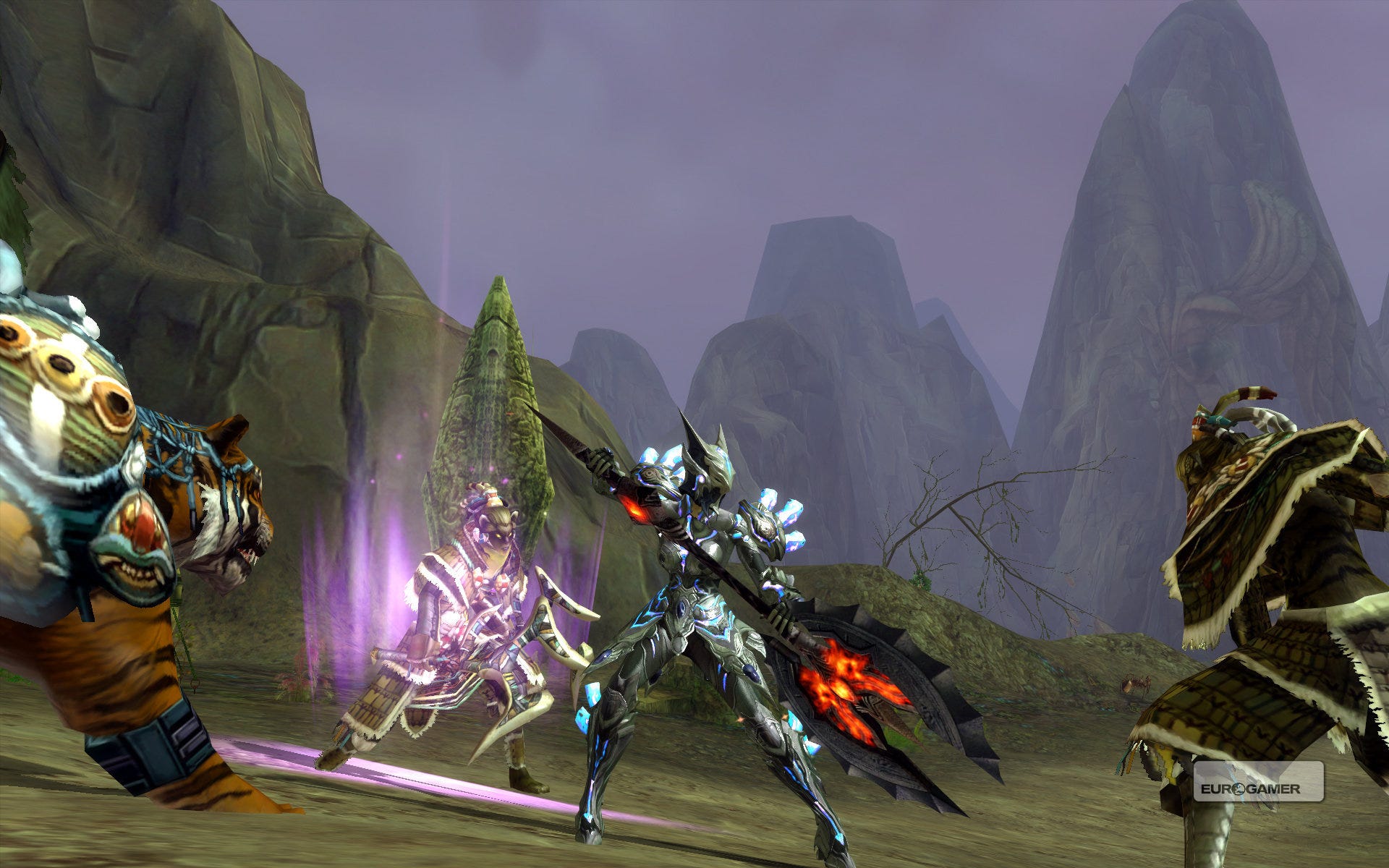
The level bands are tight - two monsters one level above you, or one monster two levels above is a dicey proposition.
This is a deeply traditional massively multiplayer RPG that's been tuned and oiled and lathed down to a perfect, stress-tested, smooth-running efficiency. It's beautiful and flawlessly easy to use. It does everything you expect and nothing you don't - until halfway through its 50 levels, at least. That's when you make your first steps in its central war zone, the Abyss, and things start to get more interesting.
But due to the brief windows and restricted level caps NCsoft has employed in Aion's closed and open beta testing, it hasn't been possible to get a full picture of the Abyss yet - and it won't be for some time after the game's launch this week. Even if you were lucky and dedicated enough to level that far, you were pretty lonely, and the Abyss - which pits the game's two player factions against each other and a third, computer-controlled faction - will only come into its own with enough sufficiently high-level and well-organised players about.
However, we do know a fair bit about it - from the game's Korean launch and from what NCsoft has already said - and that informs this review. We'll return to look at it in more detail in a future re-review.
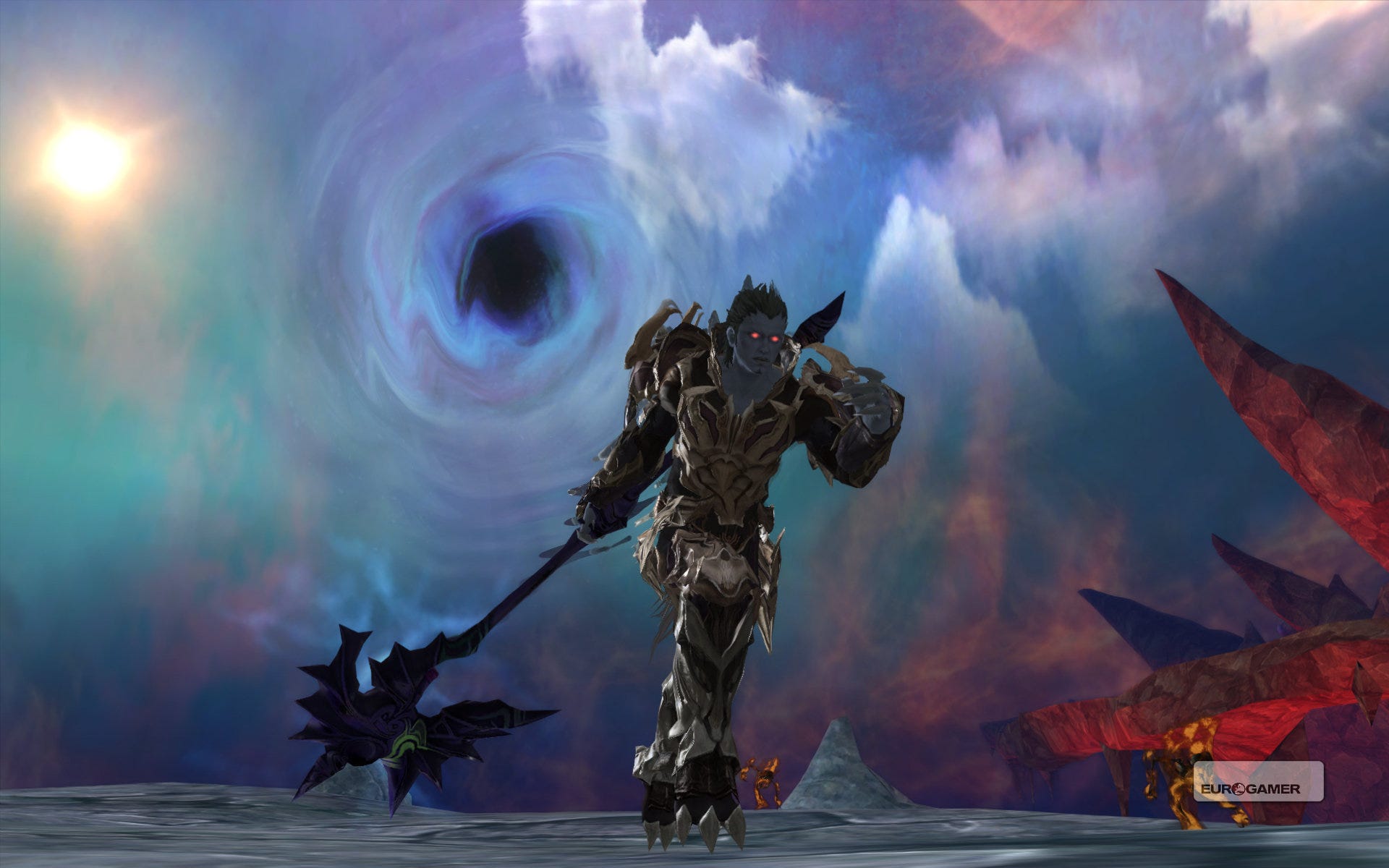
Almost all equipment is socketed and can be improved with the abundant "manastones", adding an extra layer of advancement and customisation.
For a starting player, however, the Abyss is almost irrelevant, because there are dozens of hours of straight-laced questing - and not a great deal else - between you and it. You won't even see the inside of a dungeon, never mind a player from another faction, before level 25. You'll be on your own or grouped with up to five others, running around attractive, slightly surreal fantasy locations, smashing charismatic monsters in the face and occasionally pausing to craft, trade and socialise in Aion's expansive cities.
You'll play as either and Elyos or Asmodian, humanoid races who each occupy one half of Aion's shattered, outside-in planet, Atreia. The Elyos inhabit the sun-blessed half while the grey-skinned Asmodians live in permanent twilight, and have claws and manes - but otherwise, the experience is much the same.
In the classic Korean style, both races are designed to be swoonsome waifs and shampoo hunks by default, but NCsoft has expanded the character customisation parameters considerably for the Western release. A little too much, perhaps. Many players end up looking like catalogue models in a hall of mirrors, with super-deformed, gangling giants and ridiculous midgets skittering around. It makes for an odd clash with the languorous lushness and Gothic majesty of the rest of the game's art, but it is quite funny.
There's no shared content between the races outside of the Abyss, leaving you one, largely linear path to take through the levels. You can start a character of the opposing faction on a different server, but what you find there will be a startlingly similar re-skin of the questing you've already done. Elysium and Asmodae are almost mirror worlds.
Despite the division of your adventuring into a mandatory Campaign thread and regular, optional quests, there's little choice. There's enough to cover your levelling, but only just, so you'll need to do almost every task you're given if you want to avoid pure grinding - and many of the quests are just disguised grind. Diversions from standard-issue kill-counts and measly drop-rates are rare, and you do occasionally hit walls of tough or group-only content that can be tricky to pick your way around or slog through if you insist on soloing. It's a narrow experience.
A good job, then, that the set-dressing is so opulent. There's reams of quest text - puffed up with hot air, but not without charm, and the context and care taken in sketching out the details of this foreign fantasy world is welcome. The striking settings - with their rich, humorous ecology, colourful and cosmopolitan races and fantastical, sometimes haunting atmosphere - are nicely varied and a pleasure to explore. Atreia is a great place to spend time: a vital, but still quite rare quality for an online world.
The easy luxury of the presentation extends to Aion's brilliant user interface: it's quick, clean, comprehensive, comfortable and fuss-free. No mean feat at all in MMOs, a field of gaming which verges on having the same stringent usability requirements as office software.
The game's engine, a modified CryEngine, is a beauty: clean and sharp as a fresh paper-cut, smooth as silk, and surprisingly undemanding of your PC.
Combat - at least as far as the feel is concerned - is tight as a drum. Skills execute immediately with bright, punchy sound effects and swift animations. There's a satisfying crispness, a moreish, Pavlovian, knee-jerk enjoyment to key-pounding the relatively hardy monsters into the dust. It turns out that's just as well, because it's all sheen; the depth is an illusion, a reflection in its brightly polished surface.
Although the skills are intuitive, their effects are quite basic, and there's little interaction between them or with the behaviour of enemies or other player classes. Your tactics almost never alter beyond the slotting in of new skills, the lengthening of certain rigid combos, as you level up. With few utility or escape abilities available, opportunities to think on your feet are scarce, and getting out of trouble depends on luck and bloody-minded persistence rather than imagination or skill. Pop your consumables, hope the percentage game plays out in your favour, and stick to your rotation. 2, 2, 3, 3, 5, 2, 3, 4, 5.
The ability set up a personal shop - leaving your character as an automatic vendor hawking your wares on the street - is a cute alternative to the broker that also helps give the towns and cities a lively feel.
Aion's deep-seated conservatism is also evident in the class design. The eight classes - four initially, with a secondary choice at level 10 - are rigidly traditional, with next to no hybridisation or original features at all, apart perhaps from the Chanter, a buff-merchant with adequate skills in both combat and healing. They're all solidly effective (and making the healers relatively durable, with mail armour, is a nice touch) but stolidly unimaginative. This situation is relieved when you get access to the Stigma system later on in the game, allowing you to collect and equip certain skills from other classes or later levels like loot. It's rewarding customisation, but not a substitute for class design that's interesting at its root.
Your class choice at level 10 - at which point your character recovers from a bout of amnesia and remembers it's a Daeva, a kind of demigod - comes with a couple of other perks. The first, famously, is a pair of wings, but these are of very limited use until you reach the broken, floating landmasses of the Abyss later in the game; flight is restricted to certain areas and on a short timer. The second is a class-specific super-ability with its own resource, Daeva Points, which you grind up slowly through combat. It's a useful get-out-of-jail card, and a well-judged death penalty - losing your Daeva Points when you die stings your pride more than it hampers your progress. You lose a little XP too, which can be bought back for cash.
On that subject - gold-sinks are everywhere in this game. Everything in Aion costs you money, and quite a lot of it. It's a shock to the system at first, but it's actually a very balanced economy, going by the thriving player trade in the beta. Feeding into this, crafting is detailed and enjoyable, with some great rewards. It's not mandatory, however, since there are plenty of ready sources of good loot in the game; quest rewards are plentiful, regular enemies drop some nice pieces and the armour sets are stunningly detailed and covetable. You won't have any trouble figuring out what boosts are for you, either, thanks to Aion's self-explanatory stat system.
Beyond the somewhat shallow, prescriptive combat, it's hard to pick holes in Aion. Community, economy, persistence, customisation, long-term advancement - all these peripheral areas, so often shaky in an MMO's early days, are carefully thought-out. Everything feels taut and considered, assembled from NCsoft's wealth of experience in online gaming as well as a careful study of what World of Warcraft did right (albeit what it did right five years ago - like most rivals, NCsoft is still some way from catching up with what Blizzard is doing right today).
But, pre-Abyss, it's very, very samey. And when you do get to level 25 - when Aion starts to show its true colours - there is no guarantee that you're going to like what you find.
Like Warhammer Online, Aion seems like an MMO for the everyman on the surface, but actually has a very specific agenda. This, embodied in the Abyss, is the concept of PvPvE (player-versus-player-versus-environment): the three-way clash between the two players races and the crazed, dragon-like Balaur. It's a mix of questing, skirmishing with other players, raiding and being raided by the Balaur, capturing "artifacts" (control points which convey buffs to your side), and waging large-scale, organised and (going by footage from Korean servers) spectacular siege warfare over the very valuable fortresses. All of this rewards you with Abyss Points, the key currency for the best endgame loot.
It's a shame that play-fields on a single server had to be divided into separate, instanced "channels" that you often need to switch between to find party members.
To get the most out of Aion, you're going to have to engage with the Abyss, get organised with other players, and enjoy both PvP and PvE. In this game, the two are almost inseparable. It seems to be a compelling system, and after a good run in Korea, it will probably be well-balanced. But it won't be to all tastes, it will depend on large player populations with strong leadership, and there are few alternatives to indulge in.
Instanced dungeons offering a more focused PvE challenge are quite rare before the very highest levels. Similarly, PvP is tightly controlled by level, and only available in open-world areas, with the city Coliseums offering the solitary opportunity for a jump-in, casual bout. Outside the Abyss - where raiding parties are able to use Rifts to travel to the opposing faction's side - it's hard to find a scrap when you want one, and hard to avoid one when you don't.
The useful dictionary of items, locations, enemies and NPCs, with map links, is a great and relatively spoiler-free alternative to the more explicit quest guides out there.
You'll either like the sound of this singular blend of MMO play-styles or you won't. If you do and are prepared to take the quality and sustainability of the high-level content on trust, for now - trust which, to be fair, the game seems to deserve - I'd recommend it. Aion's particular vision is built on a rock-solid if uninspired foundation, a meticulous mastery of the traditional MMORPG form. It might as well have been made by Toyota or Volkswagen. It won't let you down.
If you don't like the sound of the Abyss, however - if you're the sort of player who likes an online world to bend to your whim, rather than bend you to its own - then committing to Aion is a gamble, because there's not much else to be wrung from it but the grind. A streamlined, structured, gorgeous grind, an addictive and even rewarding grind if you're that way inclined, but a grind nonetheless. An ultimately grim and unvarying pursuit. A string of key-presses, in the same endlessly repeating sequence, reaching to the moon and back. 2, 2, 3, 3, 5, 2, 3, 4, 5...
7 / 10
