Flight of Fantasy

A history of the recurring dream.

Occasionally a videogame so perfectly exemplifies a particular type of gameplay that its name becomes interchangeable with that of its genre. Mario is easy shorthand for the Platform game; Tetris, piece by piece epitomises the Puzzle genre; Dance Dance Revolution is foot sign language for Rhythm Action; and Street Fighter's Ryu and Ken, even today, bounce hunched as poster boys for Beat-‘em-ups everywhere.

And so it is with Final Fantasy, a brand so synonymous with the Japanese Role-Playing Game that your affection, indifference or dislike towards one is almost undeniably tied to that of the other. Indeed, surely the reason that Final Fantasy divides opinion perhaps more than any videogame series is because it has so typified an avenue of gaming that, perhaps more than any other, divides opinion.

Sceptics argue that the series has increasingly just dressed ancient mechanics in fanciful multi-million-dollar clothing; that tired narrative and battle conventions, created 20 years ago as a way to best construct an epic from rudimentary technological building blocks, have been left to age hidden and unattended under increasingly thick graphical make-up. They argue that those universal threads that tie the disparate worlds of each game together - the Chocobos and Phoenix Downs and Cids and orphans and airships - have weaved a prison of a template against which creativity strains; that underneath the curves and go-ever-faster stripes, a decrepit engine splutters ­- one that should have been long consigned to videogames' mechanical scrapheap.

Fans, meanwhile, talk in hit points: Four of the top ten slots in Famitsu's Greatest Videogames of all Time poll earlier this year (including the top two positions); over twenty games released, each one more successful and ambitious than the last; thousands of adults in tears over unseen plot twists, death and opera; tens of millions of units sold, each one further propelling the Final Fantasy brandwagon deeper into a mainstream consciousness that haters argued could never be penetrated by such nerdy carriage.

So, in the lead up to the US release of Final Fantasy XII - that will likely become the defining game of the series' Sony years and the title most likely to silence the genre's critics with its brilliance - Eurogamer takes a look back over an impressive and remarkable history and reassesses whether yesterday's fantasies might still titillate today.

The Nintendo years

Final Fantasy
  • Original System: Famicom
  • Japanese release: December 18th, 1987
  • US release: July 12th, 1990
  • Other versions: NES, MSXII, Wonderswan Color, PlayStation, GBA
1

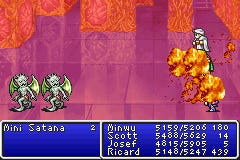
The GBA's Final Fantasy I&2: Dawn of Souls.

It was an American expatriate, Henk Rogers, his head full of Tolkien, dragons and dungeons, who first laid down the JRPG template in 1985 with his Japanese MSX title Black Onyx.

The next year Japanese developer Enix married Roger's mechanics with anime sensibilities to create Dragon Quest and, in doing so, made sprite questing and random battling as popular as Pac-Man throughout Japan. But it was the following year that Hironobu Sakaguchi's Final Fantasy would turn his ailing company Square's fortunes around, make the JRPG name famous in the West, and kick-start the careers of artist Yoshitaka Amano and chip orchestra composer Nobuo Uematsu.

Named ‘Final' either because it was to be Sakaguchi's last game or because, if it failed commercially, it would be the last game Square could afford to create (he has claimed both in interviews), Final Fantasy defied the pessimism of its fatalistic naming. The game's team-based approach to fighting and the range of different world influences on its internal mythology was fresh and would establish the bold lines that so many subsequent clones would carefully trace.

Playing the game now is a mostly tortuous experience, despite the fact Famitsu readers voted the game the 63rd ‘Best Game of all Time' earlier this year. All but the most sentimentally minded retrogamer will baulk at the machine gun volley of random battles, the disorientating lack of world map and a plotline so rudimentary and linear it could be inscribed on a toothpick. In the late 1980s these basic collections of sprites might have fired our imaginations to fill out the unspoken colour, texture and subtlety of their worlds, but nowadays, as gamers used to having all of our visualisation work done for us by ten thousand perfectly choreographed dancing polygons, this stands as little more than a dusty museum exhibit of emergent gameplay.

Eurogamer review.

Final Fantasy II

  • Original System: Famicom
  • Japanese release: December 17th, 1988
  • Other versions: Nintendo Entertainment System, WonderSwan Color, PlayStation, NTT DoCoMo FOMA 901i, KDDI au BREW, Game Boy Advance
2

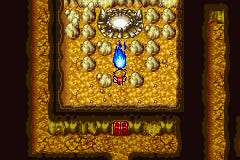
Dawn of Souls, again.

Final Fantasy II is of historical significance, not only because it introduced series' stalwarts like Cid, chocobos (here coloured white not yellow) and orphans for lead protagonists, but also because it saw Akitoshi Kawazu promoted to lead producer on the game. The differences between Kawazu's Final Fantasy II and Sakaguchi's original title are so stark it's extraordinary they even share the same name.

In Sakaguchi's Final Fantasy, players selected and named four characters of six different classes and saw these characters develop chronologically and logically through successfully completing battles. Conversely, in Final Fantasy II, the player is stuck with four set pre-named characters (Firion, Maria, Guy and Leon) that level up their offensive and defensive statistics (such as weapon and magic proficiency) not by experience points but randomly though repetition of moves.

It's an intensely frustrating mechanic further broken by some shocking bugs that allowed the player to easily cheat the system. Although the idea was mercifully removed from all subsequent Final Fantasy games (along with Kawazu right up until his late and brave promotion to lead producer on Final Fantasy XII) it reappeared in and throughout the designer's subsequent and much-despised Romancing Saga* series.

Additionally in Final Fantasy II, enemy's statistics aren't preset (their power is exponentially determined in relation to the player's level), so it's possible to reach the final dungeon (where the four kids venture to the depths of hell) having leveled too much, forcing a restart from the very beginning of the game. These crippling design flaws ensure that this is widely regarded as the least favourite game in the (main) Final Fantasy lineage.

Nevertheless, at the time the title sold well thanks to a Japanese market newly enamoured by the genre and the popularity of the first game. Final Fantasy II was set for US release (indeed it was even advertised in several trade publications as the enticingly suffixed Final Fantasy II: Dark Shadow over Palakia). However, by this time (the first Final Fantasy game wasn't released in the US until 1990) the Super Nintendo system had already shoved its ageing parent into retirement's shadows and Square decided instead to catch up with the Japanese and begin work on translating Final Fantasy IV instead.

Eurogamer review.

(Incidentally, Kawazu's first Saga game, released on Game Boy, was confusingly released as Final Fantasy Legend in the US and Europe - although the games are in reality from completely separate families.)

Final Fantasy III
  • Original System: Famicom
  • Japanese Release: April 27th 1990
  • Other versions: Nintendo Family Computer, Nintendo DS
3

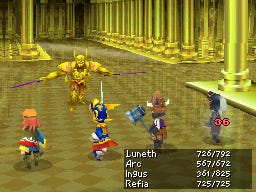
The eagerly awaited DS title, Final Fantasy III.

The third game in the series was Square's first real pioneering triumph. The relative financial success of its forefathers enabled a generous financial and temporal budget (over two years of development time) to create something altogether more intricate. With Sakaguchi back at the design helm the direction was more focused and the expanded team were able to create some of the best looking environments that would ever be seen on the now-creaking Famicom system.

Again focusing on the lives and quest of four young orphans charged with restoring balance to the world, the game also introduced to the series for the first time many of the themes and icons fans love and expect today: Moogles (originally called Moglies in Japan), summon creatures, the fat chocobo and his gyshall greens (named after a town in this game), auto-targeting, Dorga and Unne (two characters that would appear in many subsequent Final Fantasy games), floating hit points when characters dealt or received damage, the beloved job system (where characters could ascribe characters to branching ability forks) and the first special commands such as ‘Steal'. Indeed, much of what the modern player expects from a Final Fantasy game debuted in Final Fantasy III and its DNA can still be clearly seen informing even the most recent PS2 game.

The least remade of the early FF games (indeed, it has never been released in English officially), an eagerly anticipated enhanced version is soon to come to the western DS. You can expect a full appraisal from Eurogamer as soon as it does.

Final Fantasy IV

  • Original System: Super Famicom/ SNES
  • Japanese Release: July 19th, 1991
  • US Release: November 23rd, 1991
  • Other systems: SNES, PlayStation, WonderSwan Color, Game Boy Advance
4

Final Fantasy IV Advance on the GBA.

The move from NES to SNES for the Final Fantasy franchise was more than just a simple graphical upgrade - although, thanks to flashy Mode 7 effects and painstakingly detailed sprites, this is certainly one of the best looking SNES games of the era. Rather, this iteration saw Square now promoting plotline from mere incidental to indispensable pivot.

Final Fantasy games since the fourth game have always opened in medea res thrusting the player into the thick of an unfolding situation. Most second rate JRPG stroylines (even today) open in a small village with a young boy awakening to begin a journey on whose outcome the universe's fate seesaws precariously. Conversely, Square in Final Fantasy IV chose as its setting the upper echelons of a politically-charged castle courtroom, the player cast as a powerful knight, who keeps the king's ear: one Cecil Harvey.

The game opens as Cecil challenges his sire's ethics following a vicious sanctioned raid to steal a jewel from a nearby town. Such outspokenness is not tolerated by the king and Cecil is swiftly disgraced, demoted and sent away on a humiliating lowly errand to deliver a package to a remote town. Upon arrival the package reveals its content in the angry violence of a hot explosion. When Cecil awakens the town around him has been destroyed in the blast and its inhabitants mostly killed. He discovers a girl standing over the still body of her mother before, moments later soldiers from the king arrive to confirm his death and kill the girl.

At the time it was an awe-inspiring opening the likes of which had not yet been seen in a JRPG. This core creativity was enhanced for English speakers no end by Ted Woolsey and Kaoru Moriyama's sterling translation work (Woolsey would later be wholly responsible for the even better English translations of Secret of Mana, Chrono Trigger and Final Fantasy VI) and as a result this is one of the first Final Fantasy games to be genuinely enjoyable today.

Notably, the US release of Final Fantasy IV was dubbed Final Fantasy II to maintain continuity (after all, this was only the second game to be released in the territory) but still there was no release for Europe. The US version was severely tweaked: the difficulty vastly reduced to make the game more accessible to westerner newcomers to the genre and risqué graphics such as sprite cleavage on female monsters and bikinis on town dancers were censored (specifically replaced by leotards). The resultant US version of the game was so different from the Japanese one that it was actually re-released back into Japan as Final Fantasy IV Easy-type.

The recent GBA version far more closely resembles the original Japanese version with reinstated plot developments and special moves. In fact, for once Eurogamers get the best deal as the UK version of the game even irons out some technical issues that are present in the US version.

Eurogamer review.

Final Fantasy V

  • Original System: Super Famicom/ SNES
  • Japanese Release: December 6th 1992
  • Other Systems: Super Famicom, PlayStation, Game Boy Advance
5

Final Fantasy V Advance on the GBA.

Final Fantasy V was the game that embittered Western fans more than any other. Inexplicably, instead of translating and releasing this, the next Japanese title in the series, Square chose to publish the disastrous part-US developed RPG-lite Final Fantasy Mystic Quest in its place (a game which boasts a storyline so vacuous it can't even really be described as bad).

Fans hungry for the next title in the true Final Fantasy lineage were left to import, Kanji dictionary in hand, and produce printed translations of the story to share amongst themselves. Final Fantasy V was in fact one of the first Japanese-only RPGs to receive a translation patch for its PC ROM image, opening the floodgates to fan localisation.

As a game the emphasis moved from plotline to making the battle system as deep and complex as was possible with the hardware. As a result of this focus several important features debuted. Firstly the Active Battle System (whereby the time which a player took to issue commands to his team became a factor) was made evident. In fact, the ATB system (which would go on to appear in many other Squaresoft games) had been present but hidden in Final Fantasy IV having been designed by that game's planners Hiroyuki Ito and Akihiko Matsui. However, here the player could actually see a gauge indicating how long until his characters and the enemies had before they could make their next attack.

The game also sported the most complete job system (first seen in Final Fantasy III and later further expounded upon in the excellent spin-off, Final Fantasy Tactics) which allowed the player generous customisation of his team (up to 22 different jobs could be mastered). Likewise, this was the first game where chocobos played an active role in the plot. The lead character Bartz is accompanied for much of the game by a yellow chocbo Boco and different coloured chocobos (black) are also revealed for the first time.

Finally released in the west in 2002 as part of Final Fantasy Anthology, and, soon to be released on GBA (it was released in Japan earlier this month), the game plays extremely well today thanks to the job system - an RPG mechanic that has been oft copied poorly but rarely bettered.

Final Fantasy VI

  • Original System: Super Famicom
  • Japanese Release: April 2nd 1994
  • Other systems: SNES, Playstation, GBA
6

Final Fantasy VI on the GBA.

Ask most Final Fantasy fans that came to the party before the seventh game which is the best of the lot and this will be their answer with little hesitation. Many contend that this game, the acme of the 2D RPG, is yet to be bettered by any other role-playing videogame.

What it lacked in PlayStation-style full motion videos it more than made up for with the most graceful plotline of the series (which includes, daringly, the destruction of the world halfway through), and an ensemble cast each member of which is so perfectly pitched a semi-tone between the archetypes that you can't help but fall in love with each one's narrative serenade.

Final Fantasy VI was the first game in the series (and probably of all the JRPGs) to drop the orthodox medieval knights and castles setting in favour of a steampunk industrial landscape. Eurogamer recently had chance to speak with Yoshinori Kitase, director of the game, and asked him what inspired the change of scenario. "Before Final Fantasy VI, most of the RPGs were based on European heroic fantasy kind of world and people in Japan were becoming very bored by that," he said. "We felt we had to make changes to Final Fantasy in order to take into account this fact. At the very beginning of the game design, we had several ideas and orientations not normally drawn upon by RPGs. So for example, the game's opening was inspired by the movie ‘NY 1999' and we based the script around an ensemble cast rather than a single main protagonist. I think that our ideas to bring the spotlight to not one central hero but to an entire group of characters, was the main originality in this game".

Indeed, the game has the largest cast of playable characters of all the Final Fantasy games: fourteen permanent characters and a number of temporary ones including the first playable moogle (Mog). Other notable introductions to the series are the characters Biggs and Wedge (named after Luke Skywalker's wingmen in Star Wars), Espers (which reappear in FFXII) and Desperation Attacks (aka Limit Breaks).

Today Final Fantasy VI remains a marvel of technical achievement both in terms of graphics and Nobuo Uematsu's jaw dropping score (which, at one point includes a spine-tingling aria that stretches the SNES' humble chip vocal chords to sound like a microchip-bound arch-angel). It's a rare example of excellent videogame storytelling, of brilliant localisation and, thanks to some near imperceptible minor chords underpinning the narrative; this is a game that will haunt any player, old or new, to his grave.

As the third game to be released in North America,. Final Fantasy VI's name was changed to Final Fantasy III for the territory. For the 1999 PlayStation re-release the numbering was restored to the original VI. It remains so for the forthcoming GBA release this winter, which will naturally enjoy a Eurogamer review soon thereafter.

Join us again tomorrow for part two, dealing with the PlayStation years, with our review of the US Final Fantasy XII arriving on Tuesday.

Comments (72)

Comments for this article are now closed, but please feel free to continue chatting on the forum!

  • Loading...hold tight!