Delightfully Strange

A Love Letter to the DS.

The conversation went like this:

  • John: You know how we're always going on about how extremely lovely the DS is? How it does weird and wonderful better than anything else?
  • Tom: Yeah, we should probably stop repeating that.
  • John: Ah. Oh. [Quickly changes his pitch] Well I was thinking we should have a feature on EG to sort of, er, put an end to it - a definitive guide to what makes the statement so true.
  • Tom: Oh, go on then.

So here it is. This is the article intended to stop us banging on about how much we love the DS itself, rather than the game we're supposed to be reviewing. It's the piece to celebrate one of the best things to happen to obscure videogaming in years. It's not Nintendo-sponsored puff. It might sound sycophantic, but that's the cynical earwax that prevents your hearing happiness. It's a guide to the little handheld that could, defying the naysayers' predictions of defeat at the hands of the PSP, standing up to the bullying cries of, "Hey, specky two-screens!" We're getting touchy-feely about the touchy-feely. This is a love letter to the peculiar.

A date with DS-tiny

The DS wasted no time in being odd. In amongst the launch releases were Ping Pals, Feel The Magic XX/XY (Project Rub), Wario Ware: Touched!, Sprung: The Dating Game, and of course, Zoo Keeper. Sure, it had Asphalt Urban GT, Spider-Man 2 and Tiger Woods PGA Tour to feed those looking for the generic, but astonishingly, the oddities outnumbered the mainstream. For goodness sakes, two of them are loosely based around dating.
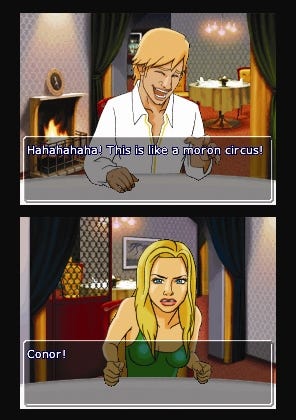
sprung

He's not entirely wrong.

Sprung is a fairly terrible game. But examine what kind of terrible game. It's a conversation-based dating sim, designed to teach you how to pull members of the opposite sex. Well of course! A relatively popular genre in Japan (let's be honest, there's a fair chance you can interchange the term "weird" for "popular in Japan" for a good portion of this piece), Sprung is a Western attempt at the idea.

Clearly intended to be for boys, the writers' hopeless attempts at creating a female player character are immediately farcical. In the opening conversation, Becky is immediately asking Brett if she can punch him in the face. Punch him in the face. Huh? The confused sexism works in all directions, with Brett assumed to be hopeless, desperately needing Becky's sympathetic guidance, while when playing as Becky she's self-assured and more prone to mock or abuse Brett.

On the other end of the dating game quality spectrum was Feel The Magic XX/XY. Renamed Project Rub in the UK, but originally - and most wonderfully - called I Would Die For You in its native Japan, however you might know it, it was evident of Sega's contraction of the fever spread by DS development. Presenting itself as a game about winning a girl's heart, Rub is purest madness, boiled in a conical flask, then distilled and titrated into silhouette-based cartoon minigames.

Along with its sequel, The Rub Rabbits! (or the infinitely superior Japanese name, Where Do Babies Come From?), it carries the warning, "Do not attempt to recreate any of the scenes in this game". (Something that should more properly have accompanied Sprung). So any who play them, and it should be everyone, will be we advised not to attempt to help a man vomit accidentally swallowed goldfish, enter the correct numbered sequence into a calculator in order to open a parachute, or breathe fire at oncoming robots. Which brings us to another important part of the DS. Breathing.

A breath of fresh air

When Nintendo added a microphone to the machine, it surely can't have intended everyone to use it for blowing on. But aside from booming "HOLD IT!" at Phoenix Wright's bumbling judge (don't worry, we're getting to him), it's rarely used for anything else. From Wario Ware: Touched!'s lunatic minigames to Lost In Blue's fire-starting, the microphone has become little more than an anemometer. And this is testimony to the subject at hand: everything about the DS' design encourages the unusual.
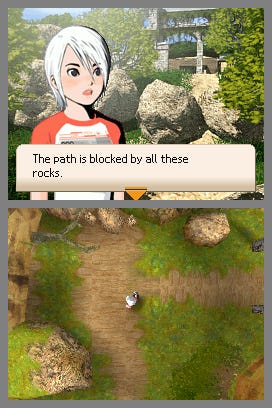
code

Another Code looks gorgeous, but beyond its Brechtian estrangement does somewhat lack depth.

Another Code (or Trace Memory abroad) makes for an interesting example. Essentially a point and click adventure, it was the first suggestion that the DS might provide a home for a genre in exodus. The stylus, should a designer wish, can be a substitute for a mouse, but in a refreshing manner. A mouse and its cursor are a three foot wire apart, but the stylus and its mark are touching. It creates intimacy. It creates a connection between the player and the device, and nothing understands that better than Another Code. Despite being a really very average adventure game, developers CING demonstrated an early depth of the peculiar potential.

Your DS exists within the game, and as something distinct from it. It creates a midpoint between novelty and Verfremdungseffekt. While there are only two good puzzles, they're two really good puzzles, asking you to recognise the DS as a distinct object, separate from the game it's displaying, as well as a tool within the game it's displaying. One requires that you reflect the top screen onto the bottom, emulating a folding glass picture frame found in the game, to reveal a completed image. The other puts an inked woodprint on the top screen, and a piece of paper on the bottom. You have to get the print onto the paper, and no amount of tapping will achieve it. And then, looking around you to make sure no one is watching, and expecting humiliation, you close the DS shut. Opening it reveals the piece of paper decorated with the picture. And breathe out in relief. You were right - the solution is that strange. Nevermind huffing and puffing onto the mic to clear a mirror of dust.

A good point

Beyond having two screens, the next most distinguishing feature of the DS is obviously its stylus. While there's little more irritating than the person who spends their life on trains tapping away on the touch screen of their mobile phone-cum-sat-nav Raspberry, bellowing at some poor unseen secretary that they'll have to make the 5 a 6 because of squash with Martin, seeing someone use it to play a game changes everything. Nintendo's belief that this manner of input might be the primary control mechanism for a gaming device was... Brave? Insane? Probably both. But impossibly right. It just flipping works.

Whether its making an FPS viable on a handheld with the wonderful Metroid Prime: Hunters, or tapping at targets in the decidedly mediocre Point Blank, the stylus has proven itself. But of course it's also bred its own brood of lunacy. A set of buttons can be assigned to pre-ordained commands, but a pen in your hand inspires creativity. Add in a screen receptive to your imagination, and there's suddenly room for something new.

While the disgustingly perfunctory Yoshi's: Touch & Go did it first, two games stand out as embracing the pen-like qualities of the stylus. Yoshi can sod off for being two levels long. First is the much underrated Pac-Pix. Definitely too short (but still infinitely longer than that bastard turtle's premature offering), Pac-Pix offers something that no other game has ever come close to, and no other medium could allow. You draw the Pac-Man, and he comes to life. Engaging with the magical nature, the game's loose story is about an invasion of children's books by evil ghosts, who must be removed by adding Pac-Man to the page. An outline of Pac-Man is drawn, and no matter how poorly you scrawl him, that exact wiggly monstrosity springs into animated action, chomping ghosts in his path. The sight of some abortive Pac-Man mutant, inexorably dragging his Elephant-Man-alike design across the page, is bizarrely disturbing. But he's your abortive mutant Elephant Pac-Man.

pacpix

Poor mutant Pac-Man. Merciful obliteration awaits him at the side of the screen.

The other is of course Kirby: Canvas Curse. We say "of course", because we've played it. But who could have expected boring old Kirby to come good. Kirby, like Pac-Pix, doesn't cast you as the character, but as the person sat in front of the character holding a stylus. He's little more than a helpless pink ball, and you are his protector. The stylus once more draws ink on the screen, this time from a limited, but replenishing reserve. Kirby rolls along them in the direction you draw, and is further propelled by giving him a prod. Draw a ramp and then poke his tummy and he'll go flying off the end. Draw a vertical line and he'll bounce to a stop. And it's beautiful. It's like nothing else. Certainly a PC's mouse has been used in somewhat similar ways, but it creates nothing of the immediacy and intimacy of just drawing the line right there on the screen, and having the game respond perfectly.

A deliberate subterfuge

The infectious nature of the DS' oddness isn't exclusive to the more esoteric games. While some make less inspired use of the stylus, or have throwaway attitudes to the second screen, there's still a drive to be in on the joke, in with the gang. Have a look at this list of DS games:

  • Guilty Gear: Dust Strikers
  • Tao's Adventure: Curse Of The Demon Seal
  • Castlevania: Dawn Of Sorrow
  • Advance Wars: Dual Strike
  • Dig Dug: Digging Strike
  • Mr Driller: Drill Spirits
  • World Championship Poker: Deluxe Series
  • Lunar: Dragon Song
  • Resident Evil: Deadly Silence

The subtitles. See?

And then there's the even more subtle recurring appearance of characters' hands reaching toward you on the box covers.

While these two are the most distinct, check out Luigi's left hand on the front of Super Mario DS (or Mario 65 as I prefer to call it) and Mario & Luigi: Partners In Time (a game deserving of a weird games feature of its own, despite almost ignoring every aspect of the DS). And then there's the covers for Rayman DS and Another Code.

A touch of madness

As we finish this celebration of why we're so ludicrously in love with our flip-top flipped-out handheld, there are still so many games we should rant on about.

What about Trauma Center: Under The Knife? You're a trainee doctor, except you've seemingly received no training at all. It's in at the deep end in DS Land! Wield a scalpel, slice open your patients, and begin the frantic business of injecting, lancing, extracting, cauterising, and sewing away at their vital bits with your stylus. Get yelled at by nurses and read through pages of superb hyperbole/story, and then find the whole business far too hard and stressful, and decide to become a lawyer.

wright

An actual photograph from a real court, yesterday.

And is there a game more full of joy than Phoenix Wright: Ace Attorney? As everyone knows it's really an uber-port of the GBA's Gyakuten Saiban, but this time in English. But this is no GBA game stuck on the DS. This is everything that makes the DS so wondrous. Embracing the point and click adventure abilities, and combining them with a how a legal system would work if Daffy Duck wrote it, it's one of the funniest and most endearing games to appear on any system. And you can yell "OBJECTION!" right into the mic. Sure, it's ridiculously linear - objectionably ("OBJECTION!") so at times - and yes, little is more frustrating than the game's not having thought of the incredibly obvious connection between the witness statement and contradictory evidence you present, but the happiness transcends it all. With its beat-em-up sound effects insanely transposed onto courtroom antics, and the bouncy-cheeriness of sidekick Maya (oh, and of course her ability to channel the spirit of her dead sister Mia), it offers no sense of reality, and yet an internal illogic that fits perfectly. And play through to the end and you'll reveal a fifth, brand new, super-long chapter that embraces the rest of the DS, from the mic to using the stylus to rotate objects in a 3D inventory.

We've failed to mention the brilliantly silly and delightful Nintendogs, or the realisation that Advance Wars was always meant to be on a DS with touch-screen control but we just didn't know it, or how Animal Crossing is made so much more lovely, or pushing Pac-Man around in Pac'n'Roll. And this is to entirely ignore the current epidemic of brain training games. The DS, in its infinite weirdness, seems intent on making you more clever - in interesting, involving and most of all, unique ways.

A stylish ending

Will this be enough? Will we get over our infatuation with the DS's abnormal nature, or even grow used to them? Will we be in control of our hyperbole as we crack computers in Project: Hacker, or cook up a storm in Cooking Mama? What about when Contact arrives later this year, and we help an alien professor retrieve his spaceship while playing as a young man unaware that the professor is aware of our playing...? No, no it won't. Obviously not. But that's ok. Because this is why we care: the DS is invigorating games development. It's shaking things up, throwing in a twist of lemon, and then pouring it on the carpet. It's the antithesis of the stagnation found in so many other areas of gaming. It's about tactile intimacy. It's about imaginative innovation. We are gamers, and we really love games. It's clear the DS inspires others of the same mind, and for that we're madly grateful. Thanks, little guy.

Comments (110)

Comments for this article are now closed, but please feel free to continue chatting on the forum!

  • Loading...hold tight!