The Rise and Fall of Sega Enterprises
Game over, yeah.
When Sega discontinued production of the Dreamcast console in 2001 and withdrew from the domestic hardware market, it marked the conclusion of one of the most tumultuous and error-strewn periods in the company's 72-year history. Sega Enterprises' spectacular fall from grace during the course of the 1990s remains a tragic spectacle of overconfidence and woefully misguided business practice.
At the start of the decade, Sega stood astride the gaming world like a colossus; it had smashed Nintendo's vice-like stranglehold in the US and conquered Europe with its street-smart marketing. But by the close of the '90s, the company's reputation was in tatters, its user-base had all but collapsed and it was driven dangerously close to the yawning abyss of insolvency.
This is the story of how The House That Sonic Built came crashing down in spectacular fashion.
Sega started the '90s as the underdog. Nintendo's control over the US and Japan was all-encompassing; it held sway over 90 per cent of the global video game market and had effectively swatted away the limp challenge of Sega's Mark III (also known as the Master System). The 8-bit Famicom was under millions of TV sets in Japan, while the western variant - known as the Nintendo Entertainment System, or NES - achieved similar penetration in North America.
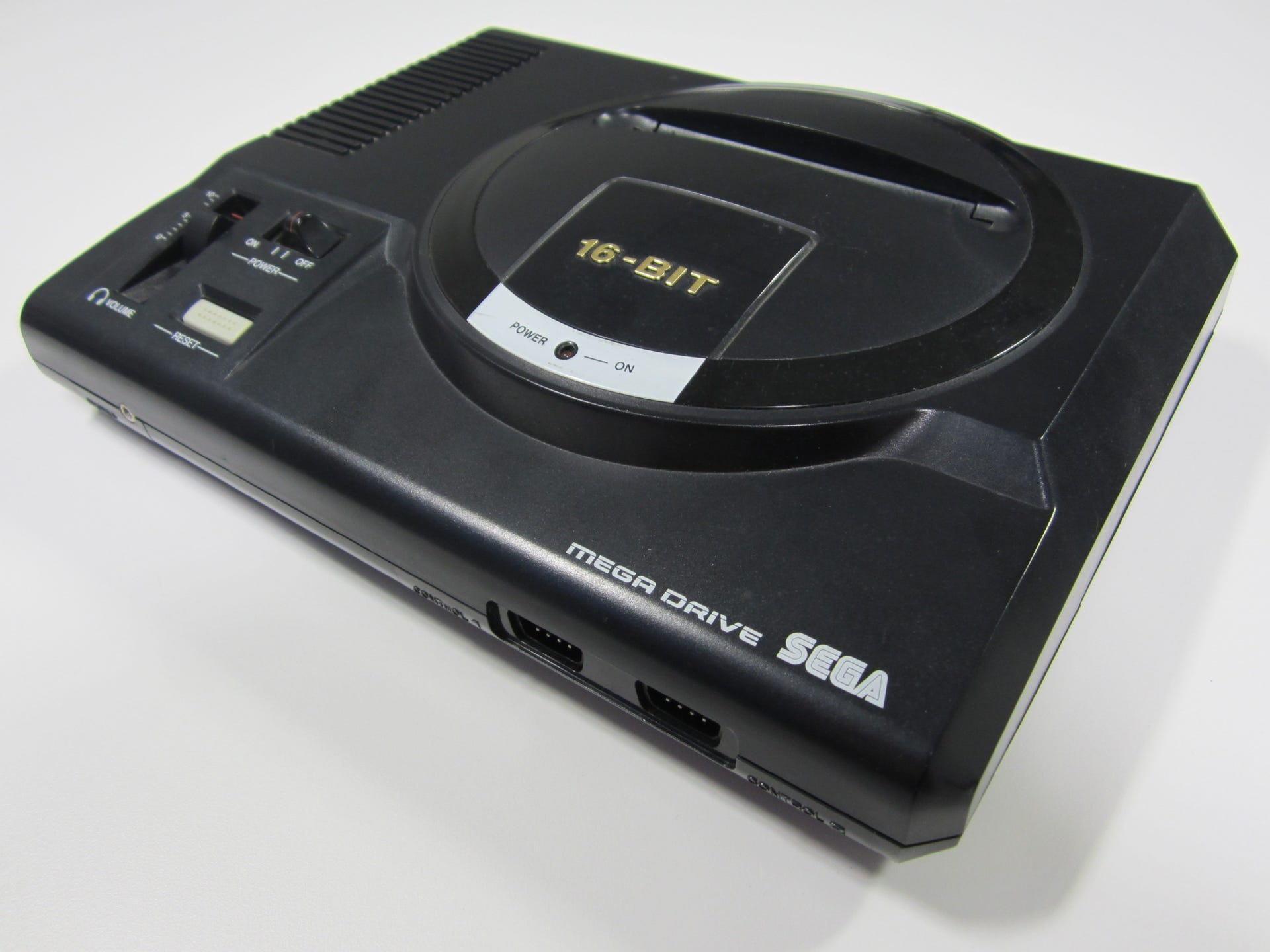
The 16-bit Mega Drive - known in the US as the Genesis - remains Sega's most successful home console. It sold around 40 million units worldwide.
However, that was all set to change with the unveiling of the 16-bit Mega Drive. Released in its native Japan at the close of 1988, the machine had struggled to unseat the incumbent Famicom, but it would be in the West where Sega's true fortunes lay.
The stars began to align with the 1989 launch of the Mega Drive - rechristened Genesis - in North America. After a encouraging start, the new console started to chip away at Nintendo's previously unassailable lead. A savvy combination of faithful arcade conversions and licensed sports titles helped establish a prestigious user-base, but it took a certain blue hedgehog to really hammer home Sega's message.
"I think Sega hit strongly on two fronts: marketing and Yuji Naka, who of course gave the company Sonic," comments Scot Bayless, who served as a senior producer at Sega of America during the period. "Sonic was - and still is - a genuinely iconic character, and he hit at exactly the right time. Combine that with great marketing execution, and suddenly Sega was the cool kid."
Sega's edgy attitude enabled it to leapfrog Nintendo not just in the US but also in Europe, where the success of the Master System had laid the ideal foundations for the new console. "Sonic was a phenomenon," says Mike Brogan, Sega Europe's development director at the time. "It was iconic and, in my opinion, was the main reason for Sega's success against Nintendo in this period." By 1992, Sonic had helped Sega to snag 60 per cent of the North American market - an almost unthinkable achievement considering Nintendo's previous dominance in that region.
Welcome to the Fantasy Zone
Getting to the top of the pile was one challenge, but remaining there proved to be quite another. As it looked to buttress its freshly won market share, Sega made the first of many critical missteps - it launched the Mega-CD. Even within Sega, there were serious doubts regarding the wisdom of such a move. "Add-on devices don't increase market share," explains Brogan. "By their very nature, they sell into the existing customer base." However, before the unit even had the chance to be exposed to consumer apathy, it experienced a nightmarish path to market.
"I joined Sega just as Mega-CD was emerging from Engineering in Japan," recalls Bayless. "My first significant job at the company was to help bring the device into the US market. It was a launch full of stumbles, but without question some of the worst errors were technical.
"The Mega-CD was designed with a cheap, consumer-grade audio CD drive, not a CD-ROM. Quite late in the run-up to launch, the quality assurance teams started running into severe problems with many of the units - and when I say severe, I mean units literally bursting into flames. We worked around the clock, trying to catch the failure in-progress, and after about a week we finally realized what was happening. The specified limit on time spent seeking the heads versus playing a track was 5 per cent. Some of our video-based titles were running around 90 per cent. We were causing the motors in the drives to catch fire."
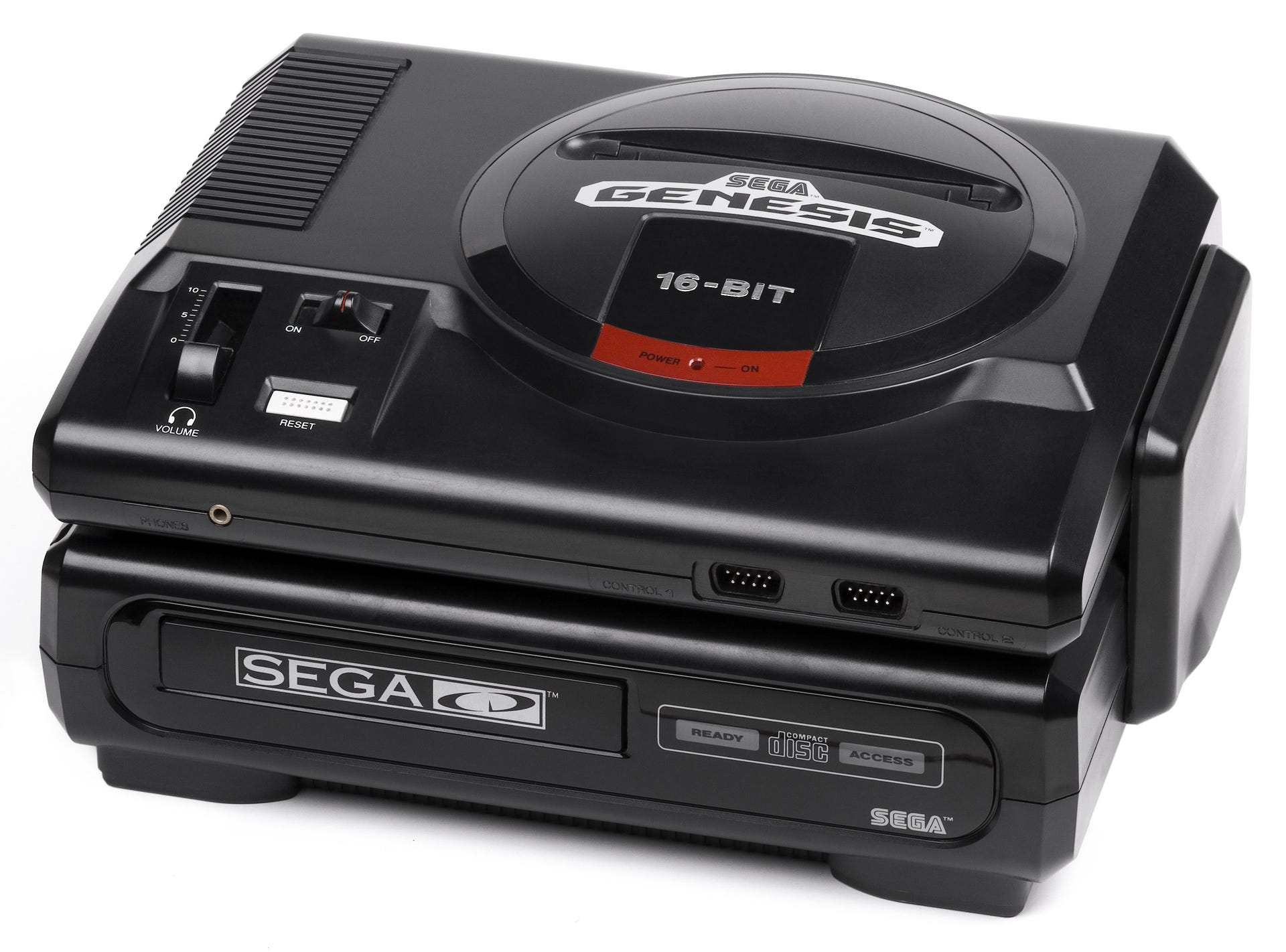
Shown here in its North American guise, the Mega-CD bolted onto the bottom of the Mega Drive. A more compact version was forthcoming, but sales remained sluggish.
Bayless and his team managed to overcome these obstacles, and the Mega-CD made it to store shelves. The initial signs were encouraging, and Bayless reveals that the device garnered celebrity fans in pop superstars Michael Jackson and David Bowie. The system even played host to what was arguably one of the most infamous video games of all time.
"Night Trap got Sega an awful lot of publicity," says Brogan. "Questions were even raised in the UK Parliament about its suitability. This came at a time when Sega was capitalizing on its image as an edgy company with attitude, and this only served to reinforce that image." However, amid the appallingly grainy FMV 'interactive movies' and hastily retooled updates of existing Mega Drive games, the Mega-CD had precious little in the way of truly essential software. Its failure to capture the imagination of the public did much to erode the good work achieved via the Mega Drive.
"The Mega-CD never really had a reason to exist," admits Bayless. "I remember we were inundated with inquiries from music people; they were fascinated with the apparent potential of a game machine that could play CD quality music, but in practice that didn't translate into a vastly improved game experience. I remember sitting in a pitch meeting while Thomas Dolby tried to sell us on a music-based adventure title. We all thought his concept was interesting, but too thin to carry a full game. Looking back, that should have been a clue that something was off the rails. If Thomas Dolby couldn't come up with something interesting to do with music in a game, what the heck did we think we were going to do that was so much better?"
Organised Chaotix
It was a valuable lesson to Sega, but it sadly wasn't heeded - the Mega-CD's lukewarm reception did nothing to dull the company's appetite for similar hardware augmentation. What followed was the 32X, an attempt to prolong the lifespan of the Mega Drive in the West and tackle the impending launch of several newer, more powerful systems.
"The 32X was born in a call from Sega of Japan president Hayao Nakayama to Sega of America's R&D head Joe Miller," reveals Bayless. "He was on speakerphone and there were several of us in Joe's suite at CES in Vegas. Mr Nakayama basically said that we had to do something about Atari's forthcoming 64-bit Jaguar console. An hour later, Marty Franz - SOA's vice president of technology - had sketched up a device that sat on the Mega Drive system bus, sported a ton of power and had two ginormous frame buffers that could be accessed directly by both the Mega Drive CPU and a pair of Hitachi SH-2 CPUs.
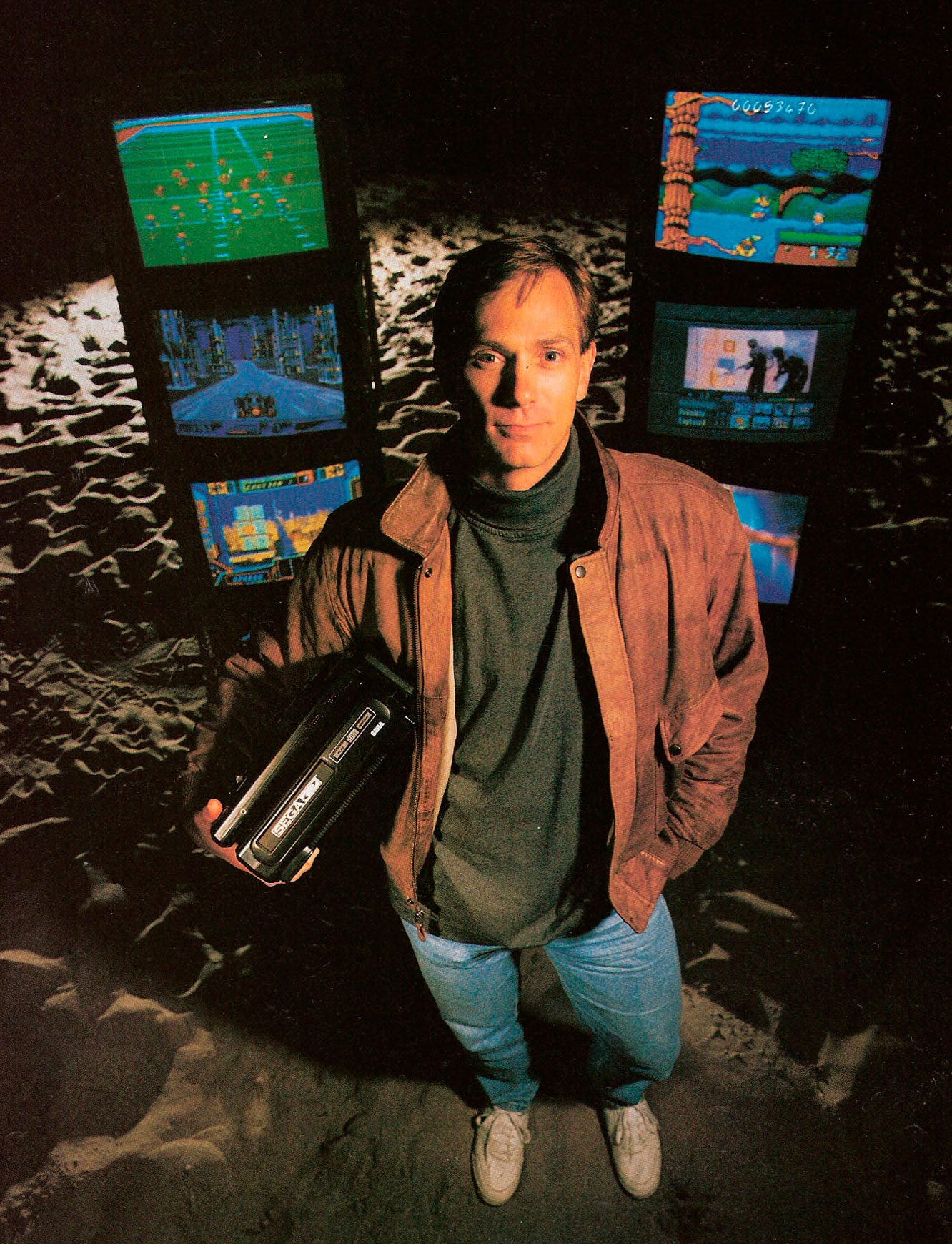
Scot Bayless was drafted in to appear in magazine advertisements for the Mega-CD, yet behind the scenes he harboured grave doubts about the system's chances and potential.
"For anyone who'd been exposed to the cutting edge of PC game development of the day, it was a coder's dream - at least in theory. Where it started to go sideways was in implementation. By the time it got to market, the 32X had been pared down significantly for cost reasons, but that reduction severely impaired its functionality, leaving it in a weird, uncompetitive space versus other devices that were looming on the horizon."
Bayless feels that Sega was guilty of focusing its attention on entirely the wrong rival. "I think the decision to respond to Jaguar was symptomatic of that pervasive lack of direction that lay below the surface at Sega. Without a clear vision, we were just reacting.
"There's an old bit of racing wisdom, 'What's behind me doesn't matter.' At least at an institutional level, Sega seemed to be living the exact opposite. Strategically, we always seemed to be focusing on what the other guy was doing instead of inventing the future as we saw it."
Looking back, it's almost a given that Sega fans would ignore the 32X - especially when you consider that the Mega Drive's true successor was just around the corner. "We were basically doing 32X to buy time for the 32-bit Saturn," continues Bayless. "Unfortunately, that turned out to be a really confusing message for fans. How do you convince someone to buy a stopgap? The result was disastrous on pretty much every level. The hardware was rushed, because there was such a narrow window ahead of Saturn. The software was rushed for the same reason. The pressure to reduce cost was even worse than normal because the bosses at Sega of Japan knew full well that the 32X had a limited lifespan. The consumer message was nearly impossible to sell."
32-Ex
Over in Europe, the situation was equally dire. Brogan and his team were given the thankless task of promoting a device that they had zero faith in. "Our first reaction was one of dismay. Saturn launch was about a year away, and it seemed crazy to divert resource from that into 32X. I'm not just talking about Sega's resource to develop the hardware, either; we were concerned that it would confuse the third party developers who would have to choose whether to put their effort into 32X or Saturn.
"This was January 1994; Saturn was due to hit the streets within a year, development kits were scarce in Europe and still in the early phases, and support from Sega was very limited, so timescales for developers were ludicrously tight. Then suddenly we dropped 32X on them with even tighter timescales. They thought we were crazy - and we were."
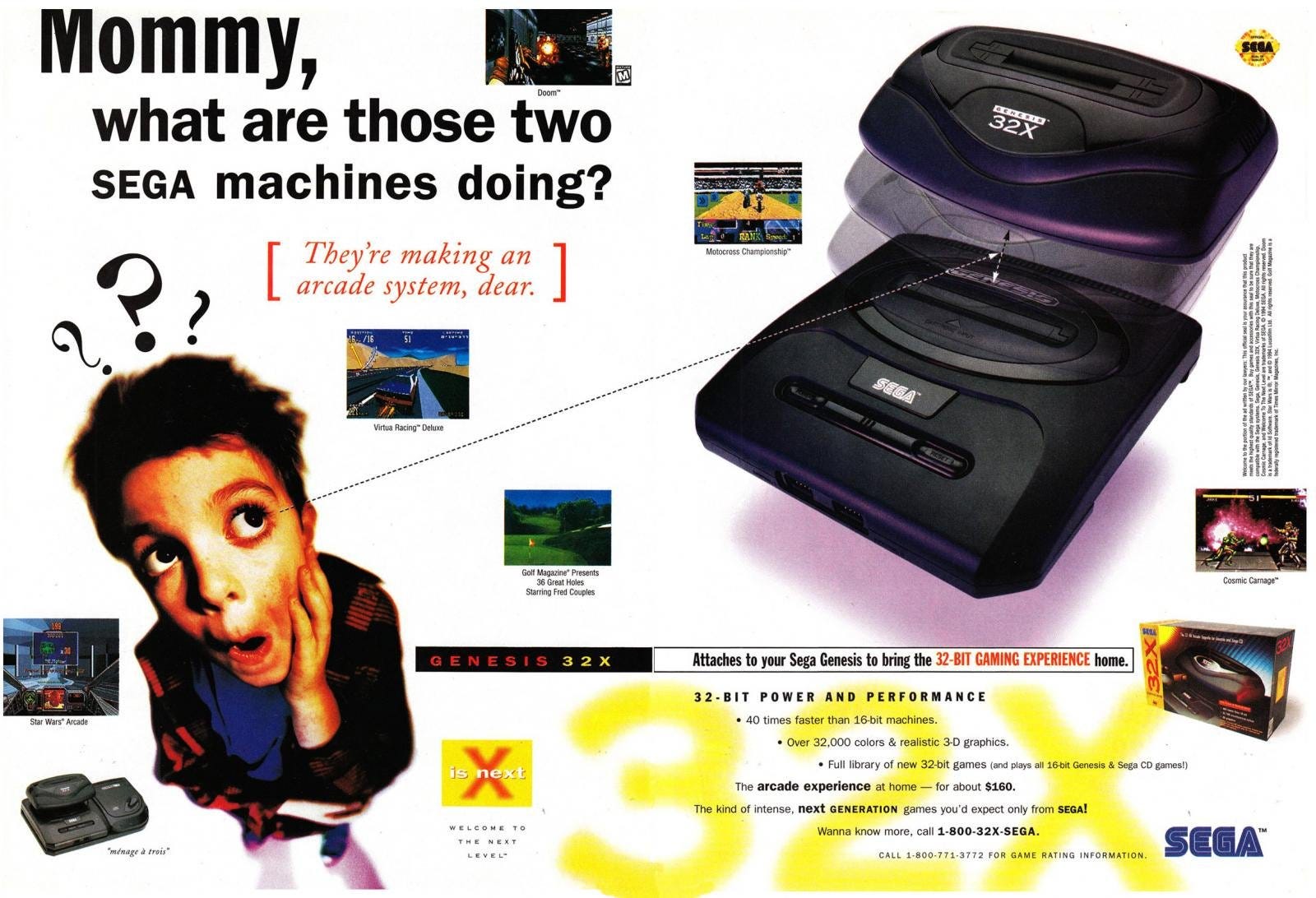
Sega's US promotional campaign for still-born 32X was particularly poor, as this awkwardly crude double-page magazine advertisement illustrates.
Even if the Mega-CD and 32X had both been met with rapturous success, it wouldn't have solved a more pressing issue at Sega - by the middle of the 1990s, the company was literally drowning in systems. The Mega Drive, Master System, Game Gear, Mega-CD, 32X and Saturn were all active in various markets around the globe, albeit with differing degrees of support from Sega's regional divisions. This put a massive strain on the company's already-stretched infrastructure.
Sega's rapid expansion in the early part of the decade drove an equally sizable growth in staff, but this created its own headaches. "When I joined SOA in late 1990, there were about 100 people in the entire organization," recalls Bayless. "By 1994 that number had ballooned to about fifteen times that figure. It was crazy and exhilarating; there was all this creative energy flowing, but it wasn't always effective."
Across the pond, the expansion was less dramatic, but still noteworthy. "We grew Sega Europe's development division from about 8 people to approximately 80 in this period," recounts Brogan. "It was an exciting time, but in retrospect we were too ambitious. Around half that number were software engineers, graphic artists and musicians, because we tried to start an internal development team from scratch. That was a mistake. We should have relied more heavily on third party developers. Managing a staff of that size was a challenge."
Rings of Saturn
The commercial failure of the 32X was unquestionably damaging to Sega's next-gen plans, but it was the long-lasting repercussions that possibly did the most harm. "32X split the target market," explains Bayless. "I'm Joe Gamer and I decide to take the plunge and buy 32X. Now, about 10 minutes later, you guys tell me I need to dump my 32X and buy Saturn? But now I'm broke! 32X was also a body blow to Sega's credibility. The first punch was Mega-CD, and then along comes 32X - another rushed launch with a weak starting line-up. At that point, even the die-hard Sega fans were starting to ask what the heck we were thinking."
In Japan, where the Mega Drive's installed base trailed way behind the Super Famicom (SNES) and NEC's popular PC Engine, the 32X was barely an afterthought. Sega of Japan was putting all of its weight behind the 32-bit Saturn, thereby avoiding the division of resources and attention that afflicted its Western divisions. Saturn's Japanese launch at the end of 1994 was a massive success, but it didn't take long for the rival Sony PlayStation to gain the lead.
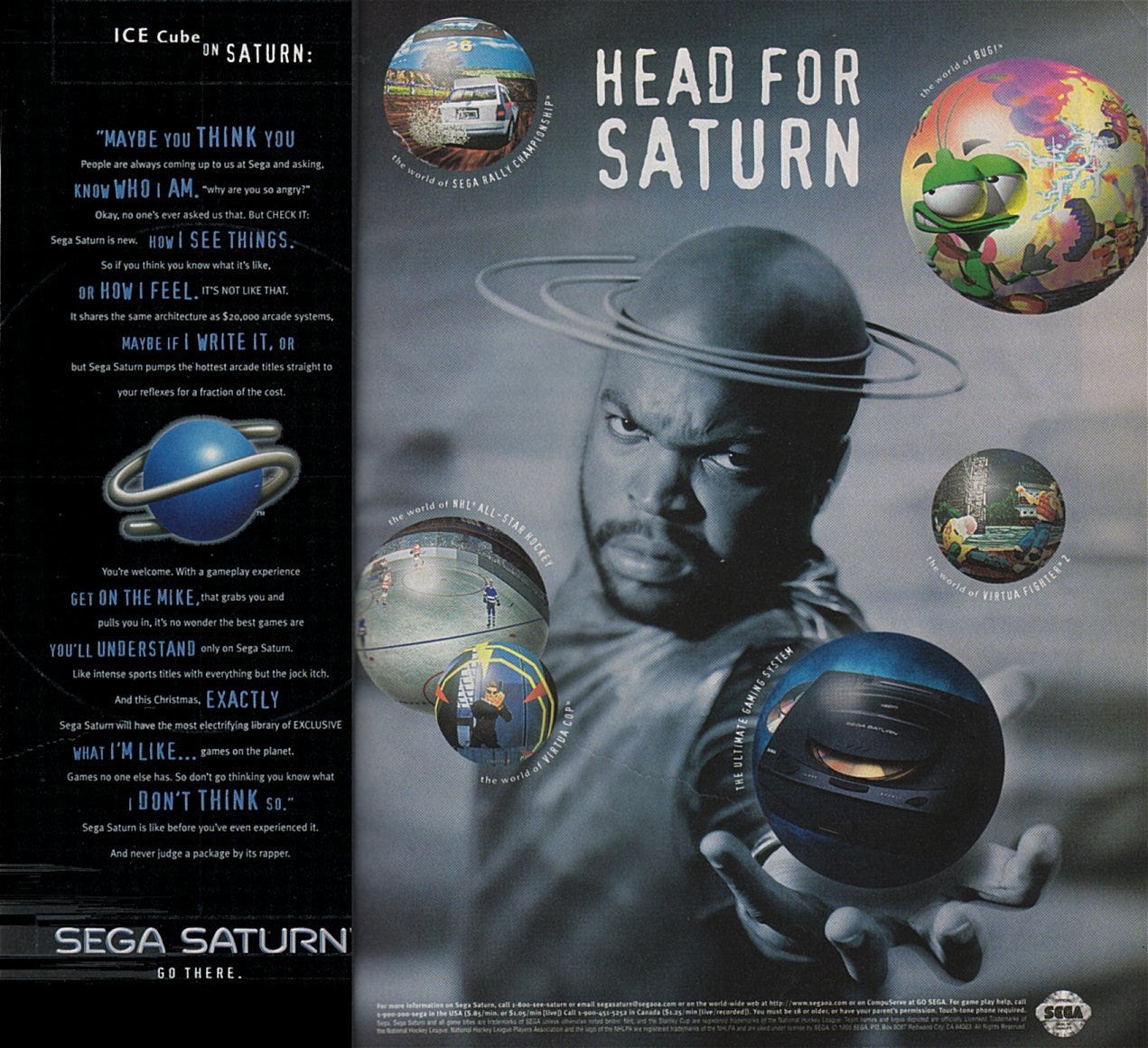
By the time the Saturn turned up, Sega's magical touch with marketing had all but evaporated. Ice Cube? Really?
"Despite its obvious improvements, Saturn was way too little, way too late to compete successfully against the PlayStation," Bayless laments. "The Saturn graphics hardware didn't really understand 3D at all. Everything was square sprites that could be distorted to simulate projection in 3D space, but the way the sprites were rendered was horribly inefficient. The result was weak 3D performance."
Industry newcomer Sony made no such mistake with the internal architecture of its PlayStation, granting it fearsome graphical prowess which dazzled both developers and prospective buyers - many of whom had previously considered themselves to be committed Sega fans. But Sony's biggest advantage wasn't directly visible to consumers.
"Although Sega of America spent heavily to build up a massive support infrastructure for Saturn developers, Sony was far more successful in helping third parties develop games for their platform," says Bayless. "And it mattered. Saturn was internally complex - a veritable Frankenstein of multiple CPUs, shared buses and specialty chips. PlayStation was much more straightforward. The Sony development tools were better, and their support systems were better. The result was a stronger launch line-up and, at the end of the day, that put Sony on top."
Dreams Are What You Make Them
Saturn lasted just four years before Sega launched a successor in the shape of the Dreamcast in 1998. The company's last throw of the dice was undoubtedly ahead of its rivals in terms of raw power, and Sega had at least attempted to learn from its mistakes by making it an easy platform to develop for. Despite a positive launch in the US, Sega's past misdemeanours conspired against the new console, and old errors were repeated.
"As good as Dreamcast was, it's a classic example of solving last year's problem," explains Bayless. "Everything about it seemed to be aimed at countering the things that made PlayStation so successful. It was well-executed, feature-rich and pretty much ticked every check box against Sony's console, but PS2 was about to shift the paradigm once again.
"Sega had, for several years, been launching new hardware at great cost, and failing to reap anything close to a sufficient return on that investment. Dreamcast did $132 million in sales right out of the gate in North America, but so what? The company spent more than that just getting it to market. Unless Dreamcast had been able to achieve a massive attach rate there was almost no way it could have saved Sega's hardware business. The damage had already been done."
When the along-awaited Sony PlayStation 2 hit the market in 2000, it marked the end of the Dreamcast's chances. Money was sunk into costly developments that had no chance of reclaiming the expense - Yu Suzuki's $50 million magnum opus Shenmue being one prime example. To make matters considerably worse, Japan was plunged into recession, prompting many companies - not just Sega - to tighten their belts.
"I'd be stunned if Sega hadn't tried to find new capital to keep the machine going while they exploited the beachhead that Dreamcast gave them," muses Bayless. "But I'd be just as stunned if that capital had actually been forthcoming. That particular period was a very bad time to need fresh money. That wasn't Sega's fault, but I'm sure it had a big impact on their decision to shut down hardware development."
The Dream is Over
January 31st, 2001 was the fateful day when Sega officially announced that it was cutting the Dreamcast adrift and was setting sail for the open waters of third party software development. To dedicated fans it was a horrific and almost unbelievable event, but to Brogan, it made perfect sense.
"When I first joined the company, I remember having a meeting with Tom Kalinske - who was then Sega of America CEO - and one of the questions I put to him was whether Sega saw itself primarily as a hardware company or as a software company. I said that if the answer was a software company, then why didn't it develop games for other platforms? Tom smiled at that and acknowledged that it was in the software business but, in his words, Mr Nakayama would rather cut off his right arm than develop anything on Nintendo hardware."
Costing $50 million to make and standing no realistic chance of ever recouping that cost, Yu Suzuki's Shenmue is indicative of Sega's rudderless development strategy during the Dreamcast period.
By 2001 however, both Kalinske and Nakayama had parted company with Sega, and the harsh realities of the business forced the inconceivable to occur. Even so, Sega's transition from hardware to solely software wouldn't be enough to save it from the chopping block - additional assistance was required, and that came from a man named Isao Okawa.
Okawa was chairman of CSK Holdings, the Japanese company that was the majority shareholder in Sega Enterprises during the late '90s. After forcibly removing Sega president Shoichiro Irimajiri in 2000, many assumed that Okawa was about to shut down the ailing video game veteran for good.
In fact, Okawa granted the company the vital transfusion of funds that would ultimately keep it alive. In 1999, he loaned $500 million of his own money to pay off Sega's debts - a loan he would later waiver on his deathbed two years later. When the 74 year-old Okawa succumbed to heart failure in 2001 following an arduous battle with cancer, he also gifted Sega his personal shares in both the company itself and CSK, which equated to a cool $695 million. The immense generosity of this one individual aided Sega's painful move into software publishing, and safeguarded its long-term future.
These days Sega Enterprises is known as Sega Corporation, and is a subsidiary of Sega Sammy Holdings. It remains and endures, but as a much-changed organisation. It is now famous primarily for its software, and presides over a glittering catalogue that includes Sonic the Hedgehog, Football Manager, Yakuza, Total War and many other best-selling titles. The company's financial outlook is also positive; it posted a net income of ¥41.5 billion last year - around £338 million - and it ranks as one of the largest publishers of video game software in the world.
Rise From Your Grave?
Despite the trials and tribulations of the '90s and the company's almost fatal dalliance with domestic hardware manufacturing, many fans still cling forlornly to the hope that Sega will re-enter the hardware arena and reclaim its previous lofty position. Is this anything more than a pipe dream?
"There is no future in selling hardware," replies Brogan emphatically. "In any market, through competition, the hardware eventually becomes a commodity. The future is in software. Sega's fault was to think that its core business was selling consoles, but consoles tend to be a one-time buy for most consumers, until the next version comes along. Software is a repeat purchase, so there's far more profit in it. If a company has to sell hardware then it should only be to leverage software, even if that means taking a hit on the hardware. I think some of the senior people in Sega never really understood that."
Bayless is a little more open to the idea of a triumphant return - although he admits that things have changed since the glory days of the Mega Drive. "This industry isn't static - far from it. We're in the Wild West right now and people are trying all kinds of crazy stuff because they can. I absolutely guarantee new stuff will emerge from all that chaos. Could that include new Sega hardware? Of course, but it's not really about that - it's about engagement and value. As my Depression Era salesman grandfather used to say, 'Nobody makes money until someone sells something.' I'd paraphrase that as, 'First you have to show people something they want to buy.' If I were invited to advise Sega on moving back into hardware, I'd start by asking one question: What will you do better than anyone else in the world?"
To long-suffering Sega fans everywhere, the answer is no doubt very simple. For the time being they will have to warm themselves not with the prospect of Dreamcast 2, but with the happy memories of beloved systems long since consigned to obsolescence and legend.
You may also like...
-
Gravity Rush Review 38
-
Activision vs. Vince Zampella and Jason West: Inside the game industry trial of the decade 66
-
Skyrim gets mounted combat in new update 47
-
Wii U Aliens: Colonial Marines is best-looking version because of console's "more modern tech" 59
-
Sony patents method to interrupt your gaming with an ad 68
-
Dirt Showdown Review 87
-
Minecraft overtakes Black Ops on XBL activity chart 24
-
Kingdoms of Amalur: Reckoning needed to sell 3 million to break even 28
-
Amalur developer 38 Studios lays off all staff - report 46
-
How the Darksiders 2 delay benefits you 8
-
Ghost Recon: Future Soldier Review 132
-
Tony Hawk's Pro Skater HD soundtrack listing revealed 13
-
Diablo 3 real money auction house delayed again, client side patch out next week 22
-
The Cave Preview: Double Fine's New Game for Sega 19
-
Gravity Rush - first 15 minutes 15
Comments (125) Latest comment 3 months ago
Comments for this article are now closed, but please feel free to continue chatting on the forum!
Comment below viewing threshold Show
Sega consoles introduced me to gaming. I hold hope that they will rise as a console powerhouse once more. More competition=more quality for us gamers, and Sega has some of the best games ever made in their library.
Comment below viewing threshold Show
Throughout playing that game I felt complete and utter immersion in a game world like no other I have experienced in 20 years of gaming (although Deus Ex 1 came close) It helped that I got it on Christmas Day as the game was set at that time of year and that I was 17/18 at the time, the same age as Ryo Hazuki. I still remember playing Shenmue all day
We were also lucky to get Shenmue 2 the next year as it wasn't released in America, Actually I think Shenmue 2 is the better game but Shenmue 1 did it first and so had the impact
loved my Dreamcast, Skies of Arcadia, jet Set Radio and Soul calibur were also awesome
I tried to get people to buy it but they were all like, OMGZ!! teh PS2!!
Comment below viewing threshold Show
Fantastic games, terrible business strategies.
Comment below viewing threshold Show
I'd love an in depth article on how the hell Shenmue cost $50 mill! And how the hell a sequel was green lit..
Comment below viewing threshold Show
Sorry, what?
Comment below viewing threshold Show
They've given us the Yakuza series, Virtua Fighter 5, Initial D and the glorious Valykria Chronicles.
They've made Sonic good again with a bunch of recent games that are actual, honest-to-goodness fun.
They've published some true classics, like Platinum's and Creative Assembly's games. You might think 'aye, but that's not developing' but the truth is it takes confidence and heavy investment to back these things. Who else, when looking at Platinum's previous fortunes making critically acclaimed but commercial failures at Clover, would honestly stump up the cash for 4 games that would probably suffer the same fate.
Fucking love Sega, and if they were 'dead' then I wouldn't be playing games anywhere near as much as I do.
Comment below viewing threshold Show
Haha! I had the exact same experience with pretty much every gamer friend I had. They loved the games on the Dreamcast (we played Powerstone and Soul Calibre for hours) but they all said they were waiting for the PS2 because it could do Toy Story and it had this thing called AN EMOTION ENGINE!!!
That's why I don't blame Sega's marketing, as all my friends had first hand experience of it and loved it.....it's just the PS2 was going to be IMMENSE - Sony said so.
Funnily enough I had a very similar experience suggesting people buy a 360 before the PS3 was launched....
Comment below viewing threshold Show
Funny how the response you look for in games throughout the years never changes.
Comment below viewing threshold Show
Nintendo and Sony both seem to have run into similar issues with the number of platforms they are trying to support over different markets.
Comment below viewing threshold Show
At the time these systems were a complete failure in everything but software. If you owned a Saturn or Dreamcast you were happy to live in your own little gaming world, blissfully ignoring everything that was on the other systems. The darkest days for Sega were the best days for gamers.
Comment below viewing threshold Show
I can remember back to the Mega CD & 32X fiascos and everyone thinking "WTF are all these add-on machines about?" Such a hideous mistake. That's where the damage was done. You look back at the Saturn and DC and they had some quality, original titles. Consumers had already lost confidence that they weren't going to get screwed-over with hardware revisions, unfortunately.
No SEGA/Dreamcast mention is complete without pointing the finger at Sony as well. Sony did an amazing job with the PSOne - smashed that generation's competitors out the park and pushed the market and userbase massively forward. But whilst I applaud Sony for their PSOne efforts, their PS2 campaign against the Dreamcast was shameful. With a series of faked images/vids they massively overstated the PS2's power and functionality - just look at what the PS2 offered compared to the DC games and you'll see there wasn't the gulf that Sony claimed. With the exception of DVD there was very little extra offered by the PS2, and you could argue that the DC offered alternatives with its online connection (too early mind, should've waited for broadband!)
I remain convinced to this day that Sony thought they could use the PS3 with their "the next gen begins when we say so" do to the Xbox 360 what they did to the DC with the PS2. I'm happy the 360 has given the PS3 a run for its money this gen, but wish the DC had enjoyed the same chance in the public's minds a generation earlier.
Having said all that, I'm not anti-Sony, and I look forward to a more humble Sony rising to the challenge in the next gen. I also like what they've done with the Vita, looks like a decent bit of kit from a long-time gamer's perspective.
In retrospect, I'm not sure how much I miss SEGA from the hardware market. Microsoft have filled the gap, and SEGA's glory days of producing innovative, interesting titles (Shenmue, Rez, Jet Set Radio, Nights, etc...) unfortunately feel a long, long time ago. Forget SEGA returning to the hardware arms race; I just want to see them developing some great, original software once again!
Comment below viewing threshold Show
Although I really really wish they would release Shenmue 1&2 HD on PSN or something, I would buy it instantly
Other things that would be nice on PSN would be a Wonder Boy Collection and the original Streets of Rage. For some reason Streets of Rage 2 is there, but not the rest of the series.
Comment below viewing threshold Show
Sega Europe laid the foundations, and the ground-rules, for Sony's excellent PlayStation marketing afterwards.
Comment below viewing threshold Show
I think you're bang on there. The Dreamcast was pretty fantastic when it was launched and wasn't that far off the PS2 in terms of overall power - But because of a few bloody tech demos that didn't equate to real PS2 performance, lots of people decided to wait to see what Sony's machine bought to the table.
Even the PS2's launch titles were pretty awful. The best game was a 2d firework fest!
Comment below viewing threshold Show
Sega is passion. And for as long as there is passion for gaming there will be Sega. That one Sega fan programming Sonic CD for XBLA is the living proof of that.
It really was the right decision to focus on Software though. They are not restircted by any platform and can develop for kinect, XBLA, or 3DS without carrying the burden of the hardware risk. Thus they can stay ambitious and check out every alley without the fear of ending up beeing forced to go all-in on a technological dead end street.
Comment below viewing threshold Show
Little mention of the fact that the Saturn was sega best performing console in Japan. They never did very well on Japanese turf. Other factors like sega gave 3rd party developer on the Saturn sub stranded dev kits to their own. Where the poor game gear? This reads like it was written from an American point of view and like a Wikipedia stub article. I'm sorry but this really needs a far more in depth article.
@Spuzzell Hardcoregaming101 did a wonderful article on Shenmue and what went wrong with it. Yu Suzuki's was Basically put on gardening leave after the game flop hence the reason he worked on very few titles after it at sega
Comment below viewing threshold Show
Crazy how much of an impact SEGA had when i was a kid and how much they seem to have faded now (though I'm a massive fan of Yakuza so there's something they're still doing right)
Now bring me a new Jet Set Radio and the ability to play Shenmue for the first time aside from tracking down a working dreamcast and I'll be happy.
Comment below viewing threshold Show
Sega never was able to sell their consoles or their handhelds. I owned the Game Gear, and the Nomad and both were poorly supported.
Also if anyone else owned the Sega Saturn you'll know how quickly that was taken off the market. When a company takes hardware off the market due to low sales it completely lowers consumer confidence.
Sega has some great games but they did not have the money to do the aggressive advertising that Microsoft does now or own as many developers as Sony or publish as many 1st party titles as Nintendo. And if they were to reenter the console race they'd be entering it with a whole different beast than when they started. Microsoft is aggressively trying to take 3rd party support from Sony, Nintendo is about to begin the next Gen, and Sony just released the Vital. There is no room left in the console market unless someone like Apple or Google were to enter.
Comment below viewing threshold Show
Imagine a world with a Sega playstation powered by silicon graphic's "project reality" chips.It could have happened if Sega had not relied on their own hardware.
Description_here
Description_here
Comment below viewing threshold Show
These consoles got me into gaming, and if any devs are reading, please make a new streets of rage game! PLEEEEEEEEEEAAAAAAAAAAAAAASSSSSSSSSSSSSEEEEEEEE!
Comment below viewing threshold Show
Fuck that, get Isao Okawa in there. His special move is if you kill him, he smashes you in the face with money. Or he could be a special move for Sonic, bringing him back to life, albeit a bit rubbish as in his post-2001 games
Comment below viewing threshold Show
the dreamcast failed because of:
- poor consumer confidence in sega hardware (past)
- high consumer confidence in sony hardware (present, and forthcoming)
- no money to support it out the gate with high profile licenses and marketing
had they had a little bit more money to play with, they may have been able to keep the DC in the race, but you can't blame sony for sega's missteps with the MCD, gamegear, 32X and Saturn.
Comment below viewing threshold Show
sega branded gaming tablet with full dc, md, saturn, arcade, android support with real buttons, arcade stick add on with tv out? Given the price of chinese tablets, could have realistic r&d costs, just compatability to work on.
Comment below viewing threshold Show
In contrast the Wii, the best selling system of this generation, pretty much shut down simply with the announcement of the Wii U. I have a number of Saturn games with advertisements for the Dreamcast in them - hardly quickly abandoned by Sega.
Comment below viewing threshold Show
This piece could have elaborated on the 'rise' though. Globally, arcades were generating more money than consoles (and continued to do so until the late '90s I think), and every home gamer knew of Sega because of the (usually weak) home computer conversions of their games (in an arcade environment alone, remembering a brand isn't so easy). The UK market was hostile to consoles because computer games on cassette were so cheap, but Sega really chose the right distribution partner with Mastertronic. Nintendo didn't stand much of a chance until they had a machine that boasted near-perfect conversions of games like Street Fighter II, although the Konami and Acclaim licensed games helped the NES a bit.
Edit: These videos are required viewing after a story like this...
http://www.youtube.com/watch?v=Hhhs5UpGrRE
http://www.youtube.com/watch?v=7Yz_Oi_6w0Q
http://www.youtube.com/watch?v=g5xqiapi_oY
Comment below viewing threshold Show
PSone had better games than the Saturn, and the PS2 had better games than the Dreamcast, oh and Sony had a little something called 3rd party support.
take the Rose tints off you ghastly beasts
Comment below viewing threshold Show
and what happened to the famed AM# depts? for me, they made the saturn... pure gameplay!
i think the arcade angle is missing from this article... as coin op was the backbone of sega.
Comment below viewing threshold Show
Unfortunately, the biggest mistake I've ever made in my videogame life is tied to the saturn. I sold more than half of my saturn collection at one point, including games I really loved to a preowned shop for next to nothing. Games like Burning Rangers and Dragon force... it really is one of my biggest regrets. Due to that, to this day, I can NEVER get rid of any game I buy. Luckily I kept Panzer Dragoon Saga and Shining Force 3 and a few others at least. I've seen PDS can go for £150 or more these days, but no way am I ever letting go of it!
Must give a shoutout to the Dreamcast as well, I only got one after it died when shops were selling them really cheap (I think I got it brand new for £49) so I only had a handful of games but they were great. Sonic adventure was pretty good but the stand out for me was Skies of Arcadia. I love that game and the sense of adventure it gives you. I wish Sega/overworks made another such RPG. I got the GC version too, but they completely ruined the soundtrack so much it made it unbearable!
Comment below viewing threshold Show
"take the Rose tints off you ghastly beasts"
Irony?
Comment below viewing threshold Show
So many brilliant titles in such a short period of time.
Comment below viewing threshold Show
Not heard/read that for a while.
Sega EnterpRYZEs. I'm glad that Modern Sega dropped that 'suffix'.
edit: @richardmcdermott
I'd very much hope that Sega would focus on their 'Arcadey' roots, and release peripherals like a 'Daytona' Steering wheel bundled with their latest driving game.
An AfterBurner flight yoke bundled with Afterburner Climax, but compatible with Ace Combat, Battlefield 3, Flight Simulator, etc... would be marvellous.
etc...
Enterprises.
Comment below viewing threshold Show
If you read it you'll see that (as far as I'm concerned), there were mulitple factors at play in SEGA withdrawal from the hardware market. SEGA's earlier misjudgements did the real damage, with consumers no longer having confidence in the company to deliver a console that would be supported in the longterm (third parties abandoned the Saturn very early, if I remember correctly).
That's not to say that Sony's strategy and lies didn't play a part though. They were another nail in the coffin, if you will. I understand why Sony did it - they were effectively eliminating a competitor after all, and it is business - but they flat out lied about the PS2's performance and quality of launch line up.
I'm just grateful the same tactic didn't work with the PS3 v the 360. People have finally realised that Sony's machines aren't all-powerful. The 360, despite launching earlier, still outperforms the PS3 for most multi-platform releases. People saw through Sony eventually.
As I said, nothing against Sony as such, just this old policy/tactic. They seem to have shed the bravado lately (PS3 failing to steamroller the 360, and the PSP and PS Vita failing to wrestle the handheld market away from Nintendo have brought a little reality I think).
I always welcome competition. I hope Sony come back with something genuinely amazing for their next home console to compete fairly with the next Xbox.
Comment below viewing threshold Show
I buy the occasional PC shooter these days but the magic is long gone
Comment below viewing threshold Show
I feel you. What a mess, eh?
Comment below viewing threshold Show
Sony's cockiness got the best of them but regardless they're still releasing exclusive titles consistently. And not all issues regarding multiplatform performance are purely hardware based, developers tend to lead on 360 and port to PS3 causing poor performance
Comment below viewing threshold Show
I do see a lot of people over evaluating the sales potential of Shenmue. It was a cracking game then, and still is, but I don't think it will manage to outsell the original games (DC 1+2 and XBOX 2), let alone be profitable enough to greenlight 3. But putting Sega Bass Fishing on the DC collection was just taking the piss, I admit.
But talking of pipe dreams, where is my Fighters Megamix 2 and Streets of Rage 4?
Comment below viewing threshold Show
Grew up with Sega machines & the DC was the best console I've owned - so many brilliant titles & everything looked so vivid & bright!
Comment below viewing threshold Show
Even when they moved to software only they made an error, rather then either supporting one system or being completely multi format they had their games strewn around various systems with seemingly no rhyme or reason to which was chosen forcing what was left of their fan base to either own all consoles or split.
Comment below viewing threshold Show
Shammmmeeee on you EG.
Comment below viewing threshold Show
I still don't understand why SEGA feels a shenmue 3 (or reborn shenmue saga) wouldn't sell. It wouldn't cost the £50mil like before and many similar games (most notably it's own yakuza) have done well.
Comment below viewing threshold Show
Strange that Sony itself repeated Sega's mistakes a few generations later.
Comment below viewing threshold Show
The high-calibre directing.
The score.
The fact that up until shenmue, not a single game existed where every NPC had voice work. This was the first ever time, and it cost a lot.
The R&D was massive. As stated, it's common these days (and still expensive, look at how expensive AC2 cost), yet this was all new to the world.
Oh and the small fact that it was in development for almost 10 years.
And shenmue 2 got greenlit because really and truly, there is no "shenmue 2", it's all one massive game, released in instalments. After so much investment, sega had to at least recoup some of it.
Comment below viewing threshold Show
I'd also like to see a 3D Ecco, and Panzer Dragoon for 3DS.
They also could release Jet Set Radio for Vita and/or 3DS with the touch controls enabling for the spray moves.
A new Jet Set Radio would also be great for the Wii U you could be drawing your own Graffity Art with the stylus. They should make it a big online game where clans would fight battles over the reign of the different territories, overspraying each others tags.
Comment below viewing threshold Show
Next time do something about that weird time period just before the Playstation when the 3DO, Neo Geo, Amiga CD32, Sega Saturn and Atari Jaguar (were about to be) released.
Comment below viewing threshold Show
Regarding Sega, everyone seems to love the Dreamcast but for me the best was the Sega Saturn. I had great times with that console and it had amazing games, some are difficult to find these days.
Comment below viewing threshold Show
"Greed and piggery wins, love and passion count for little in the end", is the lesson here, at least as far as 'success' goes. Silly ol' broken world this is, everything's backwards.
Comment below viewing threshold Show
But now to my slight shame, I now an ultimate Nintendo fanboy-I think of them as continuing the true console tradition and proper video games companies need our support over an operating system company and consumer electronics company.
However, as perfectly formed as Nintendo games are, they still don't have craziness and cool of SEGA at its best.
Comment below viewing threshold Show
EDIT- Just want to add I did own (sold them) every single Official Dreamcast Magazine (UK) and STILL own every single Official Sega Saturn Magazine (UK) along with all the demo discs.
Any offers?
Comment below viewing threshold Show
I still remember how reading Richard Leadbetter's words in SSM would bring hope to the sega fanboy inside me. We knew sega was doomed but we never stopped believing... until we eventually went out to buy a playstation...
I learned my lesson with the saturn (fortunately I was smart enough to avoid the mega-cd and the 32X) and decided to wait and see how the dreamcast vs PS2 battle would turn out. Needless to say I ended up buying a PS2, though fortunately a friend of mine bought a dreamcast which allowed me to play all those great games. That single year filled with dreamcast goodness was one of the best years in gaming for me. Then I moved on and bought a PS2, which my friend couldn't afford because he was broke lol.
Comment below viewing threshold Show
Despite being weaker graphically, and somewhat "gimmicky" (for an audience of gamers - before the idea of the family-console had dawned on the rest of us) the Wii sold lorry-loads to become the dominant console like the NES was. Only to be blown away by the Sega newcomer with their smart marketing.
Could Apple fill the boots of Sega next time round ?
There may only be room for three hardware providers in this industry. Nintendo, Sony, Microsoft, and Apple ? Which would you NOT put your money on ?
Comment below viewing threshold Show
Well done Damien, really enjoyed it.
Comment below viewing threshold Show
And then they promptly went and forgot all about that, and repeated all Sega's mistakes when the time came for the PS3, leaving the market open for Microsoft to grab a huge chunk.
Comment below viewing threshold Show
But Sony's new machine was going to have REAL HISTORICAL BATTLES, featuring GIANT ENEMY CRABS! And RIIIIIIDGE RRRRRRAAAAACERRRRRR!!!!! How could it not be better?
Comment below viewing threshold Show
We had soul calibur, toy commander and then shenmue while others waited with their ps1 and then their poor (I confirm) first ps2 games.
Of course, later, the good ps2 games appeared, but the first notable great ps2 game was jax and daxter, some 2 years after the great first dreamcast games.
Also there is a quality in Sega hardware that didn't have any of its competitors:
It's the quality of the image produced by the AV output (or VGA Box for the dreamcast, even when producing VGA, they do it better than ANY others). But even the RGB cable for the dreamcast was of unreal quality on any TV.
If you compare the image quality of the dreamcast versus the gamecube, megadrive versus the snes or the master system versus the nes, SEGA will win each time and by an impressive margin (I don't talk about games but only image/color/vividness quality)
It the same if you compare with the PC Engine or family Neo Geo or a MVS arcade Neo Geo, Megadrive wins in image quality (but with a smaller margin for the latter).
Only The PSX and PS2 approaches the Sega vividness of colors.
Anyway I remember pluging my dreamcast with an RGB cable on an old cathodic 36cm TV and some of my mates (used to PS1 graphics) came to see and they didn't at first believe it was the real game. they thought it was a CGV movie. the game was Soul Calibur...
I also had that impression the first time I saw Soul calibur. I've never had it anymore.
Comment below viewing threshold Show
You honestly can't say that the PS2 made a paradigm shift. In what way, shape or form did it do so?
Comment below viewing threshold Show
Everything Sega produced after that went downhill. Even the DC and God-Bless-Shenmue couldn't save them from going the way of the dodo.
Comment below viewing threshold Show
Microsoft also offered exclusive Sega Games like Shenmue 2, Jet Set Radio Future, Panzer Dragoon Orta, Phantasy Star Online and PGR (which is the successor to MSR on Dreamcast), plus they really cared about Online Gaming.
I eventually bought me a PS2 2 years ago (I was living at my student apartment with an old 4:3 Telli and in need for a cheap DVD player), and I feel that apart from Shadow of the Collossus and Okami I haven't been missing out much.
Comment below viewing threshold Show
I fail to see how that is the case unless you're still taking the same drugs that Sony gave you at the time to convince you that this was the case.
The DC had, for the first time, proper online play, anti-aliasing, a record breaking launch price and games line-up, high capacity discs and was easy to program for. The PS2 had NONE of these things apart from the Trojan horse of DVD...but yeah... PS2 - PARADIGM SHIFT!!
Comment below viewing threshold Show
but so what? that's marketing. sony do it, nintendo it, and sega certainly have done it. are you forgetting the genesis/megadrive vs snes battle? sega had adverts directly calling out nintendo's machines (eg http://cache.gawkerassets.com/assets/images/9/2011/11/bca71039130c09d8d69c1e363b5c10d5.jpg), amongst other things. did those sort of 'underhand' tactics kill the snes? no, because it was a great, well-supported machine.
what's the difference between nintendo vs sega and sony vs sega? the former was a much more vicious affair. again, it was sega's poor consumer confidence, and not enough money to fully support it, that killed the dreamcast.
Comment below viewing threshold Show
I have to say though that I respect Sony's gaming strategy a lot more these days and I think we have Microsoft and Nintendo to thank for that. The success of the Xbox 360, Wii and DS have turned Sony into a humbler beast and the quality of their output - both in hardware and software - has improved massively as a result.
It goes to show that those dreaming of a one-console world should think about the consequences of that. The PS2 era, particularly the year or two before the original Xbox became a major player, is about as close to that scenario as we've had in the past two decades and, in my view, it was not a great time for gaming. Nothing breeds quality like a bit of competition and the parity of power between the three main players at the moment is unquestionably the main reason we're living in a golden age of gaming.
Comment below viewing threshold Show
Things are looking better though now. The Yakuza titles on the PS2 and PS3 are fantastic, as is the recently released multi-platform Binary Domain. Sonic 4 ep.1 and Sonic Generations have been a great return to form for the beloved mascot, and hopefully Sonic 4 ep.2 will continue this trend. I just hope Sega take
advantage of their massive and wonderful back catalogue a bit more than they have been doing. Another Panzer Dragoon RPG for example, a chance for non-Japanese speakers to finally experience the ENTIRE Shining Force III saga (with Victor Ireland and co. handling the localisation!), another Jet Set Radio title, Burning Rangers 2, Streets of Rage 4, a sequel to Skies of Arcadia and last but definitely not least, Shenmue 3!...I better stop now before I get all teary eyed XD
Comment below viewing threshold Show
It was an embarrassingly unstable machine, in my experience. I imagined that the metal clips that you were told to implant surgically into the Megadrive's cartridge slot didn't really have anything to do with safeguarding against electronic interference between the two units after all; moreso that they were added by Sega's exasperated tech division simply as some kind of electronic placebo or superstitious protection against the fact that it would crash whimsically during every play session.
Before long, it was refusing to run games at all. My parents took it back to Toys R Us, even though it was nearly a year later and it would have looked suspicious due to the fact, just days earlier, the announcement that Sega were no longer supporting the 32X had been on the national news. Perhaps my little mushroom had overheard and it had died in despair?
Fortunately, the returns desk couldn't resuscitate it, either - the fact that, when I got back home, I found I had left the magical metal clips on my desk probably didn't help matters. We got our money back and a couple of months later I was instead enjoying Christmas morning with Virtua Fighter 2 on a (by then, sensibly-discounted) Saturn. Retrospectively, many would say that was a case of "out of the frying pan..." but, as a Sega-devotee and at an age when your folks expect you to pick a new console and stick with it, I felt like the jammiest bugger alive.
And I still have the clips.
Comment below viewing threshold Show
I wonder if that makes me shallow...
Comment below viewing threshold Show
PS2 came out end of 2000 over here, Devil May Cry, Silent Hill 2, GTA3, Gran Turismo 3 came out within 12 months. Each one far superior to anything on Dreamcast in every way.
All the nonsense about sony lies, no they just told the truth, the games were better. Give me GT3 over Tokyo highway battle anyday, or Devil may cry over sloppy and heavily delayed Psone and N64 ports
Nice little machine but vastly over rated, full of shallow arcade ports with little replayability. They only had one great console and that was the Megadrive.
Let it RIP
Comment below viewing threshold Show
"sloppy and heavily delayed Psone and N64 ports"
You mean Soul Reaver, Rayman 2 and Tony Hawk 2 with 60 Hz support and all?
I had a real great time with those. The best versions of those games in my opinion.
Resident Evil Code Veronica was brilliant too.
And screw Silent Hill, I have tried to play the 3rd one recently, if anything is overrated then it is this.
Talking sloppy ports you really should not forget about mentioning the really ugly black bars that came along with the PAL conversion of your beloved Devil May Cry.
Comment below viewing threshold Show
Silent Hill 2 >>>>Code Veronica
GTA3 >>>>> anything that has been released on DC
let go of your hate, the machine is rightfully dead
Atari Jaguar lite
Comment below viewing threshold Show
I still remember playing streets of rage like crazy on the old mega drive, aswell as the inbuilt alex the kidd on my master system, never did get a NES but marble madness and alex the kidd are some of my earlier gaming memories.
Ace-Reject #32
I loved the master system it was my first console my grandad bought it for me when i was 5 or 6 i think so many good memmories playing sonic and Alex the Kidd, after the mega drive i never really got any more sega consoles i went down the playstation route.
For some sad reason this mistake always pisses me off - IT'S "ALEX KIDD" - NO BLOODY 'THE' IN THERE! Why don't people know this? He was Sega's mascot until Sonic came along!
Ahem. Alex Kidd in Shinobi world was also a great (and better) game, a real over-looked gem.
Comment below viewing threshold Show
Well, GTA 3 is one game I personally never fell in love with, it was full of framedrops and the textures were nowhere near the beauty of a Shenmue, it's world was never rich in detail or interaction, and I never cared about it's protagonist or it's story. Plus, its aiming-mechanic was a cramp.
It sure is fun to fuck around in that sandbox, but it never gets deep.
Comment below viewing threshold Show
Shenmue and Shenmue 2 were incredibe games that seemed unbelievably good at the time. In hindsight the load times were annoying and not much repeat playability but at the time the experience was amazing as were the visuals. In facts it about time I played them through again. I wish they were released on a later console though to cut out the load times.
Comment below viewing threshold Show
or at least the Mega drive was the first console I truely loved.
Did not know the story about Isao Okawa. What a guy!
Comment below viewing threshold Show
oh go away you silly little man, I'm having a conversation
Comment below viewing threshold Show
I never had a Sega home console. The only machine of theirs I owned was a Game Gear, which was shit next to the Game Boy, tbh.
They were great arcade developers, though. Daytona USA was amazing.