Version tested: PC
As the gentle autumnal slumber of the countryside descends upon Haywards Heath like a welcoming, thick duvet on a chilly morning, the animals begin their preparations for the long winter ahead. There's Mr Dormouse, toying with his nuts in the crisp sunshine. A badger coughs up just enough tuberculosis to get him through another winter.
And in a house at the end of a winding road, a man in his thirties sits in his pyjamas, occasionally punctuating the stillness of nature's fragile symphony by screaming the rudest word in the dictionary. Coleridge weeps, and the squirrels become restless...
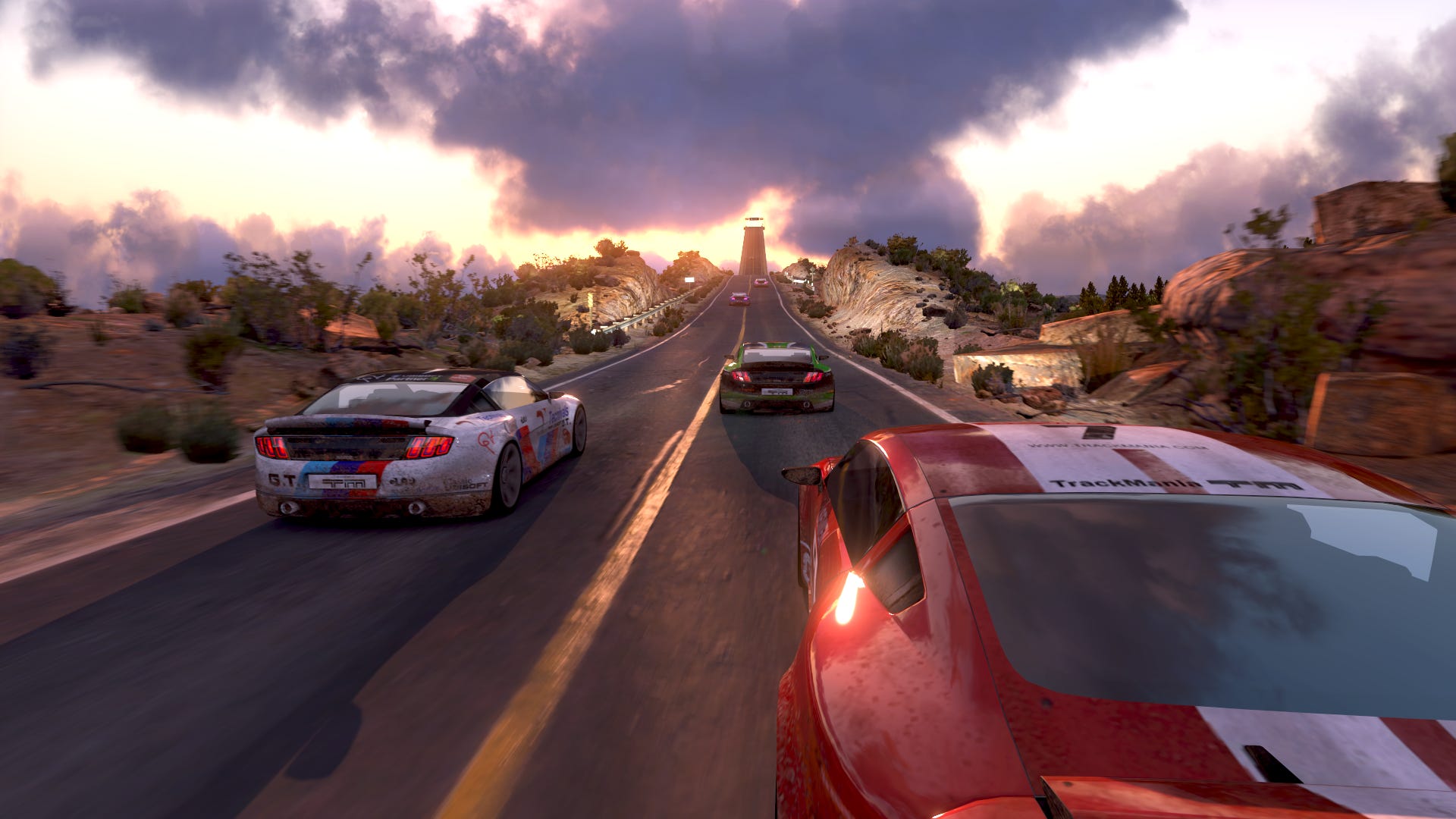
It's a fitting time of year to release TrackMania 2: Canyon, a game in which the skies are an ocean blue and prairie clouds hang low in the sky. Cold, fresh and breezy, it's a liberating environment upon which to unleash the imaginations of a community hardened by the devilish tracks crafted since the release of TrackMania nearly eight years ago.
Alongside the new environment, developer Nadeo has boldly made a radical departure for the car physics of this tricksy stunt racing series. It's divisive on paper, but a design that fits the sequel's setting perfectly; the skittish performing fleas of old have been replaced by something with a bigger bottom. It's a heavier, arcade style of handling, reminiscent of Ridge Racer, where letting go of the back end to power-slide into corners is the key to success. It's also a game that's now purely about the thrill of ghost-based racing rather than the puzzle and platform modes of old.
Around 60 official tracks are provided for the single-player game, segregated into five ranks of increasing difficulty. The names of the courses that form the progressively agonising solo campaign belie the joyful agony within. "A08" could only mean something to the people already playing (and it does) - although it's admittedly catchier than "The One Where You Want to Take Your PC Outside and Set Fire to It, Sobbing".
As is so often the case with TrackMania's craftier set-pieces, the track begins innocently enough with a gentle curve that ends with a descent into a series of hills, each one perfectly designed to land you at just the wrong angle for maintaining balance. There's a trick, of course - hit the first jump straight and you might just make it to the finishing line. Miss that first critical leap, or take the halfway acceleration strip badly, and you and your competitors will cascade around the race-track like the tin cans tied to a newly-wed's car.
Solo successes are rewarded with medals and points, giving players a sense of progression as they travel the road towards a more prestigious ladder ranking. In principle it should be compelling, but in practice it can be a somewhat confusing experience.
'I'm feelin' like a Monday, but someday ah'll be Saturday naaaaaaaaght.'
It's in exposing the competitive depth of the game to players that TrackMania 2 blunders into one of its few shortcomings. You can no longer use in-game currency to buy official time attempts (which count towards ladder rankings): you have to first unlock the Gold medal of each track. Once you've done that, a timer appears in the bottom-right of your screen, counting down the five minutes until the official record attempt can be made.
Along with myriad other fine details of the competitive game, these critical areas are simply never explained to players. Instead, it's left to the resourcefulness of the series' famously passionate community to provide the answers via wikis and patient forum responses. You'll get there in the end - and the excellent solo mode doesn't really suffer all that much as a result - but it's a frosty welcome for any newcomer.
Immediately accessible, on the other hand, are the joys of the multiplayer experience, where joining a match is near-instantaneous and the content on offer is endlessly varied by virtue of the track creator, the player hosting options, and the ability to jump straight into the server your friends are playing on. It's a system of gaming purity where no time is wasted hanging around in the lobbies of half-finished games. Once you're in, the game itself need never end as you work through a server's repeating playlist of tracks, freshly updated with the latest and greatest creations.
Even when playing with others, TrackMania 2 is a shared exercise in joyful self-flagellation. The pressure is internal and intense, the feeling of inadequacy crushing. As with snooker, you lose a match not just through your opponent's superiority, but because you screwed up and gave them the opportunity to win in the first place.
All too often you're robbed, ingloriously, by your own idiocy. The final corner, designed to inevitably undo the pixel-precision with which you've taken the rest of the course, sends you whipping head-over-heels into the drink below.
But even when you're not winning, there's something about the sight of 50 cars failing in perfect harmony that never fails to entertain. In the process of understanding their own mistakes, players crib off each other, take the neater line on the next attempt, and collectively make it to the end. Well, most of them. But it's a communal effort - and in this sequel, it's a breathtaking spectacle in the skies of the canyon.
You'll race down a narrow strip-way, hit the acceleration point and take off like a rocket into the desert sky, your co-pilots hanging in the air with you, preparing for that delicate landing and pin-perfect slide into the next corner. "For the love of God, someone put the Freebird on," you think. Then the jukebox kicks in and Freebird streams through your speakers. (Alright, that's a wishful lie - it was actually Bon Jovi's Someday I'll Be Saturday Night - but screw it, any hair-rock will do in a desert race.)
And when the track comes around again on the server playlist, you laugh. You laugh because those lemmings have just followed each over the edge of the precipice. They don't understand that there's a trick to this course - but you do, because you used to be that lemming. And where the game truly shines is in your competitors' willingness to share that knowledge with you, to bring you up to the same level of competition as best they can, so that you enjoy the track every bit as much as they do.
Concerns that the environment would become samey, that tracks might become indistinct from each other, are understandable. But as the moody hues of sunset descend on the canyon, obstacles become newly obscured by darkness, or the now-exposed terrain of the desert floor carries your car precariously as you strive not to steer, but rather to counter the game-ending turbulence of the bedrock. The game constantly challenges and surprises you, changing the rules mid-game in a way that delights as much as it frustrates.
In short, it's a game about doing your best while also laughing at yourself. I've yet to make a podium finish and I probably never will. I'm cursed to offer up my greatest performance on each track at my first attempt,before carelessly grating fractions of seconds onto my times while everyone else shaves them off. After five days of obsessive playing, I'd suck a tramp's fingers to reach that lofty ambition of a top-tier finish.
The looser the waistband, the deeper the quicksand.
We'll step back gingerly from the keyboard-versus-controller debate while noting that navigating the menus is an unnecessarily frustrating experience when using the latter. This beautifully rendered environment cries out to be enjoyed on your largest available screen and, for most, this will likely be the television in your living room. Unfortunately, you'll want to pack a wireless keyboard and mouse along with your gamepad.
Using the default settings of the Xbox 360 controller, there's also an occasional tendency for the car to drift towards the left from a cold start, even with the stick in a neutral position. The necessary adjustment may be momentary, but this is a game where hundredths - even thousandths - of a second lie between your podium finish and latter-table mediocrity. You can tweak the sensitivities of the controls to work around the problem, but only from within the game rather than the main menus.
While they can't be ignored, these are all niggles in the grander scheme of TrackMania 2, a game that captures that rarest commodity in gaming: joy. It's an experience where comedy, camaraderie and personal improvement are tied together in one glorious whole. It's also a game that hasn't even got off the ground yet, as its community get to grips with the track creation tools and the potential for re-designing the environments.
As a ghosted time-trial racer where collisions are non-existent, the struggle is internal and the other racers are members of an audience you perform for, there to silently goad and encourage you into going further. The warmth of the game comes from a community effort, huddling together as the season turns cold, in order to see everyone realise their own potential. That's something in danger of being lost in an online world of tea-bagging, one-upmanship and rabid abuse - and it's something worth staying in for as the evenings draw in.
9 / 10
