The Luddite Game Maker

Jason Rohrer on life, death, video games and diamonds.

Infancy

Many video games features death, but few appropriate it as their theme. For Jason Rohrer, the only video game designer to have been featured in Esquire magazine's list of creative geniuses, it was a slender yet focused game about mortality with which he made his name.

"I was about to turn 30, about to witness the birth of our second child, and had just watched a neighborhood friend wither and die from cancer. As such, I was thinking about the passage of life - and my inevitable death. I wanted to make a game that captured the feelings that I was having: existential entrapment bundled together with a profound appreciation of beauty. These are feelings that are hard to put into words."

And hard to put into a video game. They're harder still to sell to audiences and yet, upon its release Passage spread fast around the world.

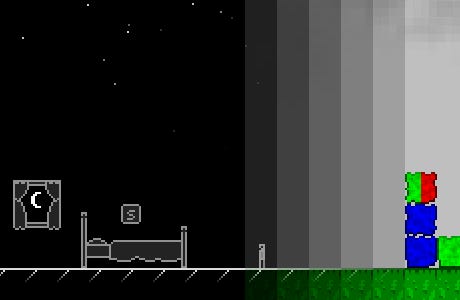
It is an unlikely success story. Here's a game in which death is inevitable for the player, with no hope of respawn. Your character, who can only move from left to right across the screen, ages incrementally with each step. Whereas Jonathan Blow's Braid tethered the passage of time to the passage of space to create mind-bending puzzles, Rohrer's work offers no solution to the profound sense of inevitable demise.

The majority of video games are obsessed with the evolving of an avatar, pressing perks, augmentations and stat bonuses onto the player as rewards for progression. Here was a game that stripped away your speed, robbed you of your beauty, took away your loved ones and decimated your family, and finally yourself in step with progress.

Who would make a game like that?

Boyhood
1

'I really admire Derek Yu's game Spelunky for its simple systems that permit interesting player-initiated stories to emerge. Realizing that you can successfully rob an item shop is one of the greatest moments in the history of games.'

"I grew up in Bath, Ohio, near Akron," Rohrer says. "It's a place of gentle rolling hills and forests. I spent a lot of time exploring the woods but I also bought video game system after system as I grew up. I have fond memories of the first Zelda and Metroid games on the NES, and also of Alien vs. Predator on the Jaguar. Wolfenstein and Doom on the PC also blew my mind, but we had a Mac at home, so playing those games was a rare pleasure. I also spent time poking around the world of King's Quest, whenever I got myself in front of a PC."

This twin obsession with the escapism in the outdoors and escapism in technology is evident in Rohrer's life today. He and his family practice simple living, earning only what they need to live. He doesn't own a mobile phone, a television or any other gadgets. And yet all of Rohrer's professional life is spent within technology.

"A Luddite building the machines, I suppose," he says, "It's an ironic combination. But the way I live my life gives me more time and attention to work on making games. My life is cheap, so I don't need a job to support myself beyond the income that I make from games."

Adolescence

Rohrer's first game was never released. "In 2002 I spent several years iterating on a game-like project called Subreal. It was an evolution simulator with genetic creatures competing in a shared environment. Each person playing the game ran a sub-section of the world, and these mini-worlds connected together in a grid through the network.

"If a creature moved off the edge of your world, for example, it would leave your computer and migrate onto your friend's computer. I iterated through a bunch of different models for the structure of the world and the makeup of the creatures - 3D flying creatures in caves, cellular creatures, colonies of algae structures, and even a Turing-complete programming language that could be subjected to genetic recombination." "The problem, of course, is that watching life evolve is only interesting for about 5 minutes. What do you actually do in such a game? Even playing as one of the creatures, and trying to eat and mate, wasn't that interesting. Then Spore came out a few years later, which was another reason not to keep pursuing a game about evolution. I think everyone had an evolution design on the back burner before Spore came out. It's a pretty common idea."

After Subreal fell by the wayside, Rohrer began work on his second game, Transcend, the first to see public release.

"I became fascinated with the so-called "golden age" of computer and video games. Jeff Minter of Llamasoft and all that. One person coming up with a novel idea and making a small, high-quality game around that idea was immensely appealing to me. Transcend had a bunch of interesting features, including a novel failure mechanic (no player death!), morphing vector graphics (which foreshadow something like Everyday Shooter), and procedurally-generated music that was linked to the gameplay.

"I was happy with it at the time, but it wasn't very popular. In retrospect, it was probably the kind of game that really needed a bunch of unique levels in it - I stopped after crafting three levels for it, feeling rather tired of working on it. But, you know, it was my first real game."

Adulthood

From there, Rohrer began working on a steady stream of relatively small games, usually released for free onto the internet, supplementing this creative generosity with income earned working on freelance projects for larger studios.

"There's not really a common theme that I am trying to explore through my games, unless you count the theme game design itself," he explains. "With each new project, I try to push off in a new direction, both thematically and in terms of design. I want to explore new corners of the design space, and I also want to constantly surprise people. I hate creative ruts, and can't understand those artists who make similar work over and over for decades. I fall more into line with someone like Picasso - a mind forever voyaging. Or maybe I just have a short attention span."

In Rohrer's opinion, his second to last release, Sleep Is Death - a two-player game in which one player dynamically writes the story while the other player follows and tries to solve it - best exemplifies this aim of surprising people.

2

At GDC this year Rohrer won the annual Game Design Challenge by proposing a game that could only be played once by a single player and then passed onto another (via a USB stick).

"It was an idea that seemed so unusual and crazy and design-perverse that I was filled with glee over the idea of making something like it. What a weird design move for me to make. I want to keep making moves that extreme, but unfortunately, ideas like that are hard to dream up. I've changed so much as a designer since I made each of my games - I'd never make another one like any of them again, if I had to do it now."

This jitteriness, and a dissatisfaction with being pinned down to one creative stream, extends to Rohrer's wider view of games. "I don't particularly appreciate video games as a super-set medium. I'm primarily fascinated by games as interactive systems. You can hear about a game or read a review or even see it being played and still not really understand it."

"I always like opening up a new board game and examining the pieces - I'm filled with wonder about how all these parts will work together when the game is actually played. So a game is really a silent object until you interact with it and explore it actively. It's waiting there for you to unpack it, and you have to bring a lot to it as you unfurl it by playing it. Not everything is dictated to you. A crucial part of it - how you play - is totally up to you. Every medium involves this aspect to some degree -mostly in terms of interpretation - but for games, it is the main event."

Middle Age

Rohrer is currently finishing a commercial release (and his ninth game) Diamond Trust of London which is due for release on the Nintendo DS this autumn. A two-player, turn-based strategy game with spying, bribing, and deception mechanics the game takes place in Angola in the months leading up to the passage of the UN's Kimberley Process for diamond certification in the year 2000.

"The reason I'm making a game for the Nintendo DS involves a bit of a long story. I was approached by Majesco, back at GDC 2009 and asked if I'd be interested in making a DS game. I pitched a few ideas to them before they green-lit."

"I worked on the game for about five months, completing several milestones and bringing the game to a gameplay-complete state (still missing tutorial and music). At that point, maybe because the market had changed, Majesco started suggesting a DSiWare release instead of a cartridge.

"I looked into it and determined that DSiWare was retail suicide (even my existing fans couldn't get the game unless they bought a DSi, whereas almost everyone has a DS lying around), so I dug my heels into the sand and stopped working on the game. We never came to an agreement about how to proceed, so we ended our contract. The game then sat there for almost a whole year before Zoo Games heard about it and picked it back up. Zoo has been awesome so far, and they're really going to make cartridges. The first edition will be limited, signed and numbered."

3

In 2009 his family of four had a budget less than $14,500 per year thanks to his practice of simple living.

Rohrer and his family are due to move to Davis, CA in a few months, in part thanks to it being "the most bicycle-friendly small city in the US." This new environment will affect Rohrer's short-term work plans. "In order to afford the cost of living there, I've got a lot of hard work ahead of me. I plan to keep releasing and selling my own games for a while. But I could also see myself heading a larger team someday."

With working alongside a larger team part of the long term plan for Rohrer, I ask him whether he has happened upon any jewels while working as a solo game maker that could benefit mainstream studio developers.

"I used to hope so, but the more I've been exposed to the mainstream development process, the less hopeful I am. It seems like they are all hamstrung by severe limitations that prevent them from exploring anything but a narrow channel in the design space. I've got a friend who is working as a writer and concept guy for a forthcoming FPS, and he's been coming up with lots of great ideas about how to make the gameplay more meaningful, but a lot of his best ideas can't be done because the game engine simply can't support them. And most mainstream devs are using some off-the-shelf game engine, which means that their designs must fit into what their engines were meant to support."

The End?

It's not only for this reason that Rohrer rarely plays video games these days. "I've got three little kids to take care of, and I'm devoting the rest of my time to making games. Most of the people I know in the game industry are either single or childless, which gives them plenty of time to play games when they come home from work. Playing video games takes up a ton of time, which is one of the many reasons why most normal people don't engage with them."

There's a certain type of irony in the fact that a man who made his name with a game exploring the passage of time and its effect on a human should see his vocation as, by necessity, a temporary one. "I feel like programming is a young person's game - hard on your body, and demanding on your mind," he says. "I don't necessarily imagine making games forever, though I've certainly kept at it longer than I've kept at any one thing in the past. Then again, as I've gotten older, my attention span has gotten longer, so you never know."

Comments (29)

Comments for this article are now closed, but please feel free to continue chatting on the forum!

  • Loading...hold tight!