Steam vs. Origin: Is Competition Good for Gamers?

EA, GOG, Gamersgate, Gabe Newell weigh in.

From its humble roots as a conduit for Counter-Strike back in 2003 to its current status as a digital delivery juggernaut with over 30 million subscribers, Steam's rise has been little short of remarkable. With an estimated 70 per cent share of the entire PC market, Valve's store has transformed a small developer into one of the games industry's most powerful players.

However, while serious challenges to its dominance have been few and far between in recent years, the playing field suddenly seems to be getting a little more crowded. EA's decision to launch its Origin store back in June presents the biggest threat to Steam's dominance yet, especially if it sets a precedent that other publishers will follow.

But has Steam built an unassailable lead? Is EA shooting itself in the foot? Or does the impending digital revolution spell the end for its good will-driven market monopoly? Eurogamer spoke to a number of key players in the PC download market, Valve and EA included, to find out.

First things first, the Steam faithful may well argue that there's no need for an alternative. Steam's brilliant, right? Accessible, developer-friendly, passionate about its content and offering good value for money, it's the fat cat it's okay to like. Certainly, you'll have trouble finding anyone willing to argue that it doesn't deserve its success, whether they be a developer, commentator or competitor.

"Steam's secret weapon is that the people at Valve just seem to understand games and their audience on a level far beyond that of most large companies, and this is evidenced in which games get promoted on the service and the overall feel of the experience," neatly surmises Supergiant Games' Grag Kasavin, whose delightful action RPG Bastion recently launched on the service.

"In spite of Steam's size, it feels more like buying games from a hobby shop than from a strip mall. I think this comes from Valve taking the long view of the business, and placing customer satisfaction as a high priority."

"The reason it has won is that it has delivered a service that everyone wants and that everyone likes," adds Nicholas Lovell, director of consultancy outfit GAMESbrief. "It just works. It makes life really easy."

But however good it is at what it does, healthy competition is vital. Not only because it drives innovation, keeps prices down and helps grow the PC market, but also because a Steam-only future might not be the level-headed utopia we'd all like to imagine.
1

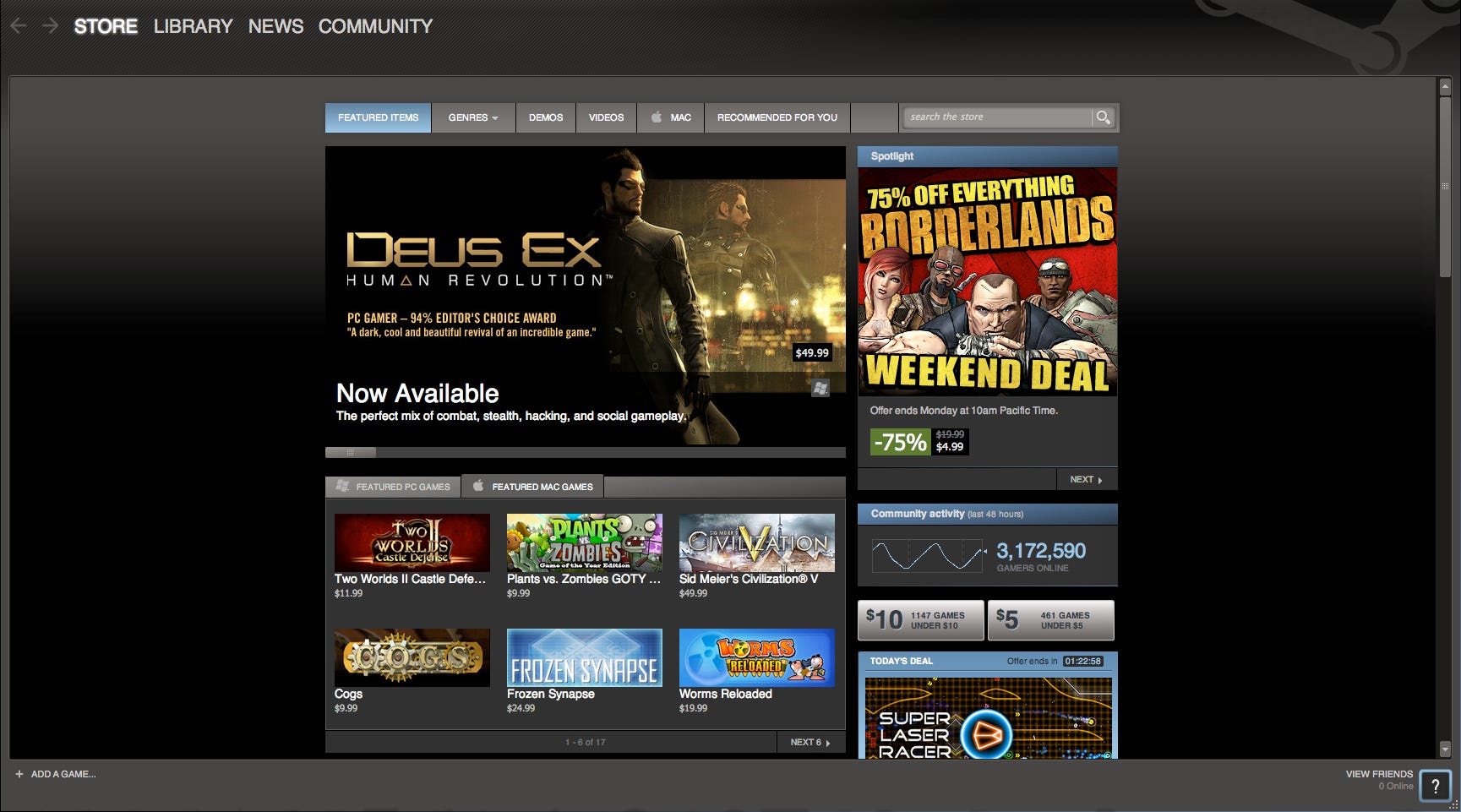
Steam's focus on promoting quality content and regular sales on its front page has played a key part in its success.

"Any monopoly is dangerous," insists Lovell. "It's all well and good we think Steam are the good guys today, but Google used to be the good guys. They used to be the upstarts, and now we're all a bit afraid of them. The good guys, once they get into power, can become the not-so-good guys.

"Any time somebody can stifle what comes to market by their choices, it's an issue. If - and I'm not saying this is happening yet - Steam goes, 'I don't like your game', then it can just stop an indie from getting their game into a meaningful marketplace.

"At one level, they've got an infinite shelf space and they can stock as many things as they like, but at another level there's only a limited number of sales, there's only a limited number of front pages, there's only a limited number of business development people willing to sign the contract," he continues.

"They can just say 'we don't want to do that'. They start being able to censor what they distribute. When one person can effectively say yes or no over whether a product gets shipped, that's a dangerous place."

So, what are the chinks in Steam's armour? Where should the competition be focusing its efforts? The consensus seems to be that anyone wanting a shot at the title is in for a monumental struggle. Valve's store has a huge, contented customer base that will prove very hard to shift.

"Steam is dominant because they were early, executed well, and keep improving the service, with very high customer satisfaction," explains Wedbush Morgan analyst Michael Pachter.

"It will be difficult for anyone to topple them. The analogy is Bing to Google search. It doesn't really matter how good the competitor is if switching costs exist, as most people who are perfectly satisfied won't bother to check out the competition."

If anyone does have the stomach to properly take on Valve, they'll likely have to have very deep pockets. Indeed, when asked what he'd do if wanted to mount a serious challenge, Get Games boss Graeme Struthers cheerfully concedes, "If I really wanted to take on Steam I'd have to go and find a colossal amount of money and buy them."

Not only will a competitor need to court publishers by offering them a bigger cut of the back-end, but they'll also have to pass on some meaningful savings to customers. And with Steam hardly pillaging gamers' wallets as it is, that's a bar many will be unable, or unwilling, to crawl under.

Blizzard veteran and current Runic Games boss Max Schaefer doesn't provide much more in the way of comfort for any would-be usurpers. He tells Eurogamer that their best hopes probably lie in Valve slipping on a proverbial banana skin and doing something to alienate its userbase.

"I think Steam benefits from being an agnostic platform - they push other people's games as much as they do their own. Unless Steam screws something up. That's a way things could change - if they do something that horribly annoys its customers. People don't have a terribly large emotional attachment to where they're clicking to buy their stuff. Right now most things that they want are on Steam. It's sort of a self-fulfilling situation - since everyone is there, that's where everyone goes."

However, there is certainly one area where competitors might be able to find a little elbowroom. Steam's dark, slick aesthetic is largely geared towards the male, core-orientated user. That leaves a huge swathe of the world's gaming population up for grabs, says Theodore Bergquist, CEO of Steam rival Gamersgate.

"Steam has pretty much locked in the hardcore market," he admits. "On the other hand, if Steam has five million paying customers and there are 90 million PC players in the US, it's easy to see who you should go chasing for.

"The next generation of digital buyers are not hardcore gamers, they are more casual consumers in the sense that they don't care about all the overlay features in a platform, they don't want to download a client, and they don't see the point of being locked in. They want to keep it simple - download and play - and they care more about price and selection, rewards and support, things Gamersgate are focusing on."

The other key factor in Valve's success is content. Tying a must-have game exclusively to the platform worked wonders for the developer with Counter-Strike. Attempting to replicate that honey trap is another possible angle of attack. And sure enough, this is where EA's Origin initiative comes in. Of course, the jury is still out on whether forthcoming BioWare MMO Star Wars: The Old Republic is that killer app, but its absence from Steam is undoubtedly a blow for Valve.

2

Making Steam membership mandatory for Counter Strike back in 2003 gave the platform a vital bump start.

Like it or not, EA's Origin store could prove but a taste of things to come, and it may well be single-publisher stores such as these that eat into Steam's bottom line rather than more conventional competition. As digital delivery increasingly becomes the industry standard for PC, it's natural for slow-on-the-uptake publishers to want to make up some ground and wrestle control of their games back from third parties. With a hefty percentage of a game's asking price being skimmed off by Valve, who can blame Riccitiello for wanting to strike out on his own?

"In the traditional physical retail distribution channel, a publisher has to give up 35 per cent of the top-line price in order for the retailer to get their margin for distribution, in addition to the overhead and production costs to manage a physically distributed item. Publishers have accepted that, mostly because they can't do it themselves," explains EEDAR analyst Jesse Divnich.

"In a digital environment, however, the barriers to create a distribution outlet are much smaller. Anyone could create their own digital storefront and pocket the distribution fee that is standard through outlets like Steam - or pass the savings on to consumers."

EA itself argues that not only does it have a right to get involved, but that the arrival of Origin on the download scene is actually a boon for the industry at large

"I am actually a big believer that competition is always good for the consumer," insists EA's European boss Uwe Intat.

"It's not as simple as competition drives prices down. It can but doesn't necessarily have to. But certainly, competition drives creativity because competitors have to come up with innovation. Usually to be successful you put the consumer into the centre of your thinking and of your innovation. So, to have different competitors out there it's usually better for the consumer.

"There are different strengths that people bring to the party. We understand our consumers in our games best. A traditional retailer, depending on what space it's in, if it's just games or it's games and music and movies, they have a broader consumer portfolio, so they understand people in many more categories a little less deep. We understand our people in our category very deep.

"So it should be a nice and innovation-stimulating competition out there, which at the end is good for the consumer."

Perhaps unsurprisingly, not everyone shares that view. Good Old Games, which happily ploughs its own niche as a provider of classic retro titles, reckons that you, the customer, will be the biggest loser if the market continues to break up.

"If in the long run all the big publishers are going to follow EA's strategy I think the market will become very complex and become a big puzzle for the consumer," explained CEO Guillaume Rambourg.

"The gamer is like any other consumer - like you or me going to the supermarket to buy food, for example. If in the future you had 50 shops - one to buy vegetables, one to buy fruit, one to buy pasta, one to buy coffee, we would all go crazy. We have to keep the market and the offers simple for consumers.

"And to go further, we have to keep consumers happy - this should be the bottom line for the industry, the obsession of the industry. Are the consumers going to be happy if there are 50 different places to buy 50 different products? I don't think so to be honest."

So, how big a threat does Origin pose to the established order? Well, while it's undoubtedly a thorn in Valve's side, it's unlikely to be able to offer the same breadth of content as Steam, despite EA's claim that it hopes to lure third parties onto the platform. While, at a stretch, a few second tier publishers might be willing to hand over control of their IP to a competitor in return for added visibility, you can bet Bobby Kotick would sooner offer up his first born.

3

Will Star Wars: The Old Republic do for Origin what Counter Strike did for Steam when it launches later this year?

However, Divnich reckons a publisher of EA's stature has enough original content and a high enough profile to run a profitable ecosystem.

"It may be fair to say that this is a Wal-Mart versus mall scenario, where consumers who just want a simple one-stop-shop experience typically prefer the Wal-Marts and Targets of the world, and those looking for specialty items or prefer bargain hunting will spend the time jumping from one mall store to the next."

Further market splintering is likely as the switch away from boxed product gathers pace, especially if/when consoles ditch discs and go download-only too. And it's not just major publishers that Valve needs to worry about. Indies - who've played a big part in the Steam success story - are at it too. Did Notch need Steam's help to make Minecraft one of the most profitable games of all time? Nope.

Sure, your average indie needs the exposure that Steam's frontpage can offer, but increasingly it's their own sites that are providing Valve with stiff competition, rather than alternative online stores. Schaefer tells us that although Steam accounted for 65 per cent of all Torchlight sales, the second biggest contributor was the Runic Games site.

The other wolf that Steam needs to keep from its doors is piracy. That's another article for another day, but as long as Ubisoft and its ilk insist on invasive, customer-baiting DRM in their downloads, it's a threat that isn't going to go away.

4

World-building phenomenon Minecraft is a rare indie that has found a huge audience without Steam's help. Will more follow its lead?

And what is Valve's take on all this hoopla? Typically, it's taking the high ground, ignoring the scrapping going on in its wake and, like GOG's Rambourg suggests, keeping its focus on what has put it in the enviable position it sits in today: its customers.

"We've never really found it helpful to us to set up somebody else as a competitor and then try to evaluate ourselves against that," company president Gabe Newell told Eurogamer at Gamescom earlier this month.

"Sometimes if feels like you're constraining yourself to the mistakes and good decisions of other people rather than just focusing on customers and what you should be doing for them. So we don't often find it really helpful to sit down and say, well, these guys are our competitor and they're doing this so we should do this.

"There are a lot of companies that, if you identify yourself as a competitor to them, you're going to follow them right into the ground. It's like, oh, they're doing this, let's do this, too. Arggh! What happened to the music genre? We have a billion dollars in plastic. Yay! Customers are a lot more helpful than competitors in making good decisions."

While Steam might not have the market all to itself any more, with that attitude, PC gamers can only hope it continues to be a leader, rather than a follower, for years to come.

Comments (100) Latest comment 8 months ago

Comments for this article are now closed, but please feel free to continue chatting on the forum!

  • Shikasama #1 9 months ago

    Steam and Origin aren't competing. EA has put games exclusively on Origin so they can control the prices and charge you more for a digital copy than a boxed copy on a shelf. They aren't competing over BF3, SWTOR and all future major EA titles.

    So no, it isn't good for anyone except EA.
  • spindizzy #2 9 months ago

    I REALLY don't want a million different stores on my computer. EA will have to work very hard to get people like me to switch.
  • Inmediasress #3 9 months ago

    Funny that this whole calamity came from Devs neglecting the PC and declaring everybody a pirate.
    I remember quite a few years back there were hardly any games (well worthwhile games) on the PC it really struggled thats when the whole PC is dying argument came around.
    Well guess what Valve reacted and created steam which more or less negates zeroday piracy and while most publishers laughed their ass off, it became big and now nobody wnats to admit, that they were wrong and that they came very late to the party.

    Steam is like M$ or Apple it won't be toppeld unless Gabe says so.
    They can try to compete but in this case too much competition just makes it more difficult to buy games because if every publisher wants his own client and makes games exclusive to it then, well you can imagine what will happen.

    If they want to compete they have to do what steam does and allow competitors games to be sold trough their service a sort of fair playing filed but seeing as the industry goes the total opposite even restricting me from which retailer I want to buy with exclusive shit I can't see a bright future for digital distribution.
    Only a messy war that maybe no one will win and will get back to boxed purchases.
  • Subquest #4 9 months ago

    Where a competitor could make headway is the price of recently released games. Steam charges 29.99 whereas you can often shop around for a boxed copy and find them a few quid cheaper. If Origin came in and offered, say, Deus Ex HR for £25, then I'd consider widening my focus
  • JoeGBallad #5 9 months ago

    The idea that competition is ALWAYS some universal force for good that 'drives prices down' etc. is a capitalist fantasy. True, it can be a good thing, and has been in other industries, but that's not what EA are after.
  • cheeky_pete #6 9 months ago

    I liked this bit. "In a digital environment, however, the barriers to create a distribution outlet are much smaller. Anyone could create their own digital storefront and pocket the distribution fee that is standard through outlets like Steam - or pass the savings on to consumers."

    Since EA are saving that 35% on selling the games themselves there is no excuse for new releases to cost £40 in the Origin store which just proves their entire motive behind it is to rip off the customer.

    Origin in my opinion won't hurt Steam as much as EA want it to and certainly won't be the application people keep running when they close a game, as most currently do with Steam. I would love to see an alternative to Steam but instead of making it more open EA have made it more closed off and that doesn't endear them to me at all it come across as exactly what it is: a pathetic money grab.

    Why no mention of Desura or Impulse reactor here since they are already direct, albeit not very big, competitors to Steam?
  • ubergine #7 9 months ago

    I haven't read the article yet, but so far this has seemed like an arsehole competition.
  • bobfish09 #8 9 months ago

    Digital outlets aren't allowed to sell games for less than the RRP, otherwise high street retailers won't stock the title. Steam gets around this on occasion with pre-purchase discounts, but on the whole, their prices, like Origin are the same as the RRP, just high street retailers are free to discount however they like.

    Also, Notch has come out and said that Steam has policies that prevent him from releasing Minecraft on there, so it isn't only EA saying there are problems with Steam and Valve.
  • linea #9 9 months ago

    Despite the fact that I abolutely HATE the idea of Origin, I know I'll find myself downloading the client and clicking 'buy' on BF3 day 1. The DVD drive in my PC hasn't worked for ages....

    If there's any way to remove the client as soon as that's done though I will be doing it
  • Scimarad #10 9 months ago

    Steam has won me over by being largely reliable and having lots of bargains. It's a total pain if you happen to lose your password, though.
  • Caimbeul #11 9 months ago

    Whilst steam is for the most part brilliant. There are still two areas where in my experience they fail badly. For all the talk of customer satisfaction of steam users, over the years I have found that if you have an issue that they are VERY slow at resolution. I have had issues with games that simply would not start on any of my 4 machines. It took just over 3 weeks of robot like replies from valve tech support asking me to do things I had stated had already been tried. In the end a helpful forum member elsewhere helped resolve the problem. And that is not the only instance of slow and poor service.

    Also, as others have mentioned. New release pricing is very poor.£35 for Deus ex when I got it at retail for £23 for example.

    Not pooh pooing steam, just saying it is not all roses.
  • Subdominator #12 9 months ago

    "Steam is dominant because they were early, executed well, and keep improving the service, with very high customer satisfaction," explains Wedbush Morgan analyst Michael Pachter.

    He doesn't disappoint, always telling everything but the truth. Steam in its early years was a bloody mess. It was clunky, buggy, nobody liked it. Everybody hated to have to use it for games like Half-Life 2 and most of all Counter-Strike. Valve's AntiCheat sucked. The login servers were hard to reach. Updates were rare (took them months to fix stuff) and when they came they screwed up other stuff. Of course things have changed to the better over the last nine years, but it's a wonder Steam is where they are right now, cause the first four years were horrible.

    In a way EA is just copying what Steam did. Make the software essential for high-profile games, then change it from a simple login tool and patch distribution to a community and store.

    #1 Valve does exactly the same thing. All their games are exclusive to Steam and can't be bought in any other online store. They charge 20 bucks for games like Counter-Strike Source for a digital copy. Go to a store and you pay almost half of that. The reason is you don't pay less because no physical copy is needed, you pay more because digital distribution is simply more comfortable. Sure, Valve has a lot of sales, but the truth is that outside of sales they are often more expensive than the average store.

    Just three random examples (from Steams top list):

    Deus Ex: Same price on Amazon and Steam
    Brink: costs 100 % more on Steam than on Amazon
    Serious Sam 3: 35,99 € on Steam (at 10 % off), 33,99 on Amazon

    It does even include Valve's own games. Amazon sells me the UK version of Portal 2 for 25 €, Steam wants me to pay 30 €.

    Steam is one of the greatest things there is (especially for indie games), but the truth is: It is expensive if you don't wait for sales. And even then their 10 % off preorders are more expensive than what you pay for the same game on Amazon.
    Edited by Subdominator at 30/08/11 @ 09:39
  • mkreku #13 9 months ago

    I never buy new games on Steam. Why? Games that cost 40 dollars in the US cost 40 euro on Steam in my country. Retail, with a nice box and shiny disc, still cost 40 dollar.. or less. Usually less.

    So yeah, a competitor could compete with pricing. Steam are NOT leading the way there.
  • Subdominator #14 9 months ago

    #6: What about the huge server farms that are needed for Origin, the huge amounts of traffic for the games, the customer support ... they had already invested 250 million bucks in Origin before they sold a single game on it. Of course they want to get that kind of money back. Nobody with common sense thinks that digital distribution leads to lower game prices. It's all about content control. The more control the publishers have over their own products, the higher the prices. Just look at something like Xbox Live. If a game releases at 1200 points it's bound to sell for 1200 points in three years. And has maybe one week of sale for Gold users, one year after its initial release.
  • syra #15 9 months ago

    The more DRM bullshit that you have to install the worse.

    Also prices go down based on competition of the same product being sold. EA isn't competing with steam other than in the cursory sense that they are in for a piece of the online dollar. EA are creating a new market for EA products. If they ever get around to third party hosting it might become a competition but the big titles are being price fixed, not suppressed by competition.

    BTW steam has been around for longer than since 2003. It just became prolific in 2003 because of the move everyone playing counterstrike had to make and HL2 hype - everyone needed to install it.
    Edited by syra at 30/08/11 @ 11:12
  • Anciegher #16 9 months ago

    How to compete with Steam. Release new games for 29.99 or 39.99 to compete with retail prices and beat Steam on their redicilous launch prices. I would certainly go there...
  • kenichi-san #17 9 months ago

    Steam vs Origin is good for gamers & competition as long as they don't have/get exclusive games. They can rather battle each other with prices and perhaps DLC content, (because i don't care about DLC). :p
    Edited by kenichi-san at 30/08/11 @ 09:13
  • Subdominator #18 9 months ago

    #13: Yeah, it seems unfair. Except it isn't. If you want to complain go to your government. The difference that you forget is:

    US price of 40 $ is excluding tax
    EU price of 40 € is including the average EU sales tax of 20 % (they don't do the correct taxes for each country because it would not be worth it, so if you buy a game on Steam from Denmark (who are at 25 % sales tax) you actually pay less than what you have to pay, if you're in Germany (19 % sales tax) you pay a bit more. The thing is:

    EU price without tax: 33.33 €
    US price without tax: 40.00 $ (which is about 29 €, the banks take their cut which is why you never get the real conversion rates)

  • technotica #19 9 months ago

    Hmm, I don't think having more digital retailers will help the market. If EA is successful other companies will follow and soon we will have dozens of stores only selling a small amount of games.

    So far I only buy games from two digital sources (and gog but gog is special), Steam and direct2drive. And that only because Direct2drive has uncensored game ( I am from germany) and steam insists on needlessly censoring certain games.


  • bad09 #20 9 months ago

    Steam Origin whatever it's all DRM and the lot can get lost IMO, the longer I'm in the digital age the more I long for the easy days of a DVD from a shop and bloody key. No internet shite, no clients running in the background, no details given just a disc and a key and you can play.

    All of it can sod off it's all just more hoops getting in the way of a once fun hobby. It this industry really wants digital only it needs to look at GOG not steam and other launchers/clients.
  • StooMonster #21 9 months ago

    Steam and Direct2Drive and Impulse and GoodOldGames and GamersGate and Games for Windows Live and GetGamesGo (from EuroGamer no less) even retailers are direct competitors because they sell content from many publishers.

    Steam (and the others) and Origin are not directly competing because Origin exclusively sells EA titles.

    Moreover, while at the moment EA titles are available on other digital distribution channels, we don't know for how long; we've already seen 'Exclusively on Origin' marketing appear.
  • StooMonster #22 9 months ago

    Subdominator: "Nobody with common sense thinks that digital distribution leads to lower game prices. It's all about content control. The more control the publishers have over their own products, the higher the prices.

    The most accurate comment of all of the above, absolutely spot on Subdominator, and it happens in other industries in practice as well as in academic business theory. Exclusive distribution channels owned by the content owner are never good, which is why Sky are forced to sell their content (such as sports) via other platforms (such as cable) for example.
  • StooMonster #23 9 months ago

    technotica: steam insists on needlessly censoring certain games

    Needlessly? Surely they are just complying with the laws of your country? If you think the censorship is needless, then you need to get onto your legislature.
  • KDR_11k #24 9 months ago

    Anyone could create their own digital storefront and pocket the distribution fee that is standard through outlets like Steam - or pass the savings on to consumers.

    The latter is not an option, Steam is tied to retail prices and release dates because retail outlets blackmail publishers into requiring that. If Steam were to price big games competitively right from the start then retailers would boycott the games which would be devastating for the publisher.
  • mAc062 #25 9 months ago

    Steam is too expensive outside of their sales. I bought the agmented version of deus ex 3 for €40 from my local Game, steam were charging €63, any competion is a good thing hopefully it drives the euro prices down on steam then maybe id consider buying non sale games, they gotta match boxed prices or whats the point.
  • apoc_reg #26 9 months ago

    If EA think their service is good they should stand toe to toe with features NOT restricting Steams access to titles.

    That would be good for gamers, this is NOT! We as gamers have no choice if we want to play EA games and that is in no way good!!!!!
  • JahB #27 9 months ago

    All this competition will just lead to is somebody clever writing a program to access all these stores through a single interface, akin to what we're seeing with IM clients. Wait a sec...

    /puts on coding hat....
  • Bennicus #28 9 months ago

    It's ironic that the "competition" of brick & mortar stores is what's keeping digital distribution prices high. Sooner they go bust the better I think, then rival digital distribution co's can actually start competing on price.
  • PearOfAnguish #29 9 months ago

    EA will have to work very hard to get people like me to switch.

    Unfortunately if you want to play BF3, SWTOR or probably every other EA game going forward you won't have a choice. And I'm sure that most, if not all, the major publishers are working on similar systems.
  • Darren #30 9 months ago

    I'm amazed when I see Steam described as being 'good value' for us here in the UK because unless you wait and buy games in their admittedly excellent sales then they are anything but IMO as long as cheaper online options exist. I never buy new releases from Steam and only purchase the odd game in their sales. I save £5-£10 per game this way. Otherwise, I think Steam are overpriced, though it is the publishers that set those prices, granted. It's still Steam selling them though and as long as their pricing for new releases remains unattractive then I'll continue to buy games on disc. At least the disc acts as a backup too.

    I seem to be building up a collection of more and more Steam games though due to their use of Steamworks, which I have to admit I'm not especially fond of due to the fact that after all this time Steam still does not allow custom installs. I'm getting fed up of having to laboriously relocate my entire Steam folder when I run out of space on the partition it is located on. Yes, there is a workaround but it really shouldn't be necessary if the software was actually any good.
  • PaletteSwap #31 9 months ago

    "Good Old Games, which happily ploughs its own niche "
    Did you use the word "plough" on purpose when talking about GoG ?
  • ShadowMountain #32 9 months ago

    I became a 'proper' PC gamer this week (i.e. not just playing Japanese visual novels and minesweeper) and my first port of call was steam. Bought Reccetear, Deus Ex, and Deus Ex: IW.

    I like the fact that you can mod games without steam kicking up a fuss (did the shifter and new vision mods etc on Deus ex to update it). Somehow I don't think EA or any other 'individual publisher clients' will take too kindly to me modding their games...
    Edited by ShadowMountain at 30/08/11 @ 10:19
  • DozyKipper #33 9 months ago

    I doubt I'd use Steam if it weren't for their megatastic sales with games at rock bottom prices.
  • bikmate #34 9 months ago

    Make it DRM free already. That's why I love GoG. I don't think Steam will go down in the near future, but if it does I'm gonna download every game I owned from torrent trackers. No way I'm throwing out money through the window.
  • Widge #35 9 months ago

    I love using Steam thanks to its sales and never really have any desire to keep up with games on release any more. Playing Mass Effect years after release didn’t really negative impact on my experience of playing the game, and I got it for all of £3.50. I can see how this is a bind for the release week gamer though.

    My main concern is I’ve now made my bed as far as a gaming client goes. Using the Patcher analogy, it is quite easy to switch from Google to Bing with just a URL, client to client is another matter. Considering I’m not fussed about grabbing things on release, additional client hoops put in place by EA just means that I’ll bypass something like Battlefield 3 entirely.

    Or.

    2 years down the line they will relent and farm it out to Steam for additional sales and I’ll have it then. Same goes for Mass Effect 3, which I’m not even remotely touching until a full DLC included bundle is released.
  • L0cky #36 9 months ago

    @Darren "I'm amazed when I see Steam described as being 'good value' for us here in the UK because unless you wait and buy games in their admittedly excellent sales then they are anything but IMO as long as cheaper online options exist."

    As other people mentioned, digital download prices of new games are artificially high; Valve have no influence on this at all. The publishers have to keep the prices up to appease the bricks and mortar chains, who still have a surprising amount of weight with their 'valuable shelf space'.

    See the recent Gamestop vs Square Enix crap over the onLive vouchers for evidence that traditional retail still has clout.

    The Steam sales are exactly why you can describe it as 'good value'; it's not an exception, it's the reason for that description.

    The big chains only sell just released games brand new; when a game comes out of it's launch window they stop stocking it and instead focus on preowned, losing all their leverage with the publishers. The moment that happens, digital download prices come down dramatically; illustrating that their launch prices were artificial.

    My guess? EA will get greedy and try to pin the prices longer than the launch window. Some time later they'll release something on Steam to test what (if any) sales they are missing out on. They'll see they're missing a shitload of sales and eventually give in and start listing on Steam again. Origin will be all but dead in 2 years.
  • kearneybobs #37 9 months ago

    So, why is it that the price of games via these digital services has actually gone up in the last two years. I used to pay €40 for games on Steam/Gamergate etc. Now I'm being asked to pay €50. Competition is supposed to drive prices down, but when it's the publishers who set the prices that's not going to happen. It hasn't happened and I cant see if ever happening.
    I still pay €40 for my PC games in brick and mortar stores and can get them cheaper from the likes of Amazon. The pricing structure of these DD sites is so outrageous, it makes them seem greedy.

    Oh, and $50 is not the same as €50, so publishers please stop pricing your games like that and you might be able to get me to buy a digital game at release. Haven't done it in 2 years and I'm not going to at those ridiculous prices.
  • Steve2911 #38 9 months ago

    I'd say that in general, the gaming industry has competition backwards. Instead of benefitting consumers with new features and lower prices, they hurt them by taking features away from those who don't use their console/platform/retailer.

    That said, Steam is by no means perfect, but is probably the most fair, user friendly and customer-centric gaming platform in the mainstream. (I'd say that GOG tops it in these areas, but it far too niche to come out on top altogether).
    Edited by Steve2911 at 30/08/11 @ 11:13
  • Nephirion #39 9 months ago

    Console games offer better trade in prices and a bouyant preowned market for those that have a casual interest in gaming. Steam does offer good sales on occassion but the policy of no refunds and very high publisher prices goes against them, you could argue the friends list and achievements, voice chat integration etc are nice to have but that is nothing that you can't get through free services like xfire, raptor etc. Steam has done well because it was like the article states forced onto the community early on and is now well established.
  • odega #40 9 months ago

    "And with Steam hardly pillaging gamers' wallets as it is"

    Come on, is this EUROgamer??? Like already said here, Steam is hardly competitive with other online sellers in EU thanks to their fancy exchange rate where 1$ is 1€. Beside special sales, I never buy anything there. I doubt Origin will do any better but enshrining Steam as the current good guy is a bit over the top considering their business practice to ransack European gamers like they do.
  • jumpdeveraux #41 9 months ago

    Valve as a company has incredible brand value even before they launched Steam and always seem to be be focussed on what is best for their customers. I really like Steam, it's not perfect but it's continually being enhanced.

    With Valve I imagine them always thinking about how they make Steam better for the customer... with EA, Ubi etc. launching their own platforms I always imagine them just wanting to corale the customer into a corner and try and empty their wallet as quickly as possible.
  • FogHeart #42 9 months ago

    For the most part I'm happy with how Steam operates. I choose to play a game, Steam starts and if necessary updates it. I end the game, Steam tells me about what's on sale, what's up and coming, and what's new. If you see anything you like, you buy it or maybe browse for something else, if not, close down. I'm perfectly happy to install other shop 'clients' that do the same.

    What I don't like is the idea of running multiple clients that do the same thing, and fragment the community by walling off players who are playing different games. If I'm running a Steam game, I get the Steam overlay and I'm locked out of communicating with gamers playing an Origin game, and vice versa. I doubt that both overlays will work simultaneously. And even if they did, I don't like the memory and processing overhead that would entail. What I'd like is the establishment of an industry standard for an overlay - a manufacturer's consortium - that establish protocols for the services an overlay provides. So you can pick an overlay client from several different ones, even ones written by software teams that don't have online stores.

    To draw an analogy, by using Chrome browser I'm not limited to sites that Google decide upon, nor am I limited by IE or any other browser. They may differ in functionality, and if I want I can install one of those not-so-well-known browsers that integrate with Facebook or Twitter. In the same way I'd like to choose an overlay that will cater to my specific needs, that will communicate with other gamers no matter which game I or they are playing, that will take me to a specific store after playing as dictated by what game store I bought the one I just closed.

    Oh, and when I finish playing a game, the first screen on the store that comes up should offer DLC for it that I don't have, which would appease companies that want to offer DLC in-game.

    Edited by FogHeart at 30/08/11 @ 11:31
  • Rizo #43 9 months ago

    If EA really wants competition why not allow steam to feature there games and give me the choice of where I purchase it from?
  • bad09 #44 9 months ago

    "EA just want to knockup a half arsed version of Steam that is little more than a DRM facility "

    Erm Steam itself is little more than a DRM facility, one a majority seem happy with as well so it's no wonder all the publishers are trying to emulate it in their own way having a client run it's games (although some get it hugely wrong like Ubi). EA itself has been emulating Steam for a while now with EADM/Origin.
  • stan_dman #45 9 months ago

    I as a customer will shop where I get the best price with a customer service that I trust, the two go together. Unlike other monopolising companies, Steam so far has stayed true and loyal to its customers and I hope it stays that way.

  • bad09 #46 9 months ago

    @Rizo

    Many stiil seem to think it's down to EA their games are not on Steam. Maybe you all should ask Valve about their new DLC policy, that would be the real area of complaint as that's the source of EA games coming off Steam, and why devs now need 2 versions of DLC if they use their own system or say GFWL.

    Or do you believe Valve should get a cut of DLC? I wonder if GAME demanded a slice of the DLC like Valve they would get the same amount of people hating on EA for saying "no"?
    Edited by bad09 at 30/08/11 @ 11:43
  • Stricker #47 9 months ago

    I am equally annoyed as other European customers on how they treat us with their marketing schemes. My country doesn't even use the Euro, yet we are pent together in this uber-rich Eurozone that is expected to pay more than both Americans and Brits.
    Even though Valve cannot always be attributed this nonsense themselves, they had me in flames when they expected me to pre-order Portal 2 for 45€, 50€ once it was released. No chance in hell.
    Digital distribution is meant to be a convenience, not a luxury; a physical copy is always a better product with or without Steam support.

    Because, really, Steam is just veiled DRM software.
  • Subdominator #48 9 months ago

    #47 The problem is F2P. The new policy is in place so a publisher can't just release a F2P title, leaving Valve with all the expenses, and then profit by selling DLC ingame or on their own store without Valve getting anything.

  • bad09 #49 9 months ago

    @Subdominator

    F2P? What has that got to do with anything and why should that affect normal retail games? Valve can just state if you want to distribute a F2P title they must get a cut or something. A blanket "we deserve a cut of all your DLC because we sold your games" policy doesn't help anything and, as we are seeing, keeps games from your distribution channel.
  • Rizo #50 9 months ago

    @bad09 if thats really the problem why not just charge more for DLC on steam than there own platform? That way consumers can make the choice on which platform they wish to make the purchase.
  • PearOfAnguish #51 9 months ago

    Perhaps, rather than every publisher building their own separate download system, they could club together to build one for all of them, splitting the development and running costs. Then they could all benefit from having a Steam-esque service they control without pissing off their customers by forcing them to install a frontend for each company.
  • immateriaux #52 9 months ago

    Don't think the article really confronts the salient point that Origin is about EA exclusivity and therefore is narrowing the choice, no matter how many other platforms are out there. That isn't really competition in the sense we consider it as consumers, if EA's place is the only place to get something how can we say if it is better than Steam? It's simply fragmentation, not competition.
  • StooMonster #53 9 months ago

    bad09: @ Subdominator : F2P? What has that got to do with anything and why should that affect normal retail games?

    I imagine that its to do with the ease of writing contracts and legally defendable positions in court more than anything else. e.g. it's easier to write a "must always" clause rather than try to second guess every possible situation or variation and individually allow or disallow them.
  • bad09 #54 9 months ago

    @Rizo

    ? You want Steam consumers to pay more than everyone else?????

    It's not just the money anyway it's the delivery method. While Valve is perfectly happy selling you games that use GFWL, OSP, Origin, etc. They want publishers/devs to sell through Steam on DLC. A good example of this is Capcoms SSF4AE. Like Vanilla it uses GWFL, because SSF4AE release after the change in policy on Steam they needed to make both GFWL and Steam versions of all the DLC, that's why Steam users had to wait for the costumes. EA simply don't want to do that and want full control over their DLC. You can't blame them for that.
  • bad09 #55 9 months ago

    @StooMonster

    Nah I don't buy that. How many F2P games are on there and how many retail games are there? It's too small an area for blanket legal mumbo jumbo that would affect far more titles than the handful of F2P they have.

    Even if it is that I imagine they would change it quickly as it is resulting in games being taken off of Steam or not being offered at all.
  • StooMonster #56 9 months ago

    bad09: While Valve is perfectly happy selling you games that use GFWL, OSP, Origin, etc. They want publishers/devs to sell through Steam on DLC.

    They want publishers/devs to sell DLC through Steam as well as other means.

    bad09: they needed to make both GFWL and Steam versions of all the DLC

    Although an overhead, surely it's no different to creating different installers for different platforms anyway? e.g. Won't retail disc based installers be different again?
  • StooMonster #57 9 months ago

    bad09: @ StooMonster: Nah I don't buy that.

    Many hours with corporate lawyers makes me suspect it's what's behind this blanket policy, and it is a blanket policy because as you point out it affects F2P plays as well as non-F2P ones. Also, it only affects new titles, not old ones on previous T&Cs.

    bad09: Even if it is that I imagine they would change it quickly as it is resulting in games being taken off of Steam or not being offered at all.

    Only EA, no other publisher has pulled titles because of new T&Cs. I imagine that they are hard-balling EA and hoping that they will change their minds.
    Edited by StooMonster at 30/08/11 @ 13:24
  • bad09 #58 9 months ago

    @StooMonster

    Well no, using Capcom as an example, retail discs you would buy through GFWL marketplace like every digital copy sold elsewhere. What Valve now ask is you do that but also do a seperate version for them so they can sell the DLC themselves. It's like GAME wanting in on the DLC and demanding publishers change their DLC delivery basically (the only reason it's defended here is the Steam mad loyalty). Steam see the DLC and want to sell it themselves rather than being sold elsewhere therefore earning a cut. It also serves as a nice hurdle for publishers and devs....unless they use Steamworks of course...
    Edited by bad09 at 30/08/11 @ 13:25
  • bad09 #59 9 months ago

    @StooMonster

    FOR NOW EA are the only ones although Minecraft isn't on there for the same reason, but how long before others do think "why the hell are doing 2 sets of DLC just because Valve want some action?", especially with many moving to their own launch clients or still using GFWL.
  • StooMonster #60 9 months ago

    bad09: the only reason it's defended here is the Steam mad loyalty

    I think they are right to do it for free games, otherwise they could end up with some huge costs while someone else makes a huge profit.

    But I don't agree that it must be a requirement that non-free games offer their DLC also through Steam as well as other platforms.

    However, that's just mad me think why the 'blanket cause' ... if the criteria was "free games" then publishers could offer the game for £1 rather than £0 but have lots of money made on the DLC, and Valve would be shafted. It would be impossible to write a legal contract that would work, hence "all DLC" has to be offered also on Steam.
    Edited by StooMonster at 30/08/11 @ 13:31
  • paketep #61 9 months ago

    Competition is good. EA isn't.
  • Matfink #62 9 months ago

    Competition is highly overrated. It's just the period of artificially lowered prices while the weaker parties get ingested by the stronger and they can have their own way.
  • stan_dman #63 9 months ago

    I agree with StooMonster, Steam should take a cut out of the DLC. I remember not long ago people would criticise a game with DLC, as you would need to purchase the DLC to get the full gaming experience so I don't see why we should defend DLC now.
  • bad09 #64 9 months ago

    "I agree with StooMonster, Steam should take a cut out of the DLC"

    Why though?

    Would you agree if D2D demanded the same? Would you agree if Game started wanting a percent of DLC. Why should a retail channel earn on DLC exactly? What makes Steam so special that people think it has a claim to a cut of the DLC of other peoples games?

    I know to many Steam is seen more as some sort of messiah than the DRM/digital distribution channel it is but what exactly gives them the right to earn off other peoples games other than selling the orginal game they offered to people? With DLC from the publishers own system or GWFL they are not even using Steam servers for the DLC if it's there so there is not even a cost involved for Valve.
  • NorfolkNClue #65 9 months ago

    Steam at least allows you flexibility to install games via it even if bought somewhere else. For instance, Steam had Deus Ex @ 29.99. EG's GetGamesGo had it @ £21, gave me a game code which I then entered on steam and installed. I liked being able to do this, as there was the chance to buy it cheaper, and then use the content delivery to keep everything in one place.
    Edited by NorfolkNClue at 30/08/11 @ 15:38
  • Sunyavadin #66 9 months ago

    Yes. competition is good as it prevents companies charging whatever they want on these download services (which only provide a "service" to the publishers).

    When there are publisher exclusive platforms like this, THAT is anti-competitive.
  • Bennicus #67 9 months ago

    "When there are publisher exclusive platforms like this, THAT is anti-competitive."
    Not really, there will still be rival companies producing competing platforms & games, and the barrier to entry for a digital distribution service is nowhere near as high as starting a high-street retail chain so there could easily be more.
  • Darksjeik #68 9 months ago

    Sticking with STEAM all the way, EA can go ^&%$ themselves
  • andybear #69 9 months ago

    there is no competition steam vs origin lol
  • DodgyPast #70 9 months ago

    Can see why the DLC cut may feel like it's double dipping, but can also see Valve feel that potentially it could be abused.

    To me the real competition for Steam is XBLA and PSN. I regularly find myself choosing between the two, and Steam tends win due to the fact that I know I can play the game again in a few years time. I think this is one of the big reasons why Valve work so hard to keep their customers happy. If they piss off enough people they can migrate to a console... and is also probably why PC gamers worship Valve so heavily. After all EA can always decide to shaft the PC but currently Valve rely on a healthy PC market.
  • Grayvern #71 9 months ago

    Steam may take a 30% cut but that has to be far less than the costs involved in boxed retail.
  • Chufty #72 9 months ago

    As others have said, the key to getting people to switch from Steam is to undercut their high prices.

    The article mentions that Steam is very cheap and potential competitors may find it difficult to charge less. This is not true; new games generally cost £30 but can be found for as little as £20 elsewhere. I often, for example, buy new games from GetGames for £5-8 cheaper than Steam, and the games usually activate on Steam anyway so there's literally no benefit to buying it on Steam.

    It's not just new games; I was at a LAN party the other day and we fancied a spot of Crysis Warhead, which I did not own. On Steam it was £17 but on Origin it was £10. Had I ordered it from an online retailer, it would have been £5.

    With Steam, if it's not on sale it's not cheap.
  • Red-Moose #73 9 months ago

    All EA have to do to beat Steam is to allow EA games on both Origin and Steam, but use their marketing might to sell that Origin is more stable for multiplayer. It can be complete horseshit, but it's worth a shot seeing as everything else quoted in this article is also complete horsehit. Steam was crap at launch, and I refused flatout to buy HL2 because back then, always on broadband was not the norm. Still haven't played it actually!
  • xuiton #74 9 months ago

    UK and it seems even EU customers of steam get shafted. Nearly every game even on sale you can find considerably cheaper in retail stores. I have no idea why UK customers actually pay for games via steam, it is a rip off. This origin seems vastly expensive too.
  • StooMonster #75 9 months ago

    stan_dman: I agree with StooMonster, Steam should take a cut out of the DLC.

    Thanks for the support stan_dman, but I wasn't saying they should take a cut, I was trying to work out and explain why I think things are the way they are.

    I think my noddlings above are pretty close to what's really going on with EA and Steam.

    The only unknown for me is whether Valve are saying that DLC for a game purchased on Steam can only be bought from Steam, or whether they are saying it also has to be offered on Steam as well as other platforms.
  • StooMonster #76 9 months ago

    bad09: With DLC from the publishers own system or GWFL they are not even using Steam servers for the DLC if it's there so there is not even a cost involved for Valve.

    I'm telling you, it's Valve's corporate lawyers and their strategy for mitigating risk that's behind this along with some analysis of business risk.

    The risk is that it's perfectly feasible that a publisher could contractually sell a game for £0 (or £1 to avoid any "free" clauses) on Steam but only make it playable by customer purchasing DLC directly from them exclusively or perhaps even 'activating' the game through an in-app purchase system -- just like iOS where the 'lite' version can purchase the 'full' version via in-app purchase.

    This is a risk to Valve because it would cost them a huge amount of money and they would make a loss on hosting that title whereas the publisher with the innovative business model would make shedloads.

    Therefore their risk mitigation strategy is to say that all DLC must be available on Steam -- exclusively or in addition to be determined -- because that prevents the in-app purchase approach from working and also the offer the game for free but charge huge for essential DLC avoidance fee scenario.

    Thats is it, it's pretty simple.
  • number3son #77 9 months ago

    How come I had to read the comments section in order to discover that EA is not actually competing with Steam, since they're future titles will all be exclusive to Origin? Why isn't that in the actual article? Maybe if the press were a little better about doing their jobs and less concerned with keeping the game publishers happy so they'll keep getting exclusive interviews and review code, consumers' lives would be made easier.
  • bad09 #78 9 months ago

    @StooMonster

    I dunno, like I said before I just don't buy they put that clause in for the tiny handful of F2P you can download through Steam especially at the expense of losing big publishers like EA. Like I said though if it is that I expect they'll change it in the future. EA have walked away how long before others get bored of doing seperate games for Steam?


    @ number3son

    "since they're future titles will all be exclusive to Origin? Why isn't that in the actual article?"

    It's not in the article because it's just not true.....yet. Only one game is to be stupidly digitally exclusive to origin alone and that's Old Republic, even there though you have the option of a disc from any retailer (which I imagine a great deal will do anyway) if you don't want to buy digitally from EA. For now no other game is exclusive to Origin and will only be missing from Steam due to the DLC policies.

    If they do start stopping retailers selling their games how long do you think Origin will last anyway? You really think people will just start paying the EA store prices or do you think they'll just go back to disc from physical retailers?
  • Zaiz #79 9 months ago

    @Chufty

    Protip, EA sets pricing on its games on Steam and on Origin. Guess why Origin was cheaper.
  • Matthew_Hornet #80 9 months ago

    "We understand our consumers in our games best."
    No, actually, Valve understand your customers better than you do.
  • AOFanboi #81 9 months ago

    Origin charges a "preorder fee" for SW:TOR. EA can go take a swim in shark-infested waters for their abuse of the name they bought when they swallowed the company that made Ultima.
  • StooMonster #82 9 months ago

    bad09: I dunno, like I said before I just don't buy they put that clause in for the tiny handful of F2P you can download through Steam especially at the expense of losing big publishers like EA.

    It's not about past games though is it? The new T&Cs only affect new games, or changes in terms to some current games. Lots of people speculating that future games might be more freemium business model or others (e.g. my example of demo turning into in-app upgrade to full version).

    Risk avoidance and mitigation seems pretty logical business based arguments to me -- but then again I spent years working in financial risk so maybe I'm biaised -- I think my theory has got legs. If you disagree, what's the alternative?

    Edit: Also, I've seen bigger deals go down than EA on Steam because of compliance with risk avoidance requirements.
    Edited by StooMonster at 30/08/11 @ 23:25
  • bad09 #83 9 months ago

    @StooMonster

    For a handful of F2P and some rather unfounded specualtion in some areas about all games being F2P eventually they are happy to lose big hitters like EA and make all the rest either use Steamworks or make 2 versions of their games? Nah still not buying it. I'm not saying you are wrong of course, none of us know the reasoning behind Valves change just I don't see them changing such a huge thing, making work for devs and publishers just so they can earn off a handful of F2P titles with a pure guess at that's how all gaming will go in the future.

    Besides looking at their F2P stuff now there is nothing on there to sell, you just download the game so maybe they already get a cut there if you buy stuff for their Steam version of the F2P game?

    As to the alternative? Well Valve could simply just want some of that DLC gravy and with such a big share of DD think they have the clout to go for it, certainly others are complying with the requirement. Or it could be a hurdle in polace to encourage more using Steamworks as their DRM, why make 2 versions when Steamworks does it all in one go?
    Edited by bad09 at 31/08/11 @ 00:13
  • spunkythefunkymunkey #84 9 months ago

    Origin has done nothing but make me want to get BF3 for the PS3, only until it eventually does appear on Steam for a more reasonable price.
  • Davemanz #85 9 months ago

    I can't help but find it funny that the article brings up Minecraft not needing Steam, when Notch has been very, very vocal in his love for Valve and desire to replicate everything they've done development and business-wise. Not that it's a mistake in the article by any stretch, just a little irony.

    But of course Minecraft is exceptional - like WoW, it's possible we'll never see another success quite like it in that particular field, well, ever. Lots of experts say no MMO will likely top WoW given how perfect its timing was and how broad its appeal continues to be. Minecraft could be similar, or it could not be.

    And I think it's worth bringing up one of the reasons Valve are so much more agreeable than big publishers - they're privately owned. In the US especially, this is a big fucking deal. Private ownership means no answering to terribly nearsighted shareholders who know nothing about the industry, etc. It also means they have freedom to put out a better product with a marginally smaller profit margin because they believe in what they do. Not because they don't care about making money or anything naive like that, just that publicly-traded companies are bound by law to maximize profits, while private companies aren't. It's an important and often ignored distinction with profound implications for how businesses are run.
    Edited by Davemanz at 31/08/11 @ 07:59
  • FeralJim #86 9 months ago

    Not on steam? not worth purchasing. Until Valve do make that proverbial first mistake and alienate all their users. I see no reason to switch. Especially when Origin is charging full price for releases they save 35% on. ROFL. Helping the consumer indeed.
  • tankboi #87 9 months ago

    It's already been said, but they are not competing if they don't release each other's games on their platforms.

    Seeing as EA own pretty much everything I can see a long and arduous path ahead.
  • bad09 #88 9 months ago

    "I see no reason to switch"

    See this is the kind of thing that's baffling me with this and I wish someone would clear it up for me.

    What would you switch to? Origin sells only EA games, it's no different than EA store and the EADM that we've had for years just all in one package like the well received Steam. Why the sudden panick over it? Why all of a sudden do gamers think it's some kind of attack on Steam and they need to "choose"? Have the media dones this with the "steam competition" nonsense or is it the timing with the Steam DLC problem coming the same time as the name change and rolling EADM/Origin out as retail DRM? Am I the only PC gamer been using Orgin (under it's old name) for ages without worrying about it?

    Besides, even if EA did start selling other publishers games on origin to actually become the competition for Steam many seem to think it is would it actually be a bad thing having more download stores? Personally, since being locked out of Steam in times of internet problems I find putting all your games in one internet DRM filled basket a tad silly and like to buy from a wide range of retailers both digital and physical.
  • DirectAim #89 9 months ago

    cheeky_pete #6 - Why no mention of Desura or Impulse reactor here since they are already direct, albeit not very big, competitors to Steam? - Probably because they are so small the vast majority of people haven't heard of them!

    bobfish09 #8 - Notch would say that. He has been very lucky with Minecraft and the reference in the article to its success is 1 in a million, Notch hasn't created the best game or the one that pushes the boundaries, he has been VERY lucky with marketing and people writing up about it. I haven't read about his competition which are making bigger and better games.

    My views on the article are that EA with census games, they are the evil ones, not Valve! I hate the fact that I cannot buy EA games on Valve and I am being forced into downloading Origin when I am 90% happy with Steam.

    The issue with ALL online distributors like Steam & Origin is that they are STILL very overpriced. I recently bought Metro 2033 for £7.99 brand new with free shipping when on Steam it is £19.99.

    Now if I was Gabe, you know what I would be doing?! I'd be getting MW3 and plastering it all over Steam, even throw then a few million and get exclusive online distribution! Fuck Origin, ill only use it for BF3, thats it.
  • SniperZoz #90 9 months ago

    I can't say i like any of this ... but i don't understand ppl saying that EA has to work hard to get ppl using Origin .... no they don't ... if you play any of EA's games, and I bet you do, you simply have no choice. It will be delivered via Origin!!!

    What shocks me is MS' silence on the matter - they missed the ball big time. Games for Windows is/was a failure and I wonder where the new "app store" on windows 8 is gonna sit .... it would be nice (as a consumer) to just lauch the MS store and get all my games from there ... but with Valve & EA (and others to follow) stance i bet the new app store is gonna fail too .... why would they want to put their games there rather then on their own store!

    What a mess it's gonna be!
  • Moz #91 9 months ago

    For me it's mute point as Origin isn't going anywhere near my PC as there's no way on earth I'll agree to EA's insane EULA. Who in there right mind would agree to a company being able to data mine their entire system!!
  • BouncingOffClouds #92 9 months ago

    This issue applies to comics, to a point, too.

    Digital distributors keeping boxed retail prices is understandable as shops would have issue with anything else, and we saw with the Deus Ex coupon stripping fiasco a hint of the possible fallout. Although you aren't getting a boxed product, although that becomes less relevant with all the DRM that is applied, the price of new digital and boxed being the same is understandable. I for one, though, can't shake the feeling paying 60 bucks or 40 quid for a digital copy is..... not desirable.

    So a comparison with comics could be drawn- they charge the same for digital releases that come out day and date with physical copies. There, though, you don't own the physical file on your PC and it feels far less appealing to many as games are digital anyway, the boxed version is just a conduit, but a comic is a collectible and a physical experience.

  • BouncingOffClouds #93 9 months ago

    Just to add, what irks me is when older games, already heavily discounted at boxed retailers, are pushed out for full price still, and when EA were charging like 30 quid or something when I looked to buy Crysis through digital downlaod last year (where I lived overseas it wasn't available boxed in English). I thought it'd be cheaper on EA's own store than anyone else's. but it felt such a rip off charging almost full price for an old game. It was 5 quid off Amazon.co.uk (but delivery was an issue where I was) and 7 quid locally new. Right now it's 30 bucks on Origin. Warhead is 20 bucks. Maximum Edition is 40 dollars on direct2drive US. Crysis is 30 bucks, and Maiximum 40 on Steam Us too. I was in the UK in the Summer and bought Maximum Edition new from GameStation for 8 quid.
    When you are the publisher, trying to make money like that off older titles, from your own store, when your retail partners undercut you so heavily, it's pathetic.
    I have my issues with Steam ( offline mode can fail and if I've no internet to sort it out, I can't play, for one). However, it's the best DRM solution if we must have one, they offer good prices in general, although mostly during sales and promos, and I need it to run a lot of my games so I have no choice, but it's fine (GFWL on the other hand.....I play offline only as I refuse to deal with that system and I'm pissed Arkhum City will use it ...).
    Digital vendors, especially publishers themselves, should realise that selling years old games at practically full price is a joke when boxed copies new are a fraction of the cost, and with more overheads in place.

    If EA gets 100% of the cost of Crysis, to continue my example, minus servers and bandwidth and applicable taxes, why charge the same as Steam and D2D who take a cut, and far more than games shops, where the return off new copies of Crysis must be a few dollars off a 10 dollar product.
  • Captain_Jono #94 9 months ago

    The basic question is this. Do you want a one stop shop, or do you prefer to have healthy competition at some inconvenience to yourself, because in the digital sphere it may not be possible to have both.

    It’s easy to throw up your hands and say “Oh just use Steam and be done with it.” The trouble with that position is that once a service becomes big enough, it becomes all too easy for that service to entrench its dominant position to the detriment of its competitors. This has happened time and again in computing, and there’s no reason to believe Valve wouldn’t follow suit, however unintentionally. Microsoft was the great bogeyman for much of the 90s and 00s. Apple has developed a near-monopoly on digital music. Even Google, that great paragon of virtue, is facing allegations that it does down competing products and services through manipulation of its search engine.

    Unfortunately its hard to see what can be done. Its all well and good to slag off any of the above companies, but the vast majority of people are simply not going to stop using Google, or iTunes or Windows for the sake of promoting competition!
  • StooMonster #95 9 months ago

    @DirectAim: I bought Metro 2033 on Steam for £2.50 (or similar, can't quite recall right now) in a sale.

    The fact that it is generally £20 on Steam -- a price set by the publisher, not Valve -- goes to show that if publishes controlled all distribution channels -- they don't control retail, retail controls them -- they would keep prices as high as they could for as long as they could.
  • mejoff #96 9 months ago

    "If in the future you had 50 shops - one to buy vegetables, one to buy fruit, one to buy pasta, one to buy coffee, we would all go crazy."

    HAHAHAHAHAHAHAHAHAHAHAHA
    Jesus Christ! Could this guy be any more ignorant?
    This exists now, some people prefer it. 30-40 years ago this was how all shopping was done, and everyone was absolutely fine. Specialists tend to carry better ranges of their specialities than generalists do.
    Sure, it's more convenient to get everything from a supermarket, but nobody goes mad from going to the greengrocer. (Ok, so a tiny number of people might go a little crazy from greengrocers due to their punctuation issues, but that's another thing entirely.)
  • Lin #97 9 months ago

    One man's monopoly is another man's format. No one goes around arguing we bring back betamax, or the standardised post code. The difference between these is that formats are agreed upon collectively by a large group of companies, consumers and other stakeholders and run independently, whereas steam is controlled by one company that cannot be expected to behave neutrallly

    What is needed is to take the valve out of steam. It should be owned by it's users, or otherwise independently run.
  • cjb110 #98 9 months ago

    As mentioned each publisher launching their own Origin would suck, very few would put the effort in to make it properly user friendly. They'd copy the easy crap, like more facebook, friends lists and other pointless rubbish...they'd miss the more boring but important stuff, reinstalling the OS doesn't mean re-downloading your steam games, patches are a thing of the past, etc etc

    Can you see EA offering its entire catalog for £60/80 on Origin, like others publishers have done on Steam?

    Battlefield 3 and Star Wars will be forgotten about on Origin as soon as the sequel's announced. Right now you can get the original CoD's on Steam for less than an pizza...
  • Camilitus #99 9 months ago

    Steam will pitch you a game via is store front, you check the features a maybe a scrn shot or 2. Then can scroll down read the marketing blurb, On the same page is a link to metacritic and sometimes direct quotes and links to negative reviews about the product posted. If EA are happy for negative quotes to appear on their store page - i'll eat a medium sized hat.
  • eaprivacypolicy #100 8 months ago

    The development in intrusive data mining policies and harsh user agreements (like EA's Privacy Policy and the Origin EULA) bodes badly for our future rights to our data and our games, and it saddens me that this is something we just tend to ignore as if it does not exist. Every time we sign up to one of these we enable more of them in the future.

    I urge people to read the EA Privacy Policy and the Origin EULA before signing up (due to what is collected, no opt-out options, no rights to legal pursuit, and third-party data sharing). The recent changes are changes in tone only and calling unique data, which even includes IP and MAC, 'anonymized' is misleading at best.