Version tested: Xbox 360
It's all a matter of timing. When Capcom pushed Third Strike into arcades in 1999, every member of its development team believed that this was the final, flawless evolution of Street Fighter.
It was, as the name suggests, the third iteration of Street Fighter III. Many disgruntled consumers consider Capcom's tradition of releasing three revisions to each of its prizefighters little more than a money-grabbing exercise. Perhaps, for the shareholders, this is true. But for the design team on the frontline it's a stepladder towards perfection, each iteration amplifying the successes of the preceding game and diminishing its shortfalls. And they know that three strikes and you're out. Better make sure the final swing counts.
It's all a matter of timing. While Third Strike was a game that refined all that had gone before, thanks to the state of the 2D fighting genre at the turn of the millennium, few were really paying attention. The previous decade had seen Capcom flood the market with Street Fighter-themed product in attempt after attempt to, at best, recapture Street Fighter II's heyday, or at worst, work the series' icons like wizened salesmen. By 1999 ennui had set in, not only amongst the general gaming public, but also within the core fighting fan base. Indeed, following Third Strike's release, it would be nearly a decade before we saw another mainline entry to the series.
So while Third Strike's development team believed they had perfected the 2D fighter with this game, what should have landed as a sucker-punch provided just a glancing blow. Critics awarded the game lacklustre praise. Sales of the subsequent Dreamcast release were modest.
Nevertheless, it was a blow with repercussions. Each year more and more players registered their interest to compete at Third Strike at fighting game tournaments around the globe. There was something at the heart of this game that was building a community and then sustaining it. While the game looked like orthodox Street Fighter - albeit with a more diverse cast - some twist in the DNA set it apart in competitive play. But what?
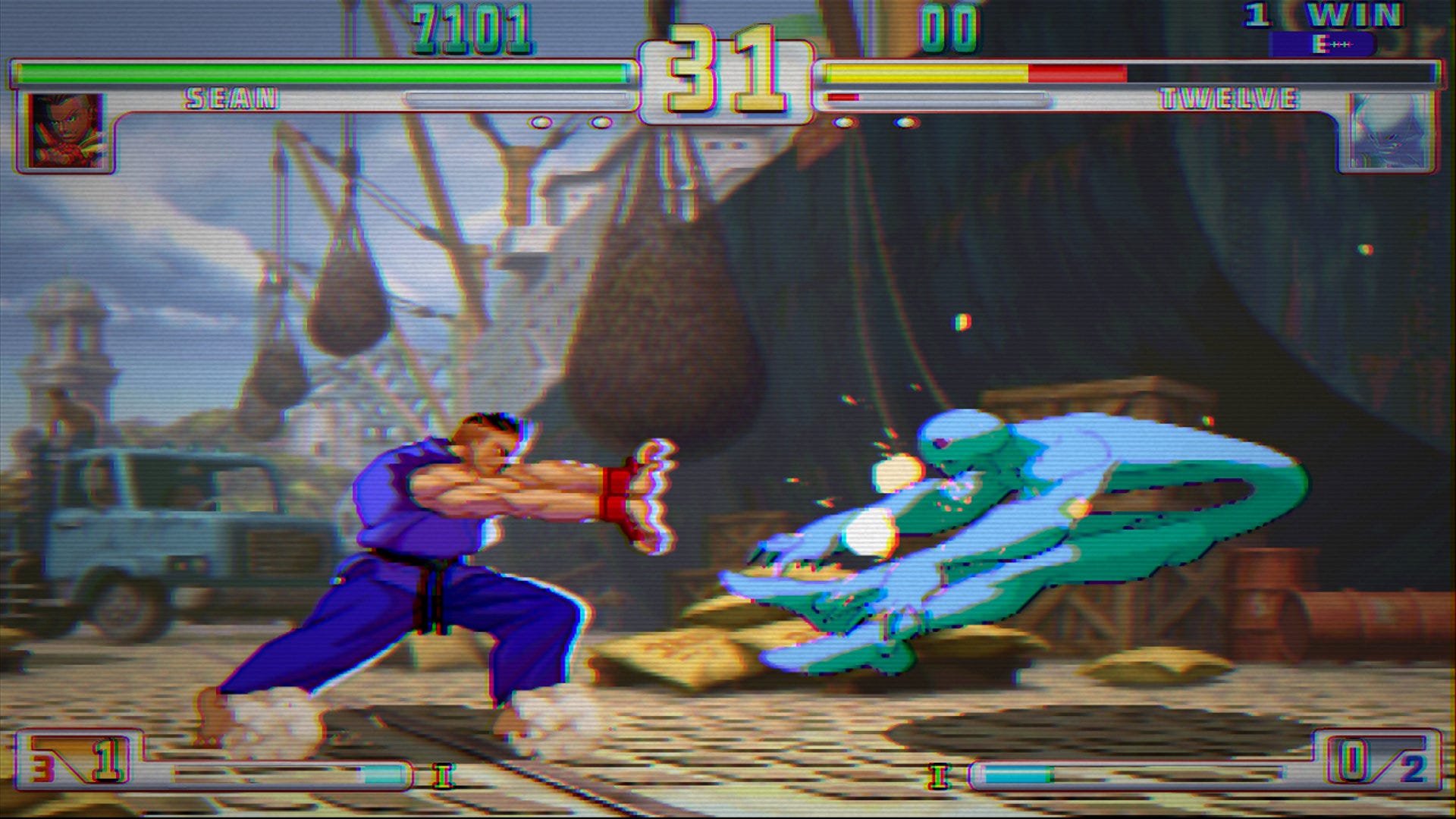
When playing online, the game displays whether you are playing with open or closed NAT as well as displaying your ping rate.
It's all a matter of timing. Street Fighter III's evolutionary change to the Street Fighter template is disarmingly simple. Press forward on the joystick at the exact moment of any opponent's hit and your character will bat it away with the back of their hand. The parry is different to a block in that, when blocking, your character sustains chip damage. By contrast, there is no penalty to a successful parry.
The temptation must have been there for to include moves which could not be parried. But the team stuck to the vision. Every attack from every character, including the multi hit 'Super Arts', can be parried by a player with expert timing. It is theoretically possible to parry every single hit in a game of Third Strike. The designers hard-coded invincibility into the game, albeit only for somebody with the reaction times of a god. Somebody like Daigo Umehara.
Despite its simplicity, the parry mechanic needed a defining Rocky-esque moment to show the world what it really meant to the fighting game genre. Japan's Umehara provided just that in the Evolution 2004 loser's bracket final, where he executed a full parry of Chun Li's Houyokusen Super Art, batting away 14 consecutive parry strikes, followed up by a Super Art of his own to take the round. The crowd went wild. Google bought YouTube. Third Strike suddenly made sense to the world.
The car-smashing interstitial minigame is joined by another interlude in which you must parry basketballs thrown at your character.
But there's a reason more people watched the internet clip of Daigo's super parry than bought copies of Third Strike across its three console releases combined. For all the wonder of the parry, it's a move that requires astonishing reaction times, well beyond the physical means of most players. So Third Strike became a spectator sport, something for mortals to gawp at.
But it's all a matter of timing. And with the success of Street Fighter IV and the clutch of other fighting titles tethered to its rocketing bandwagon, the fighting game is back in fashion, with a swollen audience full of wannabe contenders. So what better time to re-introduce Third Strike to the world in a bid to land the punch that, in 1999, failed to make much of an impact.
There's no denying that this is a reverent port from Iron Galaxy. The developer may not have redrawn the sprites and background in high definition as per Super Street Fighter II Turbo HD, but on almost every other count, the digitally distributed version of the game delivers. Two half-decent visual filters smooth out the sprites for those with HD televisions, while a remixed soundtrack from Simon Viklund provides a boisterous backing to the all new GGPO-built online lobbies (for up to eight players, with spectator modes). Meanwhile, a host of unlockable digital artwork and a huge array of training tools and challenge modes round out what is a substantial package.
Fighting games sit awkwardly with the current fad for RPG-ification, as all of the 'levelling' is done in the player's muscle memory rather than in the avatar. But Iron Galaxy's ingenious solution to providing long-term investment goals for players is to reward pretty much every input a player makes.
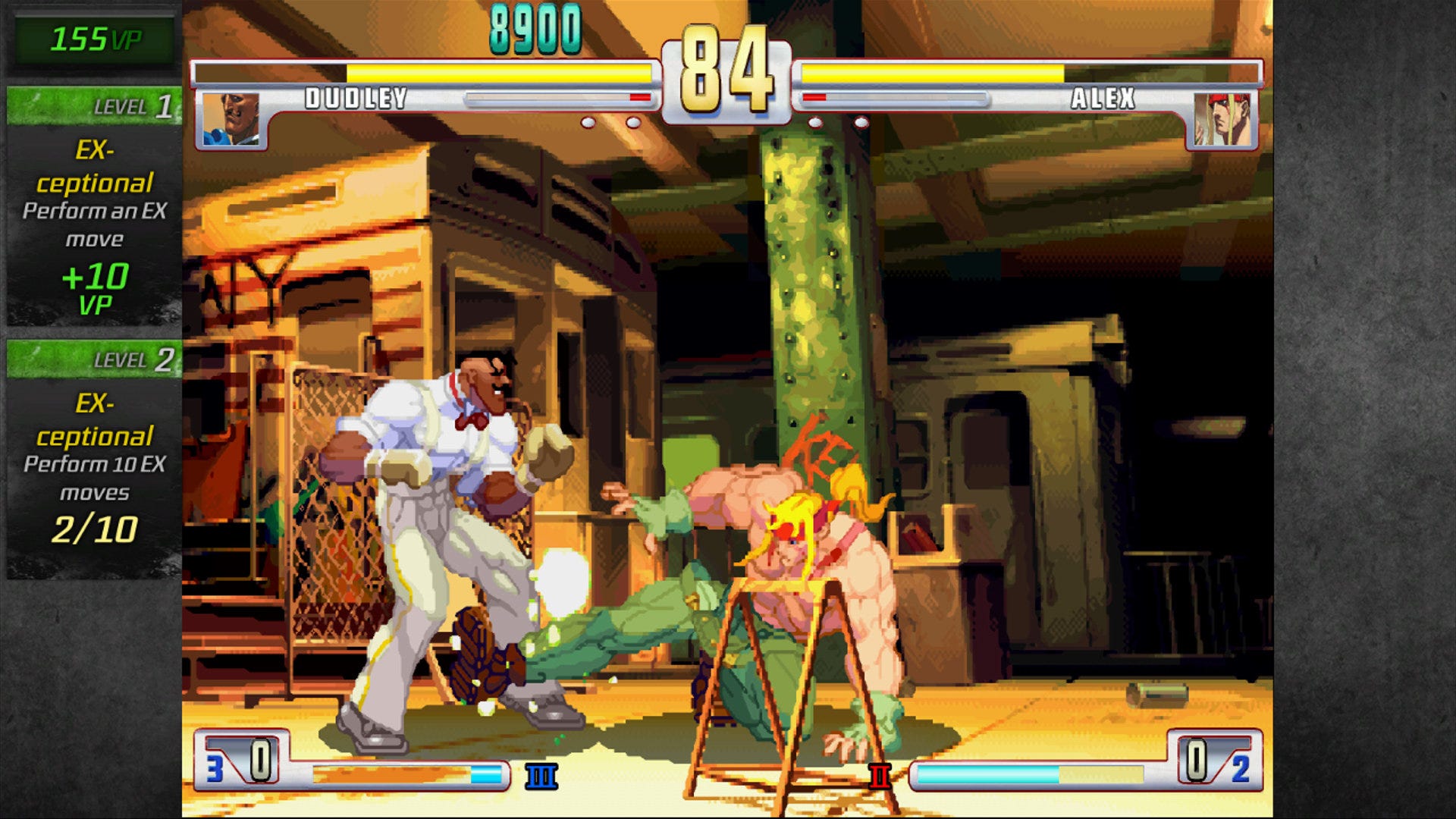
So, in the widescreen gutter next to the 4:3 play area, there's a machine-gun volley of stat read-outs, recording, for example, how many fireballs you've let fly from your palms (583 at time of writing), how many rounds you've won with a special move, and even how many opponents you defeated with a taunt from Dudley. Each stat recorded has set thresholds which, when passed, earn you currency which can be used to unlock new music, artwork and backgrounds. It's a clever system that inspires repeat play in a way that's rarely seen in fighting games.
Smart too are the Trials and Challenges on offer here. Each character has their own Street Fighter IV-style series of trials but, be warned, these scale in difficulty far more quickly than in the game's softer descendant. Meanwhile, the parry challenges aim to teach you basic timing for batting away everything from a simple fireball to a convoluted 12-hit special. This is perhaps the one disappointing area of the game. With no 'preview' of the timing of how to parry some of the more demanding moves, you must resort to trial and error in creating your own Daigo moments. All but the most skilled or dedicated players will be forced to move on.
Daigo revealed to Eurogamer in a rare interview that he was not playing much Third Strike at the time that he entered Evolution 2004. Utter bastard.
These add-ons and trinkets are most welcome, but unnecessary. Third Strike remains a staggering achievement. It's faster than Street Fighter IV and, thanks to the Guard Crush system (which disallows blocking after a certain number of consecutive hits), is a less defensive game. It's also far more exacting over inputs. It's important to remember that this is a game from the time before Capcom introduced leniency into its input schemes. (Nowadays if you throw a rogue 'up' into a two-quarter-circle forward move you'll still output the special move, but in Third Strike you do it right or you don't do it at all.) As such, this is a game to test and refine your execution, and you'll be a better player for it at the end of it, even if you have a few more grey hairs and blisters.
The roster is far from orthodox. Ryu, Ken, Chun Li and Akuma may be friendly faces (while Ibuki, Makoto and Dudley are now familiar to Street Fighter IV players) but the rest of the cast, from Ken's apprentice Sean, a Brazilian Shotokan-style fighter with a mean overhead kick, to Necro, a lithe Russian experiment-gone-wrong, sit somewhat awkwardly with the canon. Likewise, if you thought SFIV's arch villain Seth was cheap, wait till you meet Gill, Third Strike's final boss who can resurrect after KO. But it's a colourful set of characters nonetheless who match variety with keen balance.
The option to record footage and upload direct to YouTube is very welcome.
The truth is that Third Strike is an elitist's game in the truest sense of the phrase. History has shown that, through its demands on player execution, this is a game that shrunk the audience of active Street Fighter players. But few would argue that it's anything but the pinnacle of 2D competitive Street Fighter design.
In some ways, this port has been made for the more casual player. The true Third Strike aficionado will already be playing over GGPO emulation or on an original CPSIII board. So this is for everyone else, especially those players who have learned the ropes on Street Fighter IV and want to see what the grizzled fighter nursing a Scotch in the corner of the gym used to play.
Scrub that. What they still play. Few video games have been competitively relevant for as long as Third Strike. And this tight, assured release will only increase its longevity. It's all a matter of timing, you see.
9 / 10
