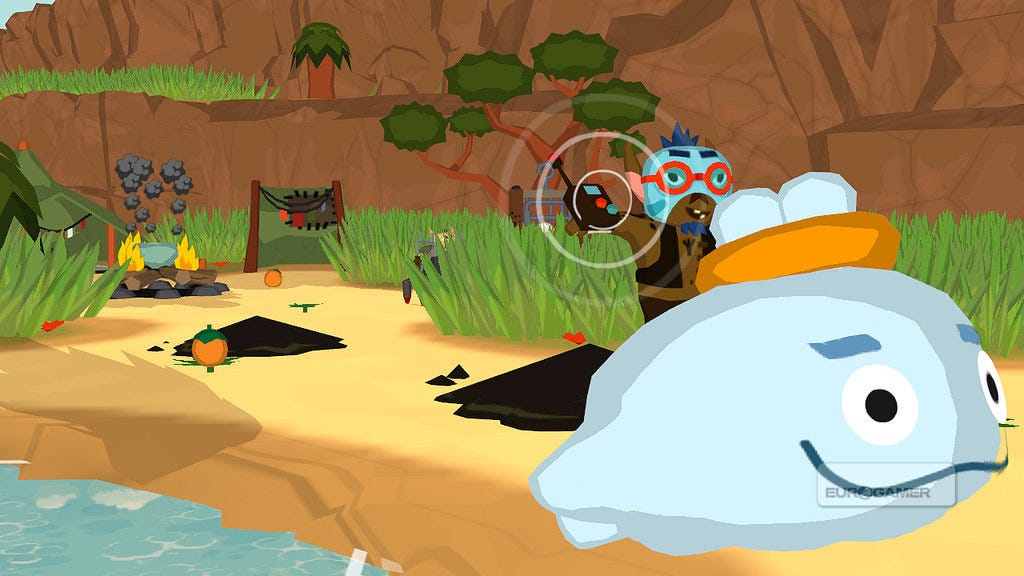
Before he became a game designer full-time, Simon Oliver made interactive exhibits for museums. I think a little of that kind of thing may have rubbed off on Okabu. I'm not trying to taint his latest project by suggesting it's anything like a piece of educational software, but it has a sweet-natured environmental message and a rigorous logic to its challenges. Whatever your age, it wants to make you think. You play as a cloud, you'll spend a lot of time wondering how water's going to interact with other elements, and the whole thing, with its neat little fields, its puzzles about harvests and its creeping threat of industrialisation, comes across like an agrarian Super Mario World. Put that on the back of the box.
There won't be a box of course. Okabu is the first straight-up console title from Oliver's tiny HandCircus outfit - the micro-studio that made its name with the Rolando platformers for iOS - and it's appearing on PSN later this year. Like his previous offerings, Okabu's colourful and cheery, and it's been built by a handful of people (just five this time): a fact that makes its sprawling levels, its ingenious, race-tuned mini-games, and its playful, detail-rich hub worlds quietly astonishing.
As with Rolando, the visuals are being handled by the illustrator Mikko Walamies, but there's no danger that anyone's going to mistake Okabu for LocoRoco. Instead, this is a game where the comfortable chunkiness of the art complements a varied design and some inventive mechanics.
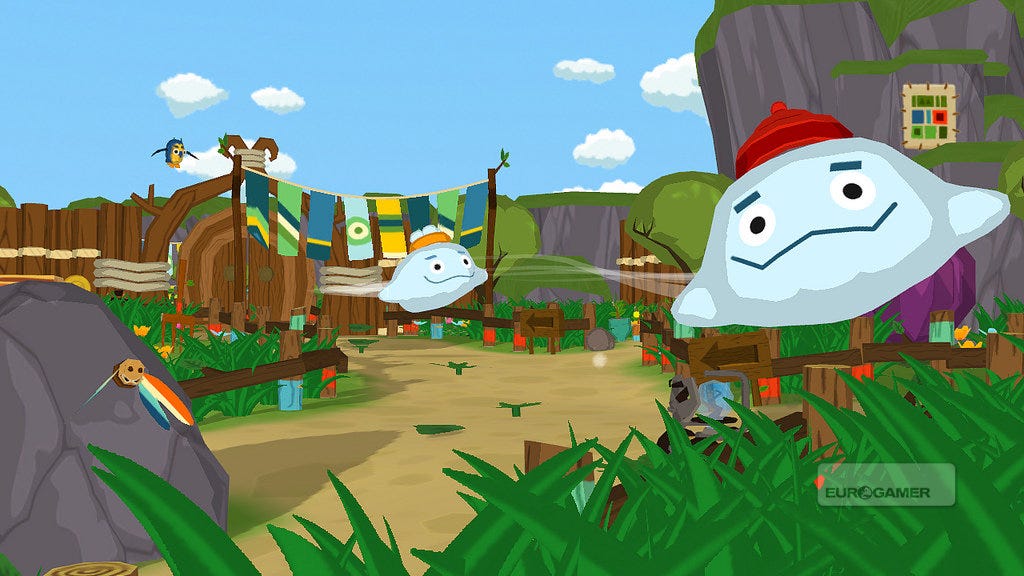
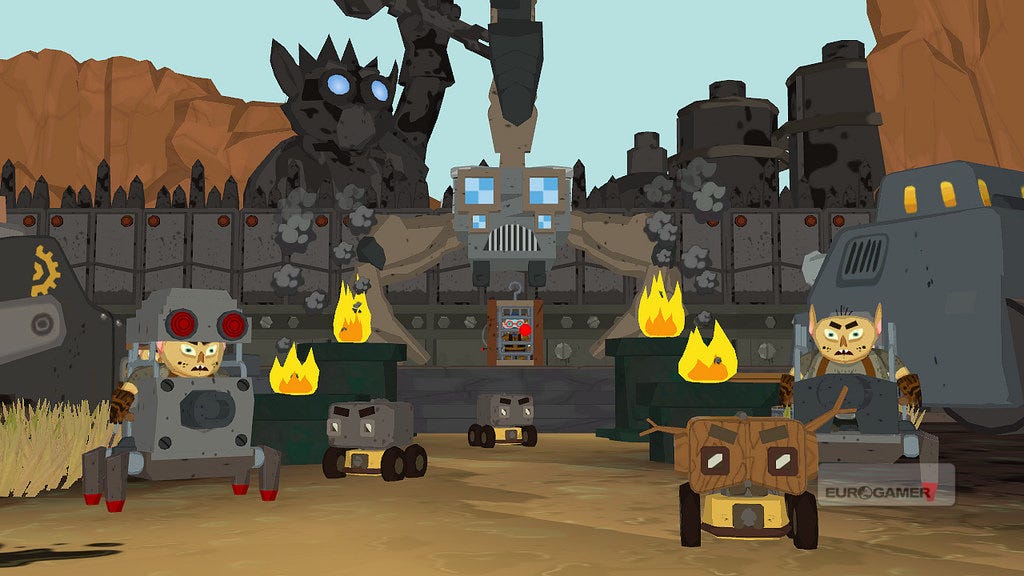
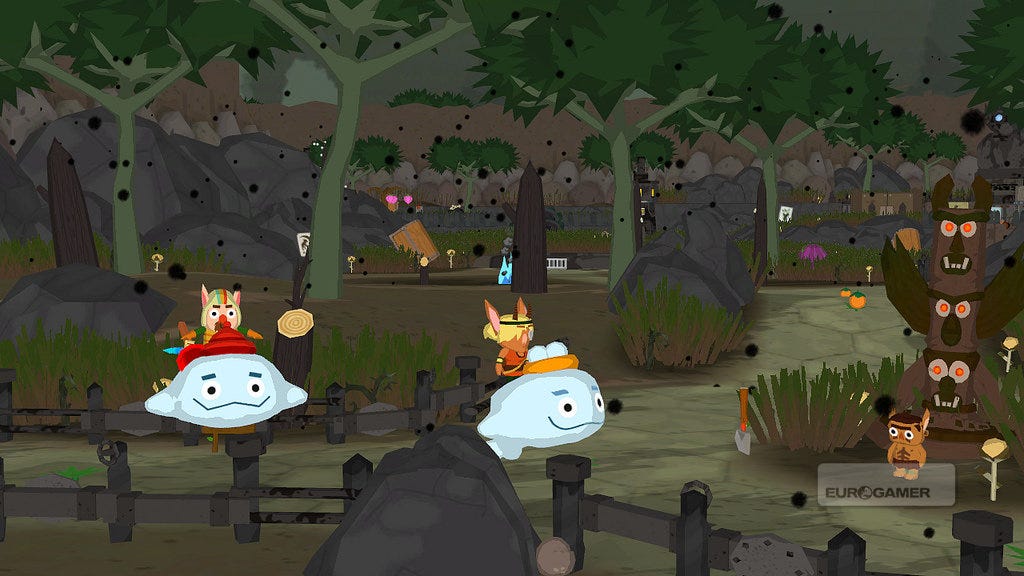
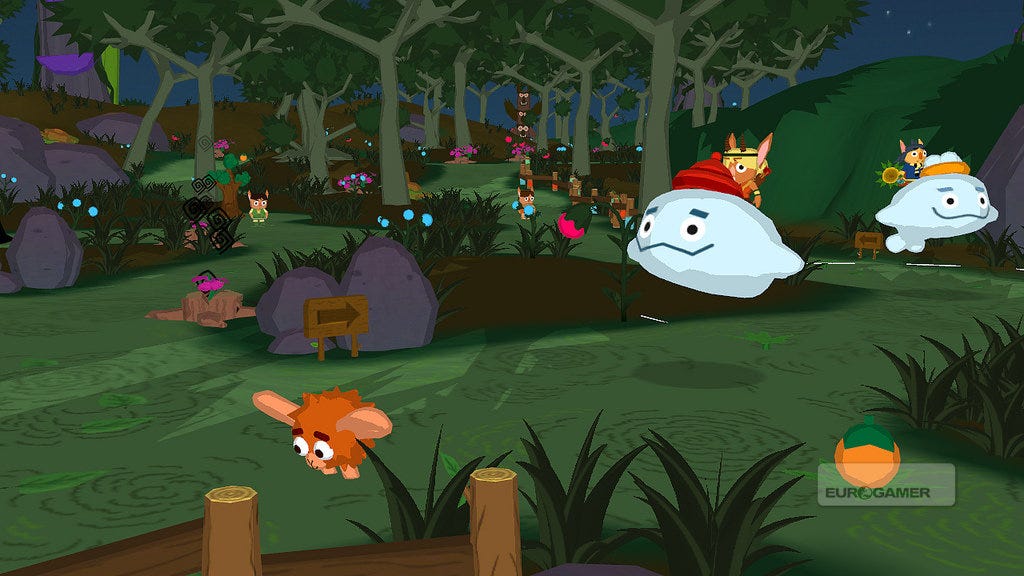
You play as Kumulo and Nimbe - there's something Oliver probably picked up in a museum for starters - two cloud whales who have come down from the sky to help out a gang of rustic cuties known as the Yorubo. The Yorubo are being menaced by the Doza, who like building factories and smokestacks and cranes and pumping stations and, actually, just about everything else that I wouldn't particularly care to live without. That doesn't matter, though: the Doza may be on track to discover penicillin first, but they're still bad news for their neighbors, and the cloud whales are here to fight them off.
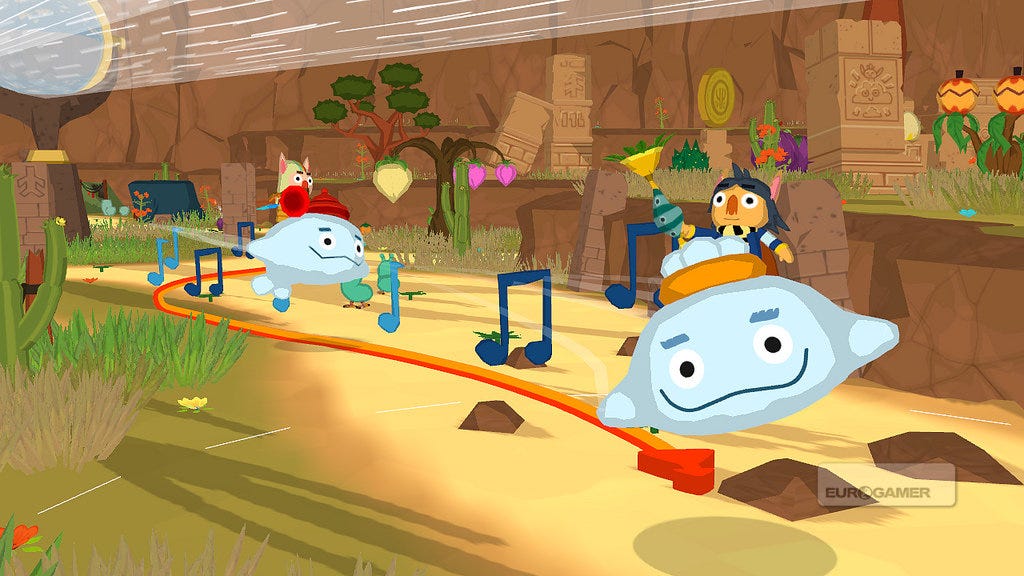
Kumulo and Nimbe gad swiftly over the surface of Okabu's maps. They can suck up water - or oil - and either rain it down on the ground beneath them or spit it out as if wielding a fire hose, while the player guides the spray around with a chunky reticule. These abilities are enough to tackle plenty of the game's challenges - you can lay down paths of oil and connect flaming gas jets to bombs in order to blow open doorways, for instance, and you can finish off a lot of Doza machinery by simply blasting it with water - but for much of Okabu, the clouds' powers are augmented by the Yorubo heroes they can carry around on their backs.
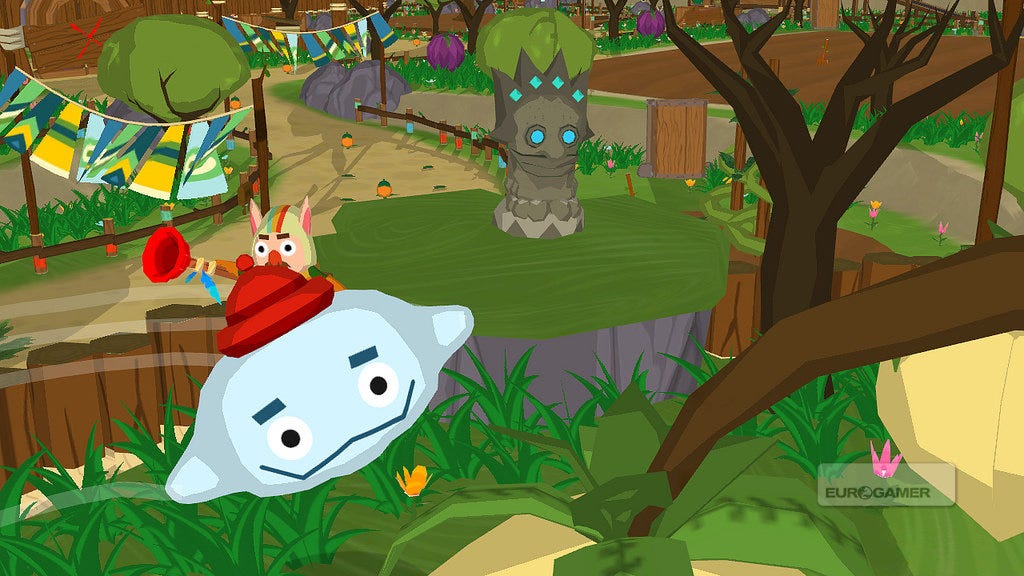
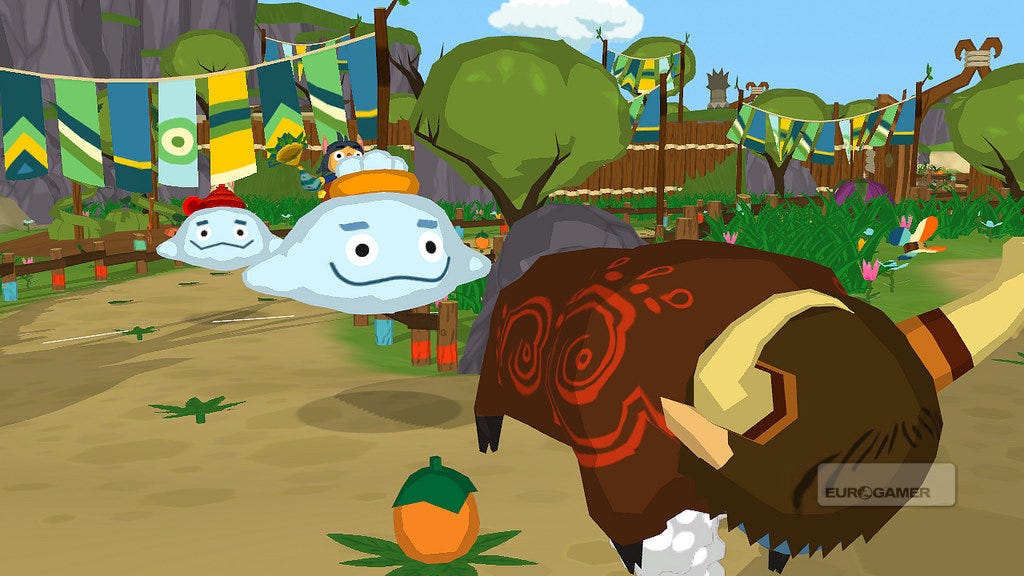
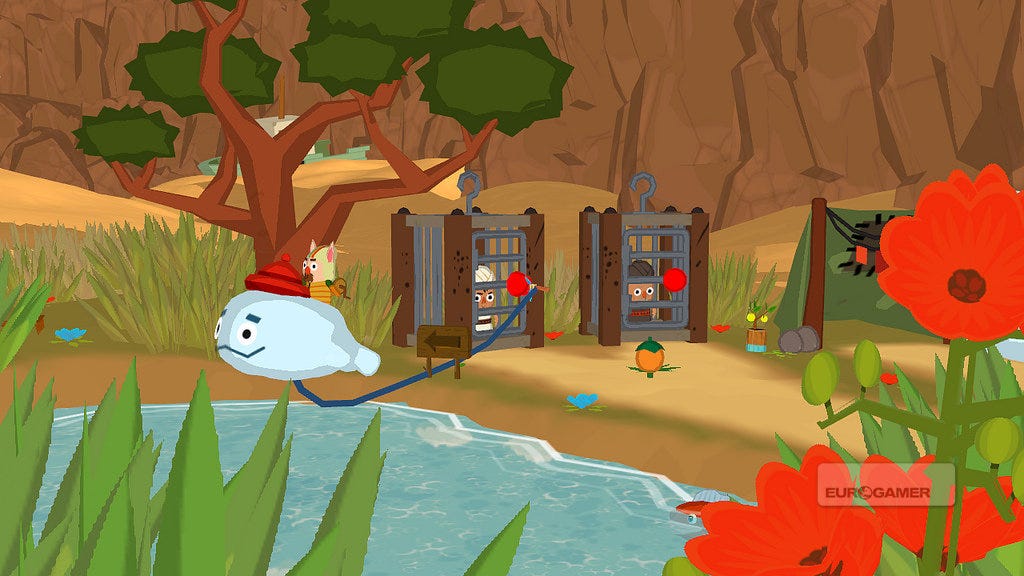
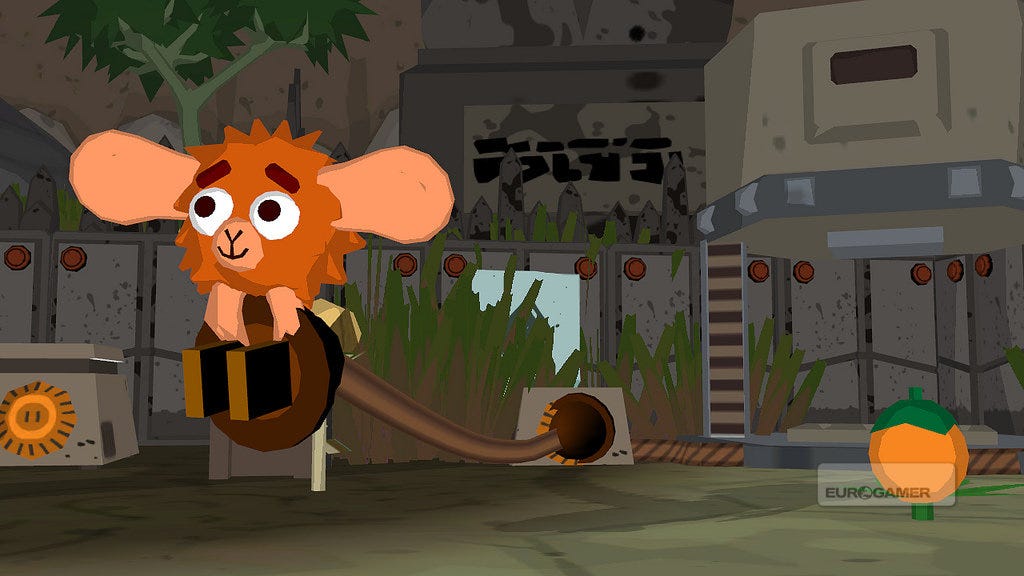
There are four of these heroes in total, and they all offer unique abilities when they're in the saddle. Captain Monkfish has a plunger on a line that he can use to grab hold of objects and yank them around, opening treasure chests, say, or manoeuvring little blocks of explosives into position. Picolo, meanwhile, can charm animals with his musical skills, allowing you to coax bulls into smashing through gates or to lead funny little duckling things (a species whose name I forgot to write down because Oliver had just offered me a chocolate biscuit) towards the spiky shrubs they like to eat. After that, there's Roki, a reformed Doza who can manipulate enemy vehicles, and Kat, who has a pet that can access narrow parts of the map. Everyone's skill is easy to use - Picolo's charming, which could theoretically be enormously annoying, sees you simply holding down a button to paint a line on the ground for your hypnotised animals to follow, while any machine Roki can interact with can be quickly identified by its bright yellow sticker - and all of the heroes look the part, too, entering the fray with college scarves bundled around their necks, or sporting fetching red spectacles.
Everything comes together in a game that's filled with exploration and puzzling. The tone is gentle, but the challenges can be fairly intricate, with multi-part quests that see you opening up new areas, clearing paths through them, and performing heroic deeds like watering crops, freeing caged Yorubo, or even taking out distant enemy encampments with a cannon. Thankfully, Okabu understands that, even though the Dozas are the baddies, their bulky tech has a certain allure to it, so once Roki's on board, expect to mess around with their cranes, guide their huge mechanical spiders around - if you keep giant spiders within reach, incidentally, you're almost certainly with the bad guys - and even roll a giant crushing ball through the world taking down their defences. Switching abilities is as easy as hopping a different Yorubo hero onto your back, and while the levels are large backtracking is kept to a minimum with Summons Trees. These not only act as checkpoints, but also allow you to instantly spawn any heroes or helpful creatures that might be out of range.
With targeting on the right stick, the camera has to take care of itself – and it's generally excellent.
Okabu's clearly been built with two-person co-op in mind, but you can play the game on your own pretty easily, too, switching between Kumulo and Nimbe with a jab of the triangle button. However you choose to approach it, HandCircus' latest promises to be quite a lengthy adventure for a download title, and when the campaign's finally over, you'll still be left with four mini-games to mess with, each one revolving around one of the Yorubo heroes. Picolo's, for example, is a weird take on tower defence games, and has you directing a grumpy drove of goats about in order to destroy waves of advancing Doza. It's brilliant.
Like everything else about Okabu, that goat defence challenge is a simple idea that's been play-tested and refined until it sparkles. HandCircus may be a small outfit, but crafting games in which every feature works as it should, and every element, from a cloud whale's beatific smile to the bouncy puffs of steam that rise from machinery, is an artful delight, speaks of the care and attention you don't always expect from the really big teams. You can already sense the effort that went into designing Okabu, then - and that's because it's already strangely effortless to play.