Retrospective: Sonic the Hedgehog
Lord of the rings.


Of late, Sonic the Hedgehog, one of the shining princes of my listless, shambling, over-sugared childhood, has started to remind me of the American Tea Party movement. This isn't because Sonic wants to cut federal spending, or because he thinks Barack Obama's an illegal alien sent to the US to kick-start the really exciting parts of the book of Revelations. It's because he's becoming a polarising idea: something that increasing numbers of people either love or hate.
While Mario's soared into space and bounced around the universe, Sonic's been on a different kind of adventure. He's passed beyond the realm of simple critical appreciation. He's become a creature of belief.
Actually, it wasn't really that different back in 1991. Unless one of your parents was an astronaut or a key figure in organised crime - I swear I knew a kid on our block who claimed he had one of each, and an aunt who was on drinking terms with Meat Loaf - nobody could afford more than a single console, so as soon as Sonic arrived on the scene, he became a key rallying figure for Megadrive owners. Besides a capacity to run dead fast without ever getting that tired, he was tailor-made to pit Nintendo and SEGA fans against each other.
As Nintendo and SEGA fans were my school's version of the Sharks and the Jets, with only a faintly diminished propensity for stabby dance-offs, he became a dangerous associate in the wrong part of the playground. (Luckily, SEGA magazines at the time provided followers with plenty of pithy ammunition for nasty encounters, in the form of anti-Nintendo jokes. Typical example: How do you spot a Nintendo owner at a barn dance? He's the one dressed as a shed. Ha!)
What gets lost in the schoolyard, of course, is that Sonic the Hedgehog was often an excellent game. The spiky mascot looked just brilliant decked out in company blue, the sing-song cry of SEY-GAH! over the opening logo sounded peculiarly as if it had been recorded by the three surviving Beatles, and the graphics had a unique SEGA glossiness to them that looked great for console owners living in such proximity to the 1980s.
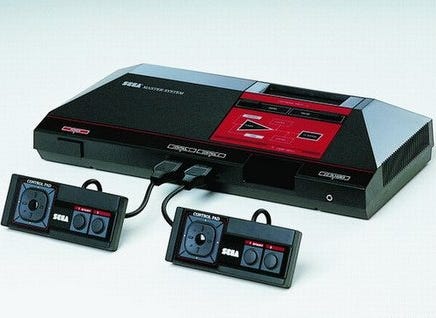
Mario's worlds always had an implied handmade quality, even before Yoshi's Island made their craftiness explicit, but Sonic's levels looked like they were sliced out of coloured glass by robot-wielded lasers. Plus they were called "zones", which gave them a kind of futuristic Crystal Maze/Running Man chic.
I first encountered SEGA's new mascot in the pages of a friend's Mean Machines in one of my school's portakabin classrooms. It was the kind of place the British army might have used to store cannon balls during the Crimean War: cold, drafty, and miserable. It takes a lot to get you excited about anything when you're in a Portakabin, but Sonic managed it - he managed it even though I was fiercely aligned with the Nintendo kids, too.
The magazine spoke of parallax scrolling and frames-per-second - we all nodded sagely, and hoped no-one else would ask us to explain what these things were - but it was the screenshots that had us gripped. Sharp, angular backdrops, rich blues and greens, and a hero who spent most of the time as a rakish, trainer-shod blur.
It was even better to behold in motion. A lot's been made of just how big a role Mario had to play in the creation of Sonic. A lot's been made of the fact that Mario used two buttons, so Sonic would only use one, that Mario tended to dawdle, so Sonic would tap his foot impatiently if you left him waiting too long.
In truth, though, the games feel completely different anyway. Years after completing Sonic the Hedgehog, when I read hippyish urban monologist Reyner Banham suggest that LA's freeway system spoke "the language of movement, not monument", I thought, "Ooh, a bit like Spring Yard Zone," and then lavishly failed my entire cultural geography unit. Banham might have been onto something, though, because Sonic's levels are a bit like freeways: a bold line threading past distant horizons. (That lecturer always did hate me, anyway.)
The best levels are actually multiple lines - a trick that Mario wouldn't be able to ape for quite a while. The Green Hill Zone, for example, has numerous paths through each of its acts.