I can't remember where I was when I was told that my first - or even my last - grandparent had died. I can't remember where I was when Challenger exploded. I can only remember where I was when I found out my mum and dad were getting divorced because dad chose the same moment to park his Citroen Dyane on my foot. (He was probably nervous.)
I can't remember what I was up to when the Berlin Wall came down, when the Hubble Telescope went up, or when the Twitter App introduced that trending bar and everybody on iTunes went mental.
But I can remember where I was when I first laid eyes on MASK I for the Commodore 64, and almost two decades later I can still remember where I was when I first got to play it.
I was in the Canterbury branch of C&A in 1987, wearing an awful Bill Cosby-style snowflake sweater that I hated even back then. My brother was trying to coax his new Walkman to life - my mum had recently done a gender politics module with the OU, so our family had to refer to them as Walkpersons - and I was idly leafing through the pages of one of his C64 magazines while we waited for the line at the tills to go down.
(All things considered, I was probably at the high watermark of the decade. The scene couldn't have been any more 1980s if Adam Ant had Lolo-balled out of the stockroom showering us all with Space Raiders and humming Axel F.)
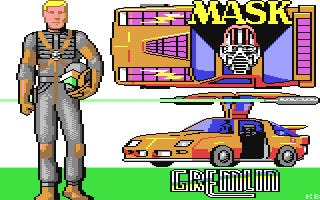
He didn't, obviously. Instead, there I was, face to face with an advert for MASK I - a Gremlin game that promised to take the all-action, keenly multi-racial, faintly right-wing spectacle of the MASK cartoon series and translate it to the scrolling pixelated world of the computer game. I was transfixed. It was too much to take in.
Looking back, I cannot for the life of me work out why I liked MASK so much. MASK was a bit like the Transformers, but not as stylish, iconic and Japanese, and not half as interesting either.
Also, it was considerably less cool. MASK was fairly square, actually. If Optimus Prime and his robo-buddies were the CIA of transforming toys, mysterious and slick, MASK would have been the Coast Guard. (I'm starting to realise why I preferred it now.)
MASK was made up of ordinary joes - hicks, for the most part, with names like Dusty Hayes and Hondo MacLean. These were names that might give the impression that you were actually dealing with a weary team of rodeo-clown-themed male prostitutes rather than an elite group of special agent types, protecting the world from menace.
Their headquarters was a gas station. A gas station! Their leader had an annoying kid and drove around in a white-trash muscle car - the kind of car my uncle Mike bought during a bad breakup.
And the hook for the series, the gimmick that made the whole thing special, was that they solved crime in their overtime. They were everyday losers with regular jobs. They were hobbyist heroes. Temps. They probably trooped over to the local Kelly's Services office every Friday for the free M&S lunch.
I digress. For whatever reason, I was crazy about MASK, and here was a computer game made just for me and my ilk.
I never bought it, of course. Back then, pocket money tended to disappear on LEGO sets or in strange, unsatisfying gambling scenarios rigged by my elder brothers. To buy a computer game, I would have had to save up, and that suggested a world of financial strategising that was entirely beyond me.
I still got my money's worth, however, and that's because of something that's sort of disappeared from games thanks to the internet - thanks to YouTube and Wikipedia and Eurogamer. I got my money's worth by daydreaming, over the next few months, about what MASK I would actually be like.
To orientate my daydreams - to give shape to whatever my sickly imagination could come up with - I had a few blurry screenshots to go by. They were the screenshots on the advert, and they showed a flying car - that was Thunderhawk, right, Matt Trakker's vehicle of choice when he had clocked on for adventure - passing over some kind of dimly rendered industrial landscape.
There didn't seem to be much in the way of enemies, so I filled them in myself, plucking my favourites from the ranks of VENOM's roster. There didn't seem to be much in the way of action, either, so I imagined the squeezy, rattling, wheezing, weirdly brilliant sound effects that the C64 could come up with. Maybe even a bit of synthesised speech.
The thing is, this is how most games were experienced by a lot of kids back then. Way before promo videos, first looks, teasers - way before Geoff Keighley shoved a microphone into some lighting artist's face and asked them about their vision for Scooby Doo Mystery Mayhem - all we had to go by were tiny, out-of-focus screenshots, a few paragraphs of smart, in-jokey text, and rampant playground speculation covering everything from cheat codes to the best volume level to pirate a tape at, and probable directions for any sequel.
The other - weirder - thing is that this was all brilliant. Games were great because they were so mysterious, and they were mysterious because our chances of getting to actually play them were so slight.
Flicking through Zzap!64 was like seeing hundreds of little photographs from alien planets - unlikely, malformed ecologies you would almost certainly never get to explore for yourself.
Because I never got to experience the flimsiness of most of these games - because I was limited, for the most part, to the games my brothers bought - I assumed they weren't flimsy.
I assumed they weren't marked out by loopy glitches, inane enemy attack patterns, and crazy, unrealistic difficulty spikes, like that bit at the very beginning of Raid Over Moscow where it was practically impossible for me to even get my attack ship out of the freaking attack ship hangar.
As Thomas Wolfe said - he wasn't talking about MASK I, as far as I'm aware - you can't go home again. Except I tried to. Several years ago, hanging out at a friend's house, we got to looking through his collection of old Commodore games - and there it was, MASK I.
We loaded it up, and it still worked. That is to say it was still a middling-to-decent side-scrolling blaster with very little, apart from some wonky sprite design, tying it into a licence I'd once loved very dearly. You had to shoot things and collect other things. There was a time travel twist. At the end, it turns out it was all a dream.
My friend had MASK II and III, too. The second instalment, with its selectable vehicles, was probably the best of the bunch, while the third was fiercely difficult - riddled with bullets and slow-down as Matt Trakker, clad in a space suit that made him look like a B-team Boba Fett, wandered over nicely mown lawns and through what could have been the mansion from Jet Set Willy, chipping away at turrets with his feeble guns.
Playing the games hasn't ruined them for me, though. For one thing, they're not as bad as I'd come to suspect they might be, and for another thing, they aren't as memorable as my own childish fantasies of them.
Reality didn't defeat imagination this time around, then, and as anyone who loves games will tell you, imagination is often the crucial part of the equation.