MotorStorm was never the sort of racer to play nicely or encourage gentlemanly conduct, but for its third PS3 incarnation the series looks set to crank its destructive tendencies up to 11. Set in and around a San Francisco-styled city during a major earthquake, populated by warring gangs of lunatics, it takes the rough and tumble racing that series fans know and love, and injects a retina-dazzling dose of disaster movie bombast into the mix.
Originally starting life as Urban Smash, a city racing game intended to be a sister franchise to MotorStorm, here, Evolution Studios game designer Simon Barlow explains how the two games merged to become the most explosive racer ever, and how the challenge of designing a racing game around tracks that are constantly deforming forced the team to approach gameplay balancing in a completely new way.
Eurogamer: Matt Southern (game director) has mentioned several times that the idea for Apocalypse grew out of an abandoned city racing prototype called Urban Smash. Can you tell us a little about how that merged with MotorStorm to become Apocalypse?
Simon Barlow: While the majority of the team were busy working on MotorStorm Pacific Rift, there were 20, possibly a few more, of us working on Urban Smash. It had potential, but that was all it was. Really the logical next step was to ask can we take the good bits of this and do something with MotorStorm? What we ended up with was this sort of mish mash of city-based racing and the MotorStorm aesthetic which didn't really work, it didn't fit. The key to it was this idea of an earthquake, a natural disaster. So what we've ended up with something that is still MotorStorm – it still plays like MotorStorm and feels like MotorStorm, you know it's from the same people – but the earthquake creates this slightly more organic environment out of the city.
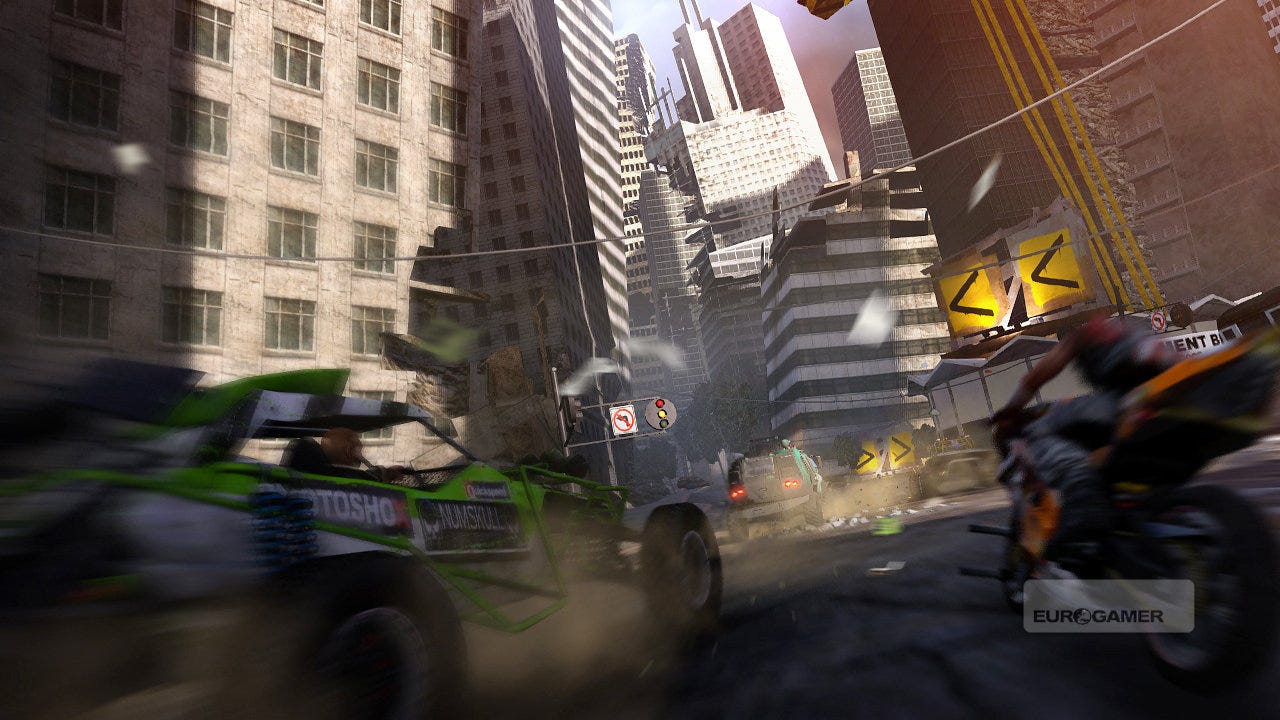
The ongoing collapse of the city means that you have to constantly adjust your tactics, even from lap to lap.
One thing we didn't want to be was a straight city racer, because that market's kind of crowded already. Those games are cool, but they're not really what we're all about. We honestly thought we could take it somewhere else, that's why we sit somewhere in between the two. You're taking the high speed action of Need for Speed or Burnout or whatever, with our traditional heritage of MotorStorm and even back to our rally games, those kind of hectic, point to point narrow races. When you start putting all these ingredients together, you think, this is going somewhere cool now, somewhere different and interesting. Forget about it being a game, this is an epic summer blockbuster movie.
Everything fell into place after that initial decision. The more you work into it, the more the ideas start flowing. This track in particular, Wave of Mutilation, which we just demoed, it's a six minute epic and it's f**king non-stop, balls to the wall action all the way through. It is one of the most intense gaming experiences we've ever put together and that I, as a player, have ever played. It still blows me away. I've played it 50 or 60 times and my jaw still drops when I see it. When you first see that twister, it's f**king terrifying. We're certainly not used to seeing this in racing games.
Eurogamer: This emphasis on dynamic environments does seem more like the sort of thing you'd expect in an action adventure or an FPS. As part of Sony's network of internal studios, does that community help to inspire you to try new things within your own area of expertise?
Simon Barlow: We've got a lot of great internal studios at Sony. We're very lucky. We've worked with some great guys. The guys at Naughty Dog, the guys at Guerilla...Uncharted and Killzone, for me, are setting the benchmark in their respective genres, in terms of pure entertainment. And we thought, well, why can't we be like those guys? Why does racing just have to be about a bunch of cars on a track? It's been done, and it needs to be more than that now. Gamers demand more, and so we took inspiration from those sort of games, the design elements they use. Why can't we do that for a racing game? That's why you've got a story this time around.
Eurogamer: Stories aren't usually a good fit with racing games. Can you explain how it works for MotorStorm?
Simon Barlow: To be honest, it's a fairly light story. It's not Uncharted or God of War, it's appropriate for MotorStorm. Maybe I'm doing it a disservice. It's not completely light. The city has a chronology, OK? Initially there's been a couple of tremors, maybe a couple of cracks, a couple of buildings have come down, but it's mostly pristine. Most of the people have been evacuated, but there's no threat of further damage. MotorStorm rolls into town and then the big one hits. That's when all hell breaks loose. So over the course of the game, the city is constantly changing, becoming more destroyed.
The game is fully 3D compatible, for those who like ducking imaginary rubble.
It's taken from the perspective of a guy called Cutter, a gonzo journalist who's embedded himself in the MotorStorm Festival, just to find out what the hell's going on. He's the player's eyes, effectively. We've hinted at the festival before, we've hinted at what goes on behind the scenes, but we've never explicitly showed it. Well, Cutter's now going to show you it. He's going to introduce you to these characters, this epic carrier that they float around the world on, this bold utopia of crazies. It would be pretty cool to just get on your aircraft carrier, self-contained, not worry about anything, rock up to another location, get your vehicles out and have a party. It's like Burning Man meets off-road racing. I can't be the only person who looks at it and thinks, I wish these people were real.
I'm not going to give too much away, because I want to see what players get from this, but it's loosely based on the story of man, from child to adolescent to adulthood and, eventually, expiration. It really fits though! There's this cool subtext, and lots of interesting stuff going on behind the scenes, but you don't need to know about that stuff if you don't want it. There are fart gags in it, for God's sake. If you just want to play it and enjoy it then it's all there, but if you want to read between the lines then there's stuff there. The stories mirror the destruction of the city, so it all ties together.
Eurogamer: How does this all of this impact the design process? It sounds like you're making a lot of work for yourselves.
Simon Barlow: We're mad. Completely mad. There are 40 unique races in this. Bear in mind the numbers of tracks we had in previous games [not counting DLC, that would be eight in MotorStorm, 16 in Pacific Rift – Ed] that's a hell of a lot. Even if you take out all of the events, and just had 40 unique races, that's still a hell of an undertaking.
So, yeah, we're crazy, but we set our stall out early. This is what we wanted. It had to be at this level, this big and this epic in scale. We just had to be very clever with the way we structured it. In one room we've got the production pipeline, the boring but important stuff. On one wall is the entire art flowchart and everybody's task is on a Post-It note, and we have a meeting every morning and you move your Post-It note along. You can see the flow of the art in the game.
In the other room is the flow of the game in terms of its story, aesthetic and chronology. We have a timeline of the city, what is happening to the city almost on an hourly basis, and we put races in there. So we'll go, OK, Dusklight, the private military contractor, they're going to bug out at this point. So we need to have a race around this time, as they're bugging out, because we need to see them leaving, firing back at the crazies and getting the hell out of there. It needs to be at night so when people are blowing s**t up it lights everything up and looks brilliant. So that's a night race. And you begin to fill in the gaps.
The only people left in the city are crazy loons or malevolent gangs. They'll do their best to disrupt the races.
It's literally just based on what's cool. Wherever you've got your inspiration from, whether its inside your head or a film or a comic book or even a piece of music, something has clicked and we need to see this, it goes up on the wall. It just starts to form. Creativity forms when you give it some constraints. So our constraint is, it's got to be 48 hours, three guys, this is the city, these are the locations you can play around with. Other than that, it's free rein, basically.
It was a lot of work. A hell of a lot of work. And probably the best part of the three-and-a-half years we spent on this game was building these tracks, and making sure that the events and the choreography were right. We'd never done this before, so we had to get good at it.
Eurogamer: One of the things about the previous MotorStorm games is that the tracks were so well balanced for all the different vehicle types, with different routes and short cuts. Now you're playing about with all that and changing it as you go.
Simon Barlow: It changes the balance, absolutely. You'd be amazed at how closely balanced it is. We've always had rules about how close vehicles have to be to each other. We've relaxed them a little for Apocalypse, and there's a reason for that. We used to have a three-second rule. Every vehicle had to be able to finish within three seconds of each other, or it wasn't balanced. We've slackened that out a little bit, but we've addressed it and added balance back in. Let me be clear about this. Balance is a state that the game is in. You don't really add balance, you add elements that help the balance. For the online experience, which is where it matters most, with 13 vehicle classes that will stretch a little bit.
Choppers are just one of the new vehicles classes.
If you pick a waterlogged track and you're going on a dirtbike or a chopper, you're screwed, pretty much. The way you compensate for that is by applying different perks to your vehicle. I really like the chopper, but it's not ideal for this sort of track, so I'm going to pick a loadout that allows me to reduce the water drag. I'm going to increase my boost cooling when I'm in water, and since I'll be in the water for most of the race, I'll be pretty much boosting all the time. That's another advantage for me. I'm also maybe going to take more of a beating. Everyone else is going to be in trucks, but I still like my chopper, so I'm going to increase the armour on it. I'm applying my own logic to it.
We're giving the player more freedom. Maybe initially, out of the box, people will look at it and think, oh, I'm never going to win on this. You can. You just have to trust us. We have got the game in a state of balance. We're happy with where we're at right now.