Version tested: PSP
Did Yasumi Matsuno jump or was he pushed? The truth behind the departure of the game designer – whose work includes such heavyweight classics as Vagrant Story and Final Fantasy Tactics – from Square Enix, three quarters of the way through the development of Final Fantasy XII, may never be known.
The company claimed it was due to illness, while insiders pointed to a growing rift between the producer and other executives. Regardless, whether due to infection, disaffection or a non-compete clause in his severance package – and other than having a hand in the script for Platinum Games' MadWorld – it appeared as though Matsuno had left game-making for good.
Tactics Ogre: Let Us Cling Together is a comeback then, but of the cyclical variety. Originally released for the Super Famicom in 1995, this medieval-themed tactical RPG impressed Square CEO Hironobu Sakaguchi enough to headhunt Matsuno from his job at Quest. This was the game that gave Matsuno a shot at the big time – and in this exquisite, loving re-release, this is the game that has given him a second chance.
In Japan, Tactics Ogre: Let Us Cling Together is seen as a classic every bit as significant as Super Mario World or Sonic the Hedgehog. It routinely tops the best-of-all-time lists, which goes some way to explaining why Square Enix has lavished such care and attention on this PSP remake.
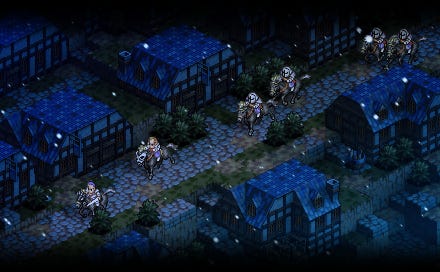
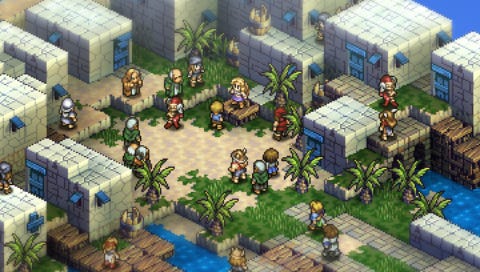
The game has been carefully refitted for the PSP's widescreen, and reworked with depth-of-field effects and new particle-effect animations for spells and special moves. Akihiko Yoshida's character designs, which will be familiar to players of the Final Fantasy Tactics series, are as detailed and expressive as ever, but the weather effects and shimmering menu animations make this a 2D world of beauty as well as intricacy.
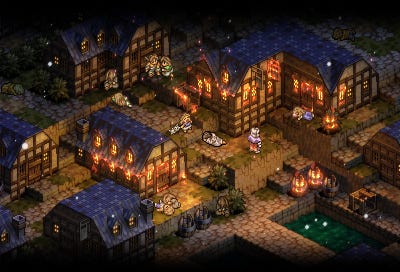
At its heart, this is an orthodox tactical RPG in which you take turns with the AI to guide a clutch of soldiers, archers, mages and healers around a gridded map in a chess-like game of dominance. The aim is almost always to overwhelm the opposing team; victory is won either by decimating their ranks or taking out their leader.
While Tactics Ogre was released before Advance Wars and Disgaea introduced their innovations to the genre, its basic interactions in no way limit the strategic game, and it remains one of the most demanding theatres of war for armchair commanders. Careful deployment of your squad is paramount to survival and victory. Place a vulnerable unit just one square too close to danger and the mistake will be punished in the most extreme terms.
Units don't earn experience points as they defeat enemies; rather, your character classes net the rewards for a hard-won battle. Every class represented on the field, from Knight to Cleric to Beast Tamer, earns points in victory, the entire class levelling up as you progress. This means that it's possible to acquire a new character midway through the game, and they will be able to be slotted into your team right from the get-go.
With space for up to 50 characters on your 'bench' but only nine slots in most fights, there are however benefits to investing in specific units. At the end of each successful battle the units present earn Skill points used to buy and equip new abilities and buffs specific to them. There are scores of these skills, which range from merely improving a character's proficiency with a certain type of weapon to increasing the chance of landing a counter-attack, with more becoming available as you increase the level of the associated class. In this way you begin to carefully tailor your squadron to your tastes.
In battle, too, there is a huge range of strategic flexibility. Not only can each character be equipped with two weapons, but they can also use and learn magic, granting a huge array of tactical options on the battlefield.
Placement of your troops is another key to success, with terrain height affecting the accuracy and voracity of an attack. Projectile attacks require a clear line of sight to their target and will strike anyone or anything standing in the way, while the direction that you leave units facing will affect their vulnerability to attack from different angles. Meanwhile, weather conditions affect play in the battlefield, with rain and snow impairing visibility for ranged attackers, all factors that must be considered before you pick your team for a fight.
If that all seems like a bit much – and for newcomers, it is a steep learning curve – it's possible to hand control of certain units to the AI with a basic instruction for how you would like them to behave: providing a support role with healing items, for example, or rushing in with melee attacks. There's no limit to the number of units you can hand to the AI, so it's theoretically possible to act as a football manager from the sidelines, directing the general flow of a battle. But with each unit you hand over, you lose a little control.
Flexibility is not limited to the game systems. Tactics Ogre's story branches in a way that few contemporary titles would dare attempt. Battles are bookended by cut-scenes that unravel a grand tale of political intrigue that reaches across continents and generations.
At key points in the drama, you are given an option for how to respond, and your dialogue choices have giant implications. Matsuno and his team elegantly sidestep the problem of branching narratives – the feeling that you're always missing out on something – by allowing you to return to key turning points in the story and choose a different path, encouraging 100 per cent completion in an attainable way.
In battles, too, there is the opportunity to rewind up to 50 moves. If you do, the game stores this rewriting of history as an 'alternate' version of the battle's events, allowing you to switch back and forth between the new set of plays and your original decisions. It's an astounding piece of design that grants flexibility and control across time as well as space.
For devotees of Matsuno's better-known (in the West, at least) Final Fantasy Tactics, the aesthetic, the tone of the story and the music will all be so familiar that Tactics Ogre feels very much like a sequel. But in many ways this earlier title is the superior game, and certainly this PSP remake suffers none of the slowdown and long loading that plagued the PSP version of Final Fantasy Tactics: The War of the Lions.
It is, however a game that demands your full attention. Battles can last upwards of 30 minutes, even with the AI controlling half of your party, and the difficulty demands you absorb and master the intricacies of the system quickly or face crushing defeat. The menu design is fussy and idiosyncratic and the micromanagement of your team, while deep and engaging, means you spend 15 minutes after every fight tinkering.
But the reward for your investment is a thoroughbred classic, a tactical RPG with all the immediacy of Advance Wars and all the long-view flexibility of Disgaea. As with Final Fantasy Tactics, an unusually compelling story ensures you come to view each unit as far more than a pawn and – once you combine the narrative with characters that are built from ten thousand of your own tiny choices – the sense of ownership and connection is rare. Tactics Ogre: Let Us Cling Together matches its tall challenge with deep reward, and provides further testament to the genius of its estranged creator.
9 / 10