Retrospective: The Acorn Archimedes
Yes, it had games on it. Shut up.

Just because I'm a bit posh doesn't mean I haven't known hardship. I might have gone to a school that had burrowed right up itself for the best part of 500 years, but that doesn't mean I haven't got scars. Technological mistakes know no class boundary. They haunt every family.
It's 1987 and we're standing in front of the three shelves of Betamax videos in Visions Rentals in Bedford. "Papa?" I ask. "Why must we choose from these, when others in the shop have so much more?" Father replies that that's simply the way it is, and that I must make the best of it. He pulls me tightly into his tweed jacket. Later I watch Lady and the Tramp for the second time.
It's 1992, it's evening and we're waiting for supper. "Father?" I ask. "May I have an Amiga or a console like the other children? It is time that our ailing BBC Master Compact were put out to pasture." Father replies that I may not. The BBC can only be replaced by whatever I use at school - to help with prep. "But what of games?" I'm simply told to make the best of it.
It was a familiar feeling then in the years that followed, when I would stand next to the solitary Acorn press shelf in WH Smiths reading their regulation four pages of games coverage each month. It would hurt me to hear other children with their Amiga Powers, CVGs and SEGA Powers frolicking around and saying unfamiliar, coarse words.
If you made the most of it, however, and believe me I did, an Acorn A3000 was a good machine to have. We got the very best of other platforms ported over, as well as some excellent homegrown stuff - the best of which made the leap the other way. To my memory the A3000 never helped me with my prep (which means 'homework' when translated from posh, by the way), but it did aid me in smuggling dirty pictures of Jo Guest into the school computer room - for which I was worshipped like a God.
Following on from my love of the BBC Micro, this then is the second chapter of the origin story that set me up as an Acorn acolyte. Wolverine's climactically ends with a battle on a cooling tower on Three Mile Island, but my own reaches its zenith at the 1994 Acorn User Show at Wembley. (And if you've seen that film, you'll know who had the better time.)
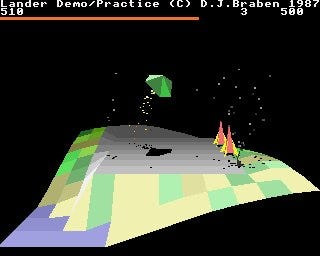
As we enter the Archimedes hall of fame, our attention should first be drawn by Zarch - a game written by Elite co-pilot David Braben, the future head Kinectimal tamer at Frontier. Every Acorn gamer knew Zarch because its demo, strangely called Lander, was packaged with most machines - and the wider world would later know it as Virus as it was ported up and off into the ether. It was a mercilessly hard game in which you attempted to control a notably Elite-looking green spaceship through the full remit of no less than three dimensions with (wait for it!) your mouse.
If you'll forgive the phrasing, the ship was bottom-propulsed, and you'd thrust your way over a limited patchwork view of the land below attempting to destroy the invaders turning your precious fields a nasty shade of red, taking out the occasional marquee-shaped structure on the ground for good measure.
Or at least you'd vaguely try. In truth, this being a game in which an involuntary hand-twitch could destroy your craft while it was still on the launch pad, I never really played the game properly. I was content to simply plummet through the sky and blow myself up in spectacular ways. Still though, Zarch was a true marvel of the times.
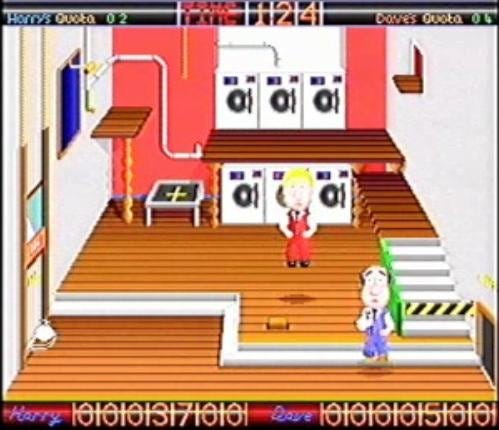
Another early Arch game, that I'm partially mentioning here because it rhymes, was Starch. You don't get many competitive/co-op laundry games these days (more's the pity), but Starch saw two peanut-headed manual workers, Harry and Dave, on a frantic clothes-cleaning night shift. Surrounded by levers, pulleys, timed washes, chutes and slidey bits, it was down to a pair of players to either help each other get their quotas, or deliberately jump ahead in the sequence of floor buttons being tapped or ropes being pulled to steal clean underwear from beneath the nose of the rival employee.