Games of 2010: Minecraft

Built to rule.

Following the media trajectory of this free-form building and survival game has almost been more compulsive than Minecraft itself. Watching that slow burn from lo-fi obscurity to darling of indie sites to mainstream PC gaming acceptance to woah-hey-everywhere has been an ambient pastime for 2010. That was before the game even hit beta status.

It's been a lesson, I hope, for gamers and games critics who look down on anything indie (unless, of course, it's neatly packaged up and validated for them by Microsoft or Sony approval).

When its name first began to creep into headlines, I was witness to a shocking amount of sneering from both gamers and industry colleagues who really should know better. "What's this Minecraft thing then? Some indie rubbish?" It was dismissed because of its graphics, because of its name, because it focused on construction rather than destruction, because it was made by one guy, because it was on PC...

It was dismissed until it was successful enough that those same critics who had peevishly ignored it finally realised they were going to look like cretins if they couldn't offer comment on it. And hey, suddenly Twitter was alight with bon mots.
1

Does the mentality that, unless a game comes from a big-pig publisher, it's a stinker really still govern so? Come on! You simply don't have the right to sneer at all those cynical Call of Duty clones all the big boys are working on unless you're also actively supporting something that is different. It doesn't matter if you like it or not. You just need to be glad that it exists. That it can exist, despite the ongoing efforts of large corporations to make gaming a walled garden.

Minecraft proved that attending every industry party in town and endlessly posting expensive trailers doesn't achieve what it used to. The games business has changed. The world's appetite for games has changed.

Minecraft is but one of a great many games to break the old rules, but it did it so subtly and yet so massively that it can't help but stand above the others. Its ease, its cheer, its immediate appeal in both appearance and concept, saw it bust into the global gaming consciousness and achieve incredible success for its creator, Markus Persson. It didn't know its place. It didn't realise it was supposed to be small and obtuse and obscure and only for neckbearded, bespectacled PC gonks. It had the temerity to be something that anyone could play, and anyone could adore.

There's an argument, and one that Persson himself has used, that this was largely a fluke. It could have been any game - his blocky game just happened to achieve the right momentum at at the right time. I've never heard so much nonsense. It could only ever have been Minecraft that did this. It takes the major backbone of MMOs (persistence, self-made narrative) and FarmVille (resource management, instant results) and puts them in a new context. It is, fundamentally, built upon elements that untold millions of people, gamers and otherwise, thrill to: selfishness and collection.

Add to that its casual lawlessness: anything can and does happen, with the sweet side-effect that catastrophe is often on such a scale that it's entertainment in itself. The videos of unexpected lava-based destruction of players' impossible structures are terrible, beautiful documents: heartbreaking but unforgettable with it.

But you can just bet they all went straight back and started building again. Just one more go. For all its openness, arbitrariness and esoteric blockiness, Minecraft is built upon that oldest of gaming foundations: just one more go. I'll do better this time.

Which rather makes Minecraft sound like an inherently solitary pursuit. In a way, it is: this is a game which hinges on personal achievement, an epic LEGO challenge. At the same time, it sings when played in groups: teams of builders with abstract, immense visions, with time the only obstacle in the way of realising them.

2

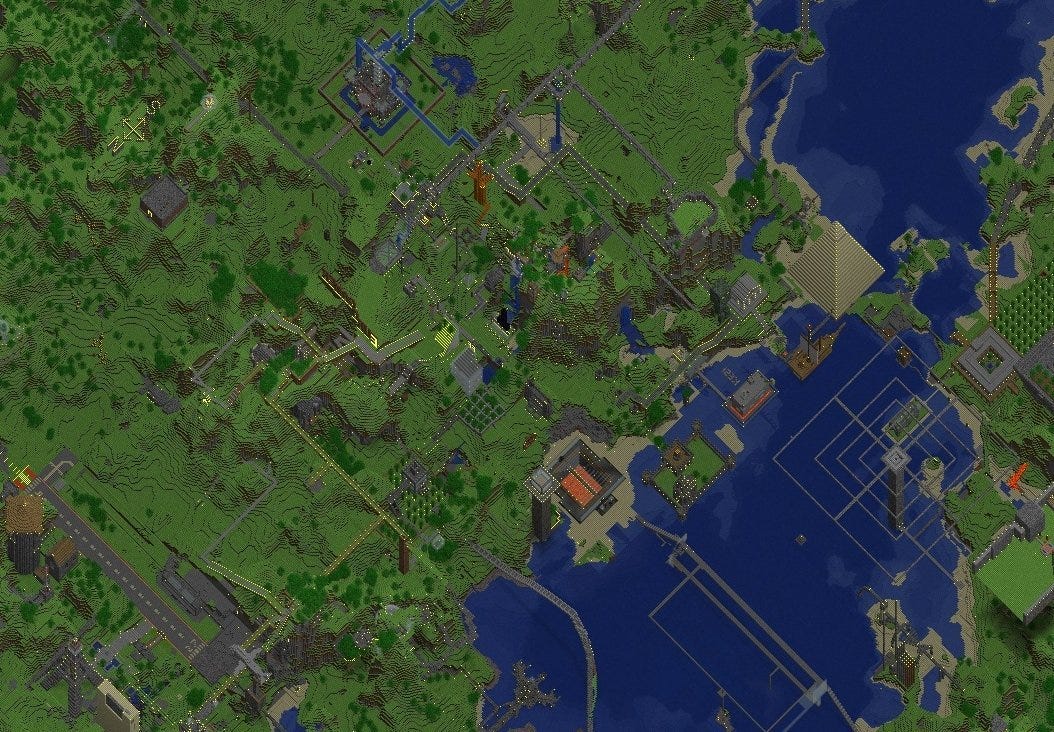
Out there, there's a universe of universes. An instantly forgettable multiplayer server IP could be your gateway to unforgettable sights. Everest-high staircases to nowhere, floating castles built around lava waterfalls, smilies the size of Wales, working animal pens, functional computer processors and to-scale starships. Endless new masteries of fire, earth and water... The sheer volume of time, effort and pixels is extraordinary: selfish obsession meets community endeavour, a world of grand, evolving art projects that anyone can almost immediately contribute to. Together, we are stronger. That's Minecraft's paradigm all over.

What I can't decide or predict is whether Minecraft is just 2010's game - a bright, unexpected star that burned with enough amiable ferocity to attract the world's attention for a few months - or if it's only just getting started. The more tools and features Persson provides, the more players can achieve, and the more YouTube-dominating wonders will be hewn from digital clay.

Compulsive playing of games is bad for society, screeched the BBC last month - that so much time and energy focused into a screen and an input device can lead to so much unfettered creation makes that argument all the more hollow.

Minecraft busts just about every games-circa-2010 stereotype there is. Like it or not, doff your hat to it.

Comments (75)

Comments for this article are now closed, but please feel free to continue chatting on the forum!

  • Loading...hold tight!