Majin and the Forsaken Kingdom
The penultimate guardian.

The Majin is everything that Ico's Yorda is not. In Fumito Ueda's classic, you lead the waif-like girl-child along a castle's craggy ramparts, crying out to her to follow your footsteps, catching her by her wrist when she falls, and batting away the black ghouls that tug at her bright white dress. It is a game about custody, about caring for someone weaker than yourself at the expense of the speed of your progress – a rare theme in a medium obsessed with the relentless exertion of power and dominance over others in search of the quickest route to a goal.
Ostensibly, Majin and the Forsaken Kingdom shares the theme. Here too you play as a gangly boy, Tepeu, thrust into a hazy pastoral world beset by fighters made of wispy blackness. Within 20 minutes you've freed a companion from captivity and begun the work of guiding him to safety.
But in contrast to Ico's Yorda, the Majin, a Muppet-like rendition of one of Shadow of the Colossus' moss-covered giants, is a physical powerhouse. For all his loveable stupidity and lumbering gait, he heightens your effectiveness with his thumping arms, which are able to prise open 10-ton gates and hurl your character over ramparts. Yorda's brilliant uselessness is overturned: rather than holding you back, the Majin is a companion without whom you could not progress.
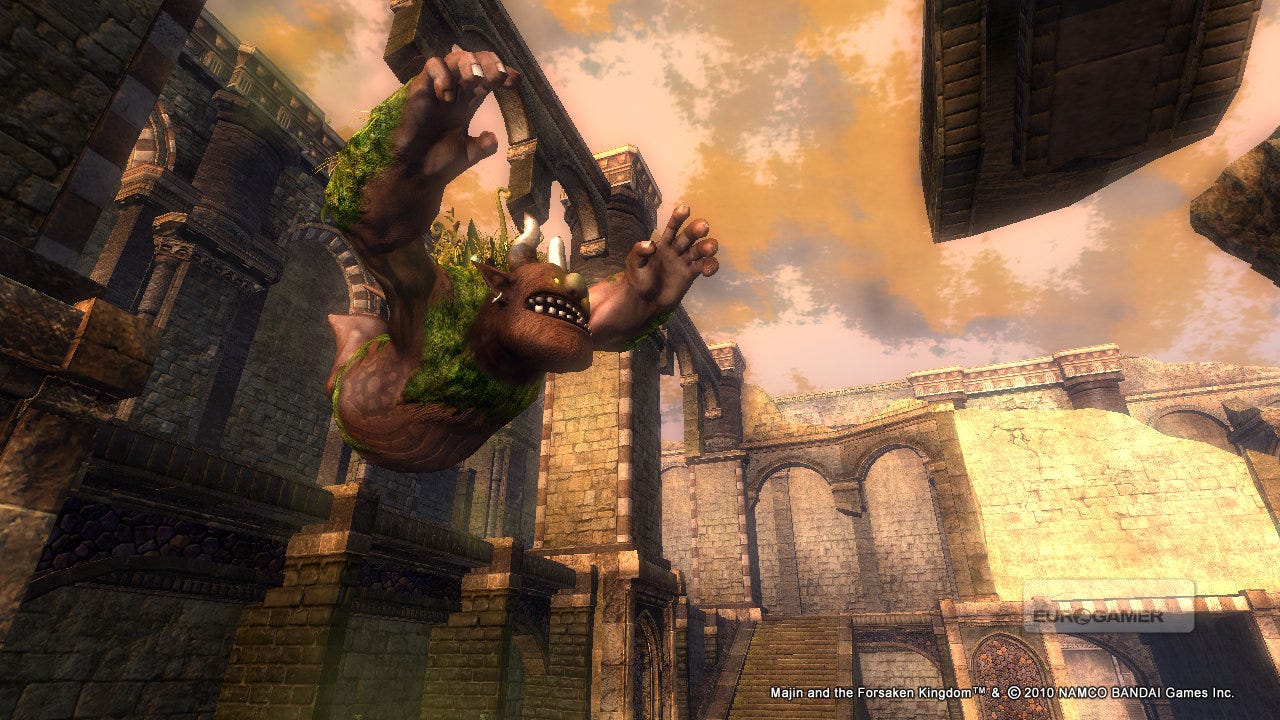
Thankfully, then, controlling this hulking mythical beast is both straightforward and intuitive. A squeeze of a trigger button brings up a reticule with which you can direct your companion and dictate his behaviour. Highlight an enemy and a single button press will send the Majin off to clobber the target, while selecting 'Action' while hovering over a fragile wall on the side of a cliff will have him topple it onto a group of enemies below with a short, sharp thrust.
In mechanical terms, the Majin acts as a handy toolbox with new abilities added as you progress; each subsequent action is another tool for overcoming the various obstacles you meet. One moment you may need to ask the beast to kneel, allowing you to access a high platform by climbing onto his back; the next, he'll be setting off a trebuchet to launch you through the air onto a nearby parapet. With a flexibility and usefulness that belies his size, the Majin is used as a Swiss-army-knife solution for a range of routine, occasionally ingenious puzzles.
While there's a heavy emphasis on stealth (sneaking up to an enemy undetected will allow you to dispatch them in a single blow) you can also team up with the Majin in fights. Lower an enemy's health enough and you can team up for a co-operative finishing move that's both weighty and satisfying. Defeated enemies drop 'friendship shards', currency that increases the strength of your combination attacks as well as levelling the Majin's abilities, while giant pieces of fruit can be claimed from the foliage to feed to your companion in the hope of reawakening yet more of his abilities.