Let me tell you why my driving to Sawbridgeworth in the summer of 1994 was one of the best decisions of my gaming life. It's not without relevance, I assure you.
Before I do, however, a little context is necessary. During my early teenage years, I suffered from something of an inferiority complex. I had a Spectrum when mates had C64s, a Master System during the NES dominance, an ST when everyone drooled over the Amiga, and a Mega Drive just as... actually, I ended up owning a SNES as well so that generation worked out without trauma. (And with hindsight - and a dollop of maturity thrown in - I've since been able to properly appreciate the numerous remarkable titles those systems played host to and that I thankfully didn't miss out on.)
Nevertheless, when the 3DO turned up I scrambled the required 400 notes together (to this day I don't know how), keen to place myself at the forefront of gaming's 'next generation'. In your face, Philips CD-i.
Okay, a year later I'd boarded the PlayStation train, but until that point I was one of the 20 or so people in the UK who owned a 3DO. Far from regretting it, I relish the short time I spent in the company of my Panasonic-produced console, because it gave me the opportunity to enjoy one of the greatest driving game experiences of all time.
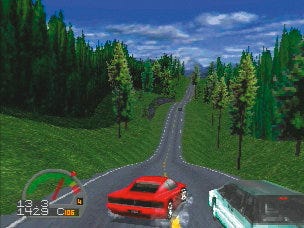
Witness 3DO power: no other console came close. Well, for a little while anyway...
I had The Need for Speed on my will-donate-my-feet-for-the-advancement-of-podiatry-to-get-this list from the moment it was announced in magazines. I was aware that developer EA Canada was effectively an evolution of Distinctive Software, whose dry-yet-oddly-engrossing Test Drive games I'd previously experienced on the ST. From the descriptions and screenshots, EA's forthcoming driving effort looked like a supercharged Test Drive - the mechanics of a PC-like sim wrapped in the visual sensibilities expected of 'next-gen' console titles.
On paper, then, pretty much my dream creation. The wait for its arrival was therefore tortuous. My fellow few 3DO owners will no doubt remember that you could rely on 3DO game release dates as much as you can expect EasyJet to keep to its flight times these days.
Which is why, having phoned every games shop within a 30-mile radius, I jumped in the car and raced towards Sawbridgeworth, home of Special Reserve and the only retailer to confirm it had stock in. And sure enough, three copies sat on a shelf unloved, cruelly ignored by the other punters. Fools, I figured, before handing over the cash and returning home to spend the rest of the summer - as with the autumn and winter, it turned out - in a bit of a Need for Speed blur.
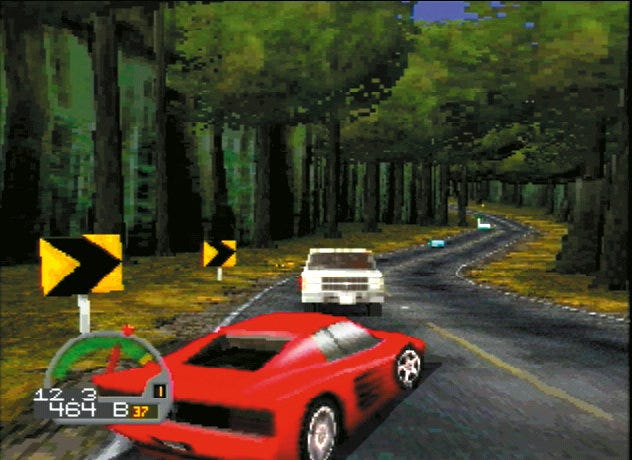
The course design was exceptional, with an exquisitely balanced pace.
Break the game down into its components and it may be difficult to spot the brilliance: one-on-one racing from a selection of eight sports cars, three point-to-point tracks, each subdivided into three stages, a sprinkling of civilian traffic and the odd traffic cop to outrun. Pretty tame even back then, perhaps, but what that list doesn't convey are the elements that held everything together.
Developed with input from Road & Track magazine, The Need for Speed was desperate to showcase the gloriousness of its vehicles - Dodge Viper RT/10, Acura NSX, Mazda RX-7, Toyota Supra Turbo, Lamborghini Diablo VT, Porsche 911 Carrera, Chevrolet Corvette ZR-1, Ferrari 512TR - at a time Kazunori Yamauchi was still toying around with cartoon cars. In 1994 and the era of the CD, this effectively meant FMV sequences. The game features plenty of stat screens, but the videos are given prominence, both in between stages (this is how your frankly annoying opponent 'communicates') and as short clips featuring the kind of stylish cinematography Top Gear hadn't thought of yet.
But the crucial aspect of the Road & Track association ultimately came down to the realism so evident throughout the rest of the game. The grainy, frame-rate-deficient and digitised visuals may look quaint now, but back then there was nothing on home console to touch them. Authentic settings (City, Coastal and Alpine), sampled engine sound and fully detailed two-dimensional recreations of the cars' cockpits ensured the most convincing driving environment seen at the time, combined with a clever 3D rendering system that enabled the road to be drawn to its vanishing point.
And then there's the handling. Supposedly based on data provided by Road & Track, the handling mechanic was hugely impressive for its day, with realistic steering characteristics for each of the cars despite the digital control and an almost palpable weight to the vehicles. This resulted in equally credible crashes, with your ride carrying momentum through every roll or spin until finally coming to a stop, smoke issuing from its bodywork (although no visual damage).
In-car detail was impressively conveyed - you even get to see the keys in the ignition.
Sure, the physics at work in the original Need for Speed weren't foolproof - one of my favourite tricks involved taking off one of the early hills on the first Alpine stage and overtaking the CPU opponent by landing in front of it - but for the majority of the time taking one of the game's cars out for a spin was an absolute joy.
And that's just it - The Need for Speed isn't so much a racing game as an enthralling driving experience. Yes, you have an adversary and the police are occasionally on your tail, but you soon realise that it's you versus the brilliantly designed road versus the civilian traffic. The slower pace of the action - resulting in part by the CPU demands of the game - deepens the connection with your environment by dictating an authentic sensation of speed. If in doubt, just check out the subsequent conversions of the game which introduced the beginnings of the arcade slant the NFS series has gone on to embody.
The first game, in its first form, however, couldn't be more different. In fact, it's hard to imagine a studio making a game like this now. The Need for Speed is about pushing a series of exotic cars to their limit on treacherous long stretches of road, darting in and out of traffic, and, occasionally, coming across your competitor on-road or outrunning a pesky cop car. Very little happens in the sense of today's set-piece driven productions, yet every drive is a new adventure.
This is pre-body deformation days, but the crashes would still make you wince.
You end up driving aggressively but cautiously, because this is no arcade racing experience. At a time when Daytona and Ridge Racer were entertaining the coin-op crowd, here was a console driving game that was built around realism. It's limited by today's standards, but still reasonably engaging - your body still tenses and you jolt backwards into the sofa as, when doing triple-figure speeds, that grey spec in the distance suddenly turns out to be an oncoming car. Imagine the impact that kind of involvement would have had back in 1994.
Actually, I'll tell you. I became so enthralled by The Need for Speed that I would catch myself subconsciously revving my mum's Metro GTa when I started it up, as I did the cars in the game prior to the start of a stage. Don't worry, I haven't suffered a similar episode since (well, apart from a couple of moments on the motorway around the time I reviewed Gran Turismo 2) but if I brave the risk of everlasting online embarrassment, it's because a game as special as this deserves it.
