Cave's Story

Bullet hell in downtown Tokyo.

It strikes me, on the way to the company's offices, that the inspiration for Cave's legendary gameplay style may be staring me in the face. Alighting from the train at Shinjuku I'm hurled into a mass of moving bodies, skipping from gap to gap in an attempt to get from one end of the world's busiest train station (3.4 million passengers per day, fact fans) to the other without being smacked in the ribs by a sharp-elbowed Japanese granny.

Sound familiar? Cave's designers, housed in an innocuous office building in the heart of Tokyo's most famous skyscraper district, run this gauntlet every day. In between rush hours, they craft fantastical versions of the same experience - helping to define a sector of the shooter genre so unique and bizarre it's been honoured with a name of its own: "bullet hell".

If you've never played a Cave game, "bullet hell" is a good summary. Firmly rooted in the scrolling shoot-em-ups which towered over the gaming landscape in the eighties and early nineties, Cave game series such as DoDonPachi, Espgaluda and DeathSmiles have picked up a devoted following of players.
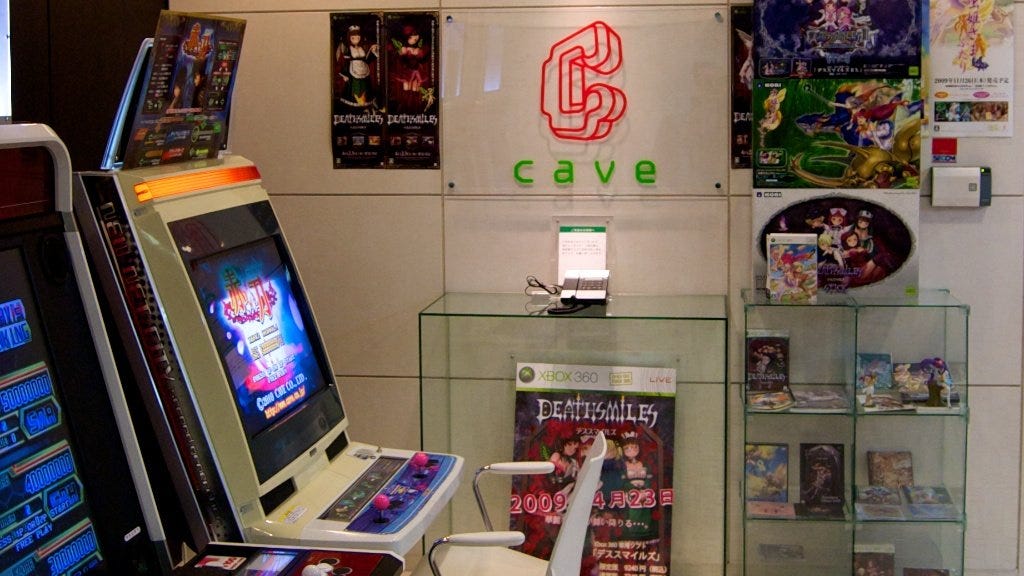
2

This is Cave's front hall. It's giving me interior design ideas, not that Japanese flats offer much interior to design.

These fans revel in the fast, ultra-precise control and extraordinary challenge of navigating a fragile craft through wave after wave of lethal bullets in fiendishly difficult patterns.

It's a fanbase firmly rooted in Japan's much-envied arcade scene, where most arcades boast at least a few bullet hell games - often occupied by a chain-smoking shooter fanatic, still as stone but for hands twitching over the controls and eyes flicking across the screen.

As Cave's own staff members acknowledge, the once-mighty Japanese arcades are in decline. But when one door closes another opens, and the company has found new success in porting its titles to Xbox 360 and the iPhone.

For all the studio's keen to explore new platforms, it's clear the arcade is still Cave's first love. That fact is driven home when you walk into the company's offices - through the innocuous lobby and up the dull elevator (probably sharing with an oblivious salaryman or office lady on the way), only to be unexpectedly deposited in front of Cave's own private arcade. This is a little row of game machines on free-play, standing in the kind of entrance hall most gamers can only dream of when buying lottery tickets.

After a quick play of the company's most recent arcade effort, a gloriously retro-looking side-scroller called Red Katana, we're ushered in to talk to programmer Takashi Ichimura. Over the years he's been responsible for a pretty major part of Cave's output, including the lion's share of the games' memorable bosses.
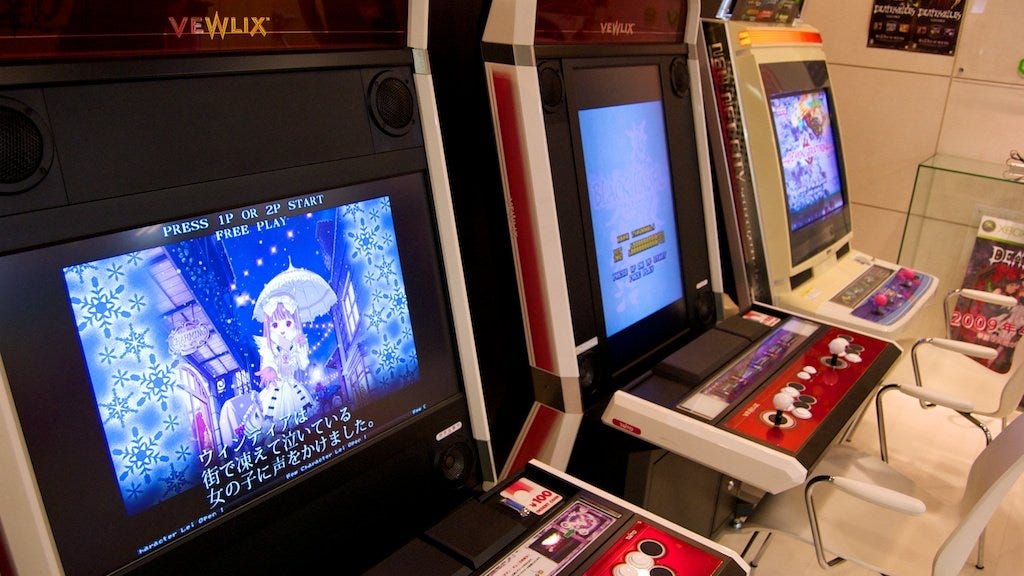
3

Cave have a vast back catalogue of releases.

When we speak, Ichimura is hard at work on the Xbox 360 port of Guwange, Cave's 1999 arcade shooter. It's the company's first venture onto Xbox Live Arcade after several disc releases for the console.

Along with offering graphical upgrades, it's also the first Cave game to feature an online co-op mode - something which Ichimura admits was tough to implement. "There are a lot of bullets and objects on screen at the same time in Cave games," he tells us, perhaps attempting to win some kind of prize for understatement, "so a hundred per cent sync was basically impossible to realise. "But we've done our best to make it feel like you're playing in the most synced way possible."

It was, Ichimura says, a slow process to get the system right - but he hopes that the door is now open for more online modes to feature in future Cave games.

Online co-op is something you can't do in the 11 year-old arcade version of the game, of course. Plus, the 360 boasts rather more graphical prowess than the JAMMA arcade board on which Guwange was originally released. I put it to Ichimura that this means the 360 versions of Cave's games will be the definitive versions - better looking and more fully-featured.

The company's arcade roots run deep, though, and that's a leap of logic Ichimura isn't prepared to make. "I wouldn't say that it's the 'real' version, or the more authentic version," he says. "We think of it in terms of making two separate versions.

"The arcade is a specific environment in which the customers who play our games don't necessarily have a lot of time to play, so we want to give them the most enjoyment they can have in a short amount of time.

"With the 360 versions, you can play at home, so you can have a much more slow experience, taking the game in over time. We change how we make the games for that home setting - that includes things like co-op modes to play with friends."

The company is still committed to putting the arcade platforms first when it creates new titles. According to Ichimura, parallel development for arcade and console isn't part of the plan. "We've always focused on the arcade first and released on the 360 later," he says firmly. "The arcade will come first for the foreseeable future."

Having broached the topic of creating new titles I'm keen to know how Cave goes about making a new game. The company's offerings feature an extremely broad range of art styles, with the more recent ones even switching between 2D and 3D.

The bullet patterns themselves can be elaborate works of art, swirls and fans of glowing projectiles ranged across the screen like a complex, unfolding orchid, albeit an orchid made out of death and explosions.

It's here, Ichimura tells me, that the games begin - with the art style and the setting. The first thing that's decided on is whether the new title will be 2D or 3D. Then the setting is determined, and an artist goes off to create the masses of illustrations and artwork required for the game.

5

No longer having to spend 700 quid on a plane ticket to Japan to play Cave games must be relieving a lot of the company's fans.

Only after that do Cave's programmers and designers start talking about the game systems themselves and determining exactly what kind of title they're going to make.

It's an odd way of working, perhaps, but it's been effective for the company for many years. It's tied in with a system of thinking about game design which permeates right into the company's design philosophy, as I discover when I question Ichimura about the bullet patterns in the games.

"The first step [in creating a new bullet pattern] is making the visual of the pattern itself and putting that out there," he says.

"We imagine and experience how the player will react to it, and of course we play it ourselves. If at that point we think that we've actually seen this kind of pattern somewhere before, we stop right there and re-do it.

"If we play it and dodging is a lot of fun, if it's an interesting pattern, we put it to one side and then make multiple patterns to combine into the final bullet pattern in the game."

It seems a little strange that Ichimura is talking about the programmers doing so much of what I'd consider to be design work, and it suddenly strikes me - as it probably should have ten minutes earlier - that he's talking about a really small team.

"Oh, it's basically about seven people," he confirms. "Four designers and three programmers, and to be honest, sometimes I even think that's too many. On top of that, there's a freelance illustrator woking on each project, usually just one person. So I guess that's eight people."

Eight people. And this process takes how long? "Eight or nine months," says Ichimura. "The most time-consuming part is adjusting the game balance at the end."

In a world where the likes of Minecraft, Angry Birds and Canabalt consume countless hours of people's gaming time, it shouldn't come as a surprise to learn that hit games like Cave's shooters can be made with such small teams - just as they were in the eighties, no doubt. But somehow, it still seems shocking.

Ichimura isn't oblivious to the unique position Cave is in, either. When I mention that I know many developers working in enormous teams, on seemingly never-ending, high-budget projects, who would give up a kidney to swap places with him, he simply smiles and says, "I guess so."

It's not all a walk in the park. Cave's fearsome reputation for producing challenging, well-balanced games means that an enormous amount of time is spent on perfecting that balance.

"The basic adjustments to the game are made by the development team itself," Ichimura explains, "but sometimes we bring in well-known players and have them play the game too - that's something we've been doing recently.

1

Even legendary Japanese development studios just look like open plan offices. But with bigger vending machines.

"Our team plays the same section over and over to see if it's fun, if it's interesting, and if not they'll re-make the whole section. It's a pretty analogue approach to balancing, I think.

"Making a boss, for instance, takes between three weeks and a month. After I get the illustrations from the artist, it takes a week to create the basic framework of the boss, and then two to three weeks of coming up with all the attack variations - and within all those attack variations, all the different bullet patterns, the movement of the boss..."

Given Cave's rich treasure trove of much-revered classic games it's not surprising the studio spends a fair bit of its time porting those titles to new platforms, as well as developing entirely new games. Along with Xbox Live the iPhone is the break-out platform for Cave, with titles like DoDonPachi Resurrection enjoying solid success on Apple's iOS devices.

"Yes, the arcade industry is declining in Japan," admits Cave's mobile boss, Yukihiro Masaki. "At the same point in time, actually, Cave's existing mobile business was also shrinking. At the intersection of those two moments, we decided to try the iPhone platform as an experiment, just to see where it would go."

4

Taking screenshots of Cave games is bloody hard, not least since it involves using my fingers for something other than panicking.

Where it went, as it turned out, was firmly in the direction of success - not just in Japan but around the world. The company's last game, DoDonPachi Resurrection, sold 30,000 copies in its first three days on the App Store, and that figure has now topped 40,000.

The numbers may not seem huge compared to sales of triple-A games, but bearing in mind the low cost of development and the fact that the game had already made a profit at the arcade, it's clear Cave has found a solid new business.

Besides, the company takes obvious pleasure in reaching a new audience of international fans. Masaki tells us happily about receiving a "very warm fan-letter from a fan in Israel - it was really enthusiastic, really great" after the launch of DoDonPachi Resurrection on the iPhone. He says that the company has been surprised and delighted by the level of feedback from abroad.

Even so, Cave doesn't seem likely to be swayed by its newfound international popularity. While enthused by reaching foreign fans, Ichimura is most animated when discussing the arcades - especially the incredibly skilled players in Akihabara ("it's kind of a special place"). They, he tells us, put even the best players in Cave's own offices to shame. Moreover, he's adamant that the new overseas audience won't change the company.

"Up to now, we haven't done an original title on 360. When we do we'll definitely take the international market into account, but in terms of changing the game's design or anything... We're not going to change our style. That's Cave's style."

And that has got to be just what the fans who work their fingers to the bone dodging the company's never-ending streams of bullets want to hear.

Comments (32)

Comments for this article are now closed, but please feel free to continue chatting on the forum!

  • Loading...hold tight!