Dead Space Ignition Review

Necro filler.

Version tested:

As this maturing medium grapples with the intricacies of interactive storytelling, it's little wonder we're seeing digital worlds expand beyond traditional boundaries and into other media. From novels to comics to viral web campaigns, publishers are understandably keen to explore other ways of keeping a brand name in the popular consciousness. An interactive comic with hacking mini-games is a new one, though.

Ignition is an "interquel", ostensibly dealing with the arrival of the Necromorphs on The Sprawl, the huge space station on which Dead Space 2 is set. For much of its brief duration – you're looking at 90 minutes to two hours for a first play through, though there are branching paths and four different endings – you'll watch a series of comic-book scenes featuring expert hacker Franco DeLille and his feisty companion Sarah Anderson.

The former's a bit of a personality black hole, reacting to impending peril with all the concern of a man who can't remember whether or not he left the landing light on, while the latter aims for 'lascivious' but hits 'irritating'. Her first line is a "that's what she said" gag, and neither the dialogue nor the performances really get any better from there.

Periodically, the pair will come across a door that needs hacking or an airlock that needs hacking or a space suit that needs hacking, or any number of tenuous reasons to pull out DeLille's all-purpose hacking machine. There's so much hacking going on that you half expect Jonny Lee Miller and Angelina Jolie to turn up. Though they made it look a lot more fun than it is here.
1

There's a not-so-subtle reference to 'cake' in one of the mini-games which is presumably a half-hearted nod in Portal's direction.

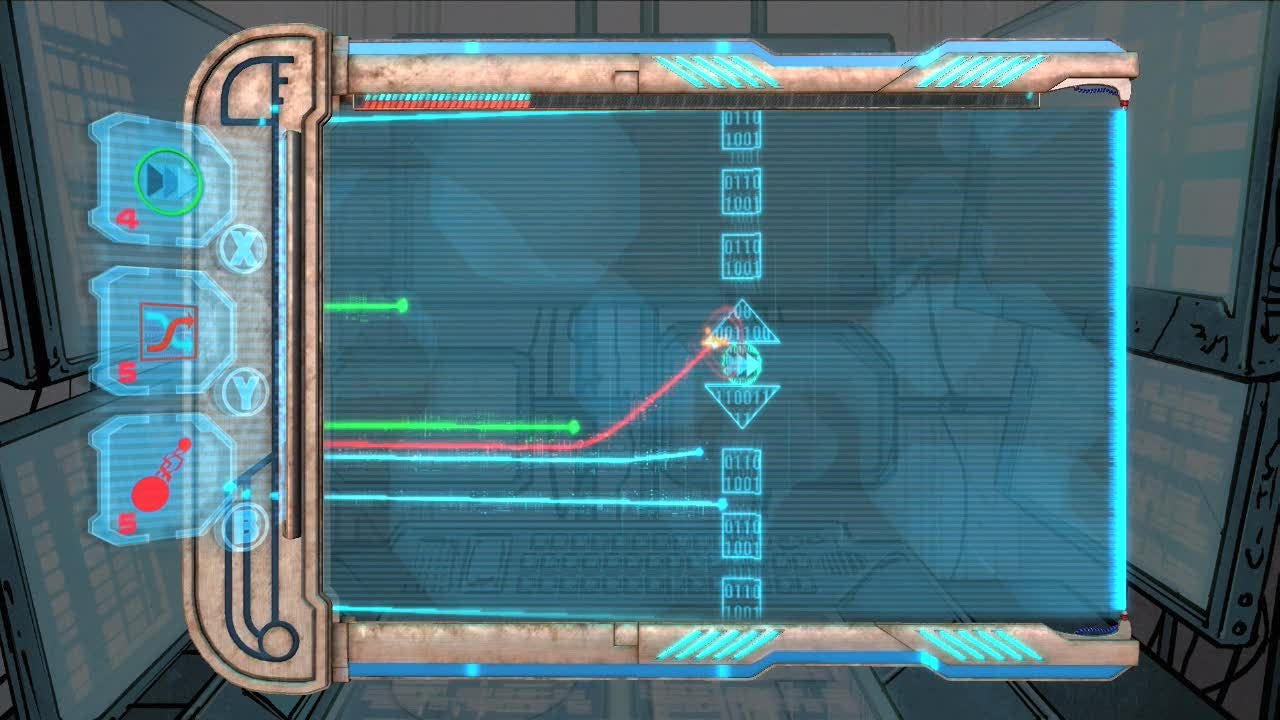
There are three different kinds of hack. First up is Trace Route, or Art Style Light Trax, as it's otherwise known. It's a pretty shameless rip-off of the WiiWare title – itself owing a not-insubstantial debt to Tron's light cycles – but with little of that game's style. The idea is to guide a red line through a scrolling course, avoiding abstract obstacles and beating the system's countermeasures to the finish.

It's curiously sluggish, visually flat, and manages the rare feat of being simultaneously easy yet frustrating. You'll invariably win the race, despite having spent an inordinate amount of time slowing down or crashing thanks to the display showing far too little of the road ahead. The courses theoretically get more difficult, but as you progress you're offered more power-ups to take down your rivals – one reverses their controls, another puts up a small wall to slow them down – so it never actually feels any tougher, even though you're dodging and weaving more than you did in the earlier stages.

System Override is an initially unfathomable task, thanks mainly to poor instructions but also a visual set-up that's hardly forthcoming with the feedback. It soon transpires that it's a kind of tower defence game in reverse, which isn't nearly as much fun as that sounds. It takes place on a hexagonal board which looks like the most complicated version of Blockbusters ever, as you fire viruses from one side of the map to overload the system core while anti-virus measures attempt to shoot them down.

You can send out as many red spinning icons as you like as long as the slowly-refilling meter isn't entirely depleted. With four different types of virus having different effects – one type is only recognised by a specific antiviral defence, another forces the countermeasures to briefly attack one another – there should, in theory, be some strategy to this, but it tends to devolve into mindless button-mashing as you press A repeatedly with the odd B and X thrown in for good measure, overwhelming them with sheer numbers rather than any kind of tactical plan.

Last but least worst is Hardware Crack, a light-reflecting puzzle where you place mirrors to guide beams into similarly-hued receivers. Colour-blind gamers will no doubt be delighted to learn that the two main colours are red and green, though yellow receptors are soon introduced, as well as a few new tricks like the ability to remove pieces which may be blocking one beam's path, and mirrors which rotate 90 degrees every three seconds.

These hacks are harder than the rest, and as such are more satisfying to complete, though if you're not very good at light puzzles you won't be able to move on with the story; hacks need to be finished if you want the plot to progress.

3

Each individual hacking game has its own leaderboard, though curiously your times in the story mode don't count.

Whether you'll be particularly bothered about that is another matter. Despite the involvement of Antony Johnston, who scripted the comic-book prequel as well as contributing to both Dead Space and the terrific on-rails spin-off Extraction, Ignition's story is astoundingly dull. The two leads have zero chemistry and precious little character, and the plot seems to tie itself in knots trying to fit in excuses for the mini-games. It's regrettable that a perfect opportunity to expand upon some of the interesting subplots of the Dead Space universe (wherefore art thou, Markerheads?) has been all but wasted. The final scene, which I won't spoil here, is a nice lead-in to Dead Space 2, but otherwise it's disappointingly light on the lore.

The dialogue might be less of an issue if the art wasn't quite so ugly. Drawings which might pass muster on the printed page have all their flaws emphasised on a TV screen, and while some close-ups are fine, others seem rushed. At one point, I wondered whether a character was just about to undergo transformation into a Necromorph, only to realise a blancmange-like appendage was actually supposed to be her hand. Worse still is the rudimentary animation, as characters bounce Zebedee-like down corridors, or jerk their arms awkwardly like terrifying meat puppets. Only on rare occasions do these effects work; one sequence involving a hostage rescue made me wonder why the rest of the game didn't look as good.

4

The narrative can be skipped to get straight to the puzzles, which seems to defeat the object.

There are local multiplayer variations on each mini-game, and Trace Route is certainly improved by the addition of a human opponent. To win at Hardware Crack, you need to light up more of your own colour receivers than your rival, while System Override puts one player in charge of the anti-virus defence systems. But they're little more than token additions, and it's hard to imagine anyone wanting to play this trio of unremarkable puzzle games when there are many, many better ways to spend your gaming time this October.

The idea of an interactive comic as narrative expansion is a sound one, but Ignition entirely fails to do the concept justice. Those who struggle through to the end get a new suit Isaac can use in Dead Space 2, a completion time and ranking, and a message which simply reads: "Congratulations on surviving Dead Space Ignition." They could hardly have chosen a more appropriate word.

3 / 10

Dead Space Ignition is available now on Xbox Live Arcade for 400 Microsoft Points (£3.40 / €4.80) and on PSN for £3.99 / €4.99.

Read the Eurogamer.net scoring policy

Comments (62)

Comments for this article are now closed, but please feel free to continue chatting on the forum!

  • Loading...hold tight!