Kabul, Afghanistan. A young man lies bleeding in the sand. A makeshift bomb has exploded beneath him. The blast has torn the flesh from his legs. Shrapnel has carved a thick red upward trajectory towards his stomach. He's dying. He will never see who killed him, or fully understand why.
Elsewhere, another young life is being extinguished among rubble and smoke. This man has been hit by a sniper's bullet. A direct hit to the head, just above the right temple. He drops like a stone, his companions scattering for cover as they try to see where the fatal shot came from before the next bullet finds them. There's panic, anger, fear.
The difference is, one of these deaths actually happened. That soldier is gone forever, his demise agonising and undignified. His body will be dragged from the battlefield and sent home to a grieving family in a box.
For the other soldier, playing the war on his console at home, death is a fleeting inconvenience. He'll respawn in 10 seconds and be back in the fray. The only lasting effect of his brutal demise will be wounded pride and a digital tick that brings his enemies closer to victory.
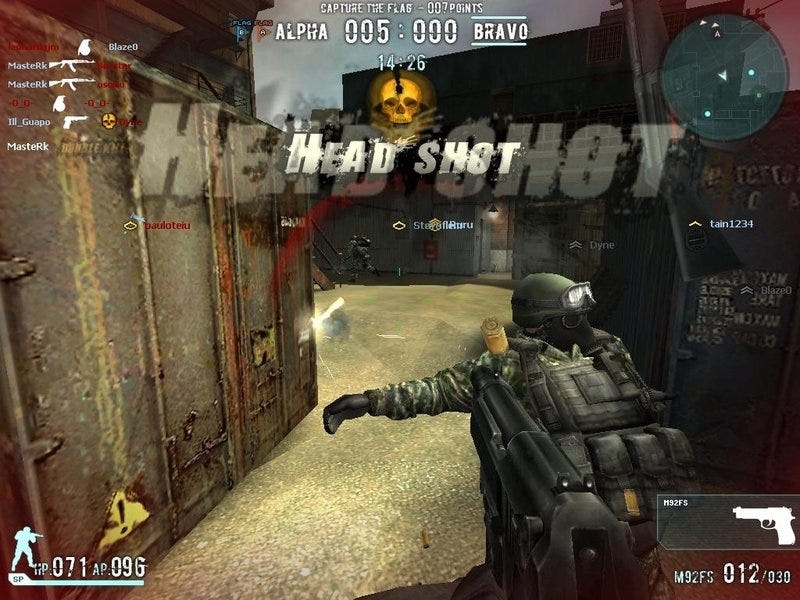
Is it possible to have a multiplayer war game that doesn't celebrate violence? Would anyone even play it?
Arguably a cheap comparison, but one I'm finding harder and harder to ignore as the first-person shooter genre continues to thunder down the battle-damaged avenue of "realistic" war simulation.
I'm not about to make a shrill demand to BAN THIS SICK FILTH. Nor is this a hand-wringing plea for people to stop making these games, or playing them. I've enjoyed them myself and will probably continue to do so. This is more a personal exploration of the issues, an attempt to work out where we're heading with games like this - and if it's somewhere we want to be going.
Medal of Honor's upcoming rebrand from World War II veteran to Afghan commando crystallised my unease. A lot of the coverage has focused on the fact that you'll be able to play as the Taliban in multiplayer, because that's an obvious ethical hurdle, but that seems like a symptom rather than a cause.
No matter how well crafted the final game turns out to be, I just can't seem to get comfortable with the idea of play fighting in an ongoing conflict. I can't see myself enjoying bomb blasts and bullet hits that have real, deadly counterparts taking lives at this very moment.
Innocent times, but could a mainstream game get away with a mini-gun-toting Bin Laden boss battle today?
Judging by straw polls of friends and discussions on internet message boards, I'm not the only one. Some bowed out when Call of Duty: World at War used archive footage of actual executions to heighten the tension of its opening level. Others said "enough" to Modern Warfare 2's "No Russian" linear shooting gallery of civilian targets.
Playing as a Taliban guerrilla, shooting US troops, will be the last straw for some. Playing a US soldier shooting impoverished insurgents may turn others off. It will be crossed by different people at different times but at some point, inevitably, a line appears in the sand.
It's in the realms of multiplayer where this issue arises most obviously. In a single-player story, even the dumbest shooter can offer up a sliver of context for what's happening. It's usually pretty poor context, but even a slender narrative can offer a small justification for indulging our more bloodthirsty urges.
In multiplayer, there's no narrative. We're playing purely for fun; character and story don't enter into the equation. It's all about the kill. We're rewarded for every enemy taken down, granted more weapons, able to become more and more lethal so long as we kill more than we die. As a gameplay mechanism, its simplicity is brilliant; as a primal link to our atrophying fight or flight response, it's invigorating. That's why so many of us flock to these games.
There's nothing wrong with playing soldiers, is there? Time was that schoolboys would run around the playground, making akka-akka-akka machine-gun noises and arguing about who would be the Germans. But we're not schoolboys, and the modern first-person shooter offers a much more realistic and immersive experience than playground games.
These shooters are ostensibly made for adults. But if you take a step back and look at the scene dispassionately, the idea of grown-ups entertaining themselves by pretending to slaughter each other on virtual representations of actual battlefields is pretty creepy. Orwellian, even. And still enormous fun. So we find ourselves back in the Contradiction Cul-de-sac.
Part of the problem is these games take themselves so seriously. The FPS has been slowly but inexorably pulling itself in two contradictory directions at once, ever since the first Medal of Honor game (produced by Steven Spielberg to piggyback on Saving Private Ryan, no less) pioneered this current trend for combining bloodthirsty excitement with a sombre "war is hell" message.
Battlefield and Call of Duty soon followed, while the likes of Counter Strike and Rainbow Six brought the same approach to modern-day combat. Now, the genre is stuck, ricocheting awkwardly between gritty realism and ludicrous cartoon violence.
Flamethrowers are now illegal in warfare, but you can get an Achievement for using them in Call of Duty.
The trouble is, when it comes to games, war isn't hell. With joypad in hand, war is frickin' awesome. It has to be. The average soldier rarely gets to fire their weapon, let alone make a confirmed enemy kill. Yet in games you mow down hundreds of foes in story mode, thousands more during your online career. You have to. That's the game.
When World at War ends with stark messages about the human cost of a war you just won pretty much single-handed, before offering you the chance to play Nazi Zombies, the message is inevitably garbled - tripping over itself to be respectful and pump-your-fist awesome at the same time. Only niche titles like Armed Assault and Operation Flashpoint have tried to find gameplay satisfaction in a virtual battlefield where anything like real-world rules apply, where combat is considered and death is sudden, costly and scary.
As gamers, our perception of these things is skewed. By way of illustration, games journo turned telly man Charlie Brooker did an excellent interview with industry publication MCV last year where he talked about using violent games footage in his Gameswipe special for the BBC.
America's Army, the FPS recruitment tool, has attracted controversy for using multiplayer gameplay to entice young gamers into the 'excitement of an Army career'.
"Let's not beat about the bush - it's f***ing tasteless," he said, describing the relentless carnage in Call of Duty: World at War. "There's a line where I say I enjoy it, but I wouldn't necessarily want to let people watch me enjoying it."
That cuts very close to the heart of my own unease with the direction these games are taking. I've lost count of the number of times my wife has walked in on me mid-game, only to be greeted with sprays of digital blood. As gamers, we take for granted actions and images that most other people would be horrified by. Headshots. Dismemberment. Instinctively shooting the red barrel to set people on fire.
We perform these deeds hundreds of times without thinking about what they actually represent. Taken out of a fantasy context and placed in a real-world scenario, the meaning of these actions changes. And yet we still get so defensive whenever questions are asked about the content of such games.
"Films turn war into entertainment, so why not games?" goes one popular argument. But that ignores the simple fact that games are not films. Games, by their nature, focus almost entirely on the action. Story can be woven around it, but the core of the experience is hours and hours of endless shooting.
Games, and online first-person shooter games in particular, don't do things like pathos, doubt and ambiguity well - if at all. When your friend gets killed you laugh, or insult him, or headshot the little scrote who took him out. In a perpetual online fragfest, the tug of war between the thrill of pulling the trigger will always win out over the dramatic need to give each bullet meaning.
"It's OK to kill Nazis, so why is Afghanistan any different?" is another common response. It's a valid argument, up to a point. For a lot of people, the World War II games are no more "OK" than more modern shooters. My grandfather fought in that war, an experience so horrible he refuses to talk about it. He'd be aghast at any random five-minute chunk of World at War - a game which I enjoyed, albeit in the same slightly guilty manner Charlie Brooker described.
But World War II is a different war from a different time. Not only was it fought against a clear national enemy bent on violent expansion, it has been so thoroughly absorbed into the cultural fabric that different approaches can co-exist. There's distance enough that, as a society, the cruel reality of newsreels and mass graves can be separated from the fictional war of The Dirty Dozen and Action Man.
The creators of Medal of Honor aren't wrong to reboot the series in the modern day, using Kabul and the Helmand Province as the backdrop to thrilling shoot-outs. However, nor is such a decision exempt from questions of bad taste or exploitation. There are as many answers as there are people playing games, but the questions deserve to be asked regardless.
Medal of Honor's Afghanistan: more exciting, less depressing, than reality.
We rightly reject the notion that playing violent games can turn someone into a trenchcoated killer. Why do we so eagerly embrace the opposite fallacy, that it's possible to lose ourselves in this material for hours at a time with absolutely no effect? Not with regard to the violence in itself, but the context. In 1991, the invasion of Iraq was compared to a videogame. Now the videogames and the wars have become one and the same.
Are we really prepared to argue to the non-gaming world that we see no cognitive difference between shooting an oogly boogly space monster with a ray gun and shooting at real people, in real places, using painstakingly detailed weapons based on real military stock?
Both might be fun, but to conflate the two is problematic. Having been the scapegoat of most recent media scare stories, it's understandable that the gamer's first response is to put fingers in ears and repeat the "only a game" mantra. The problem is, doing so only makes us look even more like the sociopathic deviants the tabloids would paint us as.
I'll play Medal of Honor, of course. I'll play Bad Company 2's Vietnam expansion. I'll play Call of Duty: Black Ops. Not just because it's my job, but because I enjoy them. How much longer I'll enjoy them is another question.
The line in the sand, for me, is uncomfortably close. By not thinking about why we enjoy gunning each other down in these playgrounds of destruction, recasting the horrors of real battlefields for our excitement and amusement, we do ourselves and the games industry a disservice. We should not leave the debate open to those who would fill in our motives with uneducated speculation and prejudice.
