It's a sultry August night in New York and Ken Levine, president and creative director of Irrational Games, writer and designer of Thief and System Shock 2, creator of BioShock, has just revealed his next game to the press for the first time. BioShock Infinite, which you can read about in detail in our preview, inverts the original's claustrophobic, art deco undersea horror to create a bright, brutal satire on early 1900s America aboard Columbia, a city in the clouds.
In a quiet room amid the very apposite turn-of-the-century splendour of the famous Plaza Hotel on Central Park, Levine - trim, dark, sharp-eyed and fast-talking - has some explaining to do. After he and his studio had distanced themselves from BioShock 2, the canonical sequel to their 2007 smash hit, and reclaimed the Irrational name after a brief spell in corporate brand land as 2K Boston, it was easy to assume they had staked their claim to creative independence and were seeking new ground.
In some ways, though, they still are, with Infinite's ties to BioShock being more conceptual than literal. What makes this a BioShock game, then, and what makes it different?
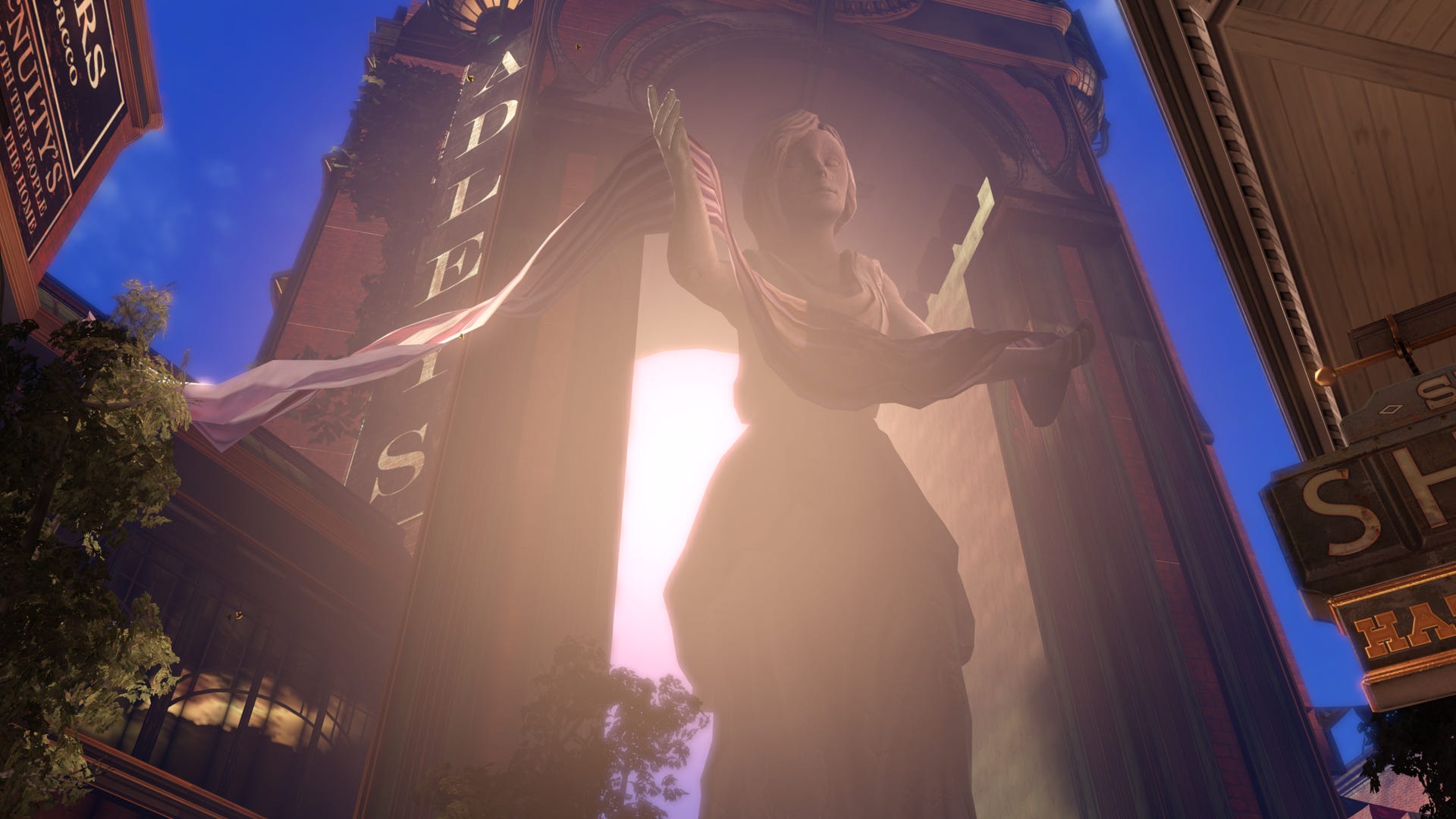
Welcome to Columbia.
Eurogamer: Why "Infinite"?
Ken Levine: You had to start with a question I can't really answer! There's lots about this world that we're going to be talking about down the road, and I think that if you really look at the demo carefully, you'll start to see there are elements that you don't notice the first time, that raise more questions than they answer, and that maybe speak to the title a little bit.
I couldn't give you a more vague answer, I know, but that's going to become clear with time.
Eurogamer: Let's turn our attention to the other half of the title, then. Was this always a BioShock game?
Ken Levine: Yes.
Eurogamer: What does BioShock mean, in that case? There are things about the tone and the art that are familiar, but the world seems very different.
Ken Levine: I think that's what we wanted to do. We're the guys that created the franchise, but BioShock was an extension of work we had done before in a lot of ways, and this is an extension of work we had done in BioShock.
But I think that it's very much a BioShock game in the sense that it's about a place. It's very important that it's a shooter set in a place where ideas are very important and ideas are the things that drive the action, and there's a notion of history, and you are empowered to go through this world and discover its mysteries and deal with the challenges in a broad range of ways.
To us, that's really what makes a BioShock game; whether it's Rapture or whether it's 1959 or it's the bottom of the sea - those things are far less important to us. Those are the expression of an idea, and the idea for us was always a lot bigger than a particular location.
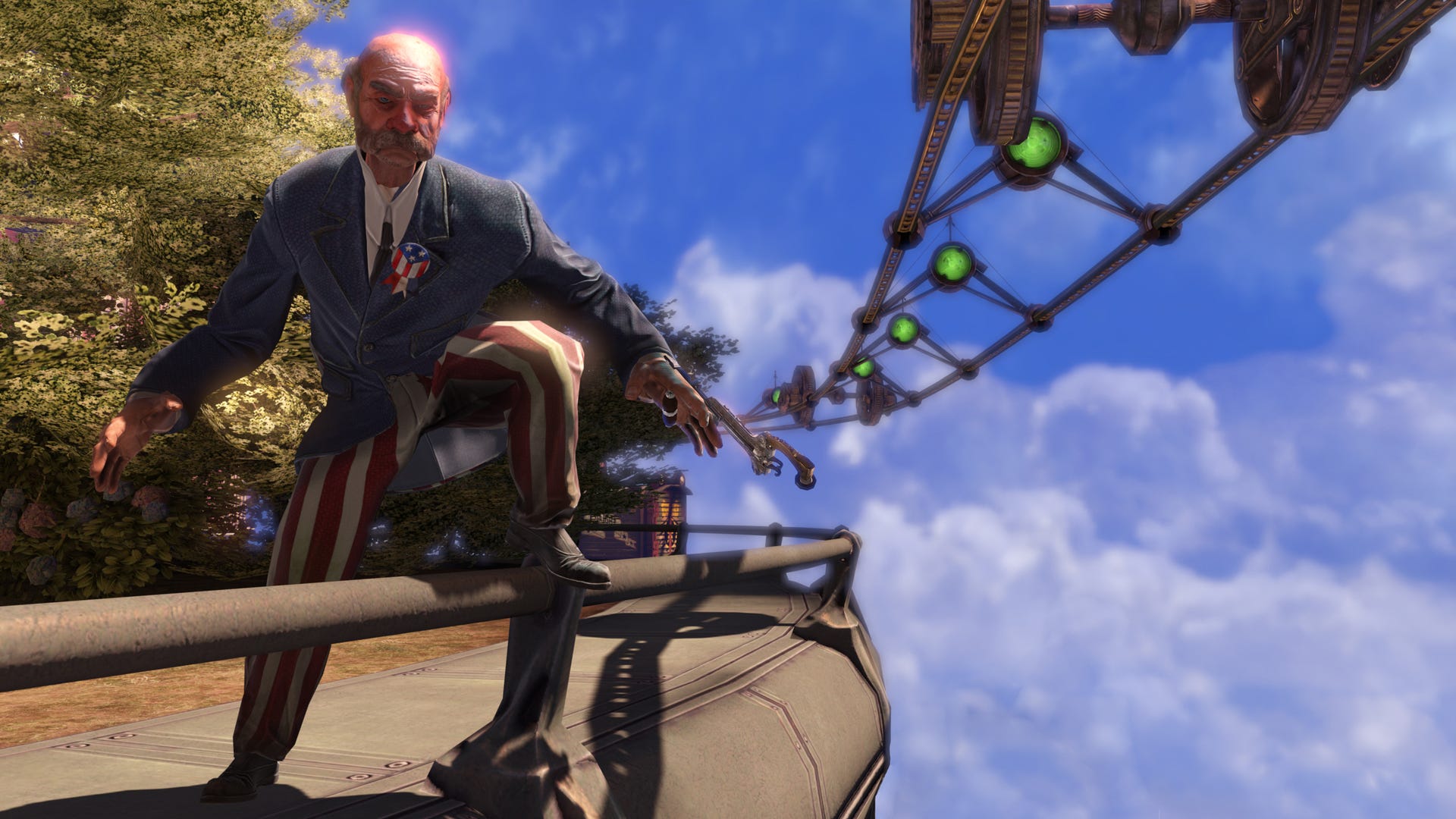
That's quite a moustache.
Eurogamer: It seems like the city, Columbia, is about a State's vision rather than a personal vision this time around.
Ken Levine: Yes, this is not a secret individual mission, this is the mission of a country that was really coming into its own and wanted to project a series of ideals out into the world in a very powerful way.
It parallels a lot of what happened in history, whether it was the White Fleet or the moon landings. Those were sort of peaceful projections, but they had other overtones to them, in terms of what the country can do, as messages.
We just looked at that period of 1900 which, I don't know about the UK, but it's not a period that people know much about in America. And that attracted us to it, in the same way that BioShock wasn't about World War Two, it was about a period afterwards that people don't know much about.
But we thought it was a really interesting and transformative time of technology waking up: almost all the technology we think of today, electricity, airplanes, cars, mass communications, all those things coming into being in the space of of 20 years. And also America waking up and becoming a player on the world stage and really transforming the world.
Eurogamer: So are you going to be exploring more political themes in this game, as opposed to the philosophical overtones of BioShock?
Ken Levine: I think they're connected. Andrew Ryan reacted to a political context. His philosophy was forged in the Soviet Union.
This philosophy was forged out of a set of ideals about what America is, and what's different here is that people have different ideas about what that is and what a democratic society is. There was a lot of conflict then and there's a lot of conflict now about what the mission of a country might be, and what the country means.
Eurogamer: It seems like you're going to end up touching on some issues that are quite sensitive today - about America and its place in the world, and how it handles it.
Ken Levine: I think you saw some elements in the trailer and the demo - you can see some of the themes that we're playing with.
Our goal is always more to report than to actually make a statement about something. To say, here are these ideas, and here are these ideas, and let people make their own decisions. I love that in previous games people never really knew where we stood on these issues as individuals, because it doesn't matter. We're just talking about those ideas out there.
Eurogamer: You've chosen to use a more defined player character this time, with a name and a past and place in the story. How come?
Ken Levine: My broken record tonight is that the first thing we decided on this game is that there are no sacred cows. A sacred cow on a couple of our games so far has been that you're a mysterious Mr X, and we used that to our advantage in those games.
We didn't want to allow ourselves that... What if it was a BioShock game but you were a clearly defined character, you had a role in the world. And that instead of somebody else driving your missions, you drove the missions yourself - in terms of you speak to yourself?
I've worked on a game called Thief where we did something somewhat similar, but we hadn't done that in one of these games: to put yourself as a character who had some basis in understanding who he was - and then take the next step of actually having a relationship with somebody else. That's not something you've seen a lot of, certainly in a first-person shooter; there are some games where the protagonist is silent but the person with them is not.
We wanted a relationship with Elizabeth that was complicated, she's trying to figure out her own mystery, she doesn't understand why she was in prison for 15 years, she doesn't understand why she's so central in this world, and you're both trying to figure that out but also trying to figure out how you two can integrate your abilities together so you can survive.
Columbia's skyline.
Eurogamer: Is there a romantic element to the relationship?
Ken Levine: There might be. You definitely sense a connection between the two characters, even in the demo, they care about each other. We'll see where that goes.
Eurogamer: It also seems like a perfect set-up for co-operative gameplay.
Ken Levine: No, you do not play as Elizabeth. She is somebody that you're with as a partner, but she's not somebody you play.
Eurogamer: What time period is the game set in? In BioShock there was a a gap of a decade or two between the city being built and the events of the game taking place. You've said that Columbia was built in the early 1900s...
Ken Levine: We're not revealing anything about the timeline right now, but the action you saw tonight takes place in 1912.
Eurogamer: The artwork, although it has a lot in common with BioShock, seems a lot brighter and more colourful.
Ken Levine: Yeah... What is more different than a city at the bottom of the ocean? A city that looks like July 4th, 1900. That's the thing that we kept coming back to. It's that idealised vision of the American past, you know when you go to Disney World, that Main Street feeling. That really drove how we wanted the city to feel.
That's quite challenging; it meant a lot for the engine, it's an entirely new engine. We needed a new engine to sell this floating city and these very outdoor environments and this intense sunlight.
I remember the summer, I was outside on July 4th with my camera just getting that... It was exactly that kind of day, that New England July 4th day. There's definitely a feeling to that time of year. There's also an idealised version of that in people's heads: back in the day when people drank lemonade on their porch.
And that's quite different to everything we've done before, where everything is chaos and ruin. We felt we had done that already and we wanted to try something different.
Eurogamer: Surely it's going to change the emotional tenor of the game... if you look at BioShock and the System Shock games, there's pressure and darkness and fear, there's quite a strong horror element. Is there going to be an impact on the action, too?
Ken Levine: Well, you definitely sense that the scale is very different. You will have these very tight, very traditional BioShock spaces. And then you have these huge things where you're moving at 60 or 80 miles an hour on these sky lines, getting into combats with 15 guys at once.
For me and the team it was about not repeating ourselves. If you look at, whether it's a Final Fantasy where one game in the series is very different to another, or even Alien and Aliens is a great example: two very different stories, one's a haunted house movie and one's an action movie.
For us I think the guiding principle is: if they never stopped making horror movies where everything was a house on a haunted hill with lightning going in the sky, you'd never have The Shining, that antiseptic bright look. How do you create horror in that?
That's what we're doing. We're always trying to challenge ourselves. We've done that, we've done the dark rooms, but that's a crutch, eventually, for a team.
The reason we didn't do BioShock 2 is because... The time frame that game had, and the company understandably wanted another game in Rapture... But we felt we had said what we wanted to say about Rapture, about those kind of environments and that kind of feel.
We want to scare the hell out of people, we want to shock people, but we didn't want to have any of the tools, the crutches, that we knew how to do that with.
Eurogamer: What did you think of BioShock 2?
Ken Levine: I think it's a very talented team, and I think it fulfilled the mission of completing the story of Rapture.
Eurogamer: Is the way the powers work roughly similar to the way they work in BioShock?
Ken Levine: You'll see some similarities and some substantial differences, both in the number of powers and how they're utilised. We definitely want to continue the theme of player expression in how they use their powers and we're expanding on that substantially, both in how you use the powers yourself and how you interact with Elizabeth.
Everything you saw with Elizabeth tonight, all the ways she augmented your powers, that's not a requirement in any of those situations. You could handle all those problems on your own if you wanted to. She's there, she's presenting them, but you don't have to leverage what she does; it's hard sometimes, she presents good opportunities for you, but you don't have to leverage that. That's really important for us.
That's just another facet of the kind of choice you have: all the traditional BioShock tools, more of them, and Elizabeth as well.
And, last thing - sorry, I get excited about this... BioShock was very much corridor, fight two or three guys, corridor, fight two or three guys. When all you have is a hammer, everything looks like a nail. Now, just the scale of the spaces and the number of enemies is going to demand much more of you. Multiple guys at once, guys moving at 80 miles an hour, guys at long distance, all those things will ask different things of the player.
It's another tool in the toolbox for us: these huge, open spaces.
BioShock Infinite is planned for release in 2012 on PC, Xbox 360 and PlayStation 3.
