Yakuza 3 Review

Chop chop.

Version tested: PlayStation 3

Given that it has the lowest petty crime statistics in the civilised world, Japan's portrayal in the Yakuza series, as a thug-infested cesspool of extreme physical violence, certainly provides an amusing contrast from the endlessly polite reality. Perhaps the whole of Japanese society is secretly fantasising about stoving each other's faces in with bicycles. It would explain a lot.

Even the gentlest stroll down a local Okinawan highway almost always ends up with lead protagonist Kiryu Kazuma being set upon by puffy-jacketed gang members eager to acquaint him with their fists. Any excuse for aggro is considered fair game, but more often than not it's simply because they want to mess him up.

Back on his old Yakuza turf you could understand the incessant hostility, but the life of the former 4th chairman of the Tojo clan has turned around somewhat dramatically. A few years on from the chaotic events of Yakuza 2 we find the sculpted man-machine holed up in the idyllic surrounds of a distant beachside orphanage, chopping onions and dispensing sage-like advice to 10-year-olds.

But wearisome problems are never that far away from Kiryu, even when he elects to decamp to the most remote part of Japan. Sure enough, trouble finds him when it transpires that frowning men in suits want to knock down the orphanage and build a military base and holiday resort where it sits.
1

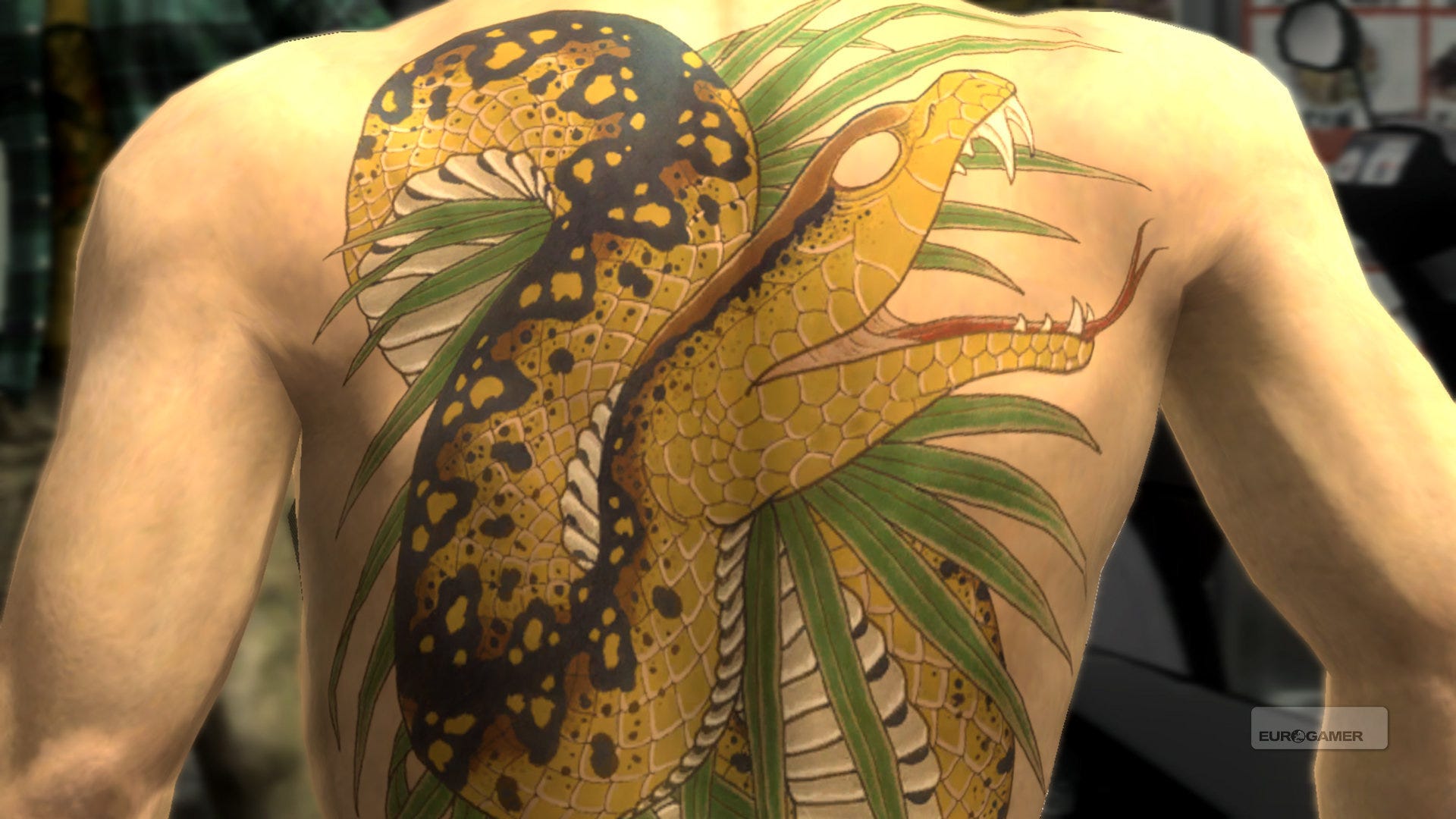
The yellow ink is especially painful, we're reliably informed.

As ever, the game's endlessly convoluted exposition provides a fine and curiously compelling framework upon which to hang accessible beat-'em-up encounters. For more than 20 hours you'll happily smash an endless supply of goons in the mush in increasingly elaborate fashion, gaining new moves and narrative insight into the bargain. It's a compelling formula, despite or perhaps because of its undemanding simplicity.

From the publisher that brought us Streets of Rage, Virtua Fighter and Shenmue, Yakuza is essentially a mashup of all three, which is hardly surprising but does mean it's the stuff of SEGAphile fantasies. Liberally sprinkled with their genius, it's the grateful beneficiary of some of their most satisfying elements, in a context which delivers a uniquely Japanese - and uniquely SEGA - flavour.

In its latest incarnation, though, most of the changes are peripheral to the ultra-accessible two-button-mashing violence at its core. Perhaps the most striking improvement comes as a result of the series' belated arrival on a high-definition platform, with the already lavish production values benefitting enormously from its graduation to PS3. From the moment Kiryu strides up the beach with his intricately etched dragon tattoo in full view, it's evidently a game with an eye for detail.
2

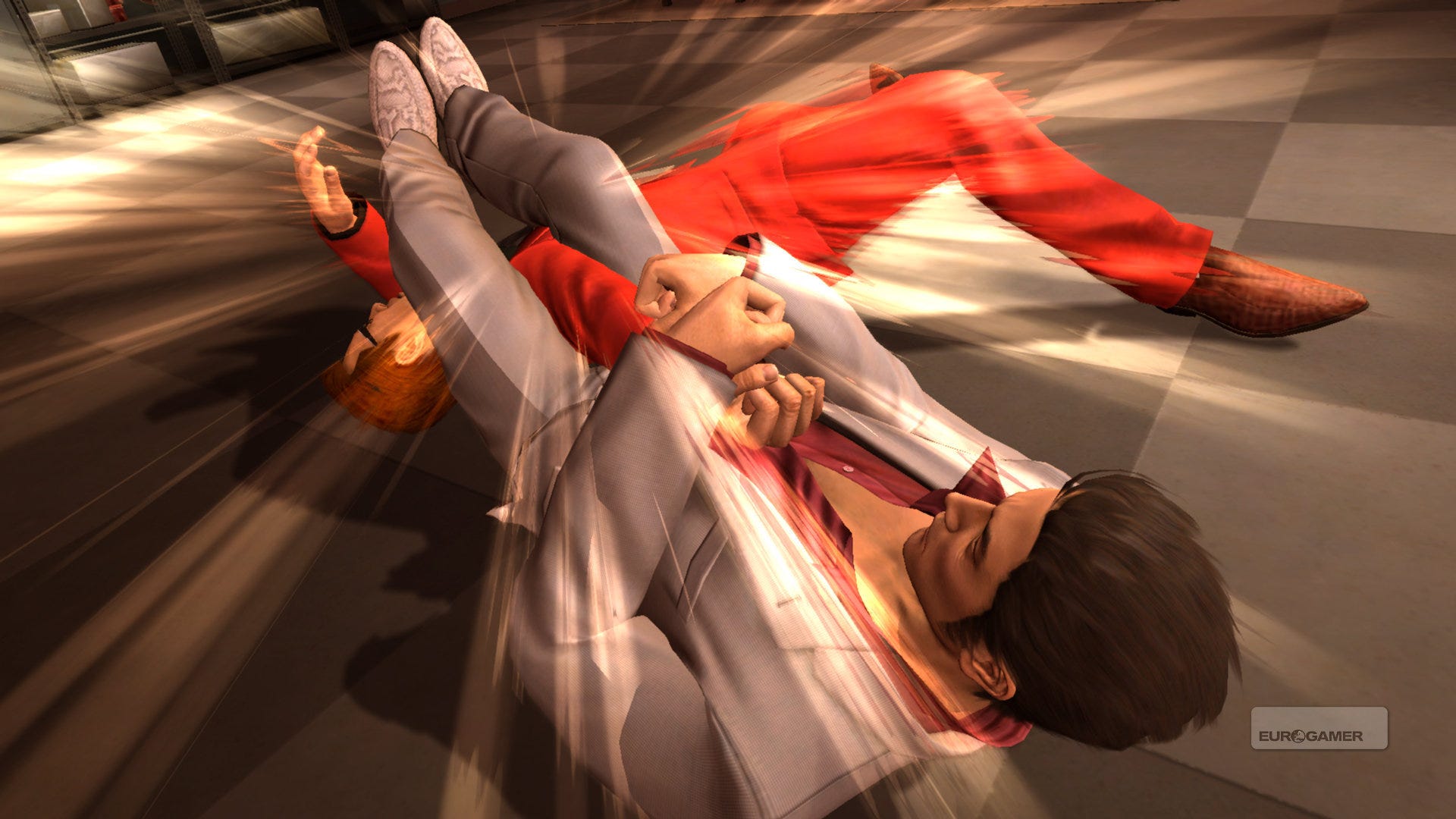
The old arm hump manoeuvre is a winner.

Wandering idly through downtown Okinawa (and, later, Tokyo), the heady bustle combines with a convincing atmosphere of enigmatic inscrutability that accompanies any Japanese urban exploration. Between the dense and narrow layout, mysterious shops and market stalls routinely offer an expansive and exhaustive array of items whose sole purpose appears to be to cater to the eccentric whims of OCD gamers.

Sampling each and every one contributes to the game's exhausting progression requirements, and it quickly becomes apparent that there are no simple shortcuts. Spending an astonishing 295 minutes watching cut-scenes is but one in a long line of extraordinary completion requirements. More than 20 hours, a completed main quest and countless side missions yielded me less than 10 per cent completion.

But if the spirit of the game is to waste as much of your time as possible, then it's just as well that you'll revel in this indulgence. Given how many side quests and mini-games the first two Yakuzas boasted, it shouldn't come as any great surprise to discover even more layered on top, but their presence remains utterly integral to the game's appeal.

In addition to the bowling, arcade games, gambling and the UFO catchers that you'll be familiar with from previous editions, Yakuza 3 beefs up the distraction quotient no end. There's golf, karaoke, darts, a batting cage, pool, fishing, fighting tournaments, card games and other incidental tasks, all of which are built into the missions themselves, so there's never any shortage of peripheral amusements to get stuck into whenever the incessant brawling loses its lustre.

They're mostly designed as throwaway extras, but the game still does a handsome job in whatever it tackles, with simple, intuitive mechanics built into every one of its mini-games, and it also manages to infuse inadvertent humour when you least expect it. Kiryu's steely expression as he casts his rod out to sea, or his impassioned karaoke performances, are sure to be the stuff of gaming legend, while his furious attempts to blog the 'revelations' he discovers via his cameraphone repeatedly drive home the game's adorable lack of self-awareness.

In the main missions, meanwhile, there's a notable attempt to improve the sense of variety. Rather than cram in one linear brawl after another until the inevitable boss encounter, greater attention has been paid to the game's pacing. The emphasis on character development during each of the dozen chapters is particularly noticeable, with numerous missions devoted entirely to dramas at the orphanage, while other sections task you with fleeing from or chasing after assailants rather than battering them into submission. While it's true that certain sections outstay their welcome, this unhurried ebb and flow is something you grow to appreciate.

Inevitably, combat still provides the main thrust of the gameplay, and a few tweaks have also found their way into the otherwise-familiar melee fighting system. A few more Heat moves have been included, while the ability to craft and repair your own weapons helps give you the edge during the really intense encounters. Although at its heart, Yakuza 3 is still the same uncompromisingly brutal mix of punches, kicks, grabs and blocks it always was, with a basic RPG-style experience system underpinning the level and variation of attacks.

3

Drinking too much antifreeze can have undesirable effects.

Although this brand of uber-violence can be supremely satisfying when it's at its most bone-crunchingly brutal, it's not without its foibles. Despite being wonderfully accessible, you tend to get inexplicably locked between opponents' attacks, which still rankles, and fight strategy is limited, mostly boiling down to mashing buttons until you can unleash one of the gratuitous head-smashing Heat moves (although there's still nothing quite like throwing a bicycle at a downed opponent and then jumping full-force at their face).

The problem isn't so much the combat itself, but that Yakuza 3 doesn't know when to leave you alone. Being spammed with random brawls when you're trying to get from A to B is tedious, and if there was a means of switching them off it would be a more pleasurable game to play in general. It's not as if the game's exactly lacking for combat anyway, and with all the extra distractions that have been added the chances are you'll be caught out more than ever by pointless random battles.

What's really likely to irk fans though is SEGA's decision to chop parts from the Western release entirely. Having already admitted that you'll no longer be able to groom hostesses in cabaret bars, it's irritating to discover that you can't engage in the hilarious erotic massage mini-game either, where Kiryu has to keep his rising excitement under control while images of scantily clad ladies waft past.

4

Few men can carry off the upturned collar like Kiryu.

The omission of Mahjong, Shogi Chess, and the Answer X Answer trivia game is hardly a big loss, but it still leaves a bad taste in the mouth, especially given that both previous Yakuza games were translated without ditching any of the more obscure elements of Japanese culture. Maybe poor sales figures in the West for both titles convinced SEGA that it wasn't worth the additional effort.

Still, in SEGA's defence, it has got a point when says there's enough great content to satisfy Western audiences. Even playing through the main missions will take a minimum of 15 hours, while the addition of around 100 side quests easily doubles that tally. Factor in the innumerable additional challenges, and the free DLC bundled with the game, and it will be hard to feel short-changed.

For a game that could well have been overlooked for a Western release entirely, the removal of a few minor elements, while frustrating, is a small price to pay. What remains is a relentlessly enjoyable action-RPG, which offers a unique insight into Japanese culture despite its exaggerations. The Western version of Yakuza 3 might have suffered a few heartbreaking cuts, but it's still intriguing at every turn and shouldn't be missed.

8 / 10

Read the Eurogamer.net scoring policy

Comments (105)

Comments for this article are now closed, but please feel free to continue chatting on the forum!

  • Loading...hold tight!