Version tested: Xbox 360
Boogie Bunnies
- Microsoft Points: 800
- In Real Money: GBP 6.80 / EUR 9.60
Colour-matching puzzle games have always been a regular feature on the videogame release schedules but, in recent times, with the advent of Xbox Live Arcade and the success of the DS, Puzzle Quest and Bejeweled, a perennial trickle's become a torrent. Cheap to make and easy to execute, they require just a couple of tweaks to the formula, a cutesy re-skin and Puzzle Bob's your uncle. Boogie Bunnies is no different in that it boats a couple of headline inventions to mark it out from being a straightforward Puzzle Bobble clone but, perhaps inevitably, these detract from rather than add to the wining formula.
The layout of the screen is similar to Taito's classic, albeit it with the upper part filled by a group of variously coloured rabbits rather than bubbles, all neatly divided into rows and columns. Over time they advance toward the lake at the bottom of the screen and it's your job to stop them falling into the water. This is achieved by shooting new rabbits, one by one, into the furry throng.
Form a group of three or more like-coloured rabbits (either in a horizontal line, vertical line or L-shape cluster) and they'll explode, slowing the rest of the group's advancement toward the bottom of the screen. As the lines of remaining rabbits rearrange themselves in accordance with reverse gravity, filling in the spaces left by their exploded comrades, any resulting three-or-more colour groupings result in a further chain reaction, ballooning your high-score in step with the rodent explosions.
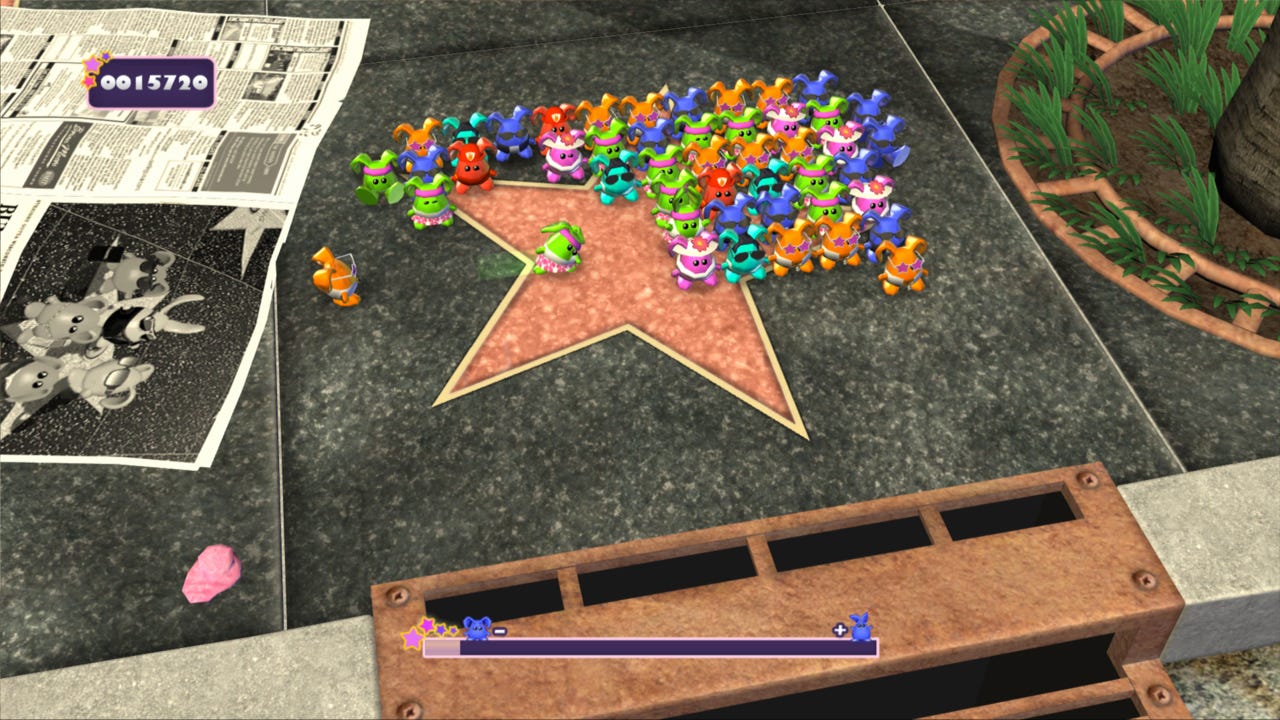
The first and most obvious novelty is that you can move the firing cannon up the sides of the play area as well as along the bottom. By continuing to press left or right your cannon will flip from the bottom onto the side of the screen, allowing you to fire a new rabbit into their number from the sides. This has several ramifications. Now it is possible to destroy groups of three like-coloured animals at the top of the mass (albeit to one side) as well as at the bottom. In a sense this increases the possible number of chains you're able to make at any one point as you're not limited to the X-axis. However it also removes any necessity to carefully aim your missile. Can't make the difficult shot? Simply run it up the sides and slot it into place from close proximity.
The second change to the formula is that the rabbits advance towards the bottom of the screen automatically (i.e. their progress isn't tied to the number of shots you've made like it is in Puzzle Bobble) and that on their way they periodically dance, a feature presumably introduced to justify the alliterative title. While the bunnies are boogying they're worth double points. That's all.
The biggest problem with the game is that it's simple but devoid of real depth. Without the challenge of precision-aiming, it becomes easy to blunder through levels without much planning and the experience is shallow and repetitive for it. Arcade, Classic, Endless and Co-op modes fail to expand the idea enough to warrant the 800 Microsoft Points price-tag because, put simply, there's an abundance of better examples of the genre.
6/10
Discs of Tron
- Microsoft Points: 400
- In Real Money: GBP 3.40 / EUR 4.80
Two weeks after Rez HD provided enough pulsing red and blue circuit-board visuals to last us until the computers rise to power, a Tron spin-off light-cycles its way onto Xbox Live Arcade to join it. Originally released in 1983, Discs of Tron is one of the oldest arcade classics to receive a re-release and graphical update on the service. But while the game's as straightforward and simple as one might expect for a movie licence more mature than many of its players will be, it's also surprisingly enjoyable in 2008's UV-richer light.
The original Tron videogame, released a year earlier than this title, is composed of four game elements based on scenes in the film including Lightcycles, Tanks, and Grid Bugs. The original plan was to include a fifth element, based upon the scene in which Tron faces off against the Master Control Program's chief henchmen, Sark, as a kind of futuristic air-hockey match. The aim of the game was to bounce discs off the wall in an attempt to corner and strike Sark (thereby 'de-rezzing' him), while simultaneously dodging his attacks. What Wikipedia won't tell you is that because the Tron videogame needed to be ready for release at the same time as the movie, this unfinished 'discs' level was pulled, before being completed at a later date following the film's release and eventually promoted as a standalone sequel with multiple levels and its own super-awesome cabinet.
The sit-in cabinet was full of bright neon tubes and angry red backlights that blared every time one of Sark's discs hit you. Control was handled by a trackball in conjunction with a gigantic transparent blue trigger joystick with a red LED thumb button used to deflect Sark's attacks. This control scheme provided perfect precision, something not replicated in the port to analogue stick. Indeed, without all of the physical paraphernalia of lights the Xbox Live experience of the game is certainly diminished, although the revitalised widescreen visuals in this update do a fairly good job of making things interesting.
The core game mechanic is successful. You can launch up to three boomerang-esque discs at any one time (each one must return to you before you can throw it again) at Sark, who will do his best to dodge your shots. Aim is handled by moving a target along a fixed line in the environment, a marker that indicates where exactly your shot will bounce off the wall. As in air-hockey, you must calculate the angles that will most effectively wrong-foot your opponent and, as the game increases in difficulty, use your three discs to pincer him in so that he cannot help but be hit. You soon get a feel for how the projectiles will physically react to different surfaces and multi-tasking the placement of three discs, as well as the deflection of enemy disc is an enjoyable if occasionally overwhelming challenge.
As levels increase in difficulty the area over which both characters can dodge and run increases, giving the game a carefully controlled difficulty. In much later levels these platforms move in the Z-axis too, adding considerable difficulty to what is already a challenging game - especially considering the relative imprecision of the controls. Despite the lacking port, the game is one of the more enjoyable super-vintage titles to appear on XBLA and it's a testament to the core design that its fun hasn't dulled too dramatically in the past twenty-five years. However, even with the updated visuals and some online head-to-head modes, without the impact of a futuristic cabinet the sparse, functional graphics will likely be too great of a disappointment for many younger players to overcome.
5/10
Chessmaster Live
- Microsoft Points: 800
- In Real Money: GBP 6.80 / EUR 9.60
With a decent and well-featured Chess game already included in last year's Spyglass Boardgame compilation on Xbox Live, one has to wonder if there's really room for another one on the service. Usually the answer would be a firm 'whatever', but as this plucky newcomer is nothing less than the latest entry in the esteemed Chessmaster videogame series, perhaps XBLA's commissioning team isn't wasting our time after all.
The Chessmaster games are famed for offering a comprehensive range of AI opponents to play against, each rated on the Elo scale, the official measure by which professional players are ranked via a complex system of levers and maths pulleys far beyond the reach of this correspondent. What we can tell you is that, at full pelt, Chessmaster scores 2,715 on the Elo system, which makes it smarter and funnier than you, bitch.
So, for players who know their Prophylaxis from their Problem Child and who want a chess personal trainer that will build mental muscles and continue providing a meteoric challenge up to and beyond senior master level, this is the XBLA chess game for you. Primarily this is a tuned and augmented version of the 2003 PlayStation 2 game of the same name and it will ably guide newcomers through the entry-level rules and complexities of the ancient game.
No matter what your ability, the game presents a plethora of different AI characters to face off against. These aren't simple name and portrait variations either. AI opponents play in a vast array of different styles: some do everything they can to avoid draws; others neglect pawns or over-emphasise protecting their queen; still more will always try to trade pieces and so on. The game's genius is in recreating the foibles and weaknesses of real-life players. After all, once you've created a chess AI engine that can decimate most of the world's players, the challenge is in creating believable weakness and error. In a sense then, the game's many competitors are all shades, shadows and imperfections of the Chessmaster himself, who sits at the heart of the game, patiently awaiting your arrival.
The game is functionally presented with stark, simple menus and little graphical flourish (although you're able to switch between a 2D board and a 3D board at a flick of the X-button at any point in a game). The chess sets are practical if not beautiful and there's not much in the way of novelty sets on offer here.
Some of the features of the more expensive PC counterpart have been cut - such as the library of historic games and classic opening moves - but it's understandable that Ubisoft would want to distinguish the releases in this way. In addition to the core Chess games there's a huge range of different and enjoyable challenges to play through, as well as timed matches and online play. Indeed, as you receive your own Elo ranking through the game, which can be taken online and shown off, this is about as solid a Chess package as one could hope for on the service.
8/10
Commanders: Attack of the Genos
- Microsoft Points: 800
- In Real Money: GBP 6.80 / EUR 9.60
Much has been made of the Art-Deco style of Sierra Online's 1930s turn-based tactical game. But gamers hoping for BioShock in miniature tanks will leave disappointed: the Midi keyboard soundtrack, clean and sterile environments, half-hearted themed heads-up displays and faux-Japanese character portraits... It's a tonal muddle. Presentation-wise, this is Advance Wars done by a BBC edutainment department, a diluted mélange of conflicting styles that comes across not so much rich and nuanced as insecure and confused, even if its heart is in the right place.
The visual mash-up is, at least in part, thanks to the back-story. Based in an alternate history where humanity cracked the human genome early in the 20th Century and developed a super-race known as Genos, this is a world populated by futuristic technology where the characters that work it are all beige neckerchiefs and Biggles goggles. The game focuses on the inevitable creation-versus-creator conflict as the Genos rise up against their masters in what is a fairly standard take on the genre.
Each of the game's fifteen levels has a set objective, achieved by the intelligent ordering around of friendly units. Each unit under your command has a defined number of points that can be spent on moving around the grid-based level, attacking enemies or capturing bases. The introduction of an action point system (albeit a hidden one) doesn't impact the game nearly as much as one might expect and battles play out in much the same way as orthodox Japanese examples of the genre. Unlike in Band of Bugs (inexplicably the only other turn-based tactical game on XBLA) you move all of your units in one turn before handing over to your opponent, a good move which allows you to build your strategy as a squadron rather than as individuals.
Units fall into the standard light and heavy classes of infantry, scouts, tanks artillery and so on. Terrain affects both defence and movement and, with numerous bonus tokens littered around the levels (granting extra money, health or experience) as well as extra objectives to fulfill, moving your units carefully is of paramount importance.
You also take a commanding officer into the field, a unit that provides both active and passive bonuses to your squadron. Passive effects include the provision of extra defence, damage or healing to units in the vicinity while active special abilities, triggered when a special gauge is filled, provide powerful area-destroying effects. COs are crucial to winning and their loss almost inevitably results in defeat. At the end of each level you're scored on a five-star scale in speed, power and tactics, encouraging repeat play in search of the 'perfect' round.
But while the game is otherwise an Advance Wars clone, somehow it's much less than its inspiration. Perhaps it's the fact the units' rock-paper-scissors relationships aren't so immediately obvious, or the weaker level design or the schizophrenic yet middle-of-the-roach aesthetics, but Commanders: Attack of the Genos lacks character, identity and personality. As a result it's impossible to recommend over its handheld rivals and difficult to even promote over XBLA's more competent and interesting Band of Bugs.
6/10
