World of Warcraft: Wrath of the Lich King Review

Going North.

Few games have been as exhaustively detailed ahead of their release as second World of Warcraft expansion, Wrath of the Lich King. After Blizzard failed to plug the leaks from early testing, it resigned itself to the inevitable and lifted any and all non-disclosure restrictions from the public beta test. The insatiable hunger for information of 11 million fans was just too great a force to resist, even for a company as powerful and protective as Blizzard.

The result was a tidal-wave of detail on wikis, databases, fansites and forums across the internet. Even the five hands-on previews we've published in the last seven months barely scratch the surface. The voracious WOW fanbase seems to have chewed up and spat out this expansion, two years in the making, before Blizzard has had a chance to serve it.

So how come it feels so new?

It really ought not to. This is essentially a four-year-old game, after all, as ubiquitous and familiar and over-exposed as they come in the live-fast, die-young world of videogames. And on the surface, Wrath of the Lich King doesn't seem to be the most adventurous expansion. Compare it to Lord of the Rings Online's Mines of Moria, out this week; it's taken Blizzard twice as long to serve up the same number of levels, half as many new classes, and answer Turbine's game-changing Legendary item system with one percentage-playing profession, Inscription. Oh, and the ability to get haircuts. There's Achievements of course - but LOTRO already had those.
5

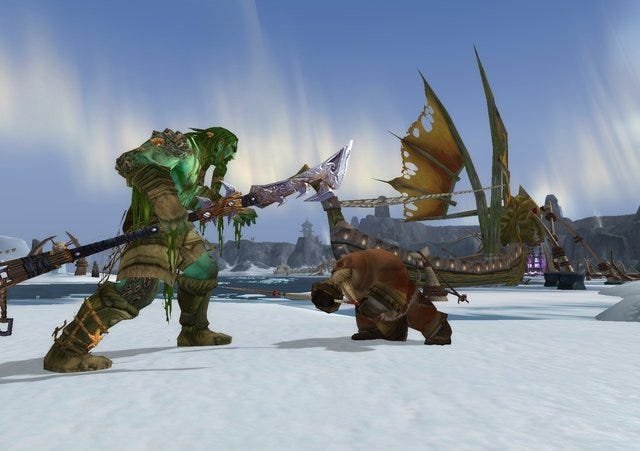
The Tuskarr race are the most lovable new faction.

Wrath of the Lich King ought to be stale - but it inspires wonder. It ought to feel dated - but it makes WOW's newest rivals look clumsy. It ought to seem derivative and formulaic, one step behind the curve - instead, it takes the bar WOW set for quality in MMOs and casually lifts it far out of reach.

Blizzard hasn't repeated the excitable, haphazard and slightly barmy revisionism of first expansion The Burning Crusade. Instead, it has brought to bear every ounce of its legendary perfectionism, craftsmanship and attention to detail. It has made the world's best MMO better, and - here's the remarkable thing - it has done so in a way that works for almost everybody, in almost every situation.

The character classes might be the best example of that. The original nine were always one of WOW's strongest suits. They weren't just great MMO class design, they were some of the best RPG class designs ever: flexible, powerful, clearly defined, conceptually strong, they bounced off each other well and (for the most part) scaled from solo to large group play effortlessly. A few weak or over-specialised character builds here and there, a few useless skills, a few periods in the doldrums for certain classes; it was ever thus in MMOs, to be expected, and a small price to pay for such an excellent line-up.
3

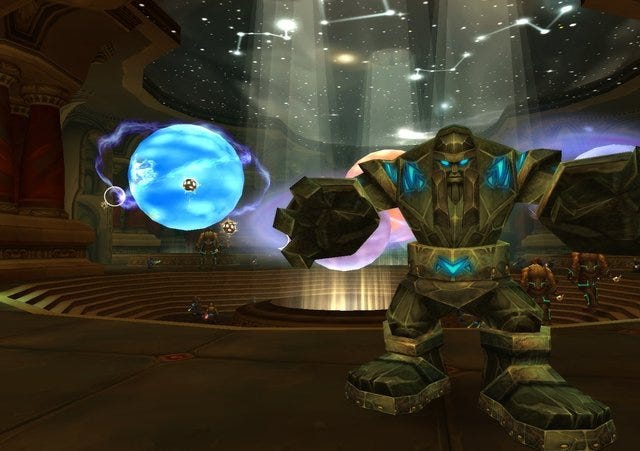
For the most part it's pure high fantasy, but Blizzard indulges its love of steampunk and sci-fi with the Titans.

But it turns out Blizzard thought that price was too high, and its designers have enjoyed a miraculous moment of clarity in Lich King. Restrictions have been shrugged off left, right and centre. Sensational new utility has been added across the board, from fundamental reworkings of the most basic early-level skills to the new top-tier talents and level 70 to 80 skills. Every class, and virtually every build of every class, has been sharpened, empowered and granted one or two logic-defying super-abilities that seem to defy all sense and balance (but don't, naturally).

The most single-minded and dry designs - Protection-spec Warriors, for example - have overnight been granted the same colourful and gratifying exuberance as everyone else. Every class is more fun to play now than it was before, and that's even before you start levelling. It's an amazing, improbable achievement, and it may never be repeated, so enjoy it while you can.

Alongside the classic classes stands the Death Knight. It's a testament to the strength of that line-up that Blizzard has only dared make one addition in four years, and the first Hero Class doesn't let the side down. This heavily-armoured undead warrior is perhaps Blizzard's strangest hybrid yet - magical damage through melee attacks, summoned creatures, and a complex resource system that attempts to combine strategic interplay of skills with a more rhythmic build-and-release style of play. It has no right to work. It does, serving up depth with a side-order of cackling satisfaction. Admittedly, it's something of a loose cannon at the moment, but it will find its place.

Everyone should play a Death Knight, if only for two levels. Those two levels would take you through the introduction to the class, a bravura piece of showmanship, storytelling, and gratifying, villainous excess. It's unusual to find such a perfectly self-contained and satisfying single-session experience in an MMO. It enriches Warcraft's world and Wrath of the Lich King's main story immeasurably, and does so with humour and brevity. It's a perfectly encapsulated taste of what's to come.

It's also a showcase for one of this expansion's least-discussed but most profound changes: phasing. This technology finally allows players to feel like they're influencing events - or at least, feel like they're part of a changing world. What's remarkable is that it does so seamlessly, with minimal instancing or breaks in the experience. Complete a certain quest chain and a whole new encampment of quest-giving characters might appear for you, but be invisible to your friend who hasn't done the same chain - without removing either of you from the underlying persistent world for a second.

The system is not without its oddities, but it's a more integrated and classically MMO approach than, say, Lord of the Rings Online's well-crafted but rigid use of instancing for one-off story events. Story flows smoothly around what you choose to do, rather than forcing you along a set path, and only occasionally isolates you from other players. Villages burn, populations move, characters die, capital cities are attacked or overrun with refugees.

4

The Lich King lords it over Utgarde Pinnacle.

Phasing is used to spectacular effect in two gigantic set-pieces at the heart of Wrath of the Lich King's storyline - the Wrathgate quests in the first half, and the climactic battle for control of the Icecrown zone. These bring all the drama and spectacle of high-end raids to every single WOW player - and then some.

Until now, WOW's very best content has remained the preserve of the raiding elite. Wrath of the Lich King redistributes that wealth of experience to everyone. Every raid dungeon is now open to teams of ten as well as 25, giving a much larger proportion of players a chance of seeing everything in the game. Not just that, but some of the neatest tricks and challenges of raiding, the most sophisticated and rewarding bits of boss design, have been incorporated in the five-man dungeons - which are fewer in number than in The Burning Crusade, but of a higher overall standard (and this from the undisputed kings of dungeon design).

Even the solo player - which, let's face it, is most of us, much of the time - has had the same level of attention. In fact, you might say that day-to-day questing is the most radically improved part of the game. WOW's detractors have often pointed accusing fingers at its doggedly traditional monster-mashing quest design, and not without reason. Lich King is unavoidably built on the same foundations, and if you never again want to be collecting random animal parts for some bitch's brew - well, you're out of luck.

2

Naxx is back, baby. Naxx is back.

But the overall experience is a universe away. Burning Crusade improved the variety, density and reward of quests several times over. Lich King does it tenfold, adds more interesting enemy designs into the mix, and then weaves the quests together into eventful, entertaining, coherent and beautifully-paced pockets of adventure, studded with memorable characters and opportunities to break out of the grind, cut loose and have fun. One minute, you're using a mind-controlled abomination to pull ten enemies at once, and kill them in a single explosion; half an hour later, you're manning a cannon, shelling an angry giant from the deck of a pirate ghost ship.

Grinding isn't supposed to be this much fun. Where's the masochistic slog that MMO fans - gaming's hair-shirted, hard-working puritans - so love to hate? Consigned to the bin where it belongs, and replaced with a lavish, Catholic banquet of entertainment. Halfway to 80 - if that - and you'll already be looking forward to bringing another character through Northrend to do some of what you missed.

Time and again, you'll find things simplified and made more coherent, barriers lifted, makework removed. The Burning Crusade's labyrinthine and perplexing system of faction reputations, for example, has been streamlined. The ability to start a Death Knight at level 55 on any server, as long as you have a character of that level or above, grants every player a shortcut to join friends and a chance to try a different class in condensed form.

There is just one feature of Wrath of the Lich King where this isn't true, and it's no surprise that it's related to what's always been WOW's weak spot: organised, open-world player-versus-player fighting. You know, the "war" bit in Warcraft, lately superseded by the strange sporting subculture of Arenas.

Blizzard's attempt to revive this moribund aspect of the game - under intense pressure from its belligerent new rival, Warhammer Online - is Wintergrasp. This dedicated PVP zone sees one side attempt to take a fortress from the other every couple of hours, by fighting first for control of workshops to make siege engines and other vehicles. There are also opportunities for skirmishing in the lulls between battles.

A pitched battle in Wintergrasp is dramatic and fun, and the system of rewarding players for contribution to the battle with access to better and better vehicles is satisfying. But it's involved, initially a bit baffling, and was imbalanced and buggy even in the very final hours of the beta test. Resting the future of world PVP on a single, large-scale and intricate project is a gamble to say the least, especially when large numbers of players are needed for it to be at its best.

6

The fortress at Wintergarde. Alliance cowards cowering within: not shown.

It doesn't help that much of what makes Wintergrasp great is available instantly and more straightforwardly in the new Strand of the Ancients battleground. Hopefully the promise of extra dungeon rewards for the winners' entire faction - plus the chance to pilot those tasty vehicles - will motivate players to get involved in Wintergrasp.

Or maybe the pursuit of Achievement points will. Blizzard's implementation of the must-have feature of late-noughties gaming isn't terribly imaginative, being, by and large, a slightly refined version of Xbox 360's. But it's the design of the Achievements themselves that counts, and here Blizzard has done an excellent job, tempting players step-by-step into epic treks into those backwaters of WOW they might not have explored yet - the fishing profession, perhaps, or seasonal events. With these superb Achievements, a grand new meta-game has been added on top of WOW's actual endgame, and you should never feel like you have nothing to do.

That feeling is some way off, though. Between you and it is Northrend, which is, by a comfortable margin, the greatest game environment ever created.

Blizzard's artists and world-builders are the best. They were the best in 2004. They're still the best now. But it's inconceivable how much better at their craft they've got in the last four years. With Burning Crusade's Outland, they ran riot, creating a gasp-inducing, lurid patchwork of science-fantasy that entertained, but was as fragmented as its shattered planes of rock, as removed as the space that surrounded it.

1

Strand of the Ancients - siege vehicles in a turnabout game of base-defence.

Northrend swaps madness for lyricism, spectacle for heart-wrenching, melancholy beauty. Its vast zones have been sculpted with infinite care around the non-linear flowering of the quest lines. They have tremendous variation and density of detail, stunning vistas everywhere you look, impressive architecture, and an eerie, haunting quality that will be familiar to anyone who's visited our own far North, be it Iceland, Siberia or the Canadian Rockies. Even the skies, lit with shifting veils of aurora, are enough to make your hair stand on end (assisted by the atmospheric musical score). It is classic fantasy.

All of this is delivered to you via a dramatic graphical upgrade. Increased draw-distance has a huge impact, making the pull of exploration even more irresistible. Lighting, shadowing and the quite magical effects have been brought bang up-to-date - visually, WOW has always been carried by its superlative art, but now that art has the frame it deserves. But it's Northrend's people and creatures that leave the strongest impression; they are strikingly imaginative and charismatic, and far more detailed in appearance and animation than anything in WOW before. They bring this perfect world to life.

Wrath of the Lich King takes the best-of-breed MMO and improves everything about it. It's a work of supreme confidence and quality that is twice as fun and ten times as beautiful as classic WOW, not to mention anything else in the genre. But above all else - in the breathtaking sweep of Northrend, in the assured, epic storytelling, in the constellation of brilliant quests - it is a grand adventure. Perhaps the grandest adventure in all gaming. In every sense, Azeroth is still the place to be.

10 / 10

Read the Eurogamer.net scoring policy

Comments (134)

Comments for this article are now closed, but please feel free to continue chatting on the forum!

  • Loading...hold tight!