Unlike most other games, MMOs change over time. Audiences grow or shrink, features are changed, interfaces are overhauled, game balance is adjusted, new content and play styles are added, communities thrive or die. A review of an MMO can't be set in stone. So, on Eurogamer's new MMO channel, we'll be regularly re-reviewing the games to let you know the current state of play, and to help you decide whether it's time to jump in - or time to leave. Here's the first of these, about the biggest game: World of Warcraft.
Talk about the elephant in the room. It's impossible to discuss MMOs at the moment without talking about World of Warcraft. It dominates almost every conversation, and lurks, a leviathan-sized subtext, under the surface of all the others. Its unstoppable and truly global success - that imposing, 10-million-subscription bulk - acts as both carrot and stick. WOW lures rivals into MMOs with the promise of riches beyond their wildest dreams, before the seemingly insurmountable challenge of taking it on drives them away with their tails between their legs.
In the circumstances, it's easy to be cynical, or even resentful. It's easy to characterise Blizzard as calculating and exploitative pushers and slave-masters. It's easy to gripe about the game's grind, its cheerfully cheesy fantasy schlock, its lack of high-concept innovations, its broad and sometimes basic populism.
None of that holds water. World of Warcraft is the biggest because it's the best - by far, on both counts. And although sceptics, lapsed addicts and rival developers won't want to hear it, it just keeps getting better.
WOW might have made Blizzard stupendously rich and powerful, but it hasn't made it complacent. Its maintenance of the game goes far beyond tinkering under the hood and bolting on new features. Its drive to improve every aspect of the game experience is tireless.
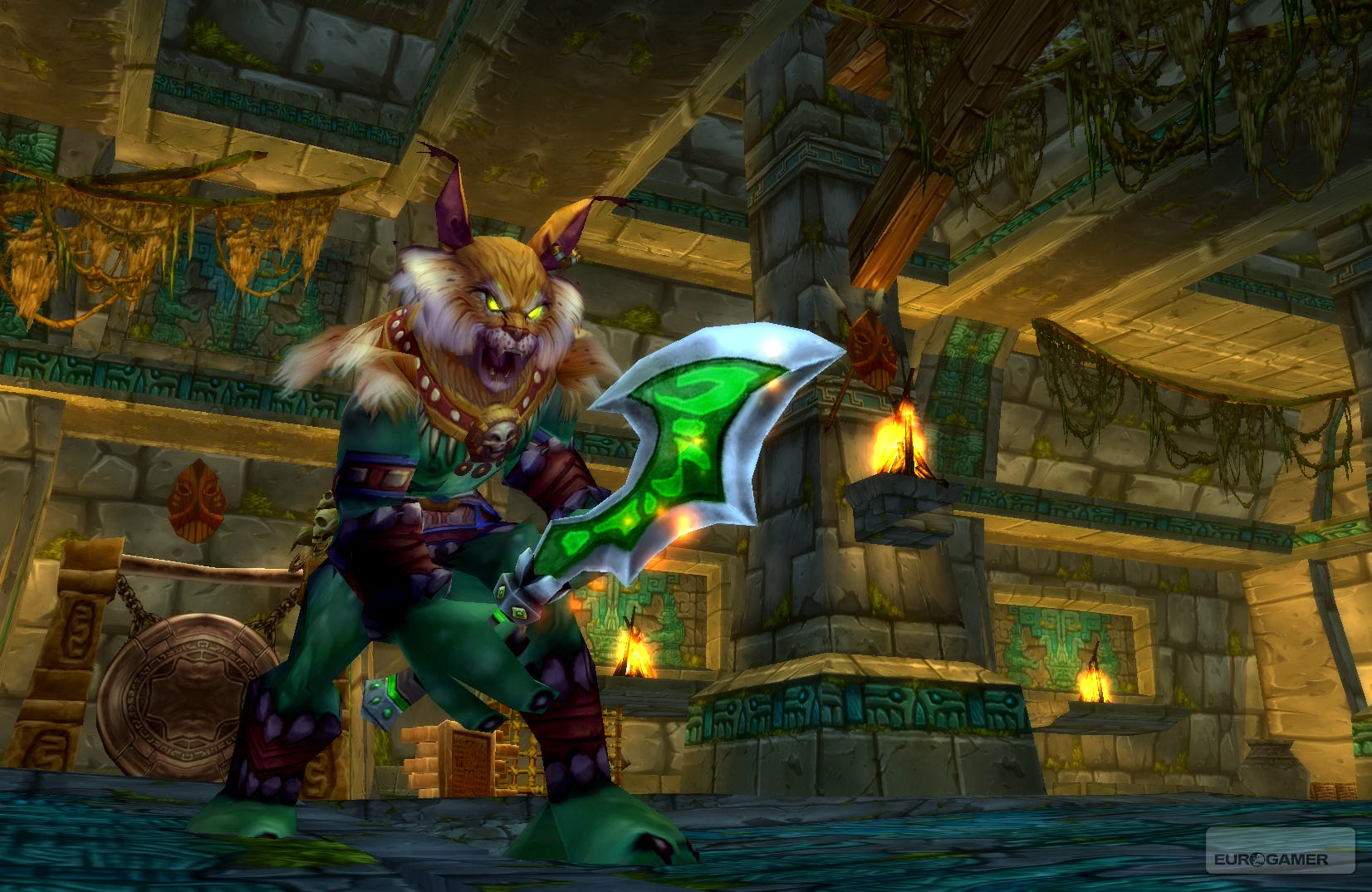
Now you wish you'd picked Conjure Whiskas in the talent tree.
In November last year, Blizzard rolled out an update called The Gods of Zul'Aman, known to some as Patch 2.3. The title refers to the addition of a new dungeon in which ten max-level players can take on the barbaric jungle trolls and their animal gods. But behind this tasty morsel of fresh adventure lay a sweeping revision to the game, the second such revision inside a year, just ten months after the release of first expansion The Burning Crusade.
Crucially, The Gods of Zul'Aman increased the speed at which characters level up between levels 20 and 60. Sound like a simple adjustment of some sliding scales? Well, it is, but its effect on the game is profound. Much of WOW's success is down to the heady rush of its first 20 levels, when power and skills and possibilities are channelled to the player in a constant, intoxicating stream. Round about the mid-20s, that stream used to dry up.
The game became an epic, heroic slog, with thousands of in-game miles to travel between disparate, sparsely populated questing grounds and disjointed storylines. Real confusion and lack of direction set in around the mid-30s, and the game didn't regain its focus until level 50 approached, and the original finishing line appeared on the horizon. It still worked - and provided you with plenty of amazing sights and adventures along the way - but you needed stamina and determination to make it through, and not everyone did.
That's all changed. For new players - and the high percentage of max-level players who like to start new characters to try out the game's enthralling selection of classes - that initial rush now never stops. If you make use of Blizzard's masterstroke innovation and keep your character "rested" - allowing you to level at twice the speed if you play less, provided you log out in an inn or capital city - you can make a new level every time you turn the game on and play for a couple of hours, right the way up to level 40.
Not only is the reward faster and sense of accomplishment greater, you can also afford to be more selective in your questing, skirting some of the hoarier grinds and longer-distance schleps. The levelling speed has caught up with the number of quests in any particular area, meaning you can be less distracted, allowing yourself to get sucked deeper into the atmospheres and storylines of areas you specifically enjoy.
One of these will now probably be Dustwallow Marsh. A cloying, treacherous swamp for level 35-40 players, notable for its stand-offs between the game's factions - clean-cut Alliance and hardscrabble Horde - it's been substantially revamped in Gods of Zul'Aman. A new neutral town has been added, along with a lengthy quest line involving two new enemy encampments, and some bizarre, Burning Crusade-style steampunk/sci-fi shenanigans at a zeppelin crash-site.
The aim was to plug one of the more barren questing gaps in the progression through the game, and revive an overlooked area. As much as the Marsh needed it, it still seems like an odd choice: the new quests arrive a little later in the levelling curve than you'd like, and it's a tough area, thickly populated with wandering monsters and crossed by unsafe roads. It pays off, though, providing a satisfying crescendo as you approach 40. In keeping with the Burning Crusade philosophy, group quests have been made solo-able, the rewards - whether cash or equipment - are significantly tastier, and the storytelling is far stronger, with more dynamic, memorable quest design. There's more incident, more humour, the world and its NPC inhabitants seem more interlinked and alive.
Audio track: Sid Vicious sings the Bear Necessities.
As was the case with the addition of Outland and the new starting areas for Blood Elf and Draenei in The Burning Crusade, it's so much better that the contrast with the original game is almost a problem. Older areas can feel mean-spirited, while newer ones seem like an embarrassment of riches where simply sneezing at a couple of weak monsters earns you a pile of gold and an awesomely ridiculous pair of barbed shoulderpads. In truth, the game's now pitch-perfect pace and more solid sense of context vastly improves even the slightest of the original zones. Meanwhile, complaining that new zones are too easy, rewarding and fun can only be the crazed bitterness of a veteran of WOW's lean times.
Gods of Zul'Aman also contained a second revolution, as profound as it was quiet. A handful of apparently simple changes to the game's interface have drastically overhauled its usability. Quest-givers are clearly marked on the mini-map, there's a drop down menu allowing speedy searches for certain vendors, trainers and important resources, while quest and gathering items in the world now have a subtle glow. These and a number of other blissfully welcome tweaks have eradicated countless hours of frustration and wasted time, and made it far less overwhelming for new players.
It's still a long, long road, of course, but progress along it is effortless now. That's also thanks in part to the game's community. WOW's enormous popularity and accessibility to younger players was certainly a mixed blessing in its early days, with chances high that you would end up grouping with catastrophically clueless, rude and illiterate adventurers. Although the servers are certainly still thriving, the game's audience has matured along with it. Its player base is now much more knowledgeable and social, and grouping with randoms to run a dungeon is more often than not a pleasant exercise in slotting into each other's groove.
If there's a downside to this, it's that WOW's social side can these days seem a little businesslike, a touch mechanical. Almost everyone is polite and capable, almost everyone knows the game inside out, and almost everyone seems engaged in a ruthlessly efficient race to the finish line. The riotous, chaotic amazement of the game's first year, when the world discovered WOW and ran amok, has abated. And, just as it ever was, this slight chill is at its sharpest when you reach maximum level.
Blizzard has bent over backwards to offer more options to level 70s than were available to 60s in the original game: fresh dungeon challenges for teams of 5, 10 and 25 players, the "heroic" difficulty setting, the Arena system for player-versus-player combat, and most notably the new, repeatable daily quests, which mean that even diehard solo players always have something to do.
The balance of power among the highest echelons of players seems to have swung from large raiding guilds to small arena teams. This bodes well for WOW's forthcoming move into eSports, but you can argue all night as to whether it actually makes the endgame more or less accessible (the organisational demands are lower, but the subculture is arguably even more intimidating).
But despite this tremendous effort on Blizzard's part, the silent majority of players will still find that WOW's dynamism inevitably ebbs away when that sweet, sweet levelling stops. It's an inescapable product of the game's greatest strength: World of Warcraft is all about the journey.
Like Easter Island, but it takes longer to get there.
It's about exploring what must surely be the greatest gameworld ever created, an impossibly rich, vibrant, varied universe stuffed with beauty, soul, high drama and low humour. It's about drinking in the spectacle and the detail - although technically undemanding, WOW is still one of the best-looking games on PC and far more visually exciting than most other MMOs (thanks to the Blizzard's world-beating art staff, who could imbue four polygons with more personality than the entirety of some lesser online worlds).
It's about discovering the myriad idiosyncrasies of your chosen class or classes: the gradual dawning that even the most basic archetypes, from healer to warrior, have been embellished with countless opportunities for hybridisation, flexibility and subtle interplay with other classes. And it's about doing all this unimpeded by the game's interface and presentation, which are as slick and accessible as you could wish.
WOW doesn't just dominate the MMO landscape because it's the proverbial goose's golden egg. WOW dominates because, in pure quality terms, it's in a class of its own. Blizzard is constantly working to keep it that way, to improve not just on its weaknesses (the grind, the endgame) but its strengths (the interface, the world-building). It's made huge leaps forward on all those fronts in the last few months alone, and as a result, WOW is an even more inviting prospect for new or returning players than it ever was. It is, in short, a masterpiece.
10 / 10
