At 60 years old, Dave Gibbons has been writing and drawing comics for over half his lifetime. From his formative years working on British institutions such as 2000AD and Dan Dare, Gibbons became best known for his collaboration with Alan Moore on the seminal 1980s graphic novel Watchmen, which single-handedly legitimised a medium previously dismissed by mainstream culture as childish.
In the early 1990s Gibbons was invited to dip into another ostensibly immature medium, that of videogames, by way of a collaboration with Charles Cecil, founder of Revolution Software. Together the pair fronted the creative direction of one of adventure gaming's most enduring point and click classics, Beneath a Steel Sky.
Now, 15 years later, the pair has regrouped for last week's release of Beneath a Steel Sky: Remastered onto iPhone. Eurogamer met with both men to discuss the parallels between their chosen mediums, and to pick over at the past, present and potential future of each man's work in his respective field.
Eurogamer: How long have you been friends?
Dave Gibbons: It's been a long, long time - in fact someone sent me a photo today of Charles and I from... was it 15 years ago Charles?
Charles Cecil: It was. Frightening.
Dave Gibbons: In the interim our hair has receded while other things have grown, but I think we must have known each other for probably the best part of 20 years.
Charles Cecil: I got in touch with you when I was at Activision and I left that company in 1989/1990, so yes, about 20 years. Our friendship came about because I was a great fan of Watchmen and thought it would be great to work with Dave in some capacity. Soon after I approached him the old Activision collapsed leading me to found Revolution. I've maintained a friendship with Dave ever since.
Dave Gibbons: One of the things I've always loved about comics is that you get to collaborate with like-minded people who share your enthusiasm. It's really the best way in the world to try and make some money. In Charles' people at Revolution I found that a group of dedicated and enthusiastic, and so I was immediately attracted to that.
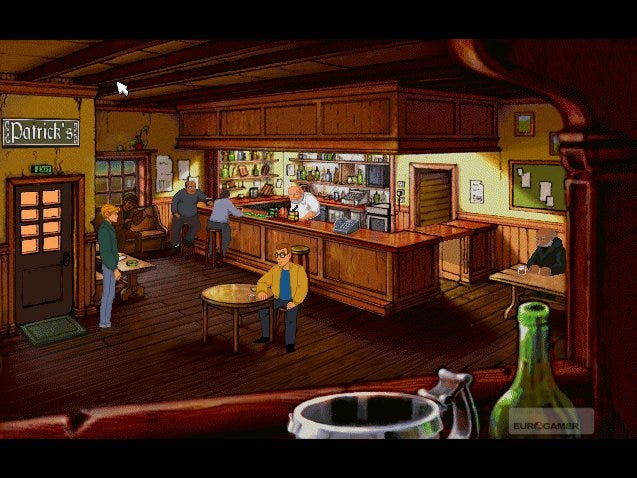
Eurogamer: Dave, how did you feel when you first got that offer to work on a videogame? Were you interested in videogames at the time, or did you view them with disdain?
Dave Gibbons: Well, my son at that time was probably about 10 years old and I brought home a computer thinking that I would do the accounts on it, or whatever it was we thought we'd use computers for back then. But in reality I'd spend most of the time looking over his shoulder or playing things like Harrier Attack on the Amstrad.
Although they were only in their infancy I could see that games were going to become something super interesting and just the kind of area where someone with my skills in drawing, writing and conceptualising could prove useful. So I was really pleased to be able to get a toe in the water when Charles called me up
Eurogamer: What do you remember about the time you were both working on Beneath a Steel Sky?
Charles Cecil: I think it deeply scarred you didn't it, Dave? That trip from London to Hull and back...
Dave Gibbons: Yeah, it was a long old haul up to Hull, but as I say there was a lot of enthusiasm between us so we'd have a chat, then have a bacon butty and then have another chat and I'd get back on the train and go home. We used to do a lot via fax machines and things. I don't think at that point we were emailing artwork and stuff backwards and forwards, so I guess compared to today, it had a sort of wild frontier feel about it.
Charles Cecil: Faxes were quite cool in those days though weren't they - it was pretty advanced to have a fax. In fact, we actually did have a modem. The problem is that you had to phone up the person that you wanted to send a file to and agree on speed and ports and all that kind of stuff. It took about an hour to get the whole thing set up.
Dave Gibbons: I can remember actually doing designs on some of the sprites on an Amiga using Paint and assembling them pixel by pixel; I mean it was a really archaic way to work, but it was good fun and we thought we were the future...
Eurogamer: How did it compare to comics in terms of the way that you were working at that time? Was it restrictive or liberating by comparison?
Dave Gibbons: I was called in to provide illustrations and also to have creative input so I got to provide suggestions for the story and the look of the characters. So it was much like the best parts of working in comics. You kind of throw your ingredients into the soup and people throw theirs. It was a very creative experience and looking back it was a very enjoyable time.
Eurogamer: What do you think is the key differentiator between the two mediums in terms of storytelling? Are there things you can achieve in one medium that you can't in the other?
Charles Cecil: I think that videogames have a lot that they can learn from linear mediums. It's often said that they are quite different and that game makers shouldn't be trying to create films or remake comics - and I completely agree with that - but we shouldn't discount finding inspiration from other mediums. When you write a story for an adventure game it's different to most mediums. In games the chunks of narrative effectively reward successful interactions and set up the scene for the next section of gameplay.
If you think of a first-person shooter, it really is pretty much a linear story, with gameplay interstitials. Conversely, in an adventure game you ideally want to build the puzzles around the story and vice versa. Puzzles should be relevant so that when you solve them, something logically moves forward in terms of the plot. That requires the designer to mould the story and the gameplay closely together - to interweave them. But beyond that consideration, an inspirational linear storyteller like Dave can offer an enormous amount.
Dave Gibbons: It's also important to have a really strong visual identity. In all of the comics that I have drawn, from Watchmen, to March to Washington, I've tried to give them a really distinctive visual identity. The recent trend in games has been towards very realistically rendered 3D visuals but I actually think this is a blind alley. I personally find things that are done with a little bit of stylisation, and a bit of control, more interesting than just somebody who is trying to approximate bad reality, something comics excel at. So I think that both media have a lot to offer one another.
Charles Cecil: I completely agree. Clearly games like the sports simulations are now so realistic that they are well to the right of the uncanny valley, but for many many other games that try to look realistic but don't quite pull it off, there's a very off-putting appearance. As a result, I've always aimed to write games that are believable but not especially realistic, firstly to avoid the uncanny valley, but secondly because it allows you to express something visually more interesting than reality.
Dave Gibbons: The strength of comics is that readers approach with an expectation that they'll have to suspend their disbelief: in real life people don't have outlines, they don't have word balloons floating above their heads, so you know in any comic book everyone acknowledges you're presenting a story in a stylised way. That approach translates equally well into games and I think that people actually like seeing reality through someone else's stylised vision. Games shouldn't shy away from that. Actually, Arkham Asylum is actually very good in that regard. I like the stylisation...
Eurogamer: The similarities between the early days of comic books and these, the relatively early days of the videogame medium are striking: both mediums struggling to find widespread acceptance or to be viewed as anything more than childish distractions. Dave, as someone who was partly responsible for one of the great legitimating comic book works of the 20th Century, what do you think it will take for videogames to gain a similar kind of acceptance?
Dave Gibbons: Well, I'm actually a bit torn on this, because when I was growing up I liked the idea that adults disapproved of comics; it gave me and the other kids our own kind of private world which was concealed from adults, and I think that, to begin with at least, that's been the case with videogames. Grown-ups didn't quite understand, like it was like a sub-culture, and I think it's almost a shame when a medium loses that in the struggle for acceptance.
That said, my son is now 30, and still plays games, and the games have become more sophisticated. He plays a lot of stuff online, something that engenders the same kinds of feelings as sports do. So I think they will find their own cultural level soon enough. Also, I think that a game is not only as good as the people who designed it, but also it's only as good also as the people who play it. As the audience evolves, so games will evolve and become accepted in a way that people in their sixties and seventies today are passionate about The Beatles or The Rolling Stones, acts that were culturally looked down upon when they were teenagers.
Charles Cecil: I agree with Dave - I think it's rather nice to be considered sort of irreverent, particularly amongst people who one doesn't hold in high regard, not to mention any particular politicians or newspapers... At the same time it's absolutely vital that we are responsible, of course, but to be viewed with suspicion by a large proportion of the population who don't get it is perversely pleasing
Dave Gibbons: What it comes down to is that there is good entertainment and there's bad entertainment. There are some comics that I read when I was a kid that do look kind of trashy now. But there are some that I read that actually stand up very very well. I like to think that, in a very convenient way, this brings us back to Beneath a Steel Sky, as it seems to be one of those games. You know it was state of the art 15 years ago but it still looks really good today and is just as good a game as it ever was.
Eurogamer: So you are both confident of Beneath a Steel Sky's contemporary appeal to gamers?
Charles Cecil: Very much so. There's so much excitement about the game, obviously partly from people who played it the first time around and loved it, but also a real groundswell from people who didn't play it 15 years ago. As a result I am confident of its appeal. One of the things that players will very quickly realise is that this is absolutely not just a quick port. We spent an awfully long time honing the game and adjusting it to fit well within the context of this particular platform. Part of the reason we've been able to do that is we don't have publisher who has funded us: we've been able to self-fund and through that control the development and timing of the release. It's been extraordinarily liberating.
Eurogamer: What videogames did you both enjoy when you were growing up?
Dave Gibbons: They didn't exist yet! Actually, I used to like the obvious classics: Pong, Space Invaders and so on. But the game I was particularly fond of was Harrier Attack, a little L-Shaped set of pixels flying over some other little pixels, that was supposed to be a harrier jump jet taking on the Argies in the Falklands War. I completely believed that. Even before we owned the Amstrad CPC my son had a wooden-effect Atari where, in a similar feat of suspense and disbelief, three little red pixels and two blue pixels represented Superman flying over Metropolis. I look over my son's shoulders when he's playing things on Xbox today, and I'm blown away by where games have progressed to.
Charles Cecil: I played an awful lot of Galaxians growing up. Then I discovered R-Type, which is just such a great game, isn't it? To me that's the pinnacle of the side-scrolling shooter genre; everything about it's just brilliant,. I remember when I was at Arctic Computing in the early eighties when we saw Impossible Mission come out, and that looked so beautiful and fabulous. I don't know, there were so many games I got hooked on. I nearly broke up my marriage over Warcraft 2.
Dave Gibbons: You're obviously not a serious gamer, Charles, or the marriage would have had to go...
Charles Cecil: Ha! More recently I thought the first GTAIII was just extraordinary in every way. The thing about having been in the industry for 30 years is the pleasure of being astounded again and again as new things come through: new gameplay ideas, amazing visuals, astonishing audio. I feel sorry for younger people because they take it all for granted. They don't realise quite how extraordinary it all is, because they haven't been through the evolution we witnessed.
Dave Gibbons: I think technological evolution is a wonderful thing - just as in comics we've had better printing methods, computer colouring and higher-grade paper, things that really do make a difference to the experience. But even so, I still feel that the quality of the story and the narrative is what actually sells comics, so it's really interesting for me to see that parallels between the two media that started off rough and ready, but are really becoming more sophisticated in appearance, but have the same heart beating at their cores.
Eurogamer: Do you think that technology has sometimes distracted from the more crucial elements to comics and games, that people have been sold on that rather than what really makes the creations engaging?
Dave Gibbons: Of course producers and artists and consumers are all seduced by the latest gizmos, the latest wonderful rendering techniques and so on. But I think after a while, once anything is possible, it falls within the remit of the artists and the writers to express their vision in the way they want to, rather than merely the way that is fashionable at the time.
Eurogamer: As someone who's recently been involved in a high-profile comic to film adaptation in the Watchmen, how do you feel about videogame to film conversions? Why do you think they, at the moment at least, tend to be weaker than comic to game adaptations?
Dave Gibbons: Well I think the raw material of games is further away from a movie. Conversely, a lot of comic books are similar to movies in their structure and length. That said, if you've got strong enough characters with strong enough motivations, and interesting things at stake, then there's no reason why stories can't move between the different media.
Charles Cecil: One of the things that we are weak in games is creating empathetic characters; something that's bread-and-butter necessity in terms of the linear mediums. When you write a game based on a comic book/film/TV, then you can assume that the person that plays that game knows and can empathise with the characters already. You cut short the need to artificially build empathy between viewer and character. I think that's why computer games based on other linear properties often work a lot better than the reverse, because you're playing to your weaknesses.
Dave Gibbons: It seems to me that the characters that you play in a video game are often empty containers for the player, rather that being fully rounded. They essentially go through the motions for you, and to that degree they are less developed because they have to fit with a huge range of different possible gamers.
Eurogamer: Have you guys been talking about working together in the future?
Dave Gibbons: Have we Charles?
Charles Cecil: Yeah, Dave and I would like to work together again and we are coming up with new ideas. I very much hope that the next title we come up with will be a joint adventure game created between the two of us.
Eurogamer: What new elements are there in videogame design that might influence an approach to, say, a hypothetical Beneath a Steel Sky 2?
Charles Cecil: Well, the audience has changed dramatically. When we wrote the game originally players loved puzzles that stopped them in their tracks. They would go away to think the puzzle over and the next morning settle on its solution. Contemporary puzzle games don't work like that so what we've done in our most recent titles is to add hint solutions. They work extremely well because those players who want to really headbang are free to, while those who just want to play the game with in-game support can do so without becoming frustrated. Certainly any game we make in the future will balance avoiding frustration with creating a challenge.
Dave Gibbons: It's much the same as in comics - it's always easy to please your core audience. The real challenge is to create something that is good, is not condescending and yet still reaches out to a wider audience. We've got an enormous opportunity with a platform like the iPhone to reach a huge audience and to entertain them in ways and in places that haven't been possible before.
Charles Cecil: What is exciting is that in the past few years the hobbyist gamers will obviously play the hardcore games but will also play the more casual games too, whereas the casual gamers won't play the hardcore games. But now the casual gamers are growing up they are becoming bored of just matching gems, finding hidden objects and so on. They have learned the grammar of gaming and want to advance. And I know that a lot of the casual game publishers have identified adventure games as a direction in which their audience will go. We are ideally positioned between casual and hobbyists I think.
Beneath a Steel Sky: Remastered is available on the iPhone and iPod Touch now for £2.99.
