Way of the Samurai 3 Review
Ronin on empty.
Version tested: Xbox 360
Making rice cakes. Bribing a cat. Finding an old lady's knickers. Spanking a radish thief. These aren't the sort of things you expect in a samurai game, but you find yourself performing a lot of bizarrely inconsequential tasks in Acquire's disappointing third entry in its cult series of flexible feudal narratives.
You're a mysterious ronin, a masterless samurai looking for purpose in Amana province during the turbulent Sengoku era. Drawing, as always, from Kurosawa's Yojimbo, the game drops you in the midst of a power struggle between two warring factions. On one side you have the Fujimori Clan, powerful and corrupt. On the other, you find the Ouka Clan, a roughshod gang of outcasts trying to overthrow Fujimori.
Trapped in the middle are the inhabitants of Takatane village, a peaceful farming community taxed to the hilt by Fujimori and brutalised by Ouka bandits. It's up to you whose side you want to take, depending on who you talk to, how you react to key events and which jobs you choose.
As with the previous games, this is a game you can finish in a couple of hours. Completion isn't really your goal though, at least not in the singular sense. There are 21 different endings to be found, depending on how you align yourself with the different factions, as well as dozens of swords and spears to earn, upgrade and master.
Start a new game from a completed save and you inherit all the weapons, items and money you accrued, as well as unlocking new abilities based on the Samurai Points you were awarded for honourable behaviour. Every time you find a different path through the story, you're stockpiling for the next.
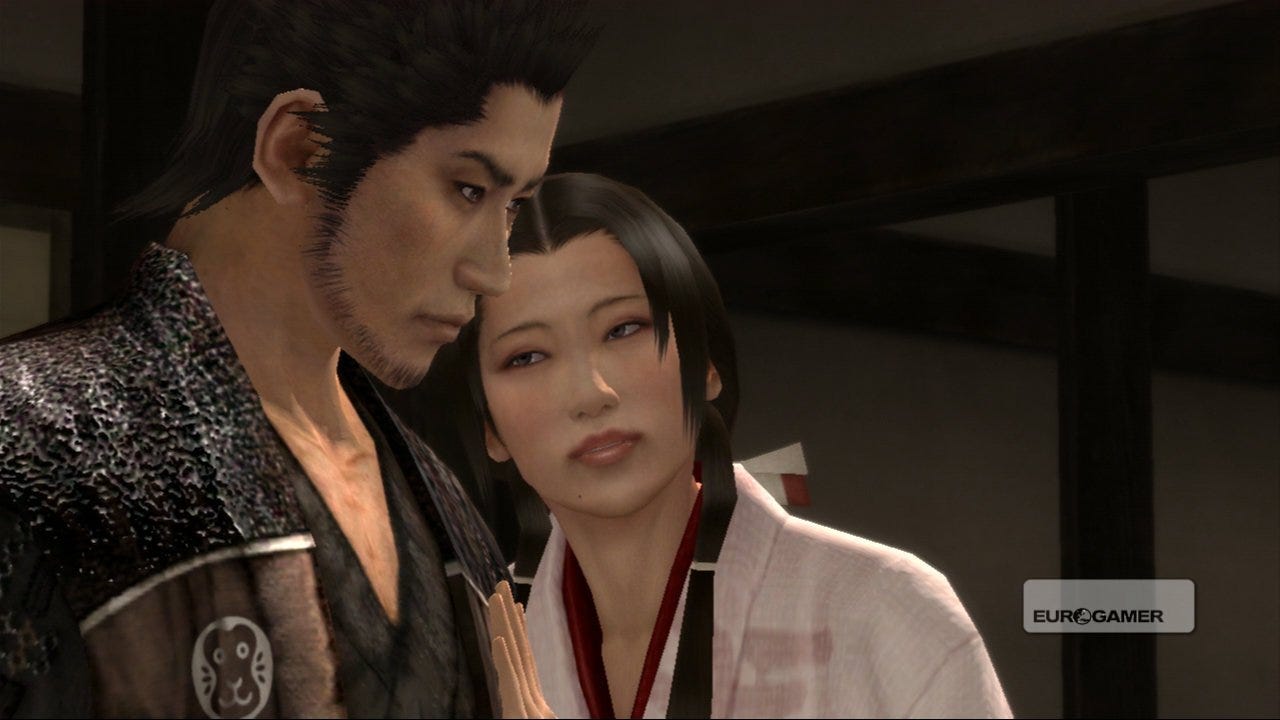
You can now form relationships with companions, but the idea is never integrated into the gameplay.
To begin with, the lack of handholding is liberating. Not just for the way it allows you to roam and discover the stories for yourself, but for the freedom it gives you in regards to your character.
You can kill whoever you like (apart from children) and you can even draw your weapon during cut-scenes if you decide you'd rather slice everyone to bits. Important events are highlighted on your map as "inklings" - the samurai equivalent of spider-sense, apparently - so there's always a beacon to tug you back into the story.
With such a freeform structure, however, too much depends on luck or foreknowledge of which actions lead to what outcomes, either from previous playthroughs or (for the desperate) the numerous FAQs that have sprouted online since the game's US release last year.
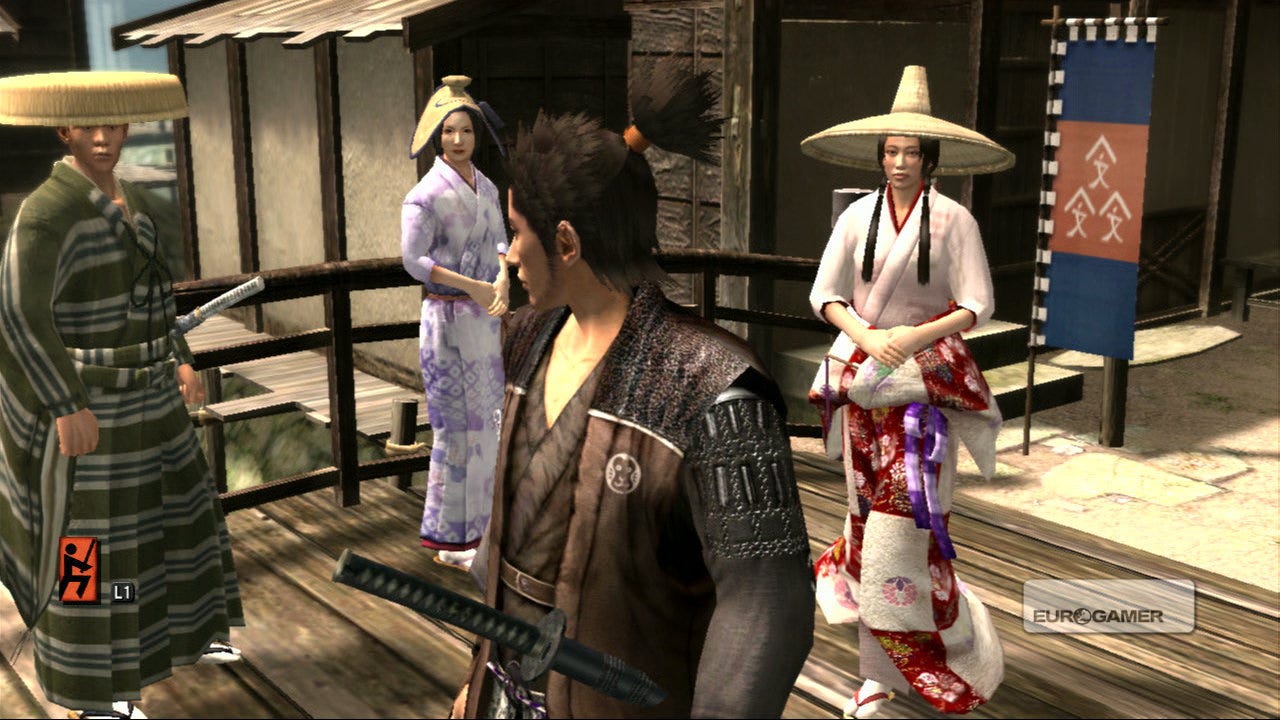
Although trigger icons allow you to draw your sword or apologise during cut-scenes, it's entirely optional.
While the game earns praise for the sheer variety of paths on offer, and the flexible way the game reacts to your actions, the stories themselves are fairly feeble efforts, often lacking basic back-story and vital connective material. It's easy to spend hours shuttling between oblique cut-scenes and various quest givers, chalking up experience and cash, but with no clear idea of the wider context.
Unless you click into one of the game's pre-defined grooves, the experience can be piecemeal and confusing. At its most frustrating, you'll find yourself reaching the end of the game with no understanding of how you got there or what it means, fighting characters you thought were friends, or assisting a faction you thought you were opposed to fight.
During one playthrough, I grew tired of life as a bandit and killed Ouka Clan's boorish leader. Once my treachery was discovered, I was attacked by Ouka loyalists wherever I went. After a few days, however, they apologised and made me their new leader. Then Fujimori Clan attacked our castle, and I carved a bloody swathe through their ranks thanks to the awesome weapon I inherited from my predecessor.
After hundreds of kills, the game abruptly cut to a closing text crawl saying I'd died in battle - even though I clearly hadn't, and could quite frankly have continued slaughtering soldiers for hours. The game had decided which path I was on, however, and from that point my demise was unavoidable, regardless of my actions on the battlefield.
A large part of the blame for this woolly lack of cohesion must fall to a game engine that feels like it's been dusted off from the PS2 era. The story may be flexible but the tools used in the telling are rigid and shallow. Dialogue appears in silent word balloons, floating crudely above a handful of character models, while cut-scenes groan with scripting that is either poorly translated or badly written, or both. Conversation options are limited to two or three inane responses, which make it hard to tell what sort of reaction you're giving.
Some of this can be put down to a lack of cultural context, but often it's clearly just stiff design. There's no room for subtlety, and the game often misreads your intentions.
The outdated code eats away even more at the basics of the genre, rendering exploration and combat unpleasantly clunky. The game is made up of just eight small areas, each filled with repeated scenery and crude textures. Clipping issues are a constant problem, and this only becomes more pronounced during fights, as arms and legs vanish inside rocks and walls, or merge and overlap in Cronenberg configurations.

Match the buttons to make moshi rice cakes. Toshiro Mifune would roll in his grave.
Collision detection is therefore predictably skewed, and it's depressingly common to see swords pass through enemies without leaving a scratch. Get more than a few enemies on screen at a time and the frame-rate plummets. For a game based around warriors famed for their poise and grace, the shoddy mechanics do little to immerse you in their mindset.
That's a pity, since trapped inside this rusty cage of antique coding there's a game of considerable depth. Different combat stances, different sword types, different skills and combinations of weapon parts; all work together to offer a remarkably detailed representation of a distinctive form of fighting. There are echoes of Squaresoft's Bushido Blade, something based on more than just swords but the culture around them as well, yet the game itself is simply too clumsy to allow these nuances to bear fruit.
While Acquire's series wins in terms of quantity where alternate endings are concerned, it's fatally undermined by its prehistoric game engine, the flat lifelessness of the story seemingly in inverse proportion to the number of routes through it. Way of the Samurai was impressive on the PS2 eight years ago but it's remained stagnant, offering the same scenario with the same technology to an audience that has grown to expect more.
Its best ideas have already been borrowed and improved by the likes of Fable II, Heavy Rain, Mass Effect and Dragon Age, all of which offer less narrative wiggle room but do so in compelling worlds populated by rounded characters. Way of the Samurai 3 wastes too much energy juggling the numerous ways it can end your story and not nearly enough on making the journey to get there worthwhile.
4 / 10
You may also like...
-
Why Devs Owe You Nothing
-
Digital Foundry: PS3 Skyrim Lag Fixed?
-
Face-Off: The Darkness 2
-
App of the Day: Sir Benfro's Brilliant Balloon
-
Sony admits "dropping the ball" with Demon's Souls
-
Ultimate Marvel vs. Capcom 3 Vita Review
-
CD Projekt: Witcher 2 intro cinematic "the most expensive asset we ever created"
-
Who Killed Rare?
-
One Piece: Unlimited Cruise SP Review
-
Grand Slam Tennis 2 Review
-
Kingdoms of Amalur: Reckoning Review
-
Gotham City Impostors Review
-
Skyrim patch 1.4 performance tip: make a new manual save
-
The Darkness 2 Review
-
Mass Effect 3 FemShep trailer debuts
-
Epic's Sweeney on graphics tech: "the limit really is in sight"
-
Valve admits hackers accessed Steam transaction log
-
Skyrim patch 1.4 now live for Xbox 360
-
Double Fine Adventure passes Day of the Tentacle budget
-
Next Xbox has tablet-like touch-screen controller - rumour
-
App of the Day: Superman
-
Sony: The Last Guardian is making "slow progress"
-
EA announces starry Syndicate voice cast
-
King Arthur 2 Review
-
Blizzard legally opposes Valve's Dota trademark application


Comments (23) Latest comment 2 years ago
Comments threads automatically close after 30 days, but please feel free to continue chatting on the forum!
Comment below viewing threshold Show
It is a bit poo.
But basically due to the complete lack of english or subtitles it was one of those where random dialogue choices led to an absolutely hilarious string of screwed up circumstances. Usually involving getting chased by angry portly men inside paper lantern shops.
Also sleeping with hookers.
Comment below viewing threshold Show
It's definitely a rental but I think it's quite a bit of fun.
Comment below viewing threshold Show
Shame about the score. I would really like to do the above, for some strange and maybe sick reason.
Comment below viewing threshold Show
I've yet to play this one, but if it maintains the the diverse open ended style of the previous games then it could still dominate in that department and yet, I've not played a game that delves into the purpose of a multipath adventure quite like WotS, even the recent Heavy Rain although has mutliple routes aplenty, restricts you to the way you execute them, WotS lets you run wild!
Well I'll give this one a go regardless, no doubt it'll be difficult to find in about month or two!
Comment below viewing threshold Show
A massively open-ended (samurai) game with "considerable depth"? I'm sold.
Comment below viewing threshold Show
They're called mochi. Pretty terrible if they've translated it as moshi in the game.
Comment below viewing threshold Show
I'm a bit worried about the "clunky" combat & exploration but even so I just have to get this.
Comment below viewing threshold Show