The launch of a game can be a blurred affair. This is particularly true of direct download games, even more so if you've been involved in a beta. After closed betas, open betas, then a nominal "launch", then an ongoing series of patches, bug fixes, tweaks and adjustments, the finished product is a fluid thing. And often the finished product doesn't even feel finished. Such is the case with Warrior Epic, which ostensibly launched on 19th May after not one but two closed betas.
This launch proved something of a false start, however, as one really rather fundamental area of this free-to-play online RPG wasn't implemented: the item store. And there were still significant server issues. On 9th June, European publisher GOA announced, "the merchants of Providence have finally opened their stalls". By 11th June, GOA's partner on Warrior Epic, True Games Interactive, sent out an email announcing another official launch, accompanied by the news that server instability issues had been resolved. Huzzah! Except that, although you could visit the GOA site and buy gold - Warrior Epic's microtransaction currency - you still couldn't actually spend it in the item shop. In fact, come the end of the month, the item shop still isn't implemented.
Warrior Epic is a free-to-play action-RPG that Gage Galinger, founder of developer Possibility Space and a veteran of Age of Empires, Age of Mythology and StarCraft, has referred to as "Diablo meets the Sims". At a time when such games are increasingly trying to muscle in on the territory dominated by the MMORPG big boys, Warrior Epic is taking a slightly less steroidal approach. This is no fully-fledged MMO - in fact, you could arguably lop off that first "M". Although the servers have the potential to host thousands of players, the game itself is played more intimately with teams of one to five.
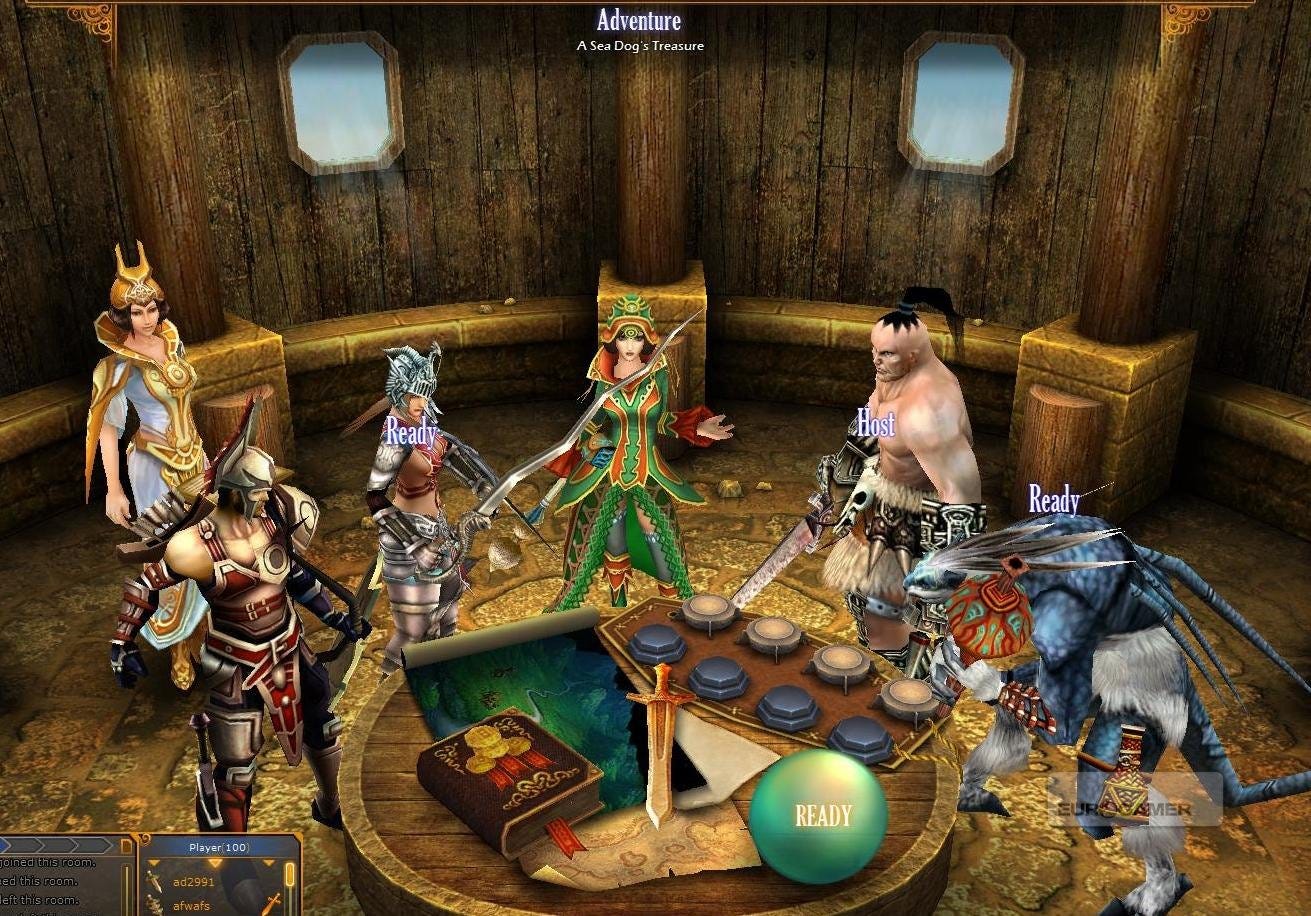
Let's get this party started!
The whole affair has a markedly retro feel, notably recalling the hugely influential Diablo, but also other RPGs that came in its wake and arrived at the cusp of the broadband explosion, like Baldur's Gate: Dark Alliance and Champions of Norrath. This may or may not appeal to you, depending on how much you need your RPG gaming to involved well-populated, finely-crafted open worlds. The experience here consists more of entering a lobby and then creating or joining a game, and going on short runs through randomised dungeons, which may take you around 20-45 minutes. It makes absolute sense for free-to-play gaming to go in this arguably less ambitious but more focused direction.
Your first adventure is a straightforward, single-player, story-based romp through some jungle. You start as a Pit Fighter, your basic Conan the Barbarian-type beefcake. All the six classes in the game have two sub-classes. In the case of Pit Fighters, there are Outcasts, who are tanks, and Berserkers, who are more about melee DPS. After hacking your way through that first jungle, smashing sundry antiquities (botanists and archaeologists - look away), your first Warrior arrives in the War Room of your Hall in Providence, and receives a face full of tutorials and instructions from the Hall Advisor. Your warrior's XP is tallied up, and so are Prestige Points - effectively experience for your Hall itself.
Interestingly, the "you" in this game isn't really your Warrior, it's this Hall. You have one Hall and as the game progresses, you can fill its barracks with a selection of Warriors. Each Warrior is effectively an alt, but, in another clever idea, they can also be used as enchantments on your weapons.
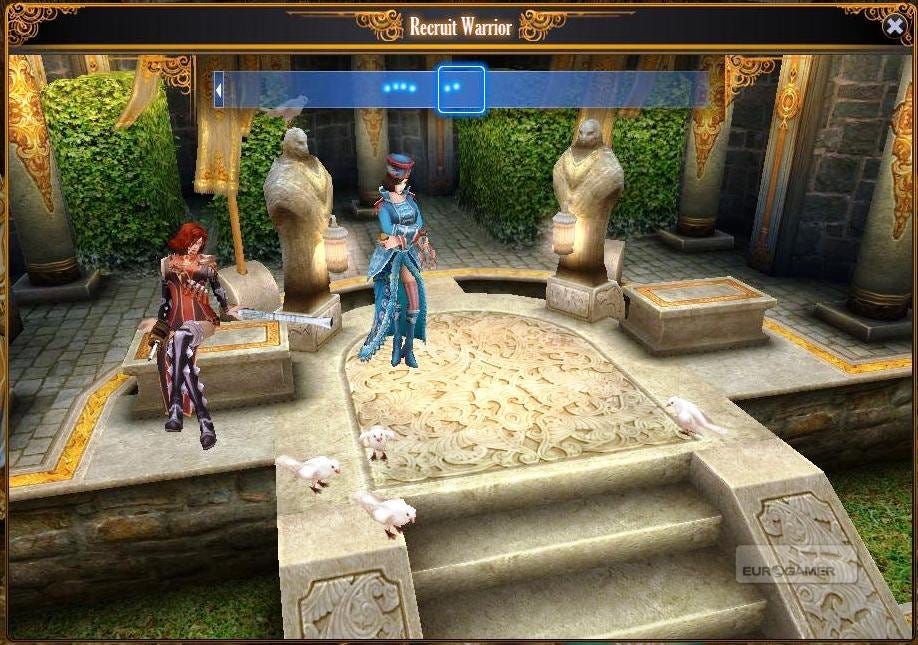
Recruiting Sgt Pepper
As you run one of the game's randomised dungeons, you have three lives. If you're stuck without life (which doesn't regenerate) and don't have a healing sub-class, you may well die under a scrimmage of mobs. The game, as it stands, can feel a bit harsh; die three times, and you lose all the XP you've accrued during that run. Health potions do not drop in the game, and can only be bought... through the item shop. Which hasn't yet been implemented. I suspect that the play mechanics will change subtly, but markedly, when that shop is finally implemented, as having a stash of healing pots will make that grim scenario where you lose all your XP less commonplace, and if you're soloing with a non-healer, you'll have a better chance of survival.
If you do die three times, your Warrior becomes a Spirit. Once spiritualised, that Spirit can either be revived from a Sanctuary in your Hall, or it can be bound to equipment as a permanent buff or enchant. The most fun, or at least most dramatic option, however, is to bring it along on a run and summon it at a key point in the carnage, when it bursts into being as a powerful attack. It's pretty nifty. Warriors can also find Monster Spirits on their adventures, which can be used in the same way - handy if you'd rather revive your Warriors.
Most people may well want to spend most of their time doing runs in the game's dungeons, which themselves are randomised in terms of their room sizes and layouts, mobs and drops, depending on the size of your group, your level and so on. But there will also be gamers who are drawn to the "dollhouse" element of the game. Developer Possibility Space wants you to play around with your Hall, managing your warriors, customising them, customising your kit with Spirits, and even customising the Hall itself. This can be done by adding new rooms like workshops (which provide skill buffs) and trophy rooms (for your achievements, which can be publicly displayed).
The Hall's most important room, however, is the War Room. When you join a game created by another player, you gather in their War Room, or if you create a game, you choose the type of run from your own War Room. The game offers three different modes of play, which you select by clicking a map on a table in your War Room. Adventure Mode consists of 1-5 player player-versus-environment quests; Campaign Mode offers more PVE, but in the form of a story, effectively continuing on from that very first run you had, hacking your way through umpteen dungeons full of randomised monsters, boss mobs and the soldiers of the enemies of Providence. The third mode is PVP for players above level 10, though it's yet to be implemented.
Pangolins. They look odd. Get used to it.
Whatever mode you play, the game does encourage co-operation. The make-up of your group for a dungeon run has strategic implications. For example, the Pangolin class, the game's only non-humans who resemble vaguely humanoid archaeopteryxes, has two sub-classes: the Shaman and the Tamer. Using elemental magic, the former can drop totems, which mobs tend to attack, giving you some breathing space when facing massed foes and the opportunity for throwing in ranged damage. Shaman also get heals from level 16. Tamers, meanwhile, have the ability to call on creatures.
Other crowd-control, meanwhile, can be offered by the self-explanatory Trapper, a sub-class of the Assassin, a class that is defined by its use of firearms. For firearms-based damage, look to the Dead Shot sub-class. Ranged attack damage, meanwhile, comes care of the Dungeon Archer class, notably the Stalker sub-class. The other Archer sub-class is the Warden, which, in another novel twist, plays music on its bow-strings which can buff comrades or debuff enemies. Possibility Space certainly isn't short of imaginative ideas.
Anyone got any breaching charges?
Magical damage comes care of the Illusionist class. The Spellbinder sub-class, in its natty Sergeant Pepper duds, is into messing with enemies' heads. The Necromancers, meanwhile, call upon dead minions. The latter are particularly adept at kiting, something you will find yourself doing a lot of in Warrior Epic. There's a lot of pulling, running, waiting for cooldowns, doing some damage, throwing some heals, and scarpering some more. It's a process that'll also likely become a lot more fluid when you can sup your own healing potions.
The final class is the sword-and-shield-wielding Devotress. Sentinels are a Paladin-ish hybrid who can fight melee, do some protective tanking - but also have a heal from level 1 and as such will spend a lot of their time peering at that ability icon waiting for its cooldown. The Avengers, meanwhile, get a bit emotional and unleash swift melee attacks.
Ooh, pretty.
Suffice to say, there's a lot going on in Warrior Epic. But at this early stage - effectively, still a public open beta - it still feels rough, and a long way from fulfilling its potential. If you can fight through installation issues, the game servers themselves are still pretty wobbly, and once you start playing, there are elements that many will find off-putting. Despite the randomisation, the dungeon running does get repetitive, especially as XP builds at a relatively slow rate. To gain XP, you may well find yourself running the same levels over and over, something that no randomisation can keep interesting. Of course, if you're lucky enough to get a good Guild and some well-oiled groups, dungeons can be blasted through more quickly.
Some may have reservations about the three-deaths-and-you're-done business, which can result in your losing out on hard-earned XP. Indeed, the target market for free-to-play games is the casual gamer - and it's the casual gamer who is most likely to run away from this situation, which due to the absurd state of affairs with the unavailability of health potions, remains unduly harsh. Gamers looking for semi-free (most cash shop items aside from health pots being for convenience and cosmetics), Diablo-style action may well find something to enjoy in this quick-fix "MORPG", but in all honesty, it wasn't ready for launch in May, and still isn't. True Games has already announced the game's first expansion, for July; it will involve the PvP mode and a new region, but let's just hope it also involves that item shop finally laying out some stock.
5 / 10
