Warrior Epic & League of Legends
Diablo and DotA for the free-to-play generation?

In simple terms, GOA is a games publisher - but it's more accurate to picture the French outfit as a service provider. That makes sense when you consider its parent company, Orange, but it still sounds like a foreign concept in videogaming. It really shouldn't, however, and it won't for much longer.
The new business and distribution models, the server farms and customer service teams, the long and co-dependant relationships between players and developers that characterise the boom in online PC gaming mark a firm move away from games as a commodity and towards what Valve's Gabe Newell calls "entertainment as a service". After all, what else would a telecommunications and networking company be doing getting involved in our pastime?
To date, GOA's contribution has been to publish and operate Mythic's MMOs - Dark Age of Camelot and Warhammer Online - in Europe, as well as importing a few casual Korean hits (notably the lovely PangYa golf) to run on its free-to-play GOA.com portal. There's a yawning stylistic and audience gap between these two operations, though - and it's one GOA is seeking to plug with two new signings it was showing off at last month's Game Developers Conference.
Possibility Space's multiplayer action-RPG, Warrior Epic, and Riot Games' RTS/RPG hybrid, League of Legends, both seek to blend MMO persistence with fast-paced, instant-gratification, short-session play. They're both developed in the US with an eye for both Western tastes and Asian habits. They're both from startup developers, and they both sound like long shots. Are they? Or is this the future of gaming?
Warrior Epic
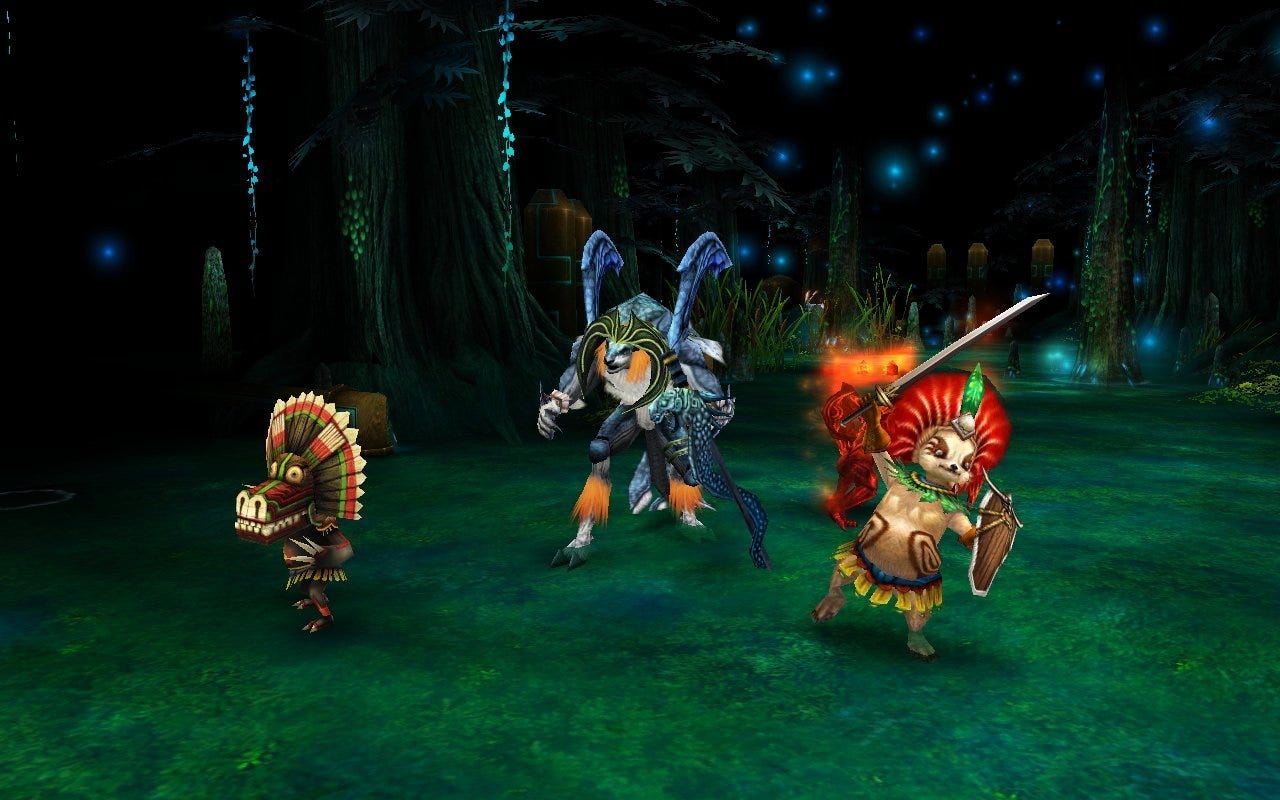
"Diablo meets the Sims." It's a compelling sales pitch, for sheer name-checking chutzpah if nothing else. Warrior Epic is a free-to-play action-RPG in which characters are treated as collectables: the centrepiece is your castle, which levels up itself, expanding as you populate it with a wild cast of customisable, extravagant, monster-mashing, role-playing heroes.
These fall into six classes: Pit Fighters (melee warriors), Illusionists (sorceresses), Pangolans (alien-looking shaman types), Dungeon Archers (rangers), Devotresses (defensive fighters) and the self-explanatory Assassins. Each comes in a couple of variations, and are generally more eccentric than most RPG designs with more weaknesses, because players are expected to have so many of them.
They're larger than life; Possibility Space wants the game to have extremely low system requirements, so it's placing all its chips on character art, and it's winning big. Warriors and enemies alike are colourful, surprising, ridiculous and cool all at once, and festooned with eye-popping armour sets and weapons. This is the only game demo I've ever been to where the developer has been proud to announce that its game features no shadows or lighting, but Warrior Epic looks terrific, so no-one's arguing.
You take these warriors into 15-30-minute missions that take place in simple, hemmed-in, maze-like dungeons with just a hint of Diablo's isometric perspective. These might be randomly-generated player-versus-environment missions that scale for solo or five-player multiplayer questing, story-led campaign missions or five-on-five player-versus-player fights that play out like a Defence of the Ancients-style mini-RTS.

The aim is to earn experience, loot and gold, naturally. The experience levels up your warrior and your castle, which unlocks the map. The gold, ultimately, buys you new characters. This is something you'll be doing a lot of due to Warrior Epic's Spirit system.
If your warrior falls down three times on a mission, it dies. Though it can be resurrected (for an in-game fee), you might choose not to, because it can also live on in death as a Spirit. Spirits can be bound to weapons as an enchantment, or brought with living warriors (up to three at a time) as a very powerful summon. It's clear that the best Warrior Epic characters will actually be amalgams of one living warrior and several dead ones. (There are monster spirits in the game too, which can be collected as loot.)
All of this will be supported by micro-transactions. Your real money - in tiny amounts, most transactions being a fraction of a dollar - buys you novelty cosmetic enhancements for your warrior and castle, and consumable items (health and experience potions). In an effort to balance the game somewhat, the benefit of consumables is always spread across an entire team, not just the player who bought them - a nice, egalitarian touch as free-to-play gaming goes. You can also buy extra warrior slots over the standard twelve.
We don't get to try it for ourselves, but Warrior Epic looks like colourful, simple and moreish RPG fun with a devastatingly clever twist - turning most players' predilection for rolling "alts" into the centrepiece of the game design. It's packed with unexpected stylistic quirks, from the Zelda-style row-of-hearts health gauge to the delightful mishmash of steampunk, surrealism, Louis XIV and heavy metal album covers in the art. If the loot flows freely and the moment-to-moment combat matches the overall design vision, this is a free-to-play game to watch like a hawk.
Warrior Epic is due for release in May, simultaneously in the US and Europe.